


(I think if you click on the little pics, they become big.)
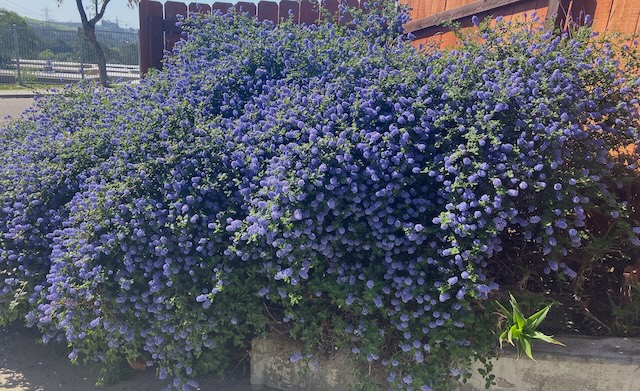
This gigantic California Lilac (Ceanothus) has survived and thrived against all odds. About seven years ago, I thought it had completely died; there was no hint of the plant at all — it had disappeared. Since dying plants are something I’ve gotten used to here in the southwest, I figured it had gone the way of many others…
However., one day as I randomly inspected the area, I saw something that strangely resembled a minuscule Ceanothus leaf, shiny and green. I kept my eye on it for a while and was amazed that it WAS that same Ceanothus plant — it had resurrected itself.
Look at it today! It’s taken over the entire area next to the driveway. Periodically, I cut it back because it grows so prolifically, I wouldn’t be able to get in the garage. Trimming doesn’t seem to bother it at all, as you can see.
What you can’t hear are the hundreds of bees it attracts and what you can’t smell is the fragrance of a blooming Ceanothus, powerful yet delicate.
Did you know? The flowers of certain Ceanothus species contain saponin, a natural compound that creates a soapy lather when mixed with water.
Historically, Native Americans used Ceanothus flowers as a natural soap for washing hands and clothes.
To use Ceanothus as soap, simply gather the flowers, get your hands wet, and rub the flowers between your hands. The saponin will create a soapy lather. It really works!
 Enchanted Seashells | Princess Rosebud
Gorgeous! Lilac is one of my favorite spring scents.
LikeLike
I love lilac too, but ceanothus doesn’t smell at all like the lilacs I remember from back east. It’s hard to describe.
LikeLike