Act of Kindness

Your acts of kindness are iridescent wings of divine love, which linger and continue to uplift others long after your sharing.” Rumi

Here’s my act of kindness…with literal iridescent wings…

As I was on my hands and knees cleaning out winter’s leaves from my little pond/waterfall in the garden, prepping for no more rain so I could fill it again, I heard a strange fluttering sound.

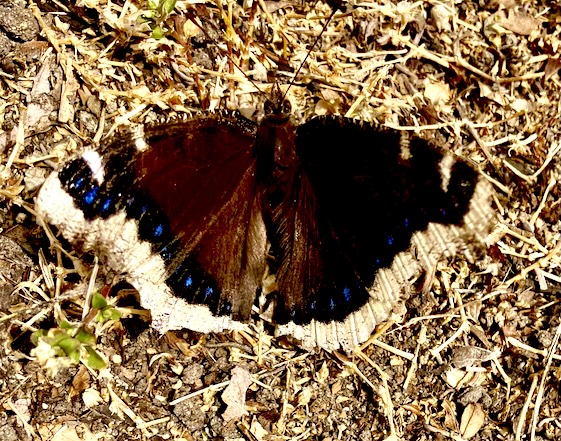
I looked up, and right above my head, I saw a Mourning Cloak butterfly held captive in a spider’s web, desperately trying to break free.

I immediately sprung to my feet (well, not SO immediately because I’m still careful not to further injure my torn meniscus that I’m stubbornly refusing to surgically repair) and freed the butterfly from certain death.

S/he fell to the ground because a very tiny bit of sticky web was holding freedom hostage and s/he couldn’t open her wings and fly away.

I sat next to her and very gently pulled off the remains of the spider web, hoping I hadn’t damaged anything, and the butterfly took off like a rocket. I couldn’t believe how fast s/he was. I never saw it again.

Poor little thing was a bit battle weary and bedraggled, but seemed to be OK after the ordeal with the spider web.

Photo by Enchanted Seashells

Have you ever touched the wings of a moth or butterfly and gotten some “powder” on your fingers? If you look through a microscope, that powder is actually tiny scales.These scales give butterflies and moths their scientific name Lepidoptera (from the Greek Lepido = scale, and ptera = wing). Each scale can be a different color and when placed next to each other, the mosaic makes up the color patterns we see. Curated from essig.berkeley.edu/exhibits/butterflywings/

Interesting, huh?

While it’s best not to touch a butterfly’s wings because it might inhibit their ability to fly, there was really nothing else I could do to save him/her. https://essig.berkeley.edu/exhibits/butterflywings/

Here’s the spiritual meaning of a butterfly with its wings stuck together by a spider web: It holds a powerful, dualistic spiritual message, often representing a, tension between the need for transformation and the reality of entrapment or stagnation. It suggests that a, period of metamorphosis or personal growth is being hindered by fear, limiting beliefs, or external obstacles. That’s pretty intense, don’t you agree?

No matter what it means, it’s a good feeling to help a wld creature.

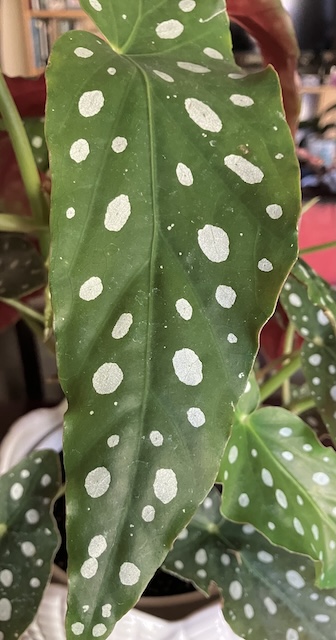
PlantLust | Polka Dot Angel Wing Begonia

Think about it: a plant with polka dots, how could you NOT love it?

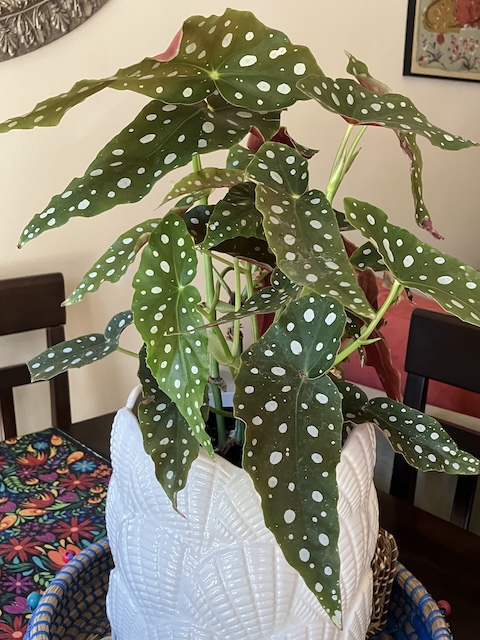
Here’s my prettypretty Polka Dot Begonia in her prettypretty seashell pot! Simple pleasures bring joy for this simple girl, I confess.

Photo by Enchanted Seashells

I’ve been lusting for this Polka Dot Angel Wing Begonia (Maculata ‘Wightii’) for a long time and finally found one in the clearance section at the nursery.

The check out employee told me there was literally nothing wrong with the plant but it was stressed out and should be repotted which was pretty awesome. (I can relate as I’m a little stressed out and wish all it took was to be repotted in new soil to fix me, too…)

When young, the Polka Dot Begonia is a beautiful tabletop houseplant. As it gets older, with good care, it becomes a beautiful floor plant, reaching four feet tall or more. 

Photo by Enchanted Seashells

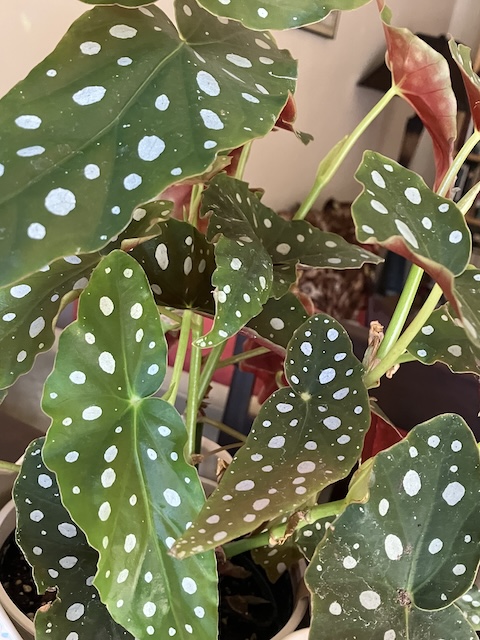
While its variegated leaves are the main reason to grow it, polka dot begonia can also show off clusters of small white flowers on and off throughout the year if it gets enough light. 

Propagating Polka Dot Begonias (Begonia maculata) is best achieved via stem cuttings placed in water. Cut a healthy stem just below a node (leaf joint), remove lower leaves, and place it in water for four to six weeks until roots reach about 2 inches, then pot in airy, fast-draining soil.

Photo by Enchanted Seashells

Fingers crossed that I won’t love this one to death like I’ve done to other specimen plants.

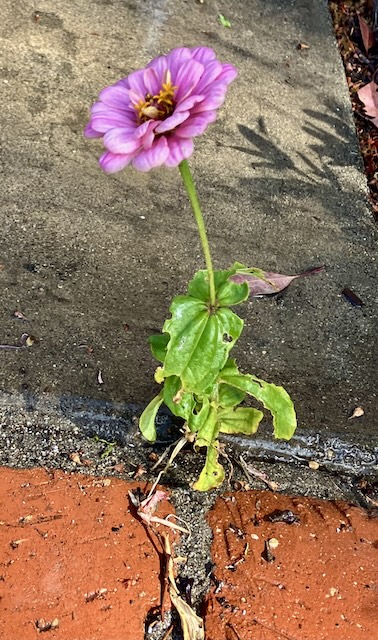
The Impossible Flower

With news of ships blown up during an illegal faux war to manipulate financial markets, a deranged fraud of a prez, skyrocketing prices, future uncertainty, there’s sanity in the simplicity of a flower that persists against all odds.

When I first noticed it, I tried to gently pry up this volunteer zinnia from between the crack in my driveway to plant in a better location, but I would have destroyed it, so there was nothing else to do but leave it where it grew. The roots are strong, much more so than I thought.

Photo by Enchanted Seashells

I’ve watered it, watching and waiting, and it just bloomed, one single, brave flower.

My plan is to wait until the flower dies and forms seeds so I’ll continue to plant resilience, grit, tenacity, and determination.

I think there’s a lesson here, somewhere…

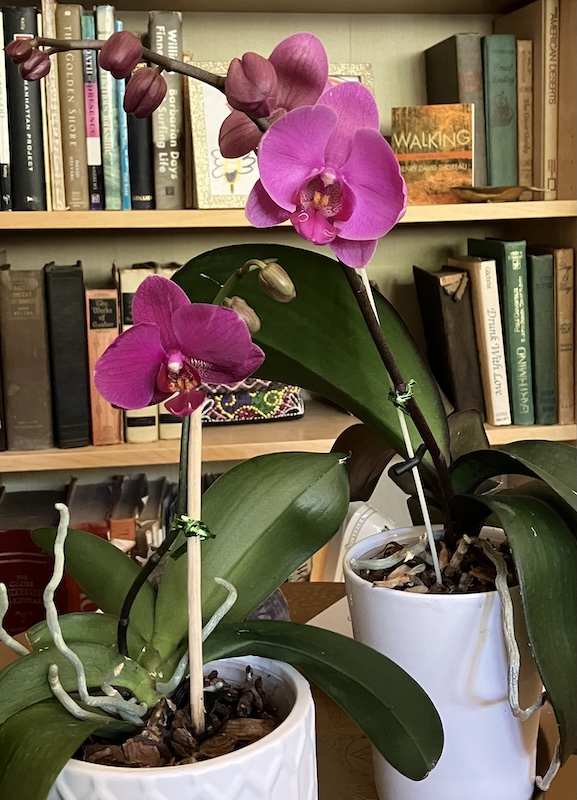
Orchid Rescue

A while back a neighbor was tossing out a few orchid plants that she thought were dead or dying. I rescued them, gave them love, and patiently waited.

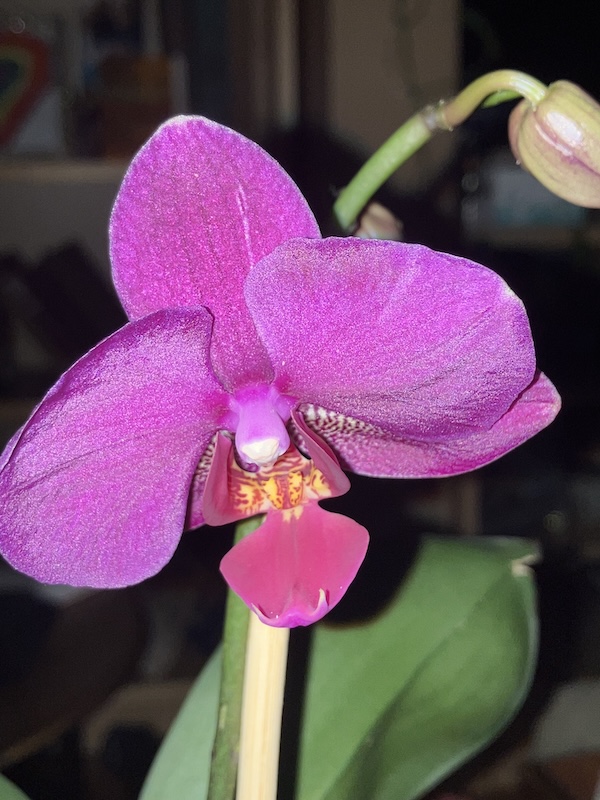
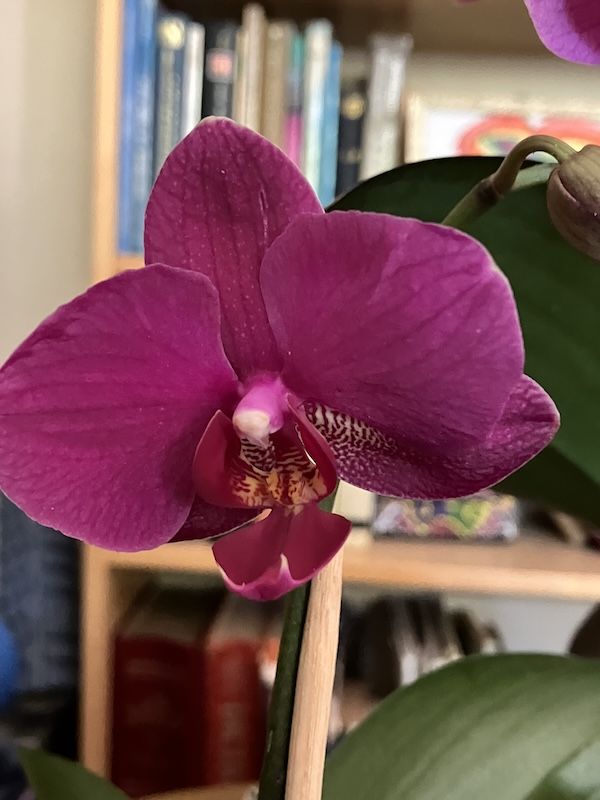
I’ve been rewarded with not one, but two of them throwing spikes and blooming at the same time!

Photo by Enchanted Seashells

Best of all, they’re one of the few flowers that don’t trigger my allergies!

Photo by Enchanted Seashells

Slightly different shades of fuchsia bring joy.

Photo by Enchanted Seashells

I don’t know why anyone would discard an orchid; they’re not that difficult to maintain and there’s immense satisfaction when they rebloom.

I found an obscure poem about orchids by José Santos Chocano, written in the 1920s:

The Orchids

Freaks of bright crystal, airy beauties fair,
Whose enigmatic forms amaze the eye—
Crowns fit to deck Apollo’s brows on high,
Adornments meet for halls of splendor rare!
They spring from knots in tree-trunks, rising there
In sweet gradation; winding wondrously,
They twist their serpent stems, and far and nigh
Hang overhead like wingless birds in air.

Lonely, like pensive heads, all fetterless.
Lofty and free they bloom; by no dull chain
Their flowers to any tyrant root are bound;
Because they too, at war with pettiness,
Desire to live, like souls that know no stain,
Without one touch of contact with the ground.

Fabulous Freesias

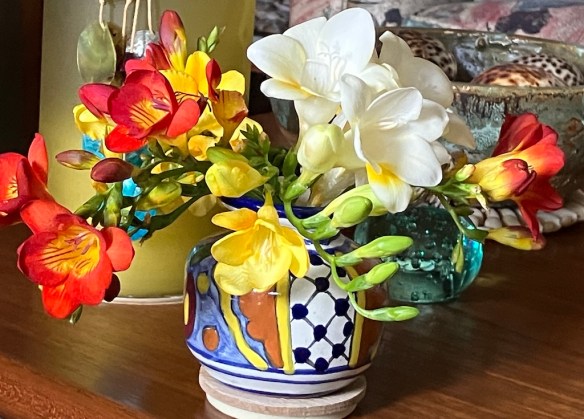
I really wish you could close your eyes and inhale the fragrance of these freesias. Our weather’s been hot here in SoCal and all the flowers bloomed at the same time.

Photo by Enchanted Seashells

Isn’t that vase adorable? I found it at a thrift shop and it’s one of my favorite things.

Have You Ever Seen a Hummingbird Moth?

This is another post in my continual quest to NOT allow current events to cause mental and emotional distress. I don’t actively ignore the news; instead, I’m trying to manage my visceral reactivity, if that makes sense.

I didn’t get good pics of March’s full blood moon, but look who I discovered on the deck this morning! He didn’t look too perky so I put him near a flower and hope he rallies…

The White-lined Sphinx Moth, Hyles lineata, is a common “hawk moth” (Family Sphingidae) and gigantic at almost four inches! I’ve seen them around here on very rare occasions but have mistaken them for hummingbirds because they’re so big.

Hummingbird moths are excellent, beneficial pollinators, especially for night-blooming flowers, helping gardens and ecosystems thrive, though their caterpillar stage might munch on host plants like tomatoes, a minor trade-off for their adult benefits. They are harmless to humans, mimic hummingbirds, and are crucial for plant reproduction, making them a positive addition to any pollinator-friendly yard.   

Hummingbird moth symbolism often centers on luck, transformation, peace, prosperity, and longevity, appearing as a messenger for change or a sign to look closer at life’s illusions, blending butterfly themes (change) with hummingbird traits (joy, flexibility) as they are mimics of hummingbirds and symbolize a spiritual connection to nature’s deeper messages and joyful living.

Life Imitates Art

Or is it the other way around?

I’ve been trying to capture this photo for a few days and my patience and persistence finally paid off. I think she’s searching for a suitable nesting site, or maybe she really thinks this hummingbird wind chime is a cousin, I dunno…

I had to snap the pic through the screen door so I wouldn’t scare her off, but I’m completely happy with the result. It’s these little joyful moments that make life worth living, don’t you agree?

I discovered a poem written by D.H. Lawrence about hummingbirds:

Humming-bird
I can imagine, in some otherworld
Primeval-dumb, far back
In that most awful stillness, that only gasped and hummed,
Humming-birds raced down the avenues.

Before anything had a soul,
While life was a heave of Matter, half inanimate,
This little bit chipped off in brilliance
And went whizzing through the slow, vast, succulent stems.

I believe there were no flowers, then
In the world where the humming-bird flashed ahead of creation.
I believe he pierced the slow vegetable veins with his long beak.

Probably he was big
As mosses, and little lizards, they say, were once big.
Probably he was a jabbing, terrifying monster.

We look at him through the wrong end of the long telescope of Time,
Luckily for us.

Black-headed Grosbeak

It’s a bird I’ve never before seen and I’m sooo happy he chose to visit the gardens at Casa de Enchanted Seashells!

The Black-headed Grosbeak is a migratory bird, with nesting grounds from southwestern British Columbia through the western half of the United States and into central Mexico.

I think this is a male; black head, black wings and tail with prominent white patches. Its breast is dark to tawny orange in color, more like the color of cinnamon.

Not a great zoom with my phone

The black-headed grosbeak eats pine and other seeds, berries, insects, spiders, and fruit. I didn’t hear him sing, however, his voice is a rich warble similar to that of an American robin, but more fluent, faster, softer, sweeter, and mellow with rising and falling passages that make the song much longer than the robin’s. The note is a sharp ik or eek. Both the male and female sing, but have different songs.

Its symbolism includes a message to live in harmony with yourself. to forgive yourself, trust your instincts, meditate more, and be kinder to yourself. When this bird flies into your life, it also prompts you to practice contentment. Alternatively, a Grosbeak meaning suggest being supportive of those around you who are struggling.

What an amazing garden visitor!

The Process of Abscission

“Simplicity is the ultimate sophistication.” Lao Tzu

Leaf Loss / Bare Bones / Blue Sky

This ash tree started out forty years ago in a five-gallon pot as a housewarming gift. As soon as the leaves begin to drop–in just a day or two– the branches will become bare and I’ll have a LOT of raking to do.

“Simplicity is the final achievement.
Simplicity is the keynote of all true elegance.” Coco Chanel

Abscission is the reason why leaves fall. Scientists believe that a reduction in sunlight leads to the reduction of chlorophyll in the leaf due to a reduction in photosynthesis and this may trigger the abscission of leaves. The actual process occurs when the weaker cells near the petiole are pushed off by the stronger cells beneath them.

That’s a lot for my brain to process and right now all I want to do is quietly savor the stark, elegantly naked branches.

It reminds me of my little vase of twigs and another example of ma https://enchantedseashells.com/2020/10/25/ma-the-space-between-things

“Nature is pleased with simplicity.” Frederic Chopin:

As pretty as it is all dressed in green, the artistry of bare bone branches are stunning in their strength of simplicity,

I see the graceful arms of a dancer against a backdrop of the bluest sky of the year.

“I have just three things to teach: simplicity, patience, compassion.
These three are your greatest treasure.” Isaac Newton

The End of Roses


She felt vaguely upset and unsettled.
She was suddenly tired
of outworn dreams.
And in the garden
the petals of the
last red rose
were scattered by
a sudden little wind.
Summer was over

— it was Autumn.

“She felt vaguely upset and unsettled. She was suddenly tired of outworn dreams.
And in the garden the petals of the last red rose were scattered by a sudden little wind. Summer was over — it was Autumn.” L.M. Montgomery

Rainbow Valley is the seventh book in the chronology of the Anne of Green Gables series of novels by Lucy Maud Montgomery.
Photos by Enchanted Seashells.