Alabaster Blooms

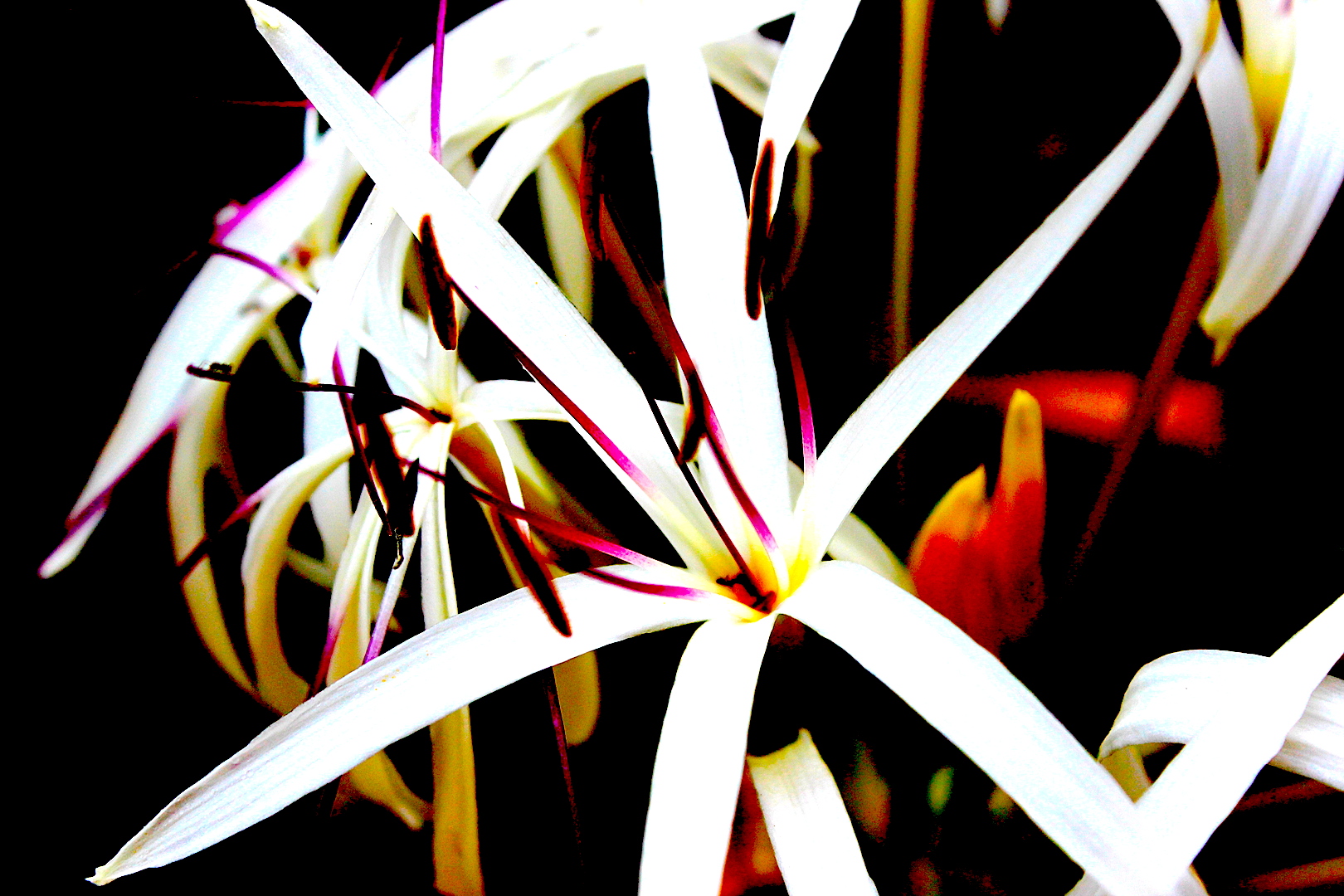
UPDATE: I just found out that it’a Giant Spider Lily (Crinum asiaticum). 

I don’t know the name of this plant; it was here when we moved here nearly forty years ago, but it blooms every summer and the fragrance is strongest after the sun sets.

How about helping me solve the mystery — if anyone knows what it is, please let me know!

whiteflower2

Wordless Wednesday: Hidden in Plain Sight

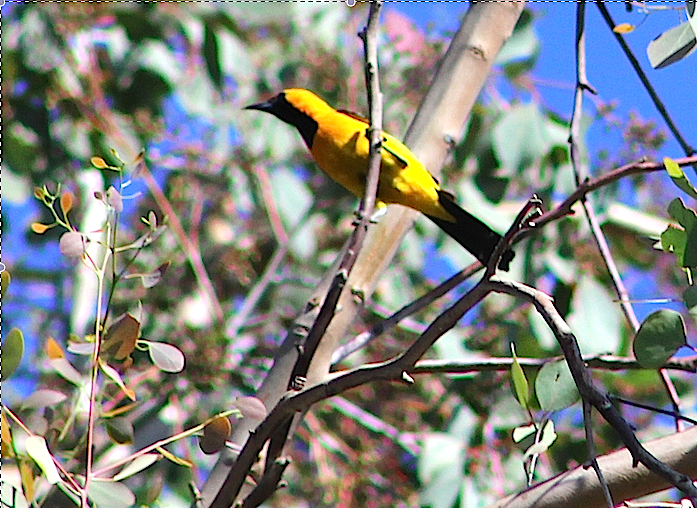
While watering plants on the deck, I grabbed my Canon Rebel T3i, trying to catch a dazzling, brilliant yellow bird hopping around the branches of our eucalyptus tree.

I snapped a dozen pics.

Most of them were blurry and worthless ‘cos he wouldn’t sit still long enough to get a clear pic. I was so frustrated!

Finally, he turned to the side and I got the money shot! I think it’s a Scott’s Oriole.yellowbirdzoomWait, there’s more!

As I was scrolling through all the other photos before I deleted them, I zoomed in and saw another bird hidden in plain sight.

Can you see it?

hiddenhawk1 A beautiful HAWK!

I think it was a Red-tailed Hawk ‘cos we have a lot of them here in SoCal, but I’m not 100% sure.

Almost invisible, hiding in plain sight, perfectly camouflaged, my naked eyes never saw this beautiful predator perched behind a large branch.closeuphawkThere must be a life lesson in this experience, but I haven’t figured it out yet. The hawk was literally right in front of my face and I didn’t see him (or her).

Linking up with other Wordless Wednesday bloggers:

Wordless Wednesday
Wordless Wednesday @ The Jenny Evolution

This is a Blog Hop!


26.
36.

You are next… Click here to enter
This list will close in 6 days, 0 hrs, 58 min (6/24/2014 10:16 AM North America – Central Standard Time)

What is a blog hop?
Get the code here…


Ruby Red Moon Cactus

I’m in love with this bright red little guy. 

pincushion

The Gymnocalycium cultivar — sometimes called ruby ball cactus or moon cactus — is actually two cacti in one.

A pure red cactus seedling lacks the ability to produce chlorophyll and will die unless it’s grafted onto a green one. The green feeds its mutant mate sugar molecules produced from water and carbon dioxide.

Once established, the two parts grow together so you can’t even see the seam.

I’m going to try and graft the babies on either side of the main ball onto other types of cacti in the garden. Wish me luck!

A Rose of Many Petals #Wordless Wednesday #Photography #Flowers

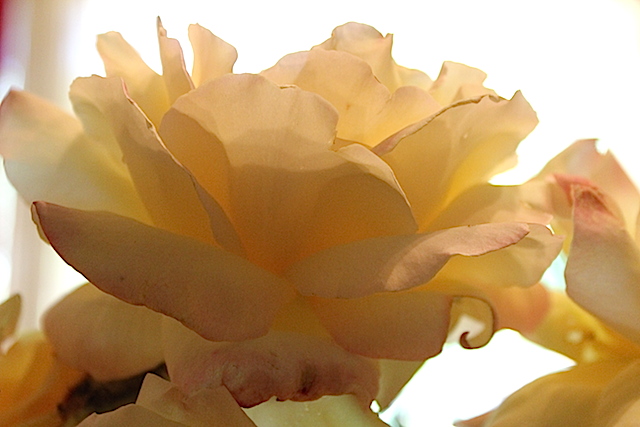
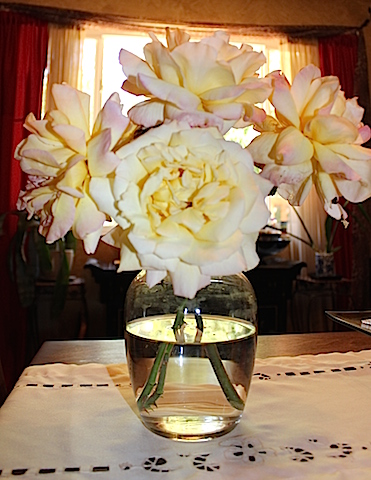
Lush, sumptuous, sensuous roses courtesy of my good RN friend whose visit included books on tape (I was unable to read anything for three days thanks to a torn retina and hellish laser surgery).

In full bloom from her garden, their fragrance is  delicate and strong, as every rose should be.

Petals, Illuminated

rose4

Petals, Layered

rose1

Petals Caressing Petals

rose6 Beautiful Curves 

rose7

Full-Blown Roses in a Clear Vaserose5


#Wordless Wednesday #Photography #Flowers #Roses

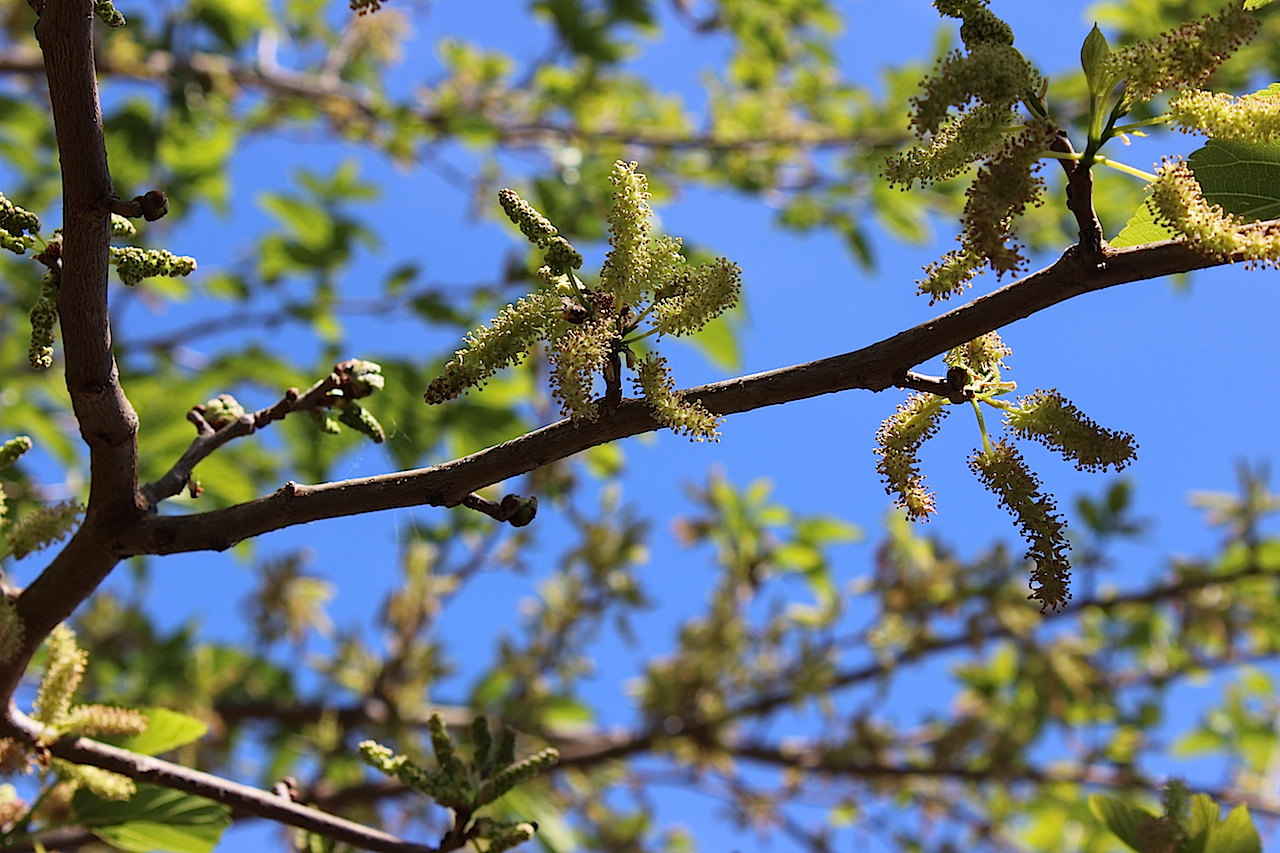
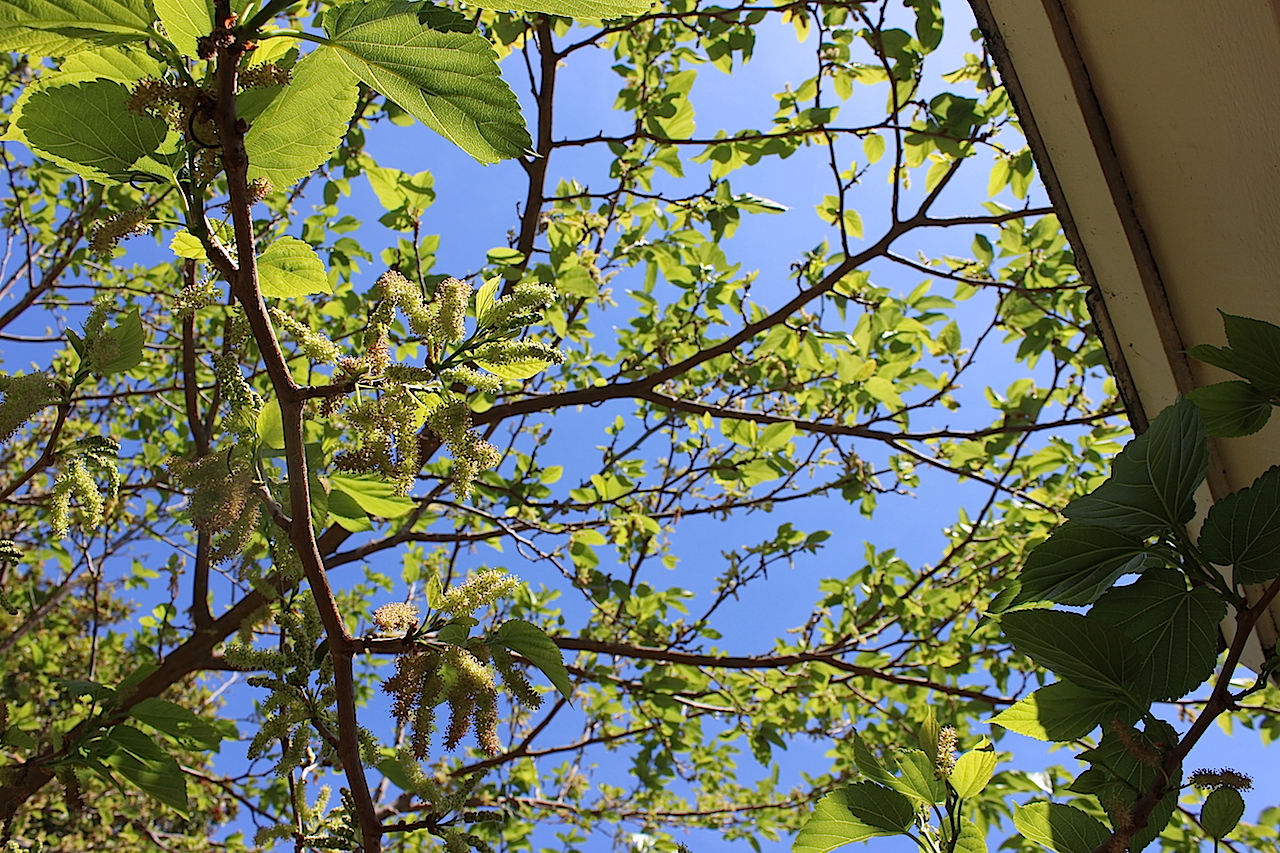
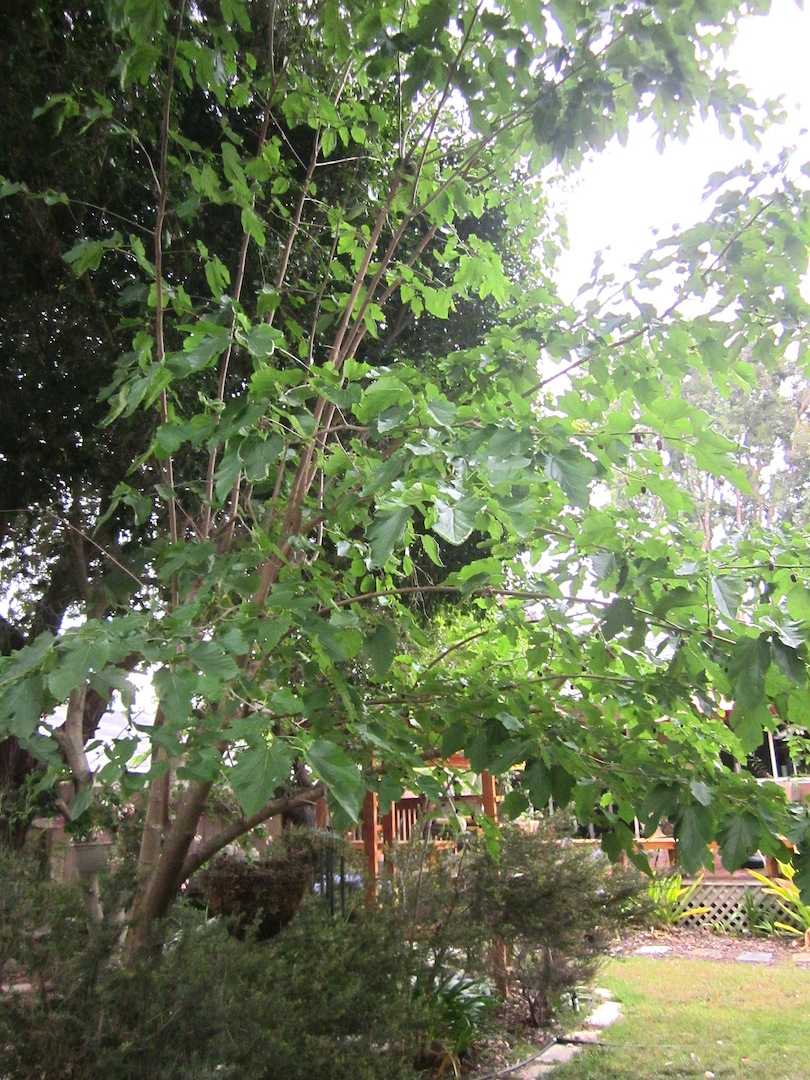
Flowering Mulberry Tree — Photos

Even in SoCal, fruit trees go through the whole process of dropping leaves in the fall, staying dormant through our mild winter, and spring is the time for budding, flowering, and fruit development.

This is our uber-prolific mulberry tree with fresh new leaves and unique flowers.

As the new leaves develop in mid-spring, tiny male and female flowers hang on separate small, slender, inconspicuous spikes. The male cluster is longer, the female rounder.

It’s been unseasonably warm — almost ninety degrees!! — and I think that’s what is causing an early flowering.

mulberry2 mulberry1

Click on the link for my mulberry jam recipe. https://enchantedseashells.com/2013/06/25/here-we-go-round-the-mulberry-bush-tree/


Silent Sunday: Turning Toward The Light

On the dining room table, anthurium with sun and shadow turning toward the light.sun:shadowanthurium

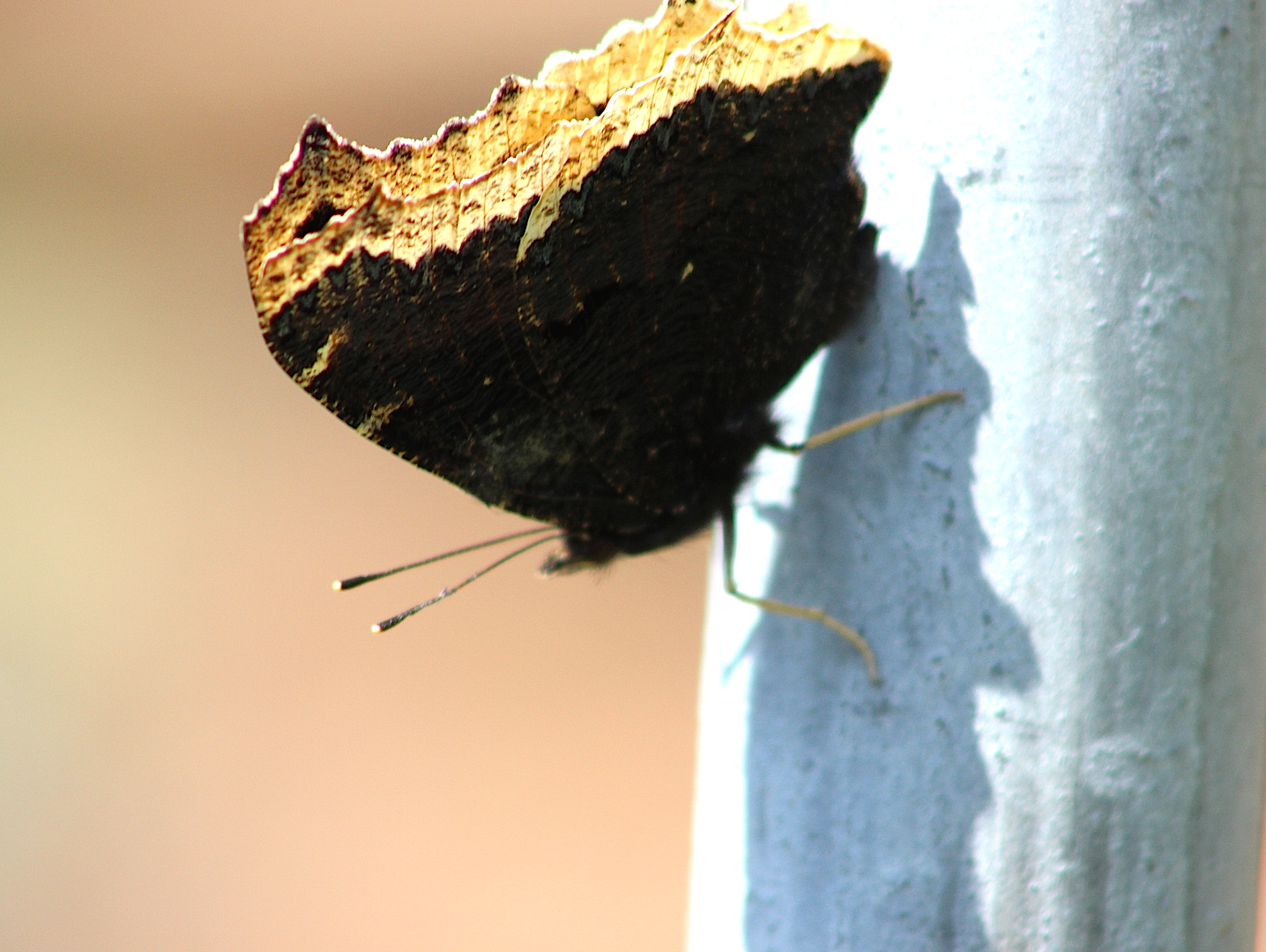
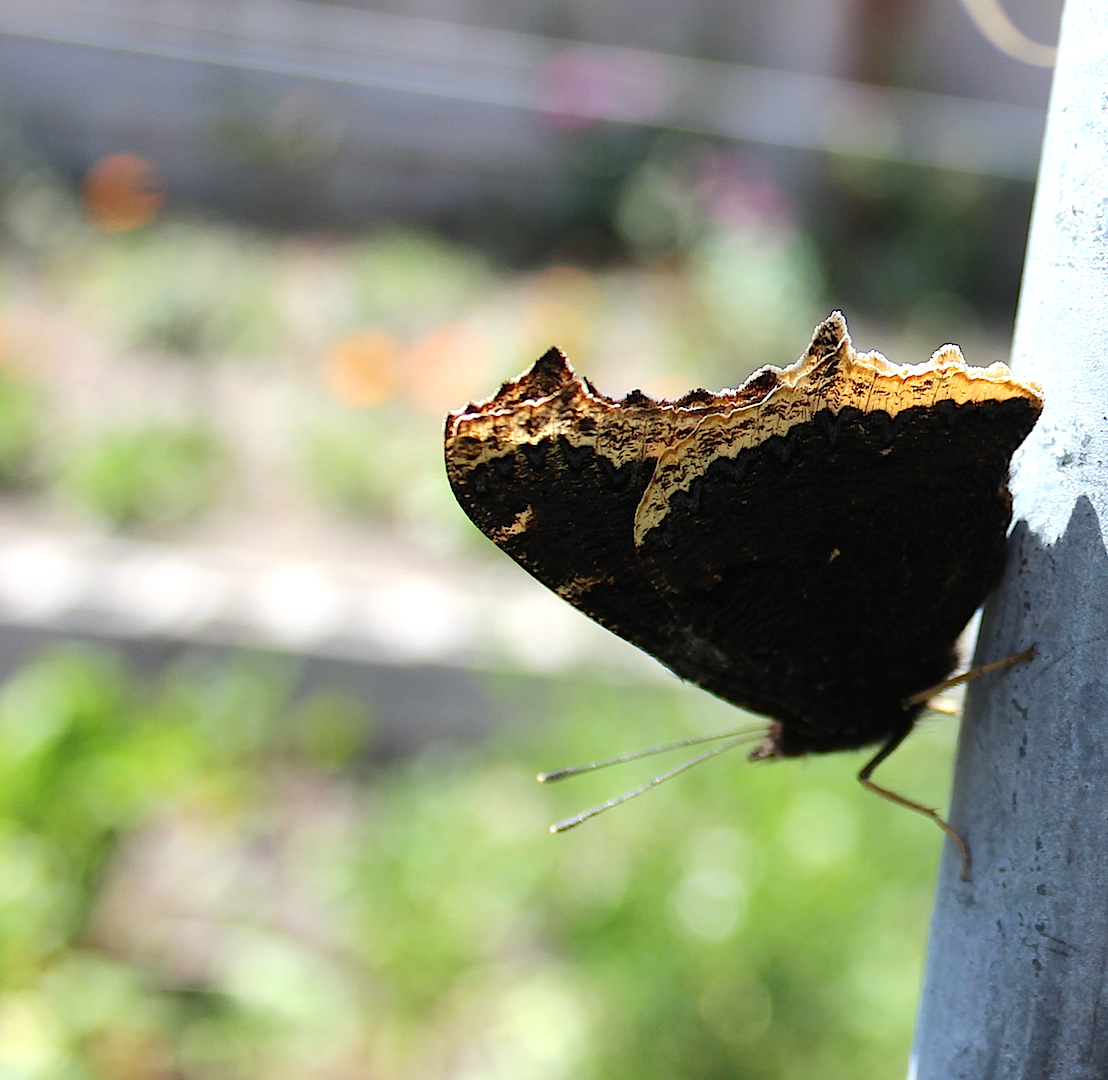
Silent Sunday: Resting Butterfly With Sun-Kissed Wings

Resting Butterfly

Resting Butterfly, With Sun-kissed Wings

Resting Butterfly

All Photos by Enchanted Seashells

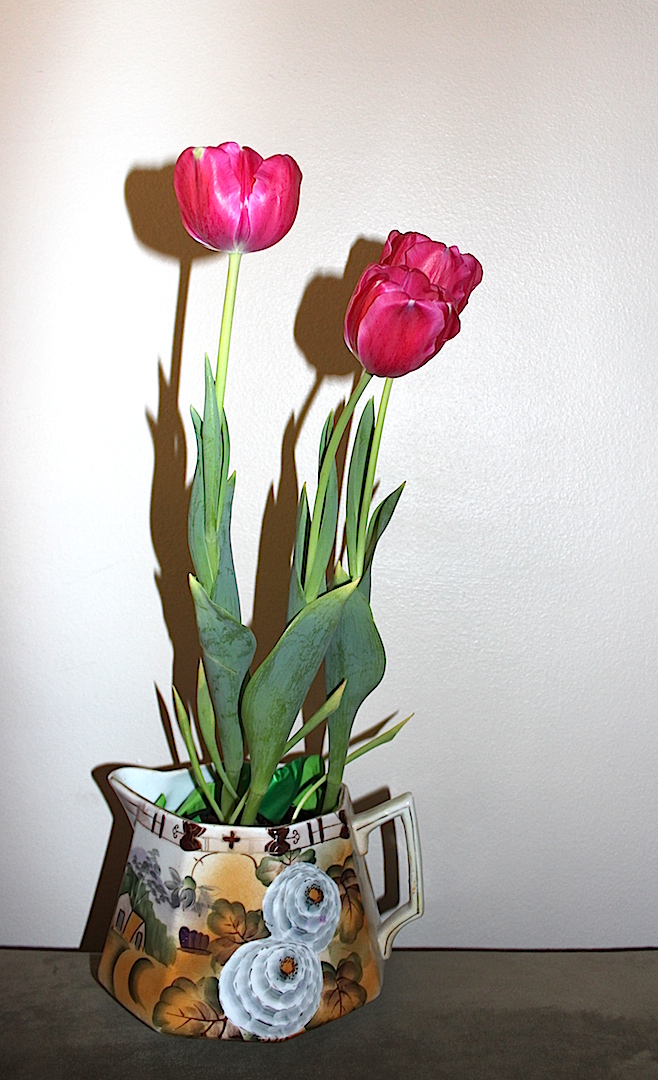
Wordless Wednesday: Tulips

Tulips and Shadows…the play of light
tulipshadow

Tulips Blooming
tulips3open

When a Zygocactus Blooms, It’s a Sure Sign the Holidays are Coming!

Whether you call it Christmas Cactus or Zygocactus, it’s really a Schlumbergera hybrid.

Christmas Cactus1Today at Casa de Enchanted Seashells, we’re packing up to drive the eight hours it takes to get to Sacramento so I can testify at the Fish and Wildlife hearing  on Friday to protest the delisting of wolves from the Endangered Species List.

However and whatever…

I’ve got a new black suit, AMAZING heels, and a speech that I hope will make a difference, ‘cos that’s what it’s really all about.

While we’ve been getting ready, I noticed a magnificent plant blooming and crying out for attention.

My bright little pot loves to sit in our kitchen window for most of the year; when I see the red buds at the tips of the leaves, I know it won’t be long before the massive butterfly blooms emerge. 

I love to say “zygocactus” like ten times in a row cos it feels so good as it rolls off the tongue, plus it’s really easy to grow!

You try it. It’s neat, huh?

zygocactus zygocactus zygocactus zygocactus zygocactus zygocactus zygocactus zygocactus zygocactus zygocactus

Schlumbergera truncatus blooms closer to Thanksgiving while Schlumbergera bridgesii blooms closer to Christmas, but through hybridization there is a certain overlapping of blooming times.

This is the most intense pink; the flowers feel kind of waxy or fleshy.
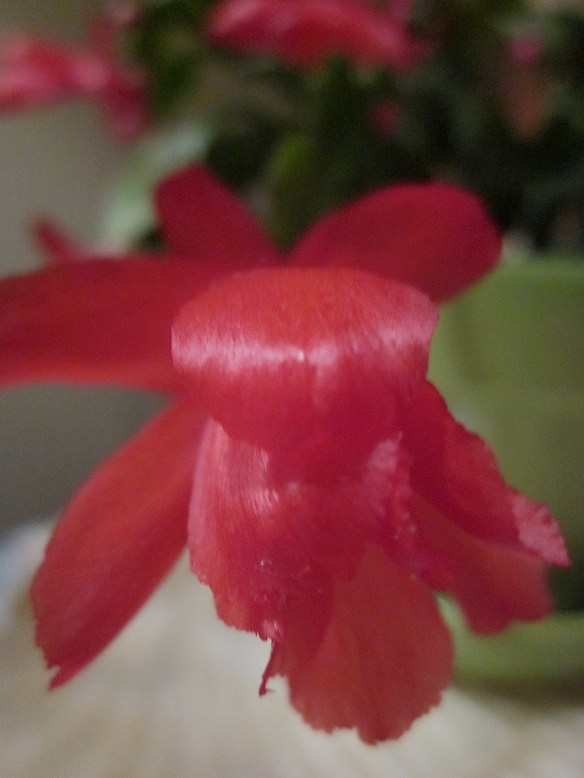
Christmas Cactus

Schlumbergera are epiphytes (tree-dwelling) originating in the mountainous rainforests of Brazil.

It’s excellent as hanging basket plant on a sheltered patio, or can be brought indoors in a bright area with excellent airflow.

Think about how lovely a blooming plant will be as a gift to bring joy for many years.

I’ve had pretty good success propagating these beauties by snipping a cutting at the natural “joint”, letting it dry out for a couple days, and then planting in sandy soil, keeping it only slightly moist until roots appear.

Don’t make the same mistakes I did by letting it get too wet or it’ll rot and die.

The next time you hear from me, I’ll be in Sacramento, meeting other wolf advocates and giving my two cents worth to a panel of Fish and Wildlife members who have blood on their hands from the senseless deaths of hundreds of beautiful wolves.

However, they have yet to hear from Princess Rosebud.

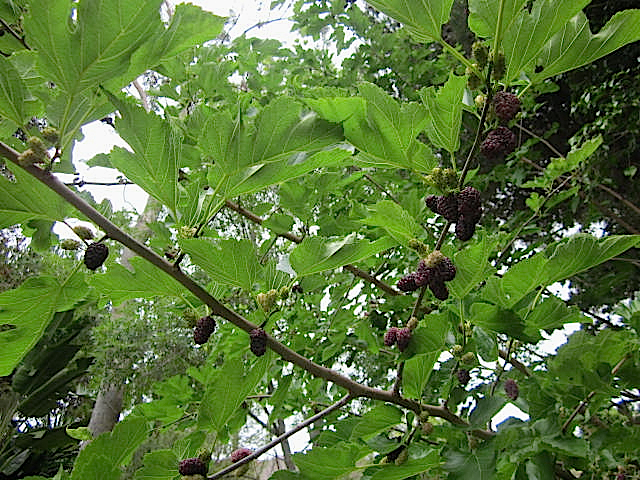
Here We Go Round The Mulberry Bush (Tree)

Bird droppings make great jam.

Perhaps generated by seeds embedded in bird poop; I’m not sure where this tree came from — I never planted it  — but one day there was a little sprout and a few years later it bore its first harvest.

We have two mulberry trees in our yard; the volunteer is fruit-bearing, the other that provides shade to the deck, is not.

silkwormcloseupSilkworms eat mulberry leaves; maybe I could raise a few silkworms and spin my own fabric — except worms are kinda gross, so I guess not.

mulberry tree3

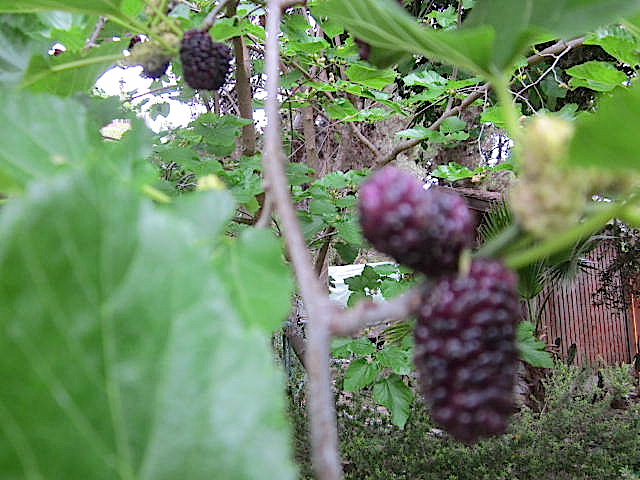
Technically, the fruit of a mulberry is not a berry but a collective fruit, in appearance like a swollen loganberry. When the flowers are pollinated, they and their fleshy bases begin to swell. Ultimately, they become completely altered in texture and color, becoming succulent, fat and full of juice.

In appearance, each tiny swollen flower roughly resembles the individual drupe of a blackberry. Mulberries ripen over an extended period of time unlike many other fruits which seem to come all at once. {Wiki} They’re very sweet and mild.

mulberry tree2

mulberry tree

I learned from Martha Stewart to spread an old sheet on the ground and shake the tree. All the ripe fruit fall; I wash, dry, and freeze in quart bags. So far, I have about eight quarts and the tree’s not done. Raccoons come by at night and gorge themselves;  during the day, crows and other birds eat from the very highest branches.

mulberrysheetA bowl of mulberries.mulberrybowl

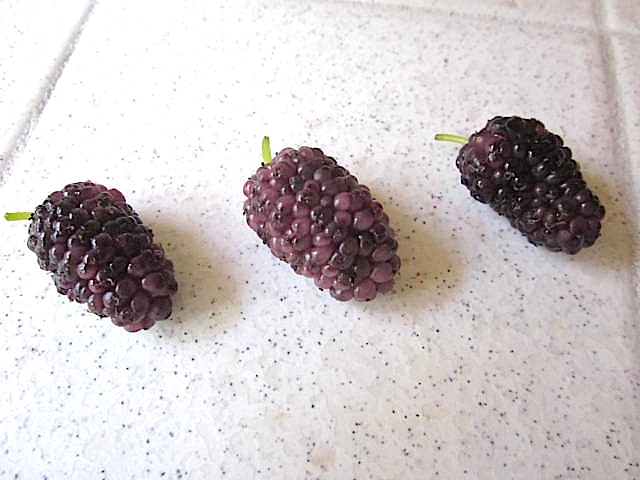
Three beautiful specimens. I add them right from the freezer to smoothies and cobblers and I’ll make a batch of jam, too. If I have enough, I’ll make a pie.

mulberry3

Mulberry Jam
(This recipe uses no pectin)

  • 2 1/2 cups mulberries, rinsed (the tiny green stems do not need to be removed)
  • Approximately one cup granulated sugar (I start with a very small amount of sugar and keep tasting. You can try agave, too.)
  • 3 tablespoons water
    Bring a large pot of water to a boil over high heat. Drop heat to medium-low and add jars and their lids. Simmer for 10 minutes to sterilize. Using tongs, remove jars and lids and place on a clean towel to let cool.
    In a medium, heavy-bottomed saucepan set over medium heat, combine mulberries, sugar, and water. Bring to a boil, boil for one minute, then drop to a simmer. Cook fruit, stirring occasionally, until foam subsides and mixture thickens slightly, about 7 minutes.
    Using a ladle, carefully transfer hot jam to sterilized jars. Wipe mouths of jars clean and screw on lids very tightly. Let cool at room temperature for at least 8 hours before using.