Poetic Truth : Pity The Nation

We are living in sad and scary times. Lawrence Ferlinghetti wrote the poem “Pity the Nation” in 2007, drawing inspiration from Khalil Gibran’s original work of the same title, published in 1933. Their words are a reminder about the cycles of history.  

We’ve been warned.

PITY THE NATION

Pity the nation whose people are sheep
   And whose shepherds mislead them
 Pity the nation whose leaders are liars
            Whose sages are silenced
  And whose bigots haunt the airwaves
 Pity the nation that raises not its voice
          Except to praise conquerers
       And acclaim the bully as hero
          And aims to rule the world
              By force and by torture
          Pity the nation that knows
        No other language but its own
      And no other culture but its own
 Pity the nation whose breath is money
 And sleeps the sleep of the too well fed
      Pity the nation oh pity the people
        who allow their rights to erode
   and their freedoms to be washed away
               My country, tears of thee
                   Sweet land of liberty!
 Lawrence Ferlinghetti, 2007


PITY THE NATION
By Khalil Gibran, 1933

Pity the nation that is full of beliefs and empty of religion.

Pity the nation that wears a cloth it does not weave, eats a bread it does not harvest, and drinks a wine that flows not from its own wine-press.

Pity the nation that acclaims the bully as hero, and that deems the glittering conqueror bountiful.

Pity the nation that despises a passion in its dream, yet submits in its awakening.

Pity the nation that raises not its voice save when it walks in a funeral, boasts not except among its ruins, and will rebel not save when its neck is laid between the sword and the block.

Pity the nation whose statesman is a fox, whose philosopher is a juggler, and whose art is the art of patching and mimicking.

Pity the nation that welcomes its new ruler with trumpetings, and farewells him with hootings, only to welcome another with trumpetings again.

Pity the nation whose sages are dumb with years and whose strong men are yet in the cradle.

Pity the nation divided into fragments, each fragment deeming itself a nation.

The Titan | Ocean’s Tragic Magic

“In one drop of water are found all the secrets of all the oceans.” – Kahlil Gibran

My thoughts are about as insignificant as a drop in the ocean, but I’ve memorialized my observations as a way to try and wrap my brain around the tragedy that unfolded the last few days about the Titan submersible.

I’ve lived near the ocean most of my life and while I love it, I’m afraid of it at the same time.

I CAN swim but it’s not my most favorite thing to do; in fact, my chest gets tight and I can start to hyperventilate simply thinking about putting my head under water — even though I know I have done it many times.

The Angel Kids aren’t like me — they’re half dolphin — both of them, and swim and jump in the waves and dive and try to surf and paddleboard with no fear of the power of the ocean.

When I first learned about the concerns regarding the loss of communication with this tiny little submersible while it attempted to reach the wreck of the Titanic, the idea of being crouched into a tight space, freezing cold, in total darkness, with limited oxygen, miles away from help — was a recipe to ignite some of my worst fears.

Lost and alone, in the dark, unable to breathe, under the sea.

I don’t like to take the Bart tunnel from San Francisco to Oakland and can’t even think of an incentive that could motivate me to endure a two-hour ride on the Chunnel from London to Paris.

Yesterday, the United States Coast Guard said that an ROV found the tail cone of the Titan 1,600 ft from the Titanic, and the ROV then found additional debris consistent with the “catastrophic loss of the pressure chamber.”

The debris is consistent with a catastrophic implosion of the vessel,” said Rear Admiral John Mauger.

Officials said that the location of the debris field matched “the location of last communication” of the submersible. The time of the implosion has not yet been determined.

From the Rear Admiral, “I offer my deepest condolences to the family. I hope this discovery provides some solace during this difficult time.” 

OceanGate Expeditions, the company that operated the Titan, released a statement on Thursday saying that they believe all five passengers on the submersible had been “lost.”

Presumed deceased are Paul-Henry Nargeolet, Stockton Rush, Hamish Harding, Shahzada Dawood, and his son, Sulaiman Dawood.

Also from OceanGate, “These men were true explorers who shared a distinct spirit of adventure, and a deep passion for exploring and protecting the world’s oceans,” the statement said . “Our hearts are with these five souls and every member of their families during this tragic time. We grieve the loss of life and joy they brought to everyone they knew.”

What I find utterly fascinating and darkly eerie is the connection to the wreck of the Titanic.

From NPR: “The OceanGate executive who was piloting the submersible on its fateful Sunday dive is married to the descendent of a couple who died in the very shipwreck his expedition aimed to see.

OceanGate founder and CEO Stockton Rush is married to Wendy Rush, the great-great-granddaughter of Isidor and Ida Straus, who choose to remain onboard the sinking Titanic together so that others could escape to safety in their place.

They were the real-life inspiration behind the heartbreaking scene in James Cameron’s movie in which an elderly couple embraces in bed as water rushes into their room.”

There’s been a disgusting amount of unkind and vicious commentary on social media about the fact that these men were millionaires and billionaires.

In my opinion, it doesn’t matter how entitled they were or how much money they had; this is a tragic, horrible way to die.

From Julias Kim via Twitter: “There isn’t one person who is hating on billionaires right now that wouldn’t take a billion dollars if it was handed to them tax free…Beware. It’s a slippery slope when we start devaluing lives based on how much money people have.”

Yet…there’s this:

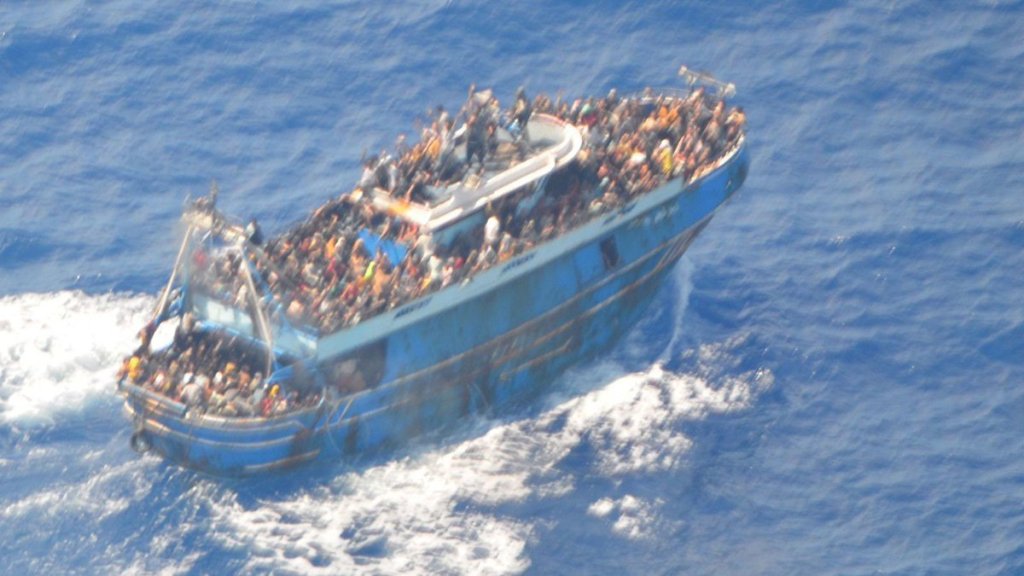
As every news report led with the OceanGate submersible, how many international efforts coalesced to rescue hundreds of migrants from the ocean off Greece?

It seems as if that catastrophe garnered little to no attention.

I feel terrible for the migrants who drowned in the waters outside Greece AND for the people who died aboard the Titan.

And yes, it’s possible to feel compassion for both.