Death Valley is HOT

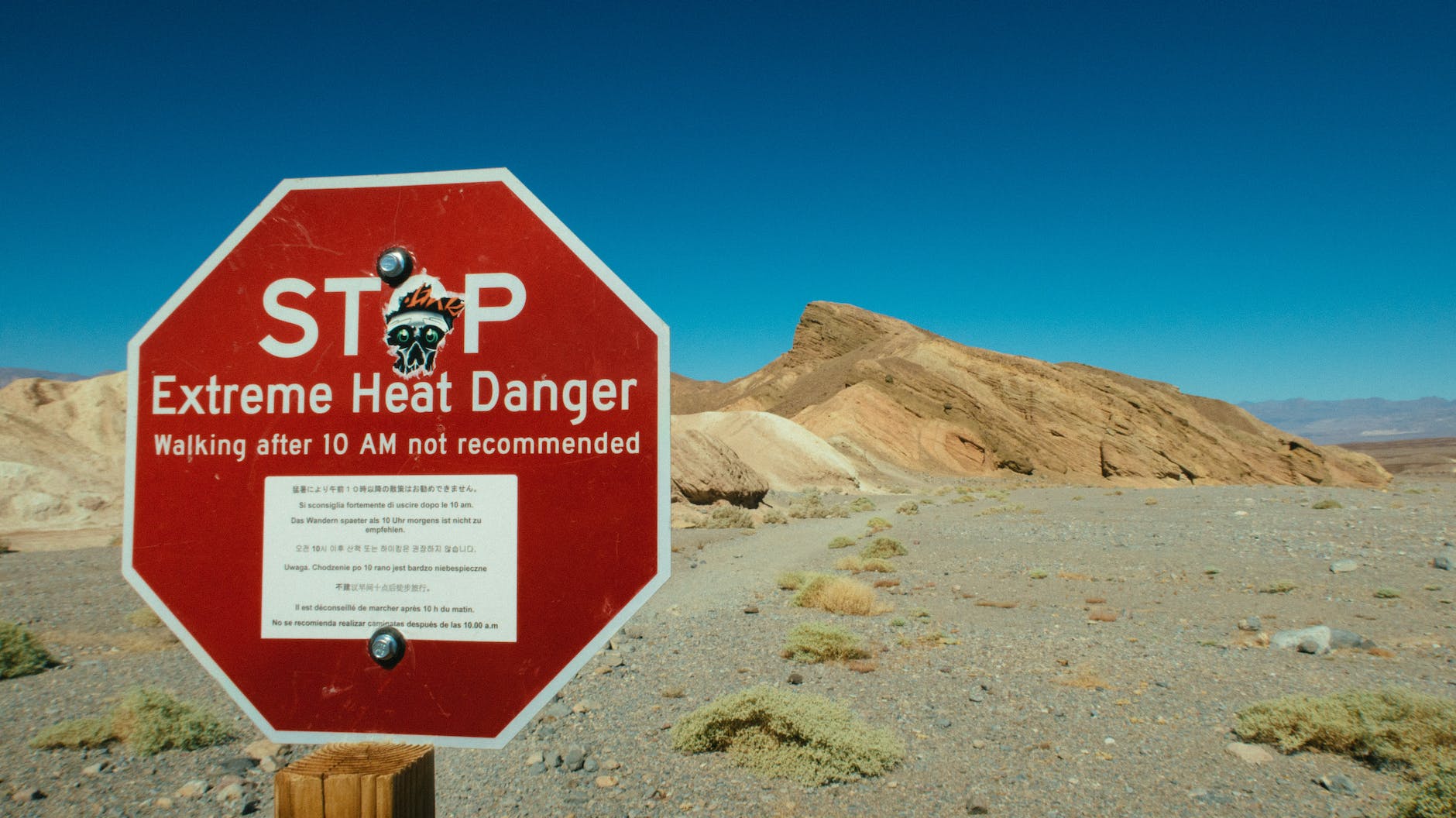
Photo by Athena on Pexels.com

Right now, visitors are flocking to Death Valley National Park to experience the forecasted EXTREME heat.

Death Valley is projected to set a verified world record for the hottest temperature ever reliably recorded, with Furnace Creek expected to reach 131 degrees with a low temperature at night of 101 degrees.

I’ve been to Death Valley a few times. It’s an otherworldly and mysterious experience. It’s a whole mind/body connection, the kind of heat that permeates down to a soulful, cellular level. Along with the magnificent silence, there’s really nothing to compare to desert heat.

Ten thousand years ago, Badwater Basin, the lowest point in North America, was once a hundred-mile long lake. It’s now a vast expanse of salty ground.

When you visit Death Vally, make sure you stop at Artists Palette, a technicolor, kaleidoscopic display of multicolored rock in that makes you feel you’re at an art exhibit.

Of course, as with the rest of our country, there were Indigenous People here before us.

The Timbisha Shoshone Indians lived there for centuries before the first white man entered the valley. They hunted and followed seasonal migrations to harvest pinyon pine nuts and mesquite beans. To them, the land provided everything they needed and many areas were, and are, considered to be sacred places.

I always thank the first people when I camp or hike, no matter where I am.

The shamanic ground markings of Death Valley tend to be found in the more remote parts of this already remote region – probably the reason why any trace of them survives at all. They are ritual and magical features left by long-ago shamans, probably of the ancestral Pima and Shoshone peoples, and they are fragile, so much so that their precise locations are not advertised.

They take various forms – ritual pathways, shrines, vision quest beds, scraped ground markings, strange sinuous lines, and weird patterns of rocks.

Vision quest beds are remote, subtly-marked locations where an Indian brave or shaman would go to spend a solitary vigil seeking a vision – a personal spiritual gift. He would go without food or sleep for perhaps three or four days and nights until the vision came. If it came at all, it would most commonly be in the form of what we would call an auditory hallucination: he would hear a chant or song.

Ritual pathways are probably the rarest of the shamanic features. a loose group of boulders.

The most enigmatic of all the shamanic relics in the valley are markings etched into the hard, sunbaked ground (‘intaglios’) or laid out with small rocks on the surface of the ground (‘petroforms’). Such features are collectively known as ‘geoglyphs’. Both types in Death Valley mainly show meandering, abstract patterns, but a few seem to depict mythical creatures. (Curated from https://www.ancient-origins.net)

If you make it to Death Valley, no matter what season, take more water than you think you’ll need to stay well hydrated!

The Beauty and Healing of the Shamanic Experience

According to Awakening to the Spirit World by Sandra Ingerman and Hank Wesselman, “Shamanism is the first spiritual practice of humankind and dates back tens of thousands of years. The fact that this spiritual practice of working in relationship and in partnership with the helping spirits is being widely used today speaks to the potency of the work.”

Shamanism is a practice that involves a practitioner who reaches altered states of consciousness in order to perceive and interact with a spirit world and channel these transcendental energies into this world.

Hold on a sec…yes, you’re on the right blog, I’m still Princess Rosebud, still Enchanted Seashells haha, just doing a little ENCHANTED exploration with the spirit world in addition to gluing seashells to any available surface. With a nature. land, and animal connection, how could it be anything but good, right?

Let me clarify…I’m not a shaman. Did you think I was? Nope, but I met an amazing woman who is a shamanic practitioner,and I’d like to share her story and my experience with you.

I met Carmen in January. I had undergone an emotional and total body 10.0 earthquake, a tsunami of pain that ruled my life so unbearably for a couple of months until I was so devastated that I was literally unable to function (I’ll tell you all about it when I can.)

A very good friend suggested that I seek out the support of a shaman for healing from these deep heart wounds.

Always a skeptic, I was so far out of my mind and spirit and soul that I would have reached up to the sky to pull down a star if that could have helped me work my way out of depths of despair.

Serendipity, divine guidance, luck, coincidence…who knows what it was, but I found Carmen located in my own little town and booked an appointment.

I had no preconceived ideas about what to expect. I didn’t even Google “shamanism”–I don’t remember how I drove to her office.

I walked through the door with shoulders hunched, tears streaming down my face. There was a candle burning and the scent of sage. I don’t remember filling out her information form…why are you here, and later I saw that I had written, “to save my life”.

Between bouts of sobbing, I told her what had happened to my world; it felt like a death but no one had died. I felt like there was something strangely wrong with me; not a medical issue, although I had absolutely suffered some health issues due to this seismic shift-but more internal, cellular, organic. I felt like there was a toxic or malignant entity inhabiting my body, causing me an incredible amount of despondency- I was tormented.

What is a shamanic journey?

In shamanic practice it is believed that part of the soul is free to leave the body. There are various times the soul might leave the body, during dreaming or to protect the soul from trauma. When a shaman is initiated onto the shamanic path, they usually learn how to send their soul forth intentionally, on the soul flight which is commonly called a journey or the shamanic journey. In early shamanic societies, many shamans were initiated because of having a near death experience. Death being an experience when all of your soul leaves the body, the near death experience is thought to teach an individual to travel with the soul.

The shamanic journey occurs by shifting awareness or consciousness in order to allow part of your soul to leave the body. The drum or rattle is frequently used. The slow repetitive rhythm shifts the individuals “rhythm” so that he or she can journey. Just the way a soothing song can help an someone achieve a calmer state. The rhythm of the drum puts you in the right state to journey. The drum beat used is very close to the frequency that is measured from the earth, and has proved effective for the majority of people. [From https://www.shamanlinks.net/shaman-info/about-shamanism/the-shamanic-journey/]

I’ve learned that everyone’s journey is different. Mine involved an out of body and trance-like dreamy experience —  meeting my spirit guides and my spirit animal (a wolf, of course), and a feeling of release of toxins and pain–and a sort of rebirth. I felt as if I was physically still in the room and simultaneously travelled away from my physical body. When Carmen brought me back from the journey and I regained my awareness of the present moment, I felt completely changed from the person who had walked in two hours before. Lighter, less burdened, less desolate, less weighted down by a thousand ton boulder crushing my heart.

Are you asking yourself if I exaggerated or if it was as intense as I’ve shared? Yup, it was, and even more so.

And all I know for sure is that I felt better walking out than I had walking in, and for the most part, that’s stayed with me, along with a renewed sense of purpose, and maybe even healed a bit.