All things exist in a state of continuous flow and harmony.
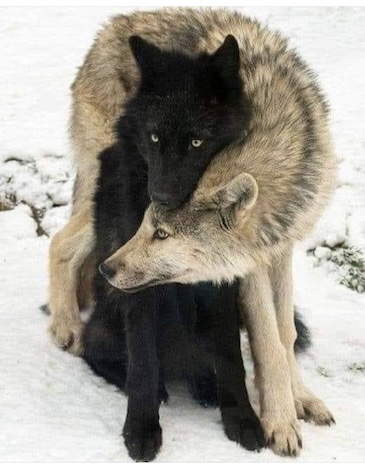
A female wolf will wrap herself around the neck of her mate because the neck is their most vulnerable part of the body.
This is how she shows her unconditional love for her mate.
Photo from Pinterest. Credit to the photographer.
Wolves are apex predators and keystone species that shape entire ecosystems. They are extremely intelligent with complex social bonds and strong family loyalty.
Wolves live in highly organized family units where they care for their young, mourn their lost, and protect injured members.
Wolves are truly amazing. Humans really need to stop killing wolves and instead, we should learn from them and then we’d become better humans.
More pics sent from the Pacific Northwest, which I especially appreciate since I’m allergic to most flowers in real life. These don’t cause sneezing and watery eyes; no antihistamine needed!
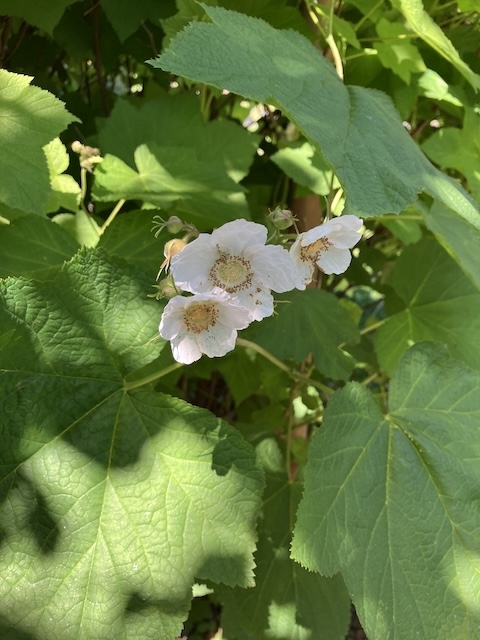
Thimbleberry flowers…this big flower will eventually produce a small, sweet, heavenly berry.
The thimbleberry gets its name from the shape of its fruit. When picked carefully, the cluster of tiny drupelets is removed from its central core, leaving a hollow, bowl-like shape that fits perfectly on the tip of a finger, much like a sewing thimble.
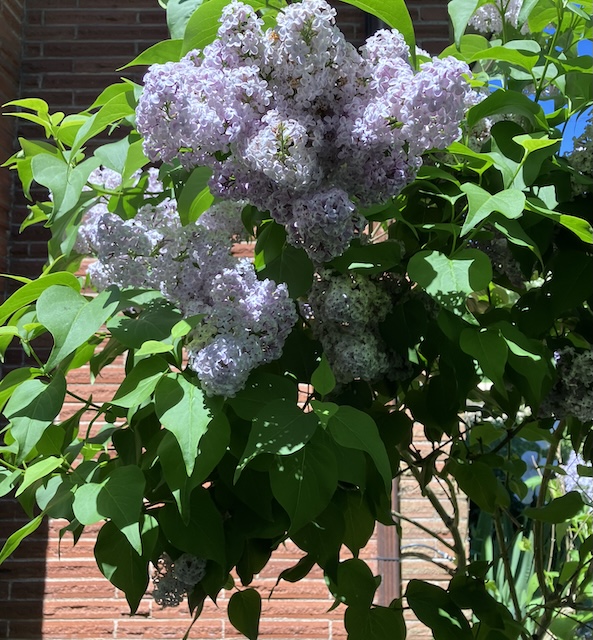
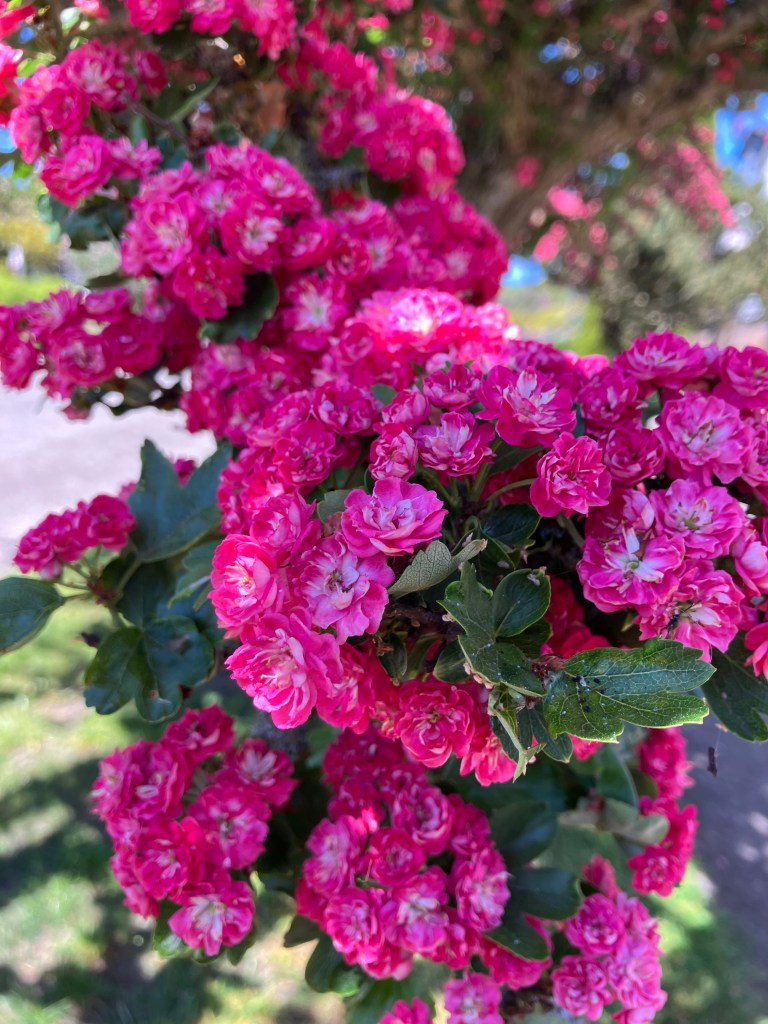
Lilac…one of my absolute favorites.
Azalea…something that would never grow in droughty SoCal.
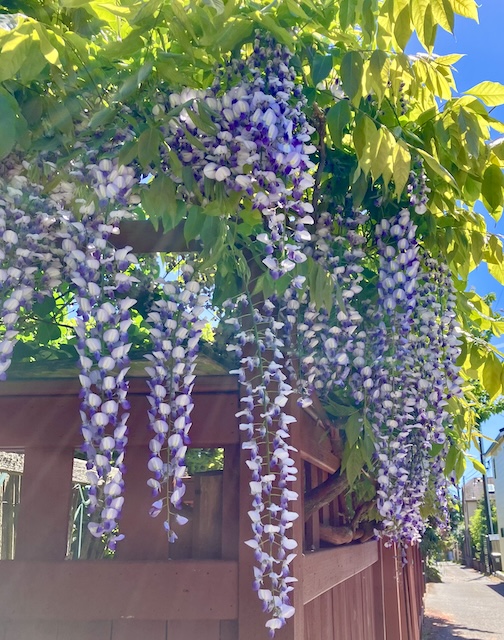
Wisteria…I tried to grow one here and watched it as it sadly shriveled up and died, but I’m happy to see how it thrives in the proper climate.
“Your acts of kindness are iridescent wings of divine love, which linger and continue to uplift others long after your sharing.” Rumi
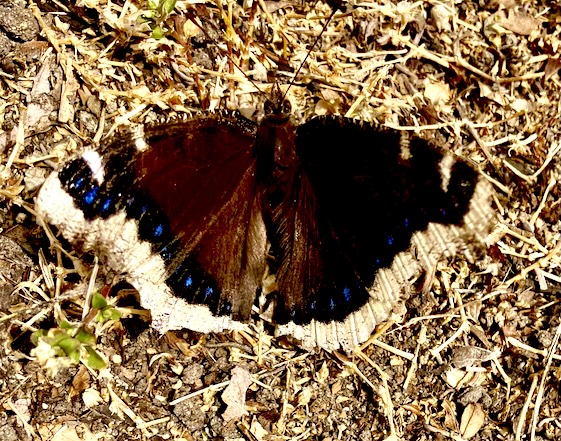
Here’s my act of kindness…with literal iridescent wings…
As I was on my hands and knees cleaning out winter’s leaves from my little pond/waterfall in the garden, prepping for no more rain so I could fill it again, I heard a strange fluttering sound.
I looked up, and right above my head, I saw a Mourning Cloak butterfly held captive in a spider’s web, desperately trying to break free.
I immediately sprung to my feet (well, not SO immediately because I’m still careful not to further injure my torn meniscus that I’m stubbornly refusing to surgically repair) and freed the butterfly from certain death.
S/he fell to the ground because a very tiny bit of sticky web was holding freedom hostage and s/he couldn’t open her wings and fly away.
I sat next to her and very gently pulled off the remains of the spider web, hoping I hadn’t damaged anything, and the butterfly took off like a rocket. I couldn’t believe how fast s/he was. I never saw it again.
Poor little thing was a bit battle weary and bedraggled, but seemed to be OK after the ordeal with the spider web.
Photo by Enchanted Seashells
Have you ever touched the wings of a moth or butterfly and gotten some “powder” on your fingers? If you look through a microscope, that powder is actually tiny scales.These scales give butterflies and moths their scientific name Lepidoptera (from the Greek Lepido = scale, and ptera = wing). Each scale can be a different color and when placed next to each other, the mosaic makes up the color patterns we see. Curated from essig.berkeley.edu/exhibits/butterflywings/
Interesting, huh?
While it’s best not to touch a butterfly’s wings because it might inhibit their ability to fly, there was really nothing else I could do to save him/her. https://essig.berkeley.edu/exhibits/butterflywings/
Here’s the spiritual meaning of a butterfly with its wings stuck together by a spider web: It holds a powerful, dualistic spiritual message, often representing a, tension between the need for transformation and the reality of entrapment or stagnation. It suggests that a, period of metamorphosis or personal growth is being hindered by fear, limiting beliefs, or external obstacles. That’s pretty intense, don’t you agree?
No matter what it means, it’s a good feeling to help a wld creature.
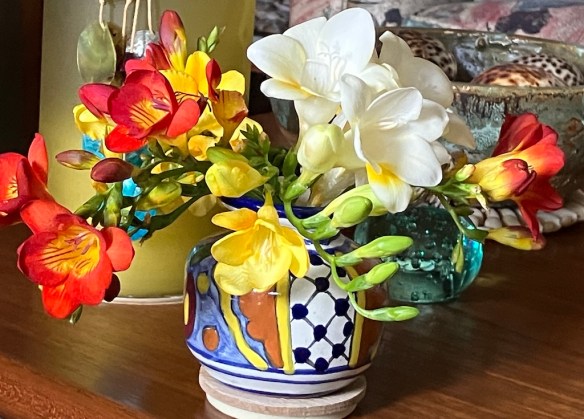
I really wish you could close your eyes and inhale the fragrance of these freesias. Our weather’s been hot here in SoCal and all the flowers bloomed at the same time.
Photo by Enchanted Seashells
Isn’t that vase adorable? I found it at a thrift shop and it’s one of my favorite things.
This is another post in my continual quest to NOT allow current events to cause mental and emotional distress. I don’t actively ignore the news; instead, I’m trying to manage my visceral reactivity, if that makes sense.
I didn’t get good pics of March’s full blood moon, but look who I discovered on the deck this morning! He didn’t look too perky so I put him near a flower and hope he rallies…
The White-lined Sphinx Moth, Hyles lineata, is a common “hawk moth” (Family Sphingidae) and gigantic at almost four inches! I’ve seen them around here on very rare occasions but have mistaken them for hummingbirds because they’re so big.
Hummingbird moths are excellent, beneficial pollinators, especially for night-blooming flowers, helping gardens and ecosystems thrive, though their caterpillar stage might munch on host plants like tomatoes, a minor trade-off for their adult benefits. They are harmless to humans, mimic hummingbirds, and are crucial for plant reproduction, making them a positive addition to any pollinator-friendly yard.
Hummingbird moth symbolism often centers on luck, transformation, peace, prosperity, and longevity, appearing as a messenger for change or a sign to look closer at life’s illusions, blending butterfly themes (change) with hummingbird traits (joy, flexibility) as they are mimics of hummingbirds and symbolize a spiritual connection to nature’s deeper messages and joyful living.
I’ve been trying to capture this photo for a few days and my patience and persistence finally paid off. I think she’s searching for a suitable nesting site, or maybe she really thinks this hummingbird wind chime is a cousin, I dunno…
I had to snap the pic through the screen door so I wouldn’t scare her off, but I’m completely happy with the result. It’s these little joyful moments that make life worth living, don’t you agree?
I discovered a poem written by D.H. Lawrence about hummingbirds:
Humming-bird I can imagine, in some otherworld Primeval-dumb, far back In that most awful stillness, that only gasped and hummed, Humming-birds raced down the avenues.
Before anything had a soul, While life was a heave of Matter, half inanimate, This little bit chipped off in brilliance And went whizzing through the slow, vast, succulent stems.
I believe there were no flowers, then In the world where the humming-bird flashed ahead of creation. I believe he pierced the slow vegetable veins with his long beak.
Probably he was big As mosses, and little lizards, they say, were once big. Probably he was a jabbing, terrifying monster.
We look at him through the wrong end of the long telescope of Time, Luckily for us.
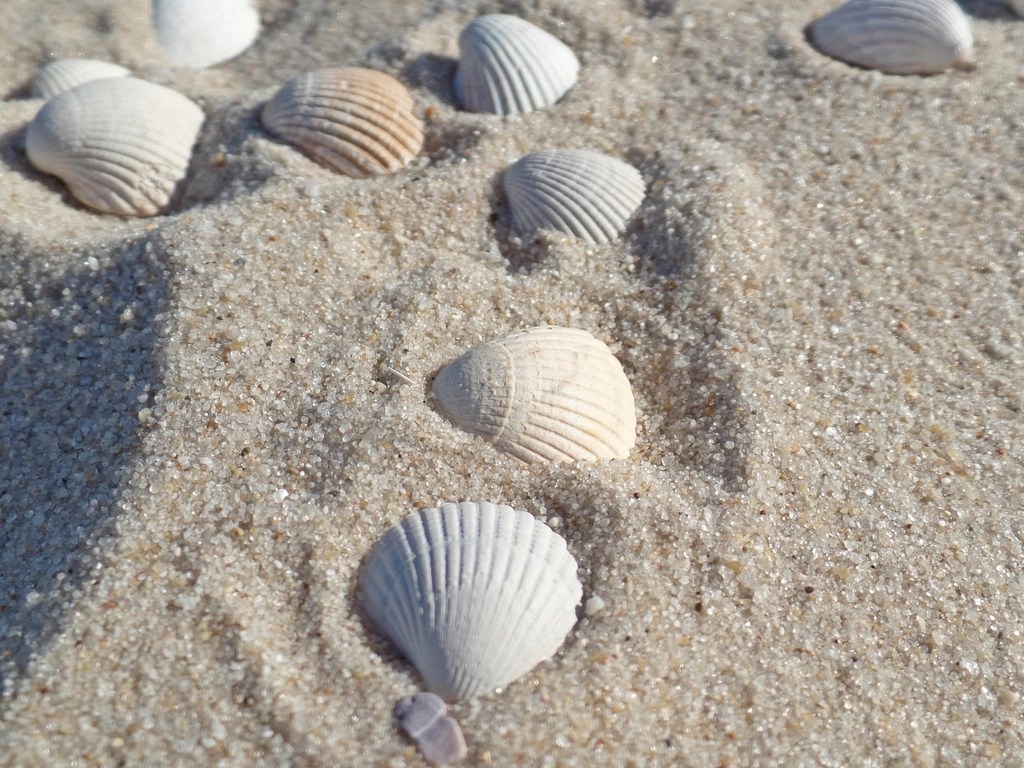
This photo was taken at the beach on a spectacularly warm December afternoon. The sky was blue and the Pacific Ocean was full of sparkles; a magnificent day.
Photo by Enchanted Seashells
Ode To Our Ocean
The sea sings out to its many saviors: Teenagers with fists thrust into the air at climate strikes, Scientists converging around their data, A child who stoops to scoop up a piece of trash.
The sea sings out for its singular subjects: Arching whales that wave from their waves, Turtles that teeter down their shining shores, Coral reefs shining brightly as cities.
The sea sings out its suffering, Knowing too much of waste, screeching sounds And pernicious poison, its depths bruised by Atrocities in the Atlantic, Misery in the Mediterranean, Its tides the preservers of time past.
The story of the ocean and the story of humanity Are one and the same, a Great River that Knows no borders and notes no lines, Only ripples. While we might call it the Seven Seas, Today we sing out your true name: The one ocean. For no matter how we try to separate your waters, You are the colossus that connects us.
Water makes up 70% of Earth, 70% of the human heart, And 70% of the human being, All of us, bodies of water, For we, too are oceans, Or at least beings bobbing in the same boat. To stand up for for our ocean Is to stand up for our own ship The sea is a restless, strong collective of many pieces. So are we. The ocean can recover. And so will we. Let us not divide the tides, But discover all they have to teach us– Green meadows of sea grass that survive pathogens, Blue-bloodied marine snails that can fight off viruses. There are more lessons to learn, Still more work to be done. So we lift our faces to the sun. May the seas help us see healing and hope, May we sing out the ocean’s survival and revival. Being the people of this blue planet is our most Profound privilege and power, For if we be the ocean’s saviors, Then it is surely ours.
Written by Amanda Gorman for World Oceans Day. Harvard graduate Gorman is an American poet, activist, and model. Her work focuses on issues of oppression, feminism, race, and marginalization, as well as the African diaspora. Gorman was the first person to be named National Youth Poet Laureate.