My little angels know how to make Grandma happy. Look what came in the mail, whole and undamaged.
It’s a gigantic, perfectly formed, preserved, and decayed leaf they found in their front yard. It brings me so much joy that the first thing they thought of was that it’s something I would appreciate.
I immediately framed it to admire every day.
March is here, winter shifts to spring, trees are budding and leafing, and it’s important to remember that autumn’s falling leaves were the catalyst to everything new. This leaf died so that more will grow; the inevitable circle of life.
It completely fills out an 8.5 x 11 frame. Isn’t this amazing?
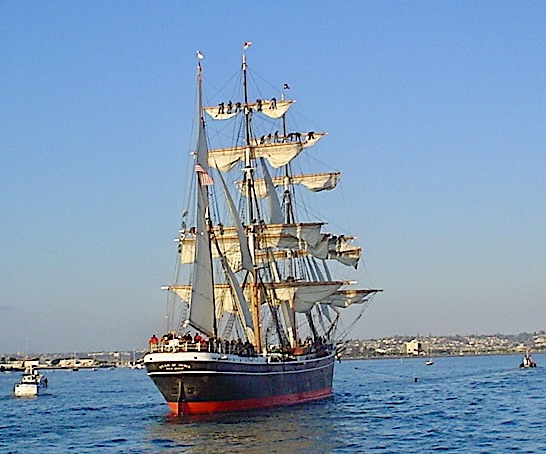
Every so often the Star of India sails in San Diego Bay. I was clearing out some old photos and discovered this one from a few years ago. If you have seen this ship at all, it was probably lining the dock in downtown San Diego, but in case you didn’t know, this is the world’s oldest active sailing ship and still sails a few times a year with an all volunteer crew.
The Star of India was built on the Isle of Man in 1863. Iron ships were experimental at that time with most vessels still being built out of wood. Within five months of laying her keel, the ship was launched. She was originally named Euterpe after the Greek muse of music and poetry.
Euterpe was a full-rigged ship and would remain so until 1901, when the Alaska Packers Association rigged her down to a barque, her present rig.
She began her sailing life with two near-disastrous voyages to India. On her first trip she suffered a collision and a mutiny. On her second trip, a cyclone caught Euterpe in the Bay of Bengal, and with her topmasts cut away, she barely made port. Shortly afterward, her first captain died on board and was buried at sea.
After such a hard luck beginning, Euterpe made four more voyages to India as a cargo ship. In 1871 she was purchased by the Shaw Savill Line of London.
Subsequently sold to the Alaska Packer Fleet, her name was changed in 1906 to the Star of India to match the other vessels in their fleet. The Star of India made over 22 Alaskan voyages before becoming obsolete in the 1920s as steam power propulsion became more reliable than wind.
The Zoological Society of San Diego purchased the ship in 1926 for use as the centerpiece of a planned maritime museum and aquarium. The Great Depression in the 30s and World War II caused those plans to be put on hold and the Star of India lay idle until she was restored in the late 50s and early 60s.
Fully restored by 1976, the Star of India set sail as part of the United States’ Bicentennial celebration.
Interesting Facts:
Launched five days before Abraham Lincoln’s Gettysburg Address
She’d be 107 years old today. I miss her more than she probably ever imagined.
Her legacy endures because Angel Boy 1.0 and DIL named Angel Girl after her. They have photos of her at their home and both children know who she is and how much of an honor it is to be named for her. She’s Daddy’s grandma, Grandma’s mommy.
Since my mom was an absolutely amazing grandma, I try to emulate some of the same things she did with my son; have endless patience with laser focused attention, play with them forEVER, and take each of them solo toy shopping.
“Look what Grandma got me, Mommy!Grandma said I could get ANYTHING I wanted” as my son showed me one Matchbox car, the only thing he chose. (He always was frugal!)
I knew it wasn’t the object that made him happy, it was spending time with Grandma that was fun and special. And important.
Happy Birthday! I wish we all had more time with her, that’s for sure.
Driving around doing errands this morning, I heard one of her favorite songs at least three times, a message for sure! She loved Prince’s When Doves Cry, and so do I.
Ambedo – n. a kind of melancholic trance in which you become completely absorbed in vivid sensory details-raindrops skittering down a window, tall trees leaning in the wind, clouds of cream swirling in your coffee.
Or while you pick weeds under the loquat tree and look up to see sugar peas in a pod backlit by the sun.
The pea plants decided to have a life of their own and the tendrils became entwined in the branches of the tree because I didn’t stake them good enough.
I became lost in time, entranced by the simple green perfection. I l subsequently discovered there’s a word for that: ambedo.
Vermilion Cliffs National Monument in northern Arizona near the Utah state line.
Known for its colorful swirls of slickrock, Vermilion Cliffs National Monument is a sherbet-colored dream world filled with fantastical rock formations.
You just can’t take a bad photo surrounded by this kind of beauty.
I never liked that song by Sir Mix-a-Lot ‘cos it seemed sexist and disrespectful but I love hiking and I love big rocks. I also see what appears to be the head of a dinosaur.
Look at this orange butterfly feasting on an orange zinnia!
I’ve never seen it before and I was so excited to learn this is a Gulf Fritillary or passion butterfly (Agraulisvanillae) They’re “longwing butterflies”, which have long, narrow wings compared to other butterflies. Gulf Fritillary is the only member of genus Agraulis. From Wiki.
#WordlessWednesday
An orange butterfly represents passion. An orange butterfly sighting can remind us to stay focused on or follow through with a plan or project until it’s complete.
The orange butterfly is associated with the sun, life, and consciousness. Spotting an orange colored butterfly can signify that a new dawn of healing and heart transformation is about to occur for someone who has been depressed or anxious.
Orange colored butterflies have also been associated with courtesy, friendliness, and liveliness.
Seeing an orange butterfly reminds us to stay positive.
Having an orange butterfly land on you or fly near you means that joy will soon come into your life in some unexpexted way.
An orange butterfly can also encourage us to be more socialble or outgoing, or seeing one can indicate that a visitor will soon arrive, or an invitation to a social event is coming–especially if the butterfly is flying inside or around the home.