At times, the southwest desert seems like an otherworldly place…stark, beautiful, sort of scary.
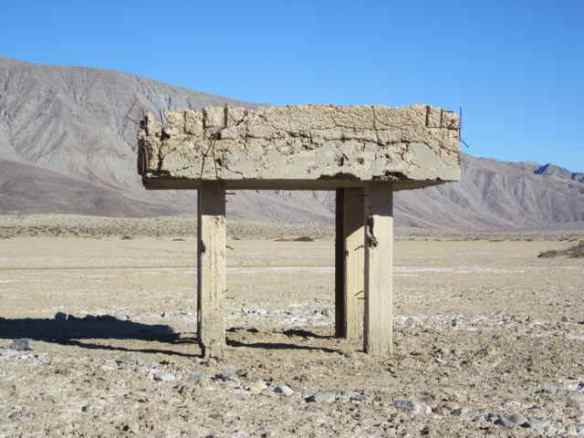
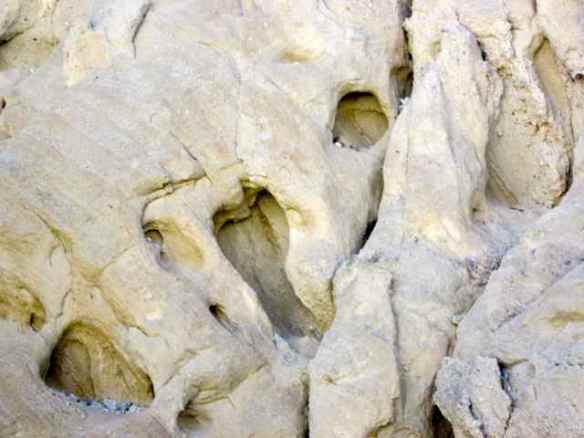
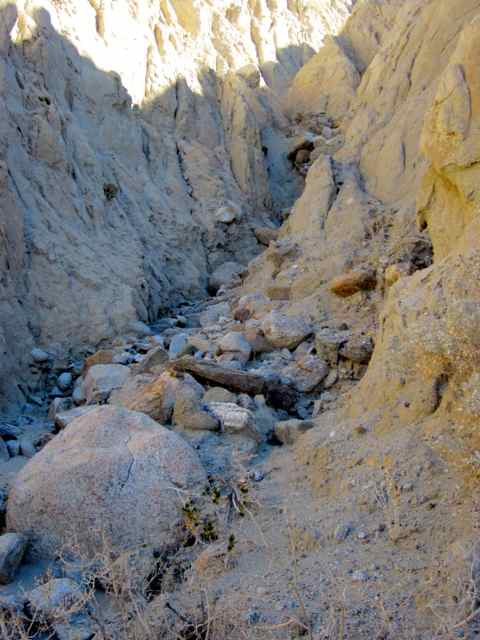
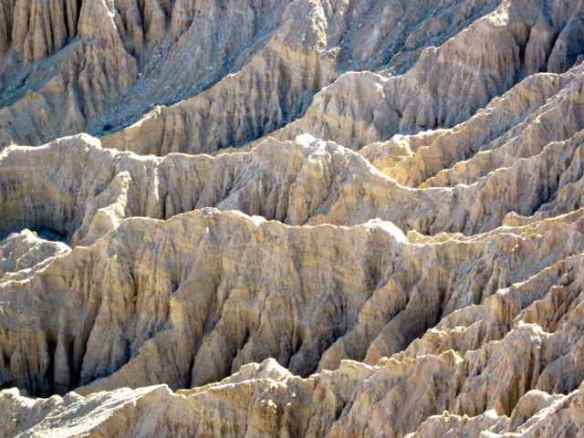
At times, the southwest desert seems like an otherworldly place…stark, beautiful, sort of scary.
“When I am silent, I fall into the place where everything is music.” — Rumi
Whew, it’s definitely time for a Rumi quote to bring down sky high BP.
Today is Martin Luther King Day and that petty psychopathic orange POS removed MLK Day and Juneteenth from the list of fee-free days for our national parks and replaced them with days like Flag Day (his birthday).
My governor, California’s Governor Newsom, countered by making over 200 California State Parks free on MLK Day.
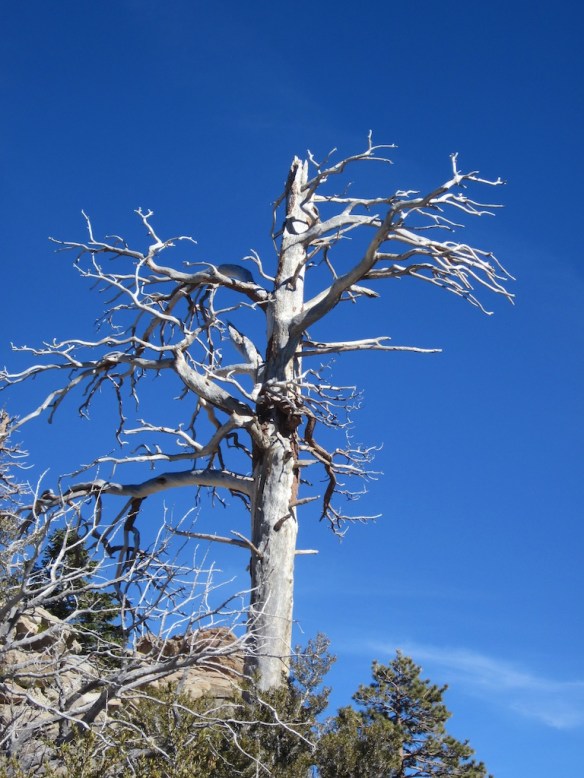
Enjoy this silent and stark tree from Mt. San Jacinto near Palm Springs, California.
Silence is healing.
“I know you’re tired but come, this is the way…” Rumi
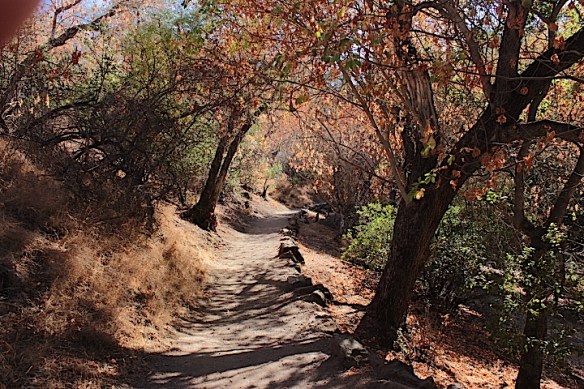
It may look like a hot and dusty trail, but I think it’s paradise. Let’s explore this path together.
A new walking trail opened up in the city of San Marcos.
It’s inland and a bit of a drive, so it’s best to get there in the early morning or late afternoon because the temps are going up.
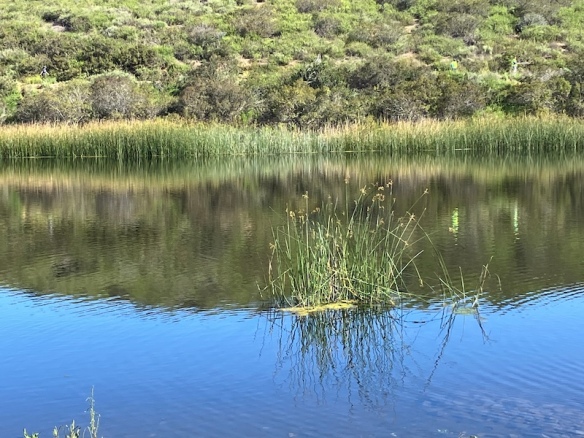
The trail is only a mile or so, not at all strenuous, but the views are magnificent with California lilacs and mature ceanothus surrounding the South Lake Reservoir — built in 1959, although it hasn’t been used as a source of drinking water since 1984.
I doubled back instead of completing the easier loop and that added an extra mile to the hike.
There’s a lot of coastal scrub, coots, ducks, redwing blackbirds, deer, bobcats, and coyotes. I wish I had seen deer; maybe next time! South Lake is also home to a rare native turtle; the Western Pond Turtle, and I’m sorry to say that I didn’t see them, either.
Definitely remember to bring water and a wide-brimmed hat as it gets super toasty in the sun!



To find the universal elements enough;
to find the air and the water exhilarating;
to be refreshed by a morning walk or an evening saunter…
to be thrilled by the stars at night;
to be elated over a bird’s nest or a wildflower in spring –
these are some of the rewards of the simple life.
~ John Burroughs
Join me on an early morning walk around the lake trails.
There’s a familiar fragrance of tule, which some people don’t like, but I love love the way it smells. Tule grows in dense stands along freshwater wetlands.
Indigenous peoples ate tule roots and seeds, while the reeds were used to make baskets, cord, sandals, and clothing. P.S. Here’s how to say it: “too-lee”
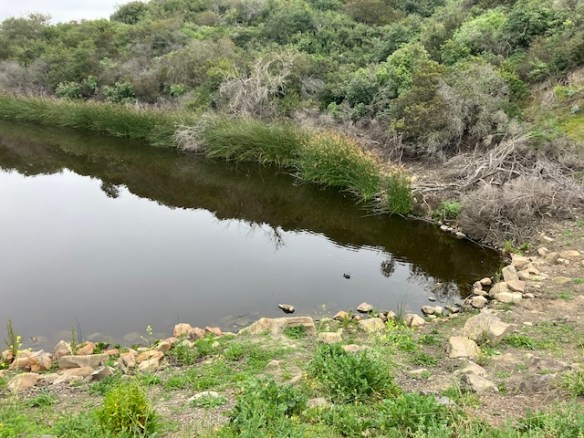
With all the rain we’ve had, everything was uncharacteristically green…as far as the eye could see…

Pretty Black-eyed Susan flowers!

It’s a human-made lake, not natural, intended to be a reservoir, but the ducks and coots don’t seem to mind a bit.

Native buckwheat.
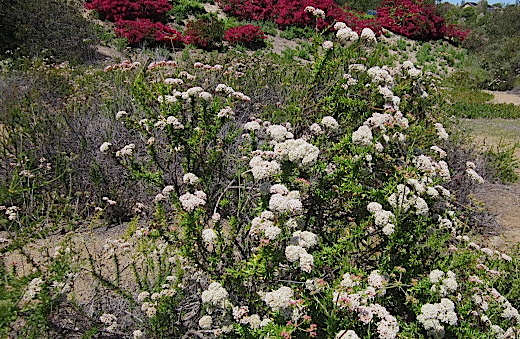
I didn’t see any coyotes this time, but it was still a lot of fun!
A few photos to memorialize January 2024.
This is my favorite, a swan pedal boat on Agua Hedionda Lagoon. It’s an activity high on the list when the Angels visit this summer. Doesn’t that look like a lot of fun?
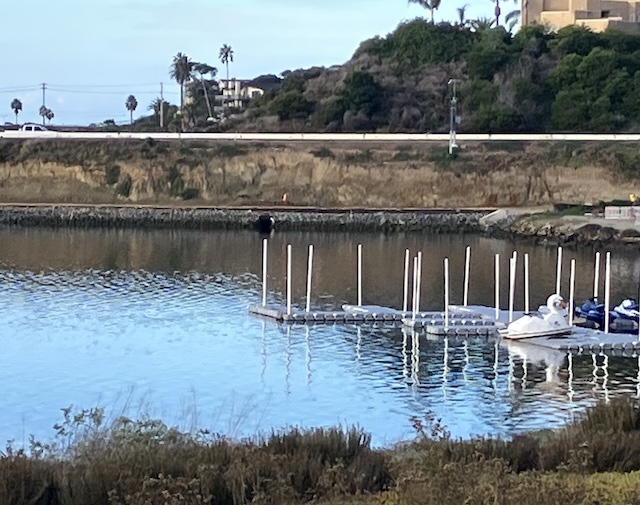
Now I’m standing on a path with a view of the trestle bridge and a peek of a blue Pacific ocean. Do any locals know my specific location? I bet not, ‘cos it’s a secret.

After walking all the way around the lagoon, this is a look to the east and a very low tide…

If you block out the electrical poles and the road, it’s easy to transport yourself back in time to when this land was the home of the indigenous Kumeyaay Indian Nation.
This is where they lived, fished, gathered berries, wove baskets, and buried their families. They lived in small family groups which had to move frequently to find new sources of food and water. Each clan wintered in a sheltered valley and migrated into the mountains in the spring.
It’s sacred land and should stay that way in perpetuity.
I believe this to be true.
"Above all, do not lose your desire to walk. Everyday, I walk myself into a state of well-being and walk away from every illness. I have walked myself into my best thoughts, and I know of no thought so burdensome that one cannot walk away from it. But by sitting still, and the more one sits still, the closer one comes to feeling ill. Thus if one just keeps on walking, everything will be all right."~Søren Kierkegaard
It seems as if I’ve see HOKA shoes everywhere. Do you know the brand or what HOKA means? HOKA is a verb meaning to soar or to fly.
I’ve worn mostly all the brands, but never HOKA. Well, never before yesterday, that is. I’m like Cinderella with shoes; they have to fit perfectly or I reject them.
I went to a local athletic shoe store and tried on a mountain of different brands and styles, resisting the HOKA for no real reason, I guess.
I was feeling dejected and a little embarrassed about the wasteland of boxes around me when the really nice and exceedingly patient employee suggested I try HOKA. “Just try them.” he said.
At first I demurred and then I acquiesced because I had literally exhausted their entire stock. When I slipped them on, it was as if my Prince Charming was sure to magically appear because they fit like a glove, so comfortable that I didn’t want to take them off. Now I understand why I’ve seen so many people wearing them.

I was drawn to the rose gold with black which is a change for me as I usually pick the brightest colors in the shoe palette.
(I guess this is a kind of review, but solely from my own experience because I didn’t get them for free or any other form of compensation.)
Even with a torn meniscus and all the other broken stuff in my knee, I will continue to perambulate, to move my body — because like Kierkegaard said, “if one just keeps on walking, everything will be all right.”
Or, as I like to say, “If you don’t use it, you lose it.” Anyway, that’s MY philosophy.
Since it’s just about time to honor June’s Full Moon, it seems like the perfect opportunity to chat about Moonstone Beach, another sea glass location I need to visit. It’s in Cambria on California’s Central Coast.
It’s said that at Moonstone Beach beach you can find moonstone agates plus jade, jaspers, and other semi-precious stones.
Here’s a photo of some of my beach glass collection. Red is the third most rare type of sea glass, and I only have a couple pieces of that color.
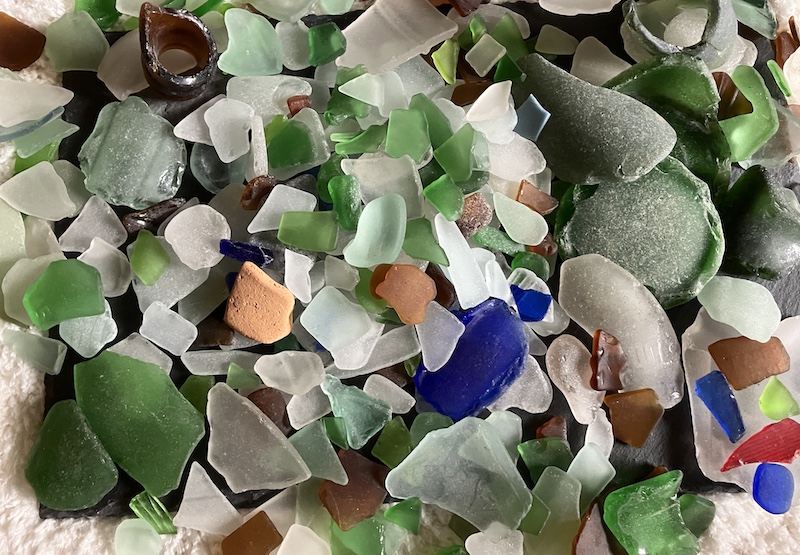
Did you know? Orange is the most rare sea glass color. Turquoise is the second most rare color and the rarest type of blue sea glass. Red is the third most rare sea glass color and yellow is the fourth. I guess white and green and brown are more common to find because I have a lot of those colors, probably because most bottles were crafted in those colors.
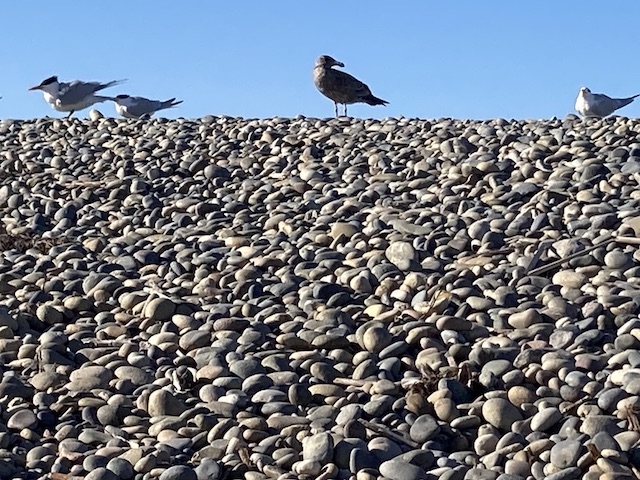
None of the beaches around me have sea glass OR many seashells, although we have an abundant and endless supply of ROCKS.
“Remember, the entrance door to the sanctuary is inside you.”- Rumi

 Enchanted Seashells | Princess Rosebud