This year, Project Coyote launches the first Annual Coyote Awareness Week, March 17-23, to celebrate America’s song dogs.
I can’t think of a better way to officially recognize the arrival of SPRING and the vernal equinox than by highlighting the importance of the beautiful coyote, especially on March 23rd which has been designated National Coyote Day.
My backyard camera captures their frequent visits, along with bobcats and sometimes both in the same night, which makes me very, very happy. I know they’re helping to deplete the rodent population that’s exploded in the last few years.
(And because a couple of readers have asked where “song dog” comes from, I learned that the word coyote comes from the Aztec word coyotl, meaning Song Dog or Barking Dog.)
The purpose of this new holiday is to raise awareness about the intense persecution and misunderstanding coyotes face and the importance of compassionate coexistence.
Coyotes represent the pinnacle of unethical and unscientific wildlife “management” in the United States. Increased awareness of and appreciation for coyotes are critically needed to reform outdated wildlife policies and end the unjust and unscientific persecution of coyotes deeply rooted in American culture ever since European colonization.
Predator extermination campaigns in the 1800s–mid 1900s nearly wiped wolves, mountain lions, and bears off the map. But when the focus turned to coyotes, they responded to this persecution with resilience and adaptability, tripling their range in the last century and filling vacant niches left where wolves were extirpated. Rather than celebrating their resilience to adapt to a human dominated world and the important roles they play in our urban and rural communities, our society has often labeled the coyote as a “pest” or a threat to human communities.
Coyote’s ability to adjust to changing conditions and diverse environments, along with their resiliency to survive and thrive in the face of relentless persecution, has left them vulnerable to insufficient legal protections. In almost every region of the United States, coyotes are legally allowed to be killed, sometimes incentivized through bounties, in unlimited numbers 365 days of the year, using almost any means, including killing contests, trapping, poisoning, hounding, and unregulated recreational killing.
“If we can change hearts and minds about coyotes, the world will be a more compassionate place for all wildlife. That is why coyotes are our flagship species at Project Coyote. And that is why we launched the first annual Coyote Awareness Week,” said Camilla Fox, Project Coyote Founder & Executive Director.
The inadequate protections for coyotes lead to at least 500,000 killed each year, of which over 55,000 are killed annually by the USDA’s Wildlife Services agency at taxpayer expense (as of 2022). Accurate numbers do not exist for how many coyotes are killed through “sport” or wildlife killing contests, because state agencies often do not track or monitor the killing of coyotes, and this number is likely a very low estimate. Even with this underestimate, it translates to: 41,666 coyotes killed every month, 9,615 coyotes killed every week, 1,370 coyotes killed every day, 57 coyotes killed every hour, and 1 coyote killed every minute.
It is vital to foster coexistence with coyotes in both urban and rural communities. Coyotes play critical roles in our multispecies communities including regulating disease transmission by managing rodent populations and culling sick animals, keeping our communities clean by scavenging carrion, and limiting mesocarnivore populations (e.g. raccoons, skunks and foxes) thereby increasing bird diversity and abundance.
Coexisting with coyotes and other wild carnivores can reduce conflict. Decades of scientific literature demonstrate the ineffectiveness of lethal “management” for reducing conflict and for reducing population size. Indiscriminate killing disrupts social systems and subsequently encourages more breeding and migration, which can lead to increases in livestock conflict. Additionally, higher survivability of coyote pups can follow brief population declines due to a temporary increase in available prey, allowing coyote populations to quickly rebound and even increase in number. Despite this data, the default reaction to coyote sightings is too often fear mongering that leads to lethal management. To combat this, citizens across the country can empower their fellow community members to instead interpret coyote behavior, reduce attractants (like unsecured garbage, compost, and pet food), and humanely haze bold coyotes.
It is well past time to replace lethal “management” with compassionate coexistence. Coyotes, like everyone, belong and have a right to exist. Coyotes are sentient, family oriented beings who deserve protection from unscientific and unethical persecution.
We encourage supporters to promote coyote coexistence in their community this week- and every week. It’s a community wide effort to keep coyotes wild and safe from unintended habituation.
“Coyote power: surviving by one’s intelligence and wits when others cannot; embracing existence in a mad, dancing, laughing, sympathetic expression of pure joy at evading the grimmest of fates; exulting in sheer aliveness; recognizing our shortcomings with rueful chagrin.” ~ Dan Flores, author, Coyote America and Project Coyote Ambassador
Coyotes were in the garden last night! I was awakened at midnight by at least two extremely conversational coyotes; yipping and howling for a few minutes. I went back to sleep with a smile on my face.
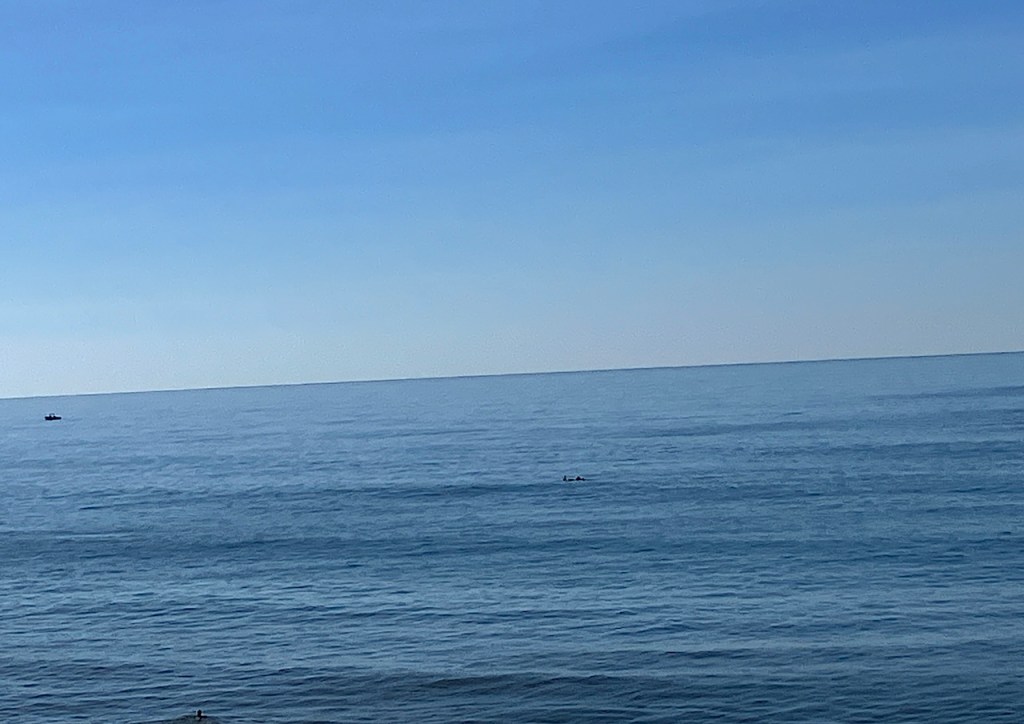
This morning I went on a beach walk (did NOT almost get run over by a crazy driver this time) and was lucky enough to see three dolphins! I’m sorry the photos aren’t great, but I only had my phone.
Here they are in the middle of the photo, to the right of the little boat. They’re moving south.
In this photo, the dolphins are directly to the left of the paddleboarders, who are actually watching them swim by.
Dolphins represent a bond between mankind and Mother Nature, in part due to their emotional connection with humans while they remain firmly part of the animal kingdom. Dolphins are representative of both the Air and Water elements as they are warm-blooded, air-breathing mammals, yet they reside in the depths of the ocean.
For me, hearing coyotes last night and seeing dolphins this morning are two positive indicators that December is starting out to be an amazing way to end 2023!
I hardly ever see my backyard friends during the day so this was a huge surprise, even more so because I was actually outside at the time.
I have no idea how I missed observing this beauty in real time, but it was such a treat to check the camera and discover my silent visitor up on the hill.
Isn’t his coloring beyond beautiful? I can’t wait to see him again…
Last night in the garden around 9pm, I heard this chorus of beautiful songdogs; my beloved coyote family. This lasted nearly a full minute, along with other shorter lyrical melodies.
Turn up the volume, as it was extremely LOUD! I wanted to run up the hill to join them, but I did that once and broke my wrist in the dark, so I merely sent them all my love.
I know what you’re thinking, but there are other reasons for this symphony besides a fresh meal…
“The sound of coyotes howling and yipping at night sometimes causes people concern and alarm. Some mistakenly believe howling indicates that a group of coyotes has made a kill. While coyotes howl for a variety of reasons, it is not likely because they have downed prey. Doing so would draw attention and might attract competing coyotes or other predators to their location, which is not something a hungry coyote would want to do. Coyotes howl and yip primarily to communicate with each other and establish territory. They may bark when they are defending a den or a kill.” https://wildlifehelp.org/solution/district-columbia/coyote/should-i-be-concerned-if-i-hear-coyotes-howling-yipping-or-barking/93
I didn’t write this and I can’t find the author to cite, but here’s one of the best posts I’ve seen about coyotes that’s worth reading and sharing:
“We humans have a strange urge to create monsters. For many, it’s not enough to believe in predators that hunt prey. We have to also project strange, sinister, and even supernatural forces onto the creatures who share our planet.
Since the beginning of time, we’ve created and exaggerated stories of dragons that abduct maidens, giant eagles that grab children, the Big Bad Wolf who pretends to be a sheep or a grandmother. The most modern version of these myths involves none other than the coyote: a 25-pound omnivore often seen in the suburbs, where it eats a diet containing mostly rodents.
You’ve likely heard about how coyotes are vicious beasts who come up with complex, cunning plans to befriend innocent dogs. When the dog thinks it has made a friend— as the legend says— the coyote will lead it back to a den, where a large pack of vicious coyotes leap upon the dog and eat it.No matter how many times you’ve heard a version of this story, it’s not true.
Coyotes do not live or hunt in large packs.
A coyote family usually includes just one pair of adults and their young of the year. While the family does occasionally work together to hunt, they usually prefer to hunt alone, and they never hunt in the large groups of 10, 20, or 30 animals that many claim to have witnessed.
While coyotes are extremely intelligent animals, their minds don’t work like human minds. They don’t develop complex plans for the future, and they don’t have a theory of mind— the ability to conceptualize and predict another animal’s thoughts and perceptions— in the same way that humans do.
A coyote simply isn’t capable of “lying” to a dog by pretending to be its friend or developing a plan to lead it into a trap. Like many other myths, the story about the coyote luring a dog to its death probably started as a misunderstanding.
Coyotes and domestic dogs are very close relatives, so coyotes have been known to sometimes approach them socially. That can include the kind of bowing and tail-wagging that we all know means, “Be my friend!” in dog language.
When a family of coyotes is heard singing and yipping later, the same people who witnessed the coyotes approaching dogs might mistake them for a pack ready to hunt. Coyotes use rapidly rising and falling notes fo create an auditory illusion, which makes a pair or trio of coyotes sound like a large pack, so it’s easy to be intimidated by the sound.
But just because coyotes are singing doesn’t mean they’re killing a dog or making sinister plans: it just means they’re a family and they’re together.With all that said, coyotes are opportunists, and like any other predator, they will eat whatever prey is available if they’re hungry enough. A small dog, especially a toy breed, may be hunted by a coyote. This is one of many reasons that small dogs should not be left outside unattended, particularly at dawn and dusk. Although coyotes aren’t known to target larger dogs as prey, they will fight with a dog if provoked, and both the dog and coyote can be injured or killed. Responsible pet owners should always take steps to prevent these incidents.
Lying, deception, and complicated, evil plans are human traits, not coyote traits. There’s no need to project the flaws of our own species onto our wild neighbors or to assume the worst of a coyote’s friendly or confused behavior.
We need to understand and coexist with our wildlife, not to fear them.”
My house is in a residential area but the upper backyard is part of a natural animal corridor. I set up a wildlife camera to capture video of coyotes, raccoons, possums, and even the occasional bobcat and mountain lion.
We have owls and hawks too, and every so often I’ll find a bunny or a rat that tells the story of predator versus prey.
Last night was different…
I was watching Red Rock on Amazon Prime because there’s literally nothing else — it’s a show about Irish cops and feuding families — when I heard a scream outside. It was a sustained and distinctive sound of distress and I’m sure it wasn’t a human and I’m sure it wasn’t a cat. I’ve heard the scream of a bobcat too, and it wasn’t that, either. (That sounds like a shrill woman.)
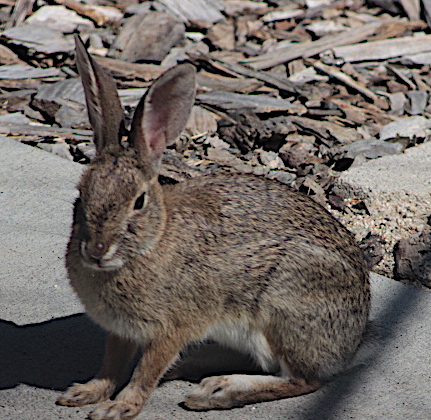
I think it was a rabbit because they also scream when they’ve been hunted by a predator and I have a lot of bunnies around here. A couple days ago I counted five of them on the lawn at the same time.
“The sound of a rabbit screaming will send chills down your spine for two reasons. First, it sounds eerily close to a terrified child. Second, rabbits only scream when a predator is chasing them down or they are dying. It is never a false alarm when a rabbit screams.”https://www.thesprucepets.com/sounds-that-rabbits-make-1835745
All the nearby dogs started to bark like crazy and there was the sound of a scuffle. I turned on the deck lights and got out my spotlight but saw nothing.
This morning I went out to search for any signs of an injured animal or fur or any indication about what had taken place, but I didn’t find a thing. As sad as it is, we must learn to co-exist with wild creatures. They have to eat, too, and bunnies and rats make up most of their diet. This was first their home and we need to respect them. Learn more at Project Coyote.
Later on, I’ll do a more thorough search but right now I’m on my own hunt for the perfect gifts for a little girl who will be two in a couple of weeks. If only Chanel had a kids line of organic lotions and potions!
What has happened to Luna is nothing short of intolerable cruelty.
Personally, I am absolutely heartbroken and disgusted. There is no justification for her suffering.
One of the valuable tools of being a blogger with a following of about 5,000 inclusive of all platforms-is the ability to ask for help, to send a message, to build awareness.
This is an urgent call to action.
Please read this post, visit the links to learn more, make the calls, and do something good before the end of the year.
Friends , this is very important to me personally as well as to our wolf and coyote communities. PLEASE HELP.
Please try to help this tortured soul Luna get back to her safe haven of 13 years with Tomi Tranchita in Illinois.
This is an emergency.
The State of Illinois is trying to get a judge to dismiss her case NEXT WEEK
We need you all to make calls immediately asking that the Lt. Governor Juliana Stratton‘s office steps in and stops this nonsense that continues to hurt Luna.
Please comment and make calls to her office as well — Be prepared to leave an informing message asking her office to step in as we rightfully expect this judge to order the state DNR attorneys to STOP BULLYING Tomi and to mediate and settle this matter — NOT DISMISS IT.
Phone: (217) 558-3085
Fax: (217) 558-3094
Phone: (312) 814-5240
Fax: (312) 814-5228
Fax and/or calls better than emails right now.
Luna should be allowed to return to Tomi’s Federal and State licensed facility without fear of another illegal raid.
History: At dawn on April 24, 2019, Tomi Tranchita’s Wildlife Education facility and her home were invaded by armed officers brandishing assault rifles and beating on her doors. These Illinois State agents seized Ms. Tranchita’s four coyotes, needlessly shooting them with tranquilizer guns, and dragged the animals by their throats with pole chokeholds, leading to the death of all but one of her perfectly healthy animals. The brutal handling of the animals was in violation of federal regulations governed by the AWA. In actual fact, the raid itself was done on a fraudulently obtained warrant, violating Tranchita’s property rights and her 14th amendment right to due process.
This raid wrongfully shut down Tranchita’s long-established, licensed Wildlife Education Program. Therefore, we ask the State to affirm that Ms. Tranchita has satisfied all state requirements to resume her Education Program and that her surviving ambassador coyote may be returned to her facility.
The excessive use of force and intimidation was orchestrated by one “peace” officer (“Officer M”) employed by the IDNR State Fish and Game Agency (IDNR). Having recently moved into her neighborhood and hearing a coyote howl, Officer M was determined to seize Tranchita’s animals. He investigated her program and found that she had inadvertently forgotten to renew a $25 state permit.
However, in applying for a seizure warrant based on that technicality alone, he neglected to inform the magistrate that Tranchita’s facility has been federally licensed the entire 13 years of its operation.
Fraudulent warrant in hand, Officer M led the violent raid showing no regard for the animals’ well-being. Beautiful, healthy coyotes, all crate-trained, were dragged by their throats, choking and bleeding. When Ms. Tranchita offered to crate the animals for their own safety, Officer M would not allow it, saying he was in a hurry because he was going on vacation.
The traumatic, brutal handling in this seizure of her four long-established educational coyotes is portrayed on several videos like this one. These animals had never before experienced violence in their lifetimes.
The brutality continues to outrage more than 40,000 citizens. The stress perpetrated on Ms. Tranchita’s animals resulted in three dying, still with no confirmed explanation. Luna, the last survivor, has been moved three times and was in state custody for five months — all on the taxpayers’ dime.
Officer M also lied to Ms. Tranchita, saying her coyotes would be taken to huge one-acre enclosures. In fact, Ms. Tranchita’s facility is significantly larger than the small enclosures they were moved to. Before he left her property, Officer M told Ms. Tranchita he knew she was upset, and he suggested she call a mental health hotline.
The IDNR denied Tranchita’s court-ordered visitation for weeks.
The agency still refuses to return any of Ms. Tranchita’s personal property, licenses, and documents Officer M took from her.
Officer M attempted to instigate neighborhood concerns but failed. By his own admission, no other neighbors had any problem with the coyotes in the 13 years Tranchita operated her facility. Every neighbor, every facility visitor, and every annual federal inspection report for 13 years stated Tranchita took excellent care of the animals; they had no concerns about her facility, or her educational program, which has also had a flawless safety record.
Indeed, the IDNR has known all along of Tranchita’s facility and her coyotes. They had been to her facility. They had themselves licensed the facility for years. They also knew of her USDA-issued federal license and that she’d held it for 13 years.
Even though this officer is under investigation by the Inspector General’s office for his failure to uphold due process procedures before instigating this raid, as well as his unprofessional and derogatory comments and brash behavior, IDNR proceeded to file charges against Ms. Tranchita instead of firing this rogue officer and apologizing for the damages his actions caused.
Months of court hearings followed the seizure, beginning in traffic court. The judges there had no wildlife law experience. Therefore, they deferred to what the IDNR’s attorneys claimed the obtusely complex rules meant.
So what did the IDNR ultimately conclude Ms. Tranchita was guilty of?
The only violation they could charge her with was the lapsed $25 “furbearer” permit — a document you can simply acquire online from the IDNR agency’s website. Conversely, the USDA-APHIS license requires annual onsite inspections of the facility and the animals, as well as acquiring the same from the veterinarian of record. These requirements, and their costs, are mandated of all licensees annually. A renewal packet is sent to every federal licensee each year prior to their renewal date, while the state IDNR offers no such oversight, not even a renewal reminder.
Is it unreasonable for a citizen to presume that she is not violating any laws when, for 13 years, her federal government renews its approval to continue operating? Further, is it unreasonable to expect that our federal and state agencies, which both regulate these activities, would communicate with each other?
Clearly, Ms. Tranchita’s missed permit payment was inadvertent; she was not trying to get away without paying a $25 fee (and immediately acquired the permit). Consider the expense and investment: She invested tens of thousands of dollars in her 13-year Wildlife Education Program and facility; and since incorporating the non-releasable coyotes as ambassadors into her program, she has paid all costs and requirements of annual inspections by both state and federal veterinarians and officials. Due to her investment and her dedication, her renewal has always been approved, and she has remained licensed under a USDA-APHIS Federal Class C Exhibitors educational use permit. There has not been a single infraction or complaint in 13 years. The facility exceeds recommended requirements for caging, public safety, and federal AWA animal care standards. And it certainly exceeds the IDNR’s standards.
This disturbing, unwarranted, and completely unnecessary action was an egregious civil rights violation by the Illinois wildlife agency. The State is blatantly exhibiting a double standard. The IDNR makes many allowances for various captive wildlife purposes and pursuits, and Tranchita’s interests are not unique among them. Selective enforcement is unacceptable.
Wildlife values
Americans’ wildlife values have been shifting for decades. How long must we be forced to wait for our state wildlife agencies to govern accordingly? These agencies do not own our wildlife, we do. They work for us — for all wildlife and for all people EQUALLY.
All non-releasable wildlife is required by the State to be euthanized. One of the very few exceptions is the rare availability of a licensed sanctuary or education program willing to accept such animals. Rare, because it is a tremendous undertaking requiring extensive knowledge, expenses and personal sacrifice to meet these animals’ needs for the duration of their lives.
Tranchita took pride in these animals and found it rewarding to educate the public about coyote biology and behavior, their value to our ecosystem, and methods and solutions for coexisting with them to reduce human-wildlife conflicts.
These animals were not house pets. The four non-releasable coyotes were safely held in large enclosures spanning her property. Tranchita’s program is clear about its position on the risks and challenges of responsible, qualified possession. Contrary to the State’s attempt to now repudiate Ms. Tranchita’s program despite its acknowledged approval, her program’s tutelage has fully supported the State’s opposition to keeping coyotes as “pets”. Education program animals are always given names and provided personalized care and attention. That does not define nor classify them as that of a house pet, and it is not a crime. Belittling the value of 13 years invested into such an animal is malicious manipulation of public opinion and of decision-makers unfamiliar with this professional pursuit.
It is heavy-handed incidents like this — when citizens are denied their right to due process — that solidifies the public’s distrust of government authority and law enforcement. This display of authoritarian government was and is not acceptable.
We ask that Governor Pritzker advise his appointed IDNR Advisory Board to direct the IDNR agency to review its prejudice in this matter and immediately seek an amicable settlement agreement with Tomi Tranchita. Specifically, we ask that IDNR affirm that Ms. Tranchita has satisfied their requirements and may resume her Wildlife Education Program. Finally, we ask that in so doing, the State will allow Ms. Tranchita to immediately reacquire possession of her last surviving ambassador coyote.
This is the first color video of my nightly visitor. It was about 6:00 a.m. Isn’t he absolutely gorgeous?
In this black and white video, there are now two coyotes and since we know they mate for life, I have my fingers crossed waiting to see if they bring me any grandchildren! Wouldn’t that be amazing?
Some coyote facts:
Urban coyotes can create territories out of a patchwork of parks and green spaces.
While many urban coyotes make their homes in large parks or forest
preserves, this isn’t the case in all situations. Urban coyotes don’t need one
cohesive piece of green space like a single park or a single golf course to
call home. They manage to make do with surprisingly small patches of hunt-able
land woven together as a whole territory.
Coyotes can thrive in a small territory if there is enough food
and shelter, but if there isn’t — such as in sections of a city with only a
handful of small parks, soccer fields, green spaces and the like — then they
will expand the size of their territory to include enough places to hunt for
food to sustain themselves. The size of an urban coyote’s range is dependent on
the abundance of food and can be anywhere from two square miles to ten square
miles or more. Urban coyotes tend to have smaller territory sizes than rural
coyotes because there is so much more food packed into smaller areas, even if
that area has only a few scattered parks.
Studies have shown that coyotes much prefer forested areas and large parks where they can steer clear of humans, and they try to avoid residential areas. But when that’s not available, they still figure out how to make do. In a large-scale study of urban coyotes by the Urban Coyote Research Program, it was discovered that “29 percent of collared coyotes have home ranges composed of less than 10 percent of natural land and 8 percent having no measurable patches of natural land within their home ranges.”
Urban coyotes may live in family packs or on their own at
different points in their lives.
It’s common to see a single coyote hunting or traveling on its
own, but that doesn’t necessarily mean it is alone. Coyotes are highly social
animals and this didn’t change when they entered the urban ecosystem. Coyotes
may live as part of a pack, which usually consists of an alpha male and female,
perhaps one or two of their offspring from previous seasons (known as a
“helper”) and their current litter of pups. The pack may also welcome in a
solitary traveler if their territory can support another member. Packs living
in sizable protected areas can have as many as five or six adults in addition
to that season’s pups.
However, a coyote may also spend part of its life on its own,
known as a solitary coyote. This is common when young coyotes disperse from
their pack and go in search of their own territory, a new pack to join, or a
mate with whom to start their own pack. A coyote may also spend a stretch of
time as a loner if it was an alpha in a pack but lost its mate. According to
Urban Coyote Research Program, between a third and half of coyotes under study
are solitary coyotes, and they are usually youngsters between six months and
two years old.
Because coyotes hunt and
travel alone or in pairs, it is often thought that they don’t form packs. The
study of urban coyotes has helped to correct this misconception and has
revealed much about the social lives of coyotes.
Urban coyotes mate for life and are monogamous.
Speaking of mates, coyotes mate for life and are 100 percent
faithful to that mate. A 2012 study published in the Journal of Mammalogy found
that “among 18 litters comprising 96 offspring, [researchers] found no evidence
of polygamy, and detected a single instance of a double litter (pups from
different parents sharing the same den).”
This loyalty holds even when there are other coyotes in adjacent
territories and plenty of opportunity for cheating. But coyote pairs stay
faithful and faithful for life. Some of the pairs followed by the research team
were together for as long as 10 years, only moving on when one mate died.
The researchers believe that this monogamy plays an important role
in the success of urban coyotes. Because a female can adjust her litter size
based on the availability of food and other factors, she can have larger
litters of pups in a city where there is a buffet of rodents, reptiles, fruits,
vegetables and so much else in a relatively small area. She also has a
dedicated mate to help her feed and raise the pups, so these large litters have
a higher survival rate, resulting in more coyotes reaching an age to disperse
to other areas of a city.
Even when food is less
abundant or there is territory pressure from other coyotes, the couple stays
together year after year. Coyotes may be opportunistic about matters of food
and shelter, but not when it comes to love.
Urban coyotes do not feast on pets and garbage; they typically stick to a natural diet.
Due to sensationalistic reporting, many urban residents think all
coyotes are out to eat their dog or cat at the first opportunity, or that
they’re dumpster divers of the first degree. On the contrary, studies have
shown that urban coyotes stick mainly to a natural diet.
Coyotes are opportunistic omnivores and will eat fruits and
vegetables along with animal prey. A study by Urban Coyote Research
Program analyzed over 1,400 scats and found that “the most common food items
were small rodents (42%), fruit (23%), deer (22%), and rabbit (18%).” Only
about 2 percent of the scats had human garbage and just 1.3 percent showed
evidence of cats. “Apparently, the majority of coyotes in our study area do
not, in fact, rely on pets or garbage for their diets,” say the researchers.
This aligns logically with urban coyotes’ preference of sticking
to parks, preserves, cemeteries, and other out-of-the-way areas as much as
possible. The food available in these locations is rodents, reptiles, fallen
fruit and other food items that are part of a natural diet.
Coyotes of course take feral cats or the occasional domestic cat
that has been left outdoors, and there is certainly evidence that coyotes that
have become habituated and overly bold will go after small dogs. However pets
are not primary prey for them, not by a long shot.
Urban coyotes often switch from naturally diurnal and
crepuscular activity to nocturnal activity.
When urban residents see coyotes “in broad daylight” it is often
assumed that the coyote has grown overly bold or is ill in some way. Actually,
it is perfectly normal for a coyote to be out during the day, as this is their
natural time for hunting.
Urban coyotes have made a behavior change to avoid humans,
switching from being active at dawn and dusk or during daylight hours, to being
mostly active at night. This strategy lowers their risk of encountering a
species of which they are naturally afraid while still hunting in an urban
territory.
However, if a coyote needs
to be out during the day to hunt or to get from one place to another, there
isn’t necessarily anything wrong or odd about the coyote’s behavior. In fact,
in the spring and summer when raising their pups, coyotes need to find more
food and so may be more active during the day and thus spotted more often.
Urban residents frequently misinterpret daytime sightings as a rise in the
urban coyote population or that the coyote could be rabid, neither of which are
usually true.
Urban coyotes help control the populations of other problematic urban wildlife like rodents.
It’s so easy to think of urban places as home to humans, pigeons,
crows and raccoons, and that’s about it. But our cities are increasingly home
to an ever more diverse array of wildlife species rats have been an issue in
cities ever since cities were invented. Coyotes play a role in limiting the
populations of these species and more, helping to keep a balance and increase
biodiversity in urban ecosystems.
Rodents are the primary food source for coyotes in rural and urban
areas alike, and studies have shown an increase in the rodent population in
areas where coyotes are removed.
The easiest way for city residents to avoid
negative interactions with coyotes is to avoid feeding them, either
accidentally or on purpose, and otherwise habituating them to humans.
When coyotes become overly bold or aggressive, and in the rare
instances when coyotes have bitten humans, it usually is discovered that they were
being fed.
Coyotes have a natural fear of humans, and like most wildlife,
will start to lose that fear and even become aggressive if they are being fed.
This is the reason wildlife managers warn people to never feed wildlife, and
there is the saying, “A fed coyote is a dead coyote.”
Once a coyote loses its fear, it is likely to become a problem
animal and that means animal control will have little choice but to lethally
remove it.
Feeding coyotes sometimes happens on purpose, but it can also be
done accidentally when people leave pet food on their porches intending it for
cats or dogs, when they leave scattered seeds under the bird feeder, or even
when they leave fallen fruit or compost in their yards.
Educating the public on the
importance of not feeding wildlife and removing any food sources, as well as
educating them on safe and humane coyote hazing strategies to maintain coyotes’
fear of humans, is the best way a city can avoid negative interactions and
instead enjoy quiet coexistence.
Trapping and killing or relocating urban coyotes does not
reduce the overall population of coyotes.
A common reaction from urban and suburban residents when they
learn coyotes are living in their area is to ask for the removal of the
coyotes, either through lethal means or by trapping and relocating them.
However, animal control officers have learned through a lot of experience that
this is not only a lot harder to do than it sounds, but it does nothing to
reduce the number of coyotes living in an area. In fact, it has the opposite
effect.
Coyotes are territorial and keep other coyotes out of their home range.
The larger the territory of a coyote pack, the fewer coyotes are present
overall. Removing coyotes from an area opens that location up for new coyotes
to come in and claim it as their own (and there will always be more coyotes
coming in to fill a void), often resulting in a short-term increase in coyotes
as the territory lines are redrawn by the newcomers. Additionally, when there
is less pressure from neighboring coyotes and more food available, female
coyotes will have larger litters of pups, again creating a short-term increase
in the number of coyotes in that area.
There are other problems with trapping coyotes. As the Humane
Society points out, “The most common devices used to capture coyotes are
leg-hold traps and neck snares. Both can cause severe injuries, pain, and
suffering. Leg-hold traps are not only cruel and inhumane for coyotes, but may
also injure other wildlife, pets, or even children. Non-target wild
animals are also caught in traps, and many sustain injuries so severe that
they die or must be killed.”
If a city wants to limit or reduce the number of urban coyotes
living there, the easiest thing to do is allow existing coyotes to work out
their own territories, naturally stabilizing the coyote population. There will
never be more coyotes in an ecosystem than that ecosystem can support, so
(despite what some may think) a city can never become “overpopulated” or
“infested” with coyotes.
We can take extra steps to make an area less appealing to coyotes by removing all extra food sources – from fallen fruit or ripe vegetables from backyard gardens to pet food left on back porches – and removing sources of water. The fewer resources available, the larger the territories need to be to support the resident coyotes, and the fewer coyotes there are overall.
Coyotes are here to stay and removing them is not and will never be an option. Our one and only path forward is coexistence.https://urbancoyoteinitiative.com
Learn more about coyotes and support the great work of Projectcoyote.com
Sorry, no pics to share ‘cos the video is grainy and black and white, but these were my three visitors last night at Casa de Enchanted Seashells.
In that order. The first video shows a cat sitting on the steps, looks to be dark gray and I’ve seen him before. The next is of a very large rat running down the steps, and the third one is a bat flying directly across the camera lens.
It sounds like it could be the start of a joke…”A cat, a rat, and a bat walked into a bar…” (Although I have no idea what kind of a punchline to write. Maybe Mrs. Maisel or Suzie could help.)
Or a children’s book, “The Tall Tale (Tail) of the Cat, the Rat, and the Bat”,
Or as Theo would say, “Grandma, that rhymes!”
Since I don’t have any decent pics of last night’s guests, here’s our beloved Bandit who ruled us all for thirteen years before she died of chronic renal failure.
The bat is from one of my favorite books, Stellaluna, by (my friend) Janell Cannon.
And the rat, well, this gif says it all…
(There were no coyotes this time, but I’m happy to report that I’ve been seeing TWO beautiful creatures in the garden, which is awesome as coyotes mate for life. I would be even happier if one day they brought some little ones to visit. It would be a dream come true. I could be their grandma, too!)







 Enchanted Seashells | Princess Rosebud