Here in SoCal, there are unusual excessive heat warnings for the coast; it could reach 105 degrees today. It was 87 degrees at 8:00 a.m. and now it’s 101 at 11:00 a.m. HOT!
The National Weather Service announced red flag warnings for high fire probability with humidity less than ten percent. The forecast also calls for areas of smoke. High heat records are being broken this weekend. Our desert temperatures could exceed 126 degrees. Crazy!
There’s ash on my car and deck from the fire in Alpine, fifty miles away in the east county. I tried to go for a walk at 7:15 and not only was it already too hot, but my breathing was compromised from the smoke so I had to turn back. As of right now, the (named) Valley fire is estimated to have burned 4,000 acres and is 0% contained. Ten structures have been destroyed.
And then I found this, the first one of the season. The first leaf fallen from the mulberry tree. Autumn in SoCal.
I see a few more yellow leaves up there; soon I’ll be raking them up and the branches will be barren.
Sometimes I hear the voice of my poetry professor and search for a poem to illustrate the bittersweet feelings of the changing season. This is a good one by Rossetti.
Autumn Song Know’st thou not at the fall of the leaf How the heart feels a languid grief Laid on it for a covering, And how sleep seems a goodly thing In Autumn at the fall of the leaf?
And how the swift beat of the brain Falters because it is in vain, In Autumn at the fall of the leaf Knowest thou not? and how the chief Of joys seems—not to suffer pain?
Know’st thou not at the fall of the leaf How the soul feels like a dried sheaf Bound up at length for harvesting, And how death seems a comely thing In Autumn at the fall of the leaf? By DANTE GABRIEL ROSSETTI
His birthdate was July 20, and he used to “give” me his birthday so that I could receive presents on that day as well as my own.
I’m not a narcissist, but here it’s all about me. And my daddy, the first one to refer to me as Princess and Rosebud. All I’ve done is combine the two to create my persona.
Nothing much has changed; that’s still about how much of my body gets wet in a pool. Can’t mess with my curls, right?
UPDATE: OK, I have been corrected by a very dear blogger friend of mine who has vast amounts of maritime knowledge and I’ll promote her blog at the same time: “Your treasure is classic for when a tree trunk with a branch sticking out of it rots in the ocean. Seen it many times walking the coast of Maine as a kid.” https://mariner2mother.wordpress.com/ (However, I might still pretend it came from the ship, but that’s in my own mind.) ______________________________________________________________________________
This is another beach treasure I found at low tide on Shilshole Bay in Ballard, outside of Seattle. I didn’t know what it might be until my son sent me an article about the location of our favorite “secret” beach.
(I used to call it SHIThole Bay cos I have the humor IQ of an overgrown teenager until Angel Boy 2.0 repeated what I said, so I had to stop acting like I’m in junior high.)
The derelict steamship SS Bering, also known as “the reindeer ship” on Shilshole Bay, Seattle, January, 1957
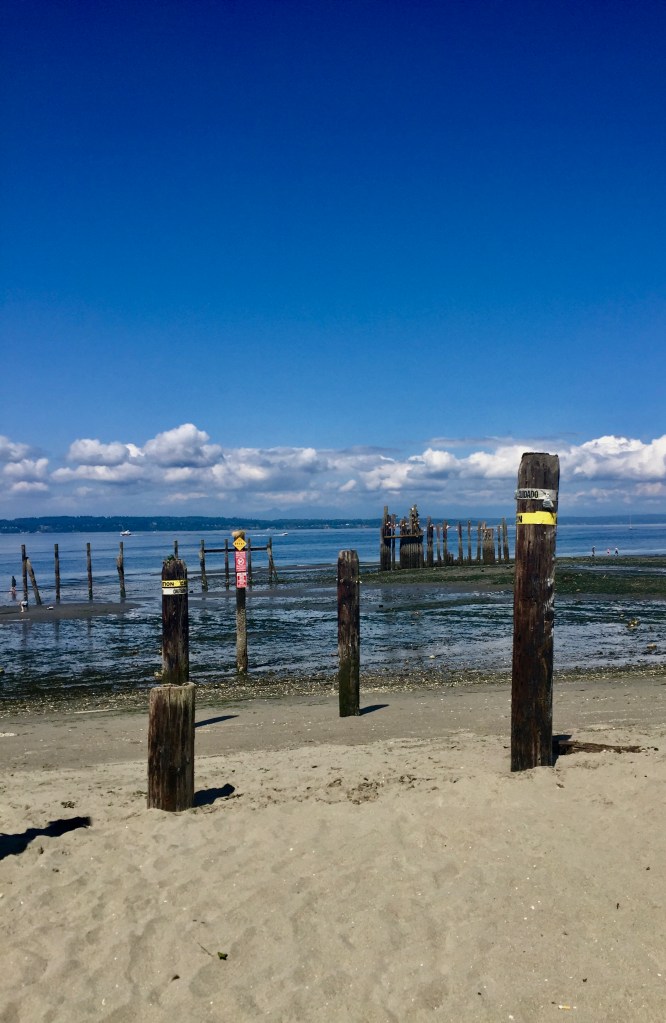
A piece of the hull can still be seen at extreme low tides and that’s what I think I found. (I’m not at all happy that the ship was used to transport murdered reindeer.) These are the pilings we see at low tide.
Photo property of Enchanted Seashells.
This is the article my son shared about the history of the SS Bering. Seattle is a fascinating city.
Derelict “Reindeer Ship” SS Bering burns on shore of Seattle’s Shilshole Bay on January 23, 1964.
On January 23, 1964, firefighters from the Ballard fire station in Seattle set ablaze the beached hulk of the former SS Bering steamship. After sitting for two decades on the shores of Puget Sound just north of the entrance to the Lake Washington Ship Canal, the engulfing flames herald an end to a vessel with a long history of service. Among its maritime roles, the ship served the Lomen Brothers reindeer herd business in the far north, for which it earned the nickname the “Reindeer Ship.”
Ship of Several Names
The origins of the “Reindeer Ship” trace to its launching under another name, the Annette Rolph, on July 4, 1918, in Fairhaven, California. The ship was a wooden-hulled “tramp” steamship built for the trans-Pacific trade, under the Rolph Navigation and Coal Company. In her later career for Rolph business interests, she worked the coastal trade and mail line between Vancouver, British Columbia, and Callao, Peru.
The Lomen Brothers purchased the vessel in 1930 and renamed her the Arthur J. Baldwin. It underwent a conversion into a refrigerated ship, for service with the Arctic Transport Co. of Nome, Alaska. For the next six years, it earned the nickname the “Reindeer Ship” for its role in bringing supplies such as lumber and gas to northern ports, and shipments of reindeer meat from the Lomen reindeer fields on return southern voyages to Seattle.
The vessel was next called Bering, starting in March 1936 under the Alaska Steamship Co. The ship was put into general service, which included special runs between salmon cannery ports and longer-range voyages through the Arctic Ocean to resupply Point Barrow, Alaska.
The ship’s final period of active service began in 1942, when it was briefly designated USS Bering by the War Shipping Administration as part of the maritime supply line to Alaska during World War II. Its service was cut short prematurely, when on its maiden voyage to the North it went aground on a reef near Cape Spencer on December 17, 1943. It was refloated by the crew and returned to Seattle, with the owners reimbursed $100,000 by the federal government for the loss.
In 1944, Tregonning Boat Co. purchased the condemned vessel for $1 and beached her at Shilshole Bay as a breakwater, just north of the entrance to the Lake Washington Ship Canal. The breakwater was envisioned as part of the plan for a new pleasure craft marina. However, funding for the new moorage never materialized and the Bering became irrelevant. To the north of the vessel, a new breakwater was later built by the federal government for protection of the new Shilshole Bay Marina. Meanwhile, the Bering remained a fixture on the shoreline for the next two decades.
A newspaper story about the construction of the Shilshole Bay Marina in 1962 described the Bering and its legacy as a local landmark:
“South of the marina, a gray weathered hulk of a freighter seems to have been beached on the shore. You’ll wonder about it. Every sightseer does. You may want to strike off across the mounds of grass and sands to inspect it at close range. At low tide, one can walk all around the ship” (Krenmayr).
In 1964, public debate continued to focus on the ship and its continued presence on the waterfront. Some saw it as an eyesore, while others viewed it as a tangible relic of Seattle’s maritime history and connection to the World War I era.
Fate of Vessel Determined
The arrival of the new Shilshole Bay Marina in the early 1960s was one factor in the public discourse about what to do with the derelict ship. Another was the question about public safety. The Seattle Post-Intelligencer reported that access to the vessel was unrestricted and a liability if left unchecked: “The old ship was an ‘attractive nuisance’ for boys in search of adventure … nine years ago a boy was saved from drowning in a rainwater pool in the hold” (Page).
The final straw came when the Ballard Order of Elks purchased the shoreline on which the beached ship was situated. In the first week of January 1964, the City Council Public Safety Committee recommended that the ship be burned in place. The Elks soon coordinated the planned burning event with the city’s fire department in Ballard. On Thursday, January 23, 1964, firefighters set fire to the hull of the ship, with curious onlookers watching from the beach. Three days later, the fires were still smoldering among the timbers of the hull’s remains, which had burned to the waterline.
Licensing: This essay is licensed under a Creative Commons license that encourages reproduction with attribution. Credit should be given to both HistoryLink.org and to the author, and sources must be included with any reproduction.
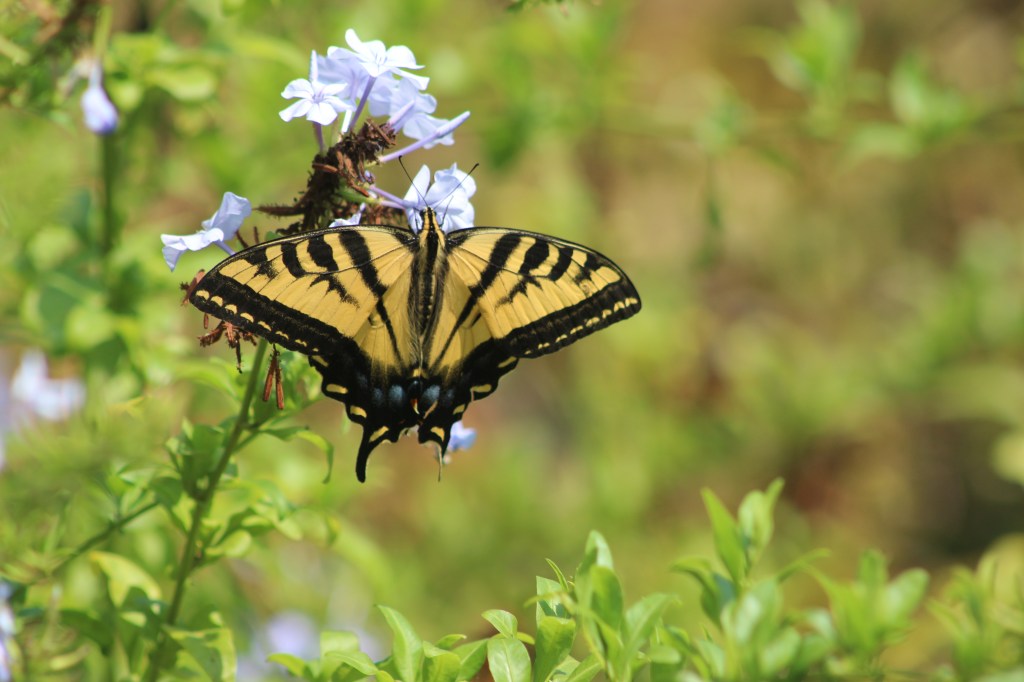
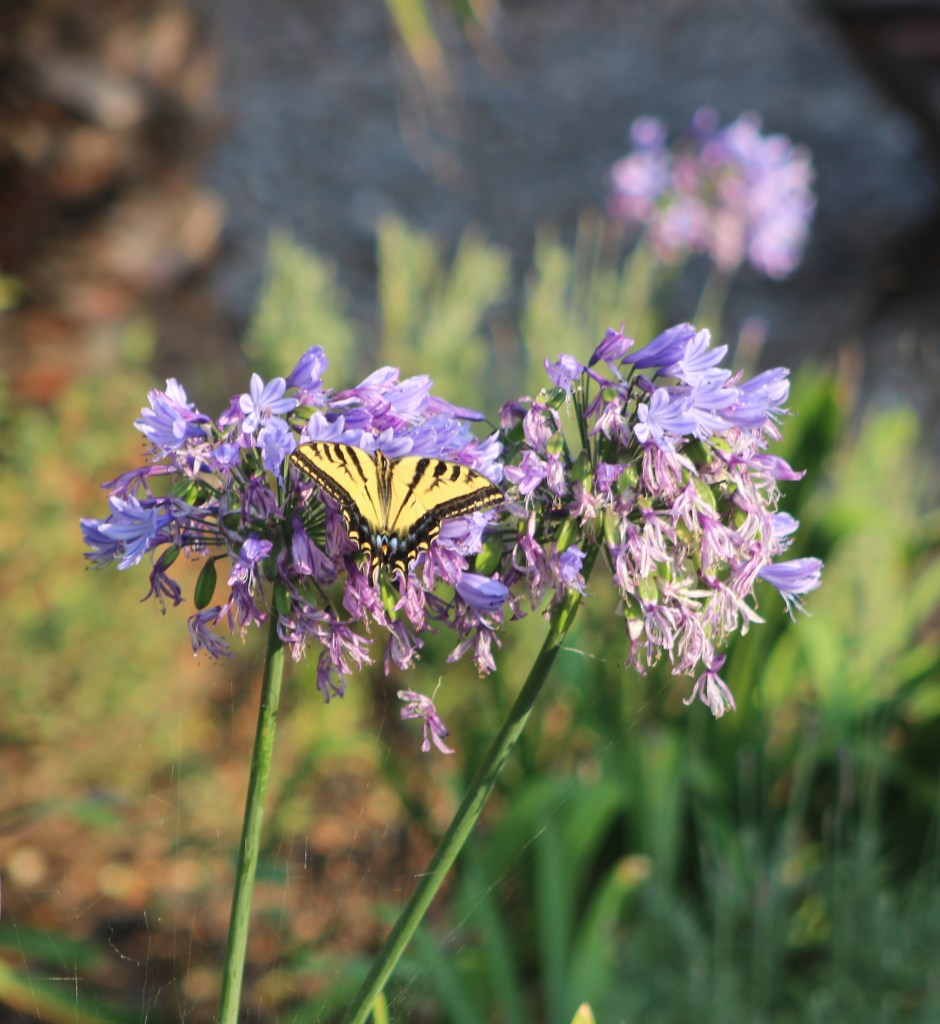
For days, I’ve been trying to capture a photo of this elusive angelic Western Tiger Swallowtail, but every single time I came close, he fluttered out of reach, teasing me. But I’m patient; I had a feeling he’d return and he did!
After chasing him/her for a week, I was talking to it, “You little bitch, stop moving around.” Maybe it knew I was on my last nerve. If any neighbors were out and about, I’m sure they thought I was talking to myself, but I wasn’t. I was talking to a BUTTERFLY. That makes all the diff.
It’s so hot this morning, I was allowed a brief moment to showcase the magnificence while feasting on the nectar of late summer flowers.
The photos aren’t the greatest; it’s hard to focus and run at the same time, but I think it captures a certain butterfly essence, the joie de vivre.
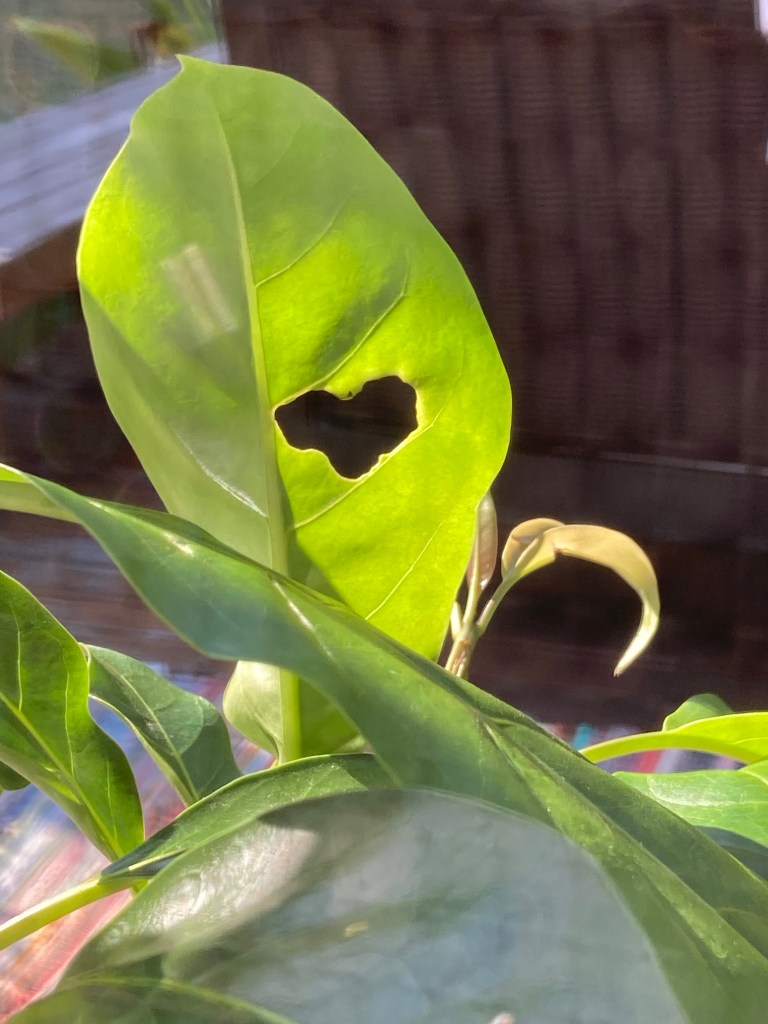
Even here where a little green worm ate a heart-shaped hole in the leaf of a Cup of Gold vine. How can I possibly be mad at the damage when he left me such a beautiful message?
Tropical clouds drift into Southern California from Mexico but no rain.
This blue sky was in sharp contrast to the whitest clouds I’ve ever seen.
I think weather is fascinating.
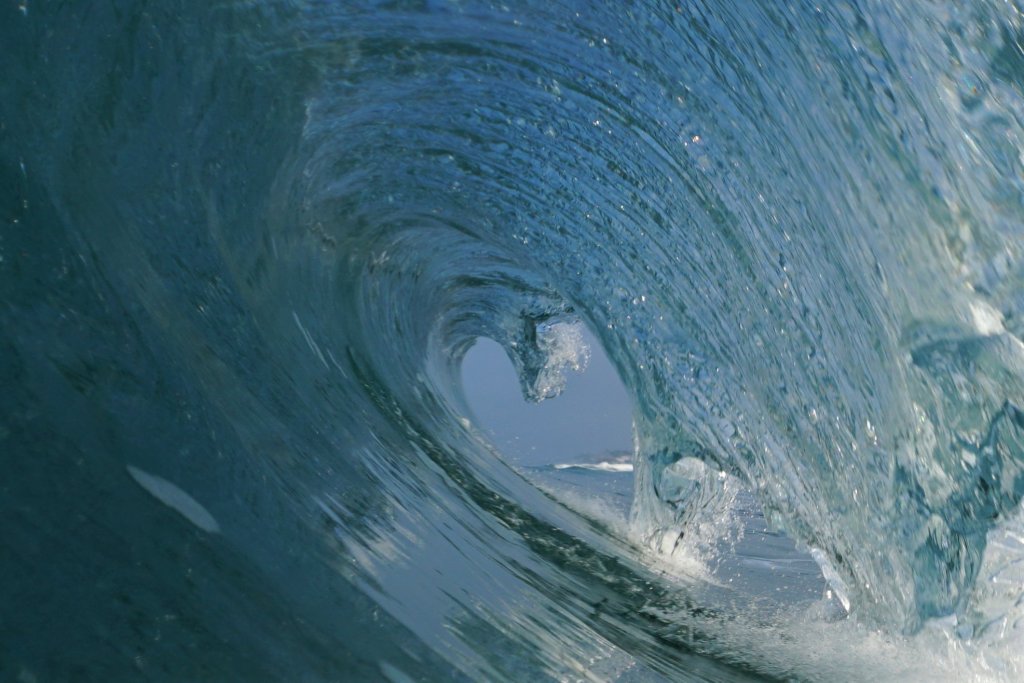
Still no rain in sight for us; perhaps some elevated surf, but according to NOAA:
A large area of disorganized showers and thunderstorms, associated
with a trough of low pressure, extends several hundred miles
southwest of the southwestern coast of Mexico.  Environmental
conditions appear conducive for development, and a tropical
depression is expected to form within the next few days before the
system reaches cooler waters later this weekend.  This system is
forecast to move west-northwestward at 10 to 15 mph away from
the coast of southwestern Mexico.
* Formation chance through 48 hours...high...70 percent.
* Formation chance through 5 days...high...90 percent.
Do you have these charming creations in your town?
A fairy door is an adorably miniature door usually set into the base of a tree, behind which may be small spaces where people can leave notes, wishes, or gifts for the “fairies”.
Fairy doors are thought of as portals to a magic realm in which the fairy can come and go, but humans cannot enter.
There are lots of them in my little beach town of Carlsbad, but this is a new fairy door I noticed on my walk today.
It might have been missed altogether except that I was walking slower than my usual very brisk pace because I have a broken toe and it was too painful to walk as fast or as far as I usually do.
The next time, I’ll definitely remember to bring a little offering.








 Still no rain in sight for us; perhaps some elevated surf, but according to NOAA:

 Enchanted Seashells | Princess Rosebud