This post is a departure from what I usually write about because I just spent a few minutes gazing at this mindblowing optical illusion and I was totally freaked out, so I need to ask…
Does this work for everybody? The brain is a wondrous thing…
Schroeder stairs is an optical illusion, a two-dimensional drawing which may be perceived either as a drawing of a staircase leading from left to right downwards or the same staircase only turned upside down, a classical example of perspectivereversal in psychology of perception. It’s named after the German natural scientist, Heinrich G. F. Schröder, who published it in 1858.
This little Jewish girl from Detroit dancing around in a pink tutu and satin toe shoes harbored a secret desire to live among the wolves and become accepted as a pack member.
Crazy, right?
Crazy because the only wolves I encountered in Detroit were the hormone-addled little boys at the Jewish Community Center.
“The gaze of the wolf reached into our soul.” Barry Lopez
It wasn’t until we moved to California and I was in college that I did anything about it.
Back in the 1970s, I joined the fight to save the wolf from extinction by advocating for protection under the Endangered Species Act (ESA),
In college, I studied predators and made plans to accompany research scientists and live with wolves in Minnesota and Michigan but never fulfilled that dream because I couldn’t (obviously) bring my dog, and I didn’t want to leave her.
Another dream unfulfilled. Oh, well.
Wolf print, Yellowstone
I was lucky to finally get to Yellowstone National Park and see IRL several of the wolves who make up the Lamar Valley pack, but never heard the song of the wolf, probably because we camped right on Slough Creek and the water, while beautiful, drowned out most animal sounds.
I’m still involved in the never-ending fight to save, defend, and protect this magnificent animal; read about my experiences in Sacramento when I testified at the Fish and Wildlife Service‘s wolf delisting hearing: Saving Wolves.
From my testimony: “At 6:00 a.m., a few miles outside our camp at Slough Creek, we followed others to a bison carcass, and our efforts paid off with a multiple sighting of many wolves, including 755. There was an overwhelming sense of awe among the dozens of us who silently watched him cross the road and then a collective sigh of relief when he disappeared safely over the ridge.
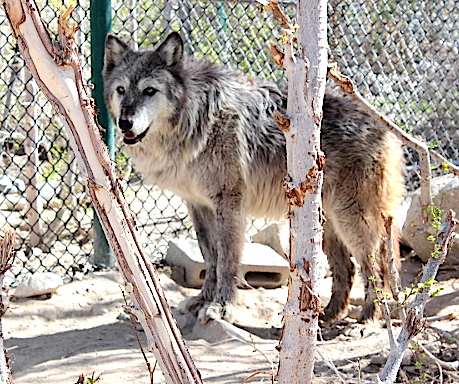
I recently took a drive to the Mojave Desert town of Lucerne to spend a few hours at Wolf Mountain Sanctuary, a 501c3 nonprofit organization founded in 1976 by Tonya Littlewolf.
Many wolves call this sanctuary home, and while I finally heard the haunting song of the wolf, the whole experience could only be described as sad.
Why sad?
Sad because these magnificent creatures NEED to be rescued.
Sad that humans think they have the right to try and make pets out of these wild animals. (Not gonna work.)
Sad that the wolves can’t roam free, sad they’re hunted, tortured, hated, vilified.
Wolves are among the most intelligent species.
HOW DARE WE DESTROY THEM.
Wolf Mountain Sanctuary
So yes. Sad. Very sad.
From Wolf Mountain Sanctuary website…all volunteer educational organization dedicated to the preservation, protection, and proper management of wolves in the wild and in captivity. We are a forever home for all of the wolves we rescue. We rescue wolves from the movie industry, private owners, and from breeders. The impression a 180 pound wolf leaves on you is everlasting. To look into their knowing, wise, amber colored eyes is a moving, spiritual experience. When you look into the eyes of a wolf, you see your soul…
“We have doomed the Wolf not for what it is, but for what we have deliberately and mistakenly perceived it to be..the mythologized epitome of a savage, ruthless killer..which is, in reality no more than a reflexed images of ourself.” Farley Mowat
Wolf Mountain Sanctuary
Denali (Deh-Nah-Lee) (“Great One” or “Highest Mountain”) was one of two pups born in the wilds of Alaska. He was rescued from the wolf-killing that was taking place in that state, both by private citizens and government agencies.
He’s a beautiful wolf with a golden sand coat. Denali’s personality is very sweet, curious, and friendly.
The wolves at Wolf Mountain Sanctuary seem to be well cared for and healthy.
When I met this handsome guy, Holan, he immediately jumped up, put his front paws on my shoulders, and licked my face. See my joy? This is the smile of someone who loves wolves.
Wolf Mountain Sanctuary
“The wolf is neither man’s competitor nor his enemy. He is a fellow creature with whom the earth must be shared.” L. David Mech
Look at him. The eyes. Amazing.
Wolf Mountain Sanctuary
Wolf Mountain Sanctuary
“Throughout the centuries we have projected on to the wolf the qualities we most despise and fear in ourselves.” Barry Lopez
Wolf Mountain Sanctuary
“Inescapably, the realization was being borne in upon my preconditioned mind that the centuries-old and universally accepted human concept of wolf character was a palpable lie. On three separate occasions in less than a week I had been completely at the mercy of these “savage killers”; but far from attempting to tear me limb from limb, they had displayed a restraint verging on contempt, even when I invaded their home and appeared to be posing a direct threat to the young pups.” Farley Mowat, Never Cry Wolf
WHY SAVE THE WOLF? Look at them: they are so noble, so beautiful. The wolf, as well as other endangered species, are ecological indicators. It is by studying these species and learning how to preserve them that we learn the main factors affecting our environment.
Perhaps in so doing, we will learn undiscovered ways to benefit mankind!
Unfortunately, there are those who deny the wolf’s place in the ecosystem. Wolves are gunned down from airplanes and snowmobiles (which some consider “sport”). Sometimes the fur is taken; however, more often than not, the animal is simply left to decay.
The wolf is poisoned “en masse,” trapped by leg-hold traps, used as adornments for the idle rich.
Today, the wolf’s range is limited to Alaska, Canada, the upper Midwest, and in Yellowstone National Park. Some of the YNP wolves have traveled into adjoining states, which allow hunters to kill wolves on sight and for little to no reason. In the 1930’s, there were approximately 50,000 wolves roaming the North American continent. By the 1940’s, that number had been decreased to 1,000. Today, mostly because of conservation efforts, there are approximately 3,000 wild wolves on the entire continent. They have made a small comeback, but because of the recent delisted from the Endangered Species Act, wolves are once again under attack.
Wolf lovers need to band together and do all we can to help them. TIME IS RUNNING OUT!
Only you can save the wolf from extinction. Proper management procedures must be put into action.
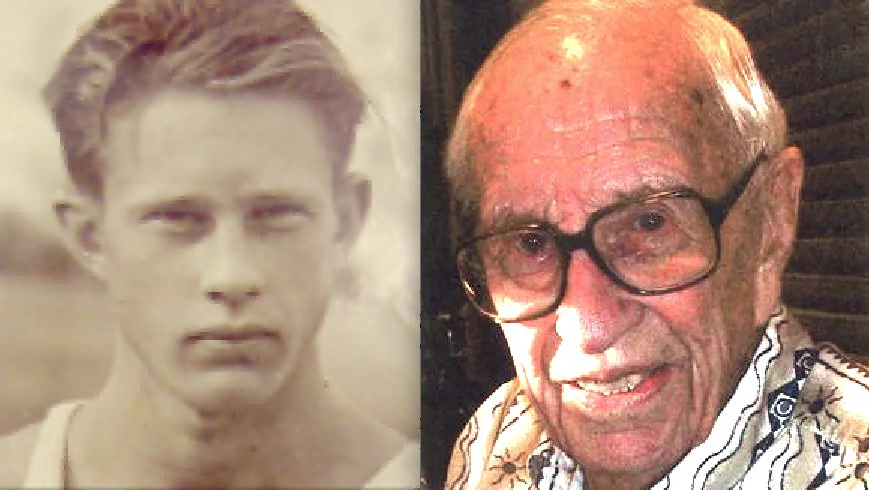
I think this should be taught in schools because I can’t believe I never heard about Robert Emmett Fletcher Jr. Have you?
Robert Emmett Fletcher Jr. was an American agricultural inspector who quit his job to manage fruit farms of Japanese families sent to internment camps during WW2.
Fletcher was born in San Francisco and grew up on a farm in Contra Costa County east of San Francisco. He attended the what would become the University of California at Davis, graduating with an agriculture degree in 1933. He managed a peach orchard and subsequently worked as a state and county agricultural inspector, in which capacity he got to know Japanese American farmers throughout the state.
Upon learning about the looming relocation of Japanese farmers in his area, Fletcher grew concerned. This led to the Tsukamoto family, who owned a grape ranch in Florin near Sacramento, proposing that he take care of their farm while they were away.
They offered him their home and all net profits from the crops (though Fletcher would only take half) after covering farming costs, mortgages, and taxes.
Two other families, the Okamotos and Nittas, also proposed similar arrangements.
Despite deep anti-Japanese sentiment — including a bullet fired into the Tsukamoto barn, Fletcher continued to work. When the families returned home in the fall of 1945, their farms and homes were intact—the Tsukamotos’ home had even been cleaned by Fletcher’s wife Teresa—and half of the profits were waiting for them.
His inspirational story is recounted in history books, including “We the People: A Story of Internment in America” by Elizabeth Pinkerton and Mary Tsukamoto, whose farm he saved.
It seemed like he’d live forever even with dementia, but nope. Rest in peace to legendary Anthony Dominick Benedetto, better known as Tony Bennett. He was 96 years old.
Not just an amazing musical artist, did you know that while he was in the Army, he was demoted for having dinner with a black friend?
Did you also know that while in the Army, he hunted Nazis and helped liberate Dachau prisoners?
Did you know that he marched with Martin Luther King and promoted musicians of color in the 1950s and 60s?
He won eighteen Grammy Awards, honors from the United Nations, and the Kennedy Center. Tony found new success later in life when he collaborated with Amy Winehouse and Lady Gaga, recording acclaimed music and touring together,
I don’t mean the ultra religious definition of doing something good to fulfill one of 631 commandments and I don’t mean BAR/BAT Mitzvah, (which I never did) but doing a mitzvah has also come to express an individual act of human kindness; a good deed.
Here’s the story. A couple days ago, I had a doctor’s appointment . As I walked to the office, I said hello to two people sitting on the curb out in front. They were a bit older than me but looked frail, and the man was in a walker.
There was a wait for the doctor and I chose to sit outside because no one in the waiting room was wearing a mask (except for me) and there was a lot of coughing AND the door was closed. (Yup, I’m still a mask wearer in crowded placed, even if no one else does.)
While I was standing outside on the sidewalk, I chatted with the couple. They told me they had been waiting an hour in the hot sun (we’re having a heat wave) for their Uber. The woman was on the phone trying to find some way to communicate with the company, which is impossible, by the way.
I felt horrible that these older people were left stranded and told them if they were still there when I was finished with my appointment, I’d drive them home as I learned they didn’t live all that far away from the doctor’s office. In case you thought they could take a bus, that’s not an option. Public transportation is horrible in my area.
I went back in the office and could see that the doc was so backed up, I’d probably be forced to wait at least an hour to see her, so I decided to reschedule my visit to next week.
When I left, I saw those poor people were still waiting, still on the phone, looking pretty stressed out. I told them I’d be more than happy to drive them home, which I did.
They were beyond appreciative and repeatedly offered gas money which I declined. They couldn’t believe a total stranger would help them. The man had cancer, was diabetic, in overall poor health, and his wife wasn’t much better.
How could I not help?
It was such a small thing to do for another human; a mitzvah, a helping hand.
I have so much to be grateful for in my life; it felt nice and right to extend a simple and random act of human kindness, not for any reward in this life or the next — for no reason other than I felt like it.
Fortunately, a growing number of cities and counties are opting to prohibit fireworks, including recently adopted bans in Portland, Oregon; San Jose, California; Detroit, Michigan; and King County, Washington (home to Seattle).
The Animal Legal Defense Fund advocates in favor of such bans to protect animals and the ecosystems in which they live.
Companion Animals at Risk
Every July like clockwork, news articles and social media posts are published sharing advice for animal guardians about how to keep their companions as safe and calm as possible on the Fourth of July.
And, every July like clockwork, municipal animal shelters fill to the brim with dogs and cats who’ve escaped their homes and yards, becoming lost as they try to flee the sounds, smells, and vibrations of fireworks.
Wildlife Suffer for Fireworks
As for animals in the wild, they face perils of their own as a result of fireworks. “We know what to expect, but wildlife don’t,” the U.S. Fish and Wildlife Service notes, adding that “[t]he abrupt lights and sounds are often seen as a threat by nesting bald eagles and easily startle great blue herons and other colonial nesting birds.”
Additional Problems for Humans and the Environment
Fireworks have environmental and public health impacts that are rarely considered or fully appreciated. They release particulate matter and toxins, adversely affecting air quality. They also pose a serious risk of igniting wildfires, particularly in areas facing dry conditions.
Many humans are also bothered by fireworks, including people with post-traumatic stress disorder, those on the autism spectrum, and others with sensory processing challenges.
“It doesn’t matter how old you are, there is a little child within who needs love and acceptance.”- Louise Hay
Do you still wish upon a star? I do, because my own inner child is blissfully naive and unsophisticated.
Star light, star bright, First star I see tonight, I wish I may, I wish I might, Have this wish I wish tonight.⭐
I wrote a letter To my inner child And, I told her How loved she was by me And, if no one else Ever told her so She knew How loved she was, by me
⭐
And when We grow up We must never forget That hidden, down deep Within us Is our forever inner child Resting, silently within us Forever waiting Forever hoping That one day We shall Remember it
⭐
And, if a star shall fall Down upon the ground Why, I shall pick her up For she longed to be found I shall hold her forever Forever in my heart Knowing that we shall never Ever again, be apart
By Athey Thompson from A little Pocket Book of Poems
The last week has been heavy with sad and tragic events from around the world. As we leave June and enter another month, let’s lighten the energy with a beautiful quote by Henry Wadsworth Longfellow about planting kindness wherever we can.
“Kind hearts are the gardens, Kind thoughts are the roots, Kind words are the flowers, Kind deeds are the fruits, Take care of your garden And keep out the weeds, Fill it with sunshine, Kind words, and Kind deeds.” — Henry Wadsworth Longfellow
Here’s confirmation.from San Bernardino Sheriff’s Department:
Coroner Identifies Remains Located in the Mt. Baldy Wilderness Area on June 24, 2023
DATE/TIME: June 24, 2023 / 10:00 a.m.
INCIDENT: Human Remains Located
LOCATION: Mt. Baldy Wilderness Area
DECEASED PARTY: Julian Sands, 65-year-old resident of North Hollywood, CA

UPDATE- June 27, 2023: The identification process for the body located on Mt. Baldy on June 24, 2023, has been completed and was positively identified as 65-year-old Julian Sands of North Hollywood. The manner of death is still under investigation, pending further test results.

We would like to extend our gratitude to all the volunteers that worked tirelessly to locate Mr. Sands.
Hopefully, this information will offer some kind of solace to family and loved ones.







 Enchanted Seashells | Princess Rosebud