Satori: Word of the Day

In Zen Buddhism, satori defines the inner, intuitive experience of enlightenment, perhaps similar to having an epiphany.

Satori is said to be unexplainable, indescribable, and unintelligible by reason and logic.

It is comparable to the experience undergone by Gautama Buddha when he sat under the Bo tree and is the central Zen goal.

It’s a moment of total presence, of no mind and no thought but a flash of insight and awakening of the light of our own consciousness.

I also discovered that in Japanese folklore, Satori are mind-reading monkey-like monsters said to dwell within the mountains of Hida and Mino. That sounds pretty scary to me, so I’ll stick to the other definition of satori as instant enlightenment.

Have you experienced satori?

“Satori is the sudden flashing into consciousness of a new truth hitherto undreamed of. It is a sort of mental catastrophe taking place all at once, after much piling up of matters intellectual and demonstrative. The piling has reached a limit of stability and the whole edifice has come tumbling to the ground, when, behold, a new heaven is open to full survey.”

D.t. Suzuki, An Introduction to zen Buddhism

Thalassophile: Word of the Day

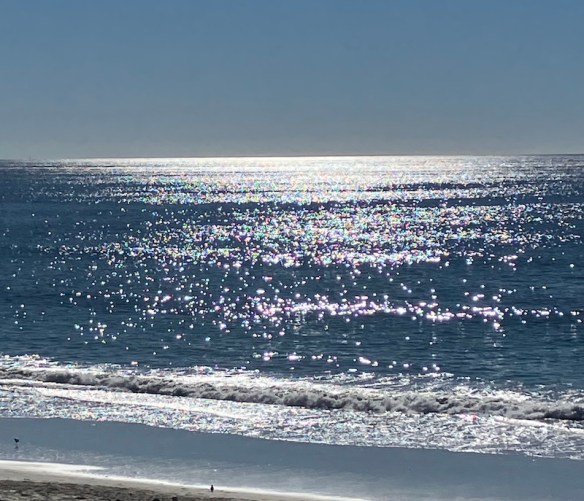
Thalassophile: One who loves the sea.

That would definitely be ME. I love all bodies of water; oceans, lakes, waterfalls, creeks, and ponds. I need vitamin SEA!

Thalassophile is derived from the Greek word thalassa which means sea, and the word ‘phile or philos,’ a person fond of something specific.

The word is also influenced by Greek mythology where Primordial Goddess Thalassa was the primeval goddess and spirit of the sea.

Thalassa was the literal body of the sea and in Aesop fables, manifests as a woman formed of sea water, dressed in seaweed instead of clothing. Check out her hair, which is similar to mine, lol.

This eternal spirit of the sea was sometimes portrayed rising from the water, which is definitely NOT me, as I rarely submerge myself in the briny deep.

In sky news, the planet now named Thalassa was discovered in August 1989. Thalassa was most likely formed from fragments of Neptune’s original moons, which were smashed by the disturbances caused when the ice giant Neptune captured Triton. Thalassa is unusual for an irregular moon because it is roughly disk-shaped.

Thalassa circles the planet in the same direction as Neptune rotates, and remains close to Neptune’s equatorial plane. Thalassa’s orbit is slowly decaying due to tidal deceleration and may eventually crash into Neptune’s atmosphere or be torn apart and form a planetary ring.

As above, so below…

Word of the Day: Nemophilist

This is such a great word!

Nemophilist: One who is fond of forest or forest scenery; a haunter of the woods.

Photo by veeterzy on Pexels.com

Oh yes, I’d love to haunt some woods right about now, with the stars above and the full moon to guide a late night hike…

There is a pleasure in the pathless woods,
There is a rapture on the lonely shore,
There is society, where none intrudes,
By the deep sea, and music in its roar:
I love not man the less, but Nature more,
From these our interviews, in which I steal
From all I may be, or have been before,
To mingle with the Universe, and feel
What I can ne'er express, yet cannot all conceal.
George Gordon Byron

(George Gordon was an English romantic poet and peer. He was one of the leading figures of the Romantic movement, and has been regarded as among the greatest of English poets. Wiki)

Word of the Day: Lalochezia

Are you guilty of doing this, too?

The word of the day is lalochezia. It’s a noun formed from the Greek lalia (speech) and chezo (to relieve oneself).

Maybe that’s where the term “potty mouth” came from??

I have been known to unleash a hearty string of f-bombs and other expletives. To be completely honest, it is, usually, quite satisfying.

Lalochezia: The use of foul or abusive language to relieve stress or ease pain, emotional release through swearing.

Lalochezia describes that moment when you’re so stressed out and angry that you start spurting out the foulest language possible to relieve stress and pain.

Yup, been there, done that…

I’m sure that a few deep restorative yoga breaths — some vital prana — is probably way more soul healing, but in some cases the venting of specific profanity MIGHT be nearly as invigorating.

I guess I have a ways to go before I enter the transcendent state of nirvana, or as my dad would say, “that’s not very ladylike, Rosebud, and I’m sure you can think of more appropriate language.”

Not always.

(graphic from pinterest)

Enjambment | Measure: Robert Hass

A few years ago UC Berkeley hosted an Eco-Poetics Conference. My son was invited to participate and while there he was honored to meet the poet, Robert Hass.

Hass served as Poet Laureate of the United States from 1995 to 1997. He won the 2007 National Book Award and shared the 2008 Pulitzer Prize for the collection Time and Materials: Poems 1997-2005. In 2014 he was awarded the Wallace Stevens Award from the Academy of American Poets.

I love the way his mind works, it’s as simple as that.

From Hass: “This poem is called measure – I think it belongs to my learning as a young writer as to where I felt poems were coming from.”

Measure 

Recurrences.
Coppery light hesitates
again in the small-leaved

Japanese plum. Summer
and sunset, the peace
of the writing desk

and the habitual peace
of writing, these things
form an order I only

belong to in the idleness
of attention. Last light
rims the blue mountain

and I almost glimpse
what I was born to,
not so much in the sunlight

or the plum tree
as in the pulse
that forms these lines.

FYI: Enjambment…From the French meaning “a striding over,” a poetic term for the continuation of a sentence or phrase from one line of poetry to the next. An enjambed line typically lacks punctuation at its line break, so the reader is carried smoothly and swiftly—without interruption—to the next line of the poem.

Word of the Day: Latibulate

Latibulate is a word we definitely need to bring back into daily circulation!

It’s the the action of hiding oneself in a corner: verb, 17th century English.

To be in our latibule (noun) means a cozy, safe place, special to you, hidden away from everyone, in an attempt to escape reality; also to lie dormant.

A place to meditate? A she-shed? A man cave? A blanket fort?

I always thought it’d be so cool to have one of those hidden rooms, to be accessed only by those who knew which secret panel to press in a bookcase.

Or if you’re mom to a toddler, it could even be the bathroom, where we can hide for a few minutes of privacy and silence. Maybe. Maybe not.

Mom/Grandma, are you in there? Whatcha doing? Can I come in? The door won’t open!”

Angel Boy 2.0 no longer joins me in the bathroom. That was a tradition we agreed to stop when he was four and he kept his word. Now that he’s seven, he likes his own private time and we all respect that, too.

Angel Girl, not yet four, is more fluid in her boundaries. She’s in that in between stage; not quite a big girl but no longer a baby. Sometimes she likes company and a chat, sometimes she likes to brush her teeth with me, mirroring all of my actions. Yes, it’s as adorable as you could picture it.

Especially now, we all need a place to latibulate away from civilization, far away from the madding crowd.

“Far from the madding crowd’s ignoble strife,
Their sober wishes never learned to stray;
Along the cool sequestered vale of life
They kept the noiseless tenor of their way.”

– Thomas Gray

Word of the Day: Cosmogyral

Cosmogyral: whirling around the universe.

I like the thought of whirling around the universe, spiraling through the galaxies in a playful weightless freefall.

It seems to evoke the ultimate surrender and that appeals to me, to belong to the sacred geometry of planetary orbits.

I envision the whirling not so much like a crazy fast dervish, but more like a butterfly ballerina, pirouetting from one flower to another to extract equal amounts of nectar and joy from each stop along the way.

Graphic credit to https://vocal.media/fyi/sacred-geometry-of-planetary-orbits

Strawberry Full Moon’s Penumbral Thoughts

| Penumbra: a shadowy, indefinite, or marginal area |

I sent you a present last night you know
Though it didn’t address you by name
It was all of those meteors showering, dancing
And falling to earth like the rain

I wrote you a letter last week you know
But it won’t have arrived in the post
I wrote on the bright coloured curves of a rainbow
The reasons I missed you the most

I sent you a message just yesterday
But it wasn’t a message in words
For I spoke to the wind and I taught her our song
And I asked her to make sure you heard

I drew you a picture last Tuesday
But you may not have noticed it there
For I drew round the clouds with the rays of the sun
So they glowed as they hung in the air

No, you may not get gifts like you used to
Or get messages stored on your phone
But I’ll make sure I’m sending something each day
So you know that you’re never alone

And tomorrow I’ll paint something wonderful
I don’t know quite yet what it will be
But I promise you’ll know when you see it
That it’s sent just to you

Love from me
Xxx

From When I Am Gone – Becky Hemsley

F.E.A.R.

I don’t have a great knowledge of Zig Ziglar’s works or motivational philosophy but this saying resonates with me.

“F-E-A-R has two meanings: Forget Everything And Run or Face Everything And Rise. The choice is yours.” Zig Ziglar.

Word of the Day: Pareidolia

Pareidolia: (n.) the instinct to seek familiar forms in disordered images like clouds or constellations; the perception of random stimulus as significant.

Pareidolia is a type of apophenia, to see patterns in random data.

Pareidolia is the tendency for perception to impose a meaningful interpretation on a nebulous stimulus, usually visual, so that one sees an object, pattern, or meaning where there is none, like the Rorschach inkblot test.

Studies have shown that facial features aren’t the only thing that we see when we come across an illusory face. It was found that we also see age, emotion, and gender – and strangely enough the vast majority of these funny faces are perceived as male faces, like the man in the moon.

I’m sure my neuroscientist DIL would have a much more scientific and intelligent explanation than I do, but I find it fascinating to discover faces or animals in clouds or common objects.

Check out these examples:

From Bored Panda