“If you find me not within you, you will never find me.
For I have been with you, from the beginning of me.”
Rumi
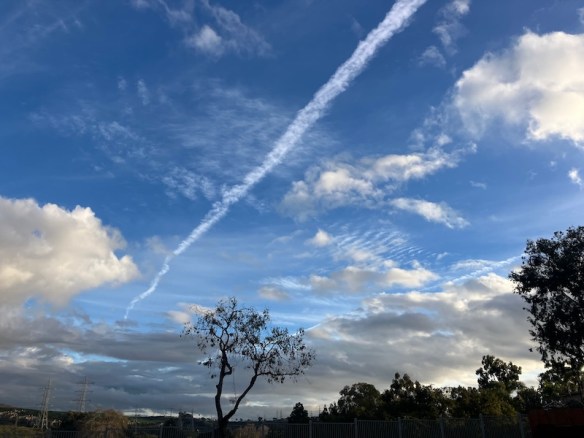

“If you find me not within you, you will never find me.
For I have been with you, from the beginning of me.”
Rumi
Myrmecophobia: that huge word describes a fear of ants.
I don’t mind if they stay outside and it’s not like I have intense physical reactions like panic attacks. but I do admit to compulsive cleaning and excessive use of toxic chemical sprays to prevent any possibility of an ant infestation.
I read some articles about how to overcome a fear of ants but I don’t really want to do that. Overcoming this phobia isn’t my goal. I like that I’m diligent about NOT allowing an army of ants to occupy my living space.
Updated ant saga: After I initially encountered the scout ants in my bathroom and quickly dispatched them, the next day I walked into the kitchen and was shocked to see a MILLION ants. I’m not exaggerating. Well, maybe I am, but only slightly.
I had been hopeful that the scouts found in the bathroom had been successfully “dealt” with, but I guess a message was still able to reach the collective.
The colony decided to retaliate in a big way and war was imminent. It seems as if they gathered their forces and decided to descend on my kitchen counters and sink during the night. I awoke to large-scale hostility.
I had to take immediate action, and I’m quietly optimistic that this will be the end of the 2026 ant assault. All surfaces have been compulsively scrubbed and bleached and there isn’t a single crumb of food in the sink to attract another interloper.
The part that terrifies me is when I ruminate about how they breached my defenses and found a way to stealthily sneak in the house while I was asleep and vulnerable. Was it revenge for the “scout” episode? Are their tiny ant minds capable of such machination?
But why me?
A couple days have passed and the enemy lines have been drawn. It’s the first thing I think about when I wake up in the morningvand I check to make sure my perimeters haven’t been breached.
However, it appears that these militant ants have honored the agreement to stay outside (at least for now). My fears have slightly subsided but I am on high alert.
Do no harm. It’s really a simple way to live.

Ahimsa is an ancient Indian ethical principle meaning nonviolence, non-harm, or harmlessness toward all living creatures.
It’s a core virtue in Hinduism, Buddhism, and Jainism. It forms the first restraint (yama) in Patanjali’s Yoga Sutras, and inspired Mahatma Gandhi’s peaceful resistance movements.
Non-harming: Avoiding injury or pain to any living being, including animals and insects, through the smallest footprint possible.
Three Levels: Practiced through thoughts, words, and physical deeds.
Universal Benevolence: Cultivating an inner attitude of peace, empathy, and love instead of malice or aggression.
I think we need to include the Three Gates that I annoy the Ferals with on a regular basis.
When they’re being obnoxious to each other, I ask if what they’re saying passes through the three gates…
The three gates of speech are a mindful communication framework often attributed to Sufi mystic traditions and the poet Rumi, as well as Buddhist teachings.
They act as a filter to pause and evaluate our words before we speak:
Is it true?
Is it necessary?
Is it kind?
I think we all can benefit from the practice of Ahimsa and think before we speak, right?
Has this ever happened to you? Have you ever forgotten a word while you were in the middle of a conversation? Did you feel that it was on the tip of your tongue but oh so elusive?
I have, and it just happened to me today! I was chatting with a friend and completely lost the word I was searching for. It was so annoying,
I discovered there’s a word to describe that phenomenon. It’s lethologica, the technical term for the “tip-of-the-tongue” feeling—that frustrating moment when a specific word or name is on the tip of your tongue but you can’t quite retrieve it from memory.
The term combines lethe (meaning forgetfulness or oblivion, referencing the River Lethe in Greek mythology) and logos (meaning word or speech).
Every language seems to have a way to describe it; in German it’s Es liegt mir auf der Zunge (It’s lying on my tongue.)
While it happens to everyone, lethologica is a complex neurological event involving many factors that aren’t completely understood. Scientists believe one contributing element could be sleep levels, as lethologica tends to happen more often to those who are tired. Other factors might include how well the memory was encoded (the base memory of the word) and interference from other memories, which can cause confusion.
Studies have also found a positive correlation with age. Older adults might experience lethologica up to once a day, while younger adults experience it around once a week. The average native English-speaking American adult knows around 42,000 dictionary words; it’s only natural that some are forgotten from time to time.
The most common resolution for the failure to recall a specific word is to NOT think about it, which is often when the word suddenly “pops up” out of nowhere. This is referred to as a spontaneous resolution or one in which the state resolves itself.
Some content curated from: grandezza.seabreezecommunications.com and https://www.verywellmind.com/ Image credit to owner, from Pinterest.
As someone who loves shiny, glittery things, I always wondered if there was a specific term to describe the sun’s sparkles on the ocean, and I discovered that there is, and it’s adorable!
The proper technical and descriptive term for sun sparkles on water is sun glitter or sun glint.
This phenomenon occurs when sunlight reflects off wind-rippled water waves, creating a shifting, bright path of individual glints known as a “glitter pattern”.

I love to be at the beach on a hot summery day, taking pictures of sun glitter.
EXCOGITATE: To think out; devise; invent. To study intently and carefully in order to grasp or comprehend fully.
TO THIINK IN OR THINK OUT…WHAT IS YOUR METHOD?
According to wiseGEEK, to think outside the box means means to “handle a situation or challenge in an unconventional manner. The origin of the phrase is believed to date back to the 1960s, and is often associated with a famous mental puzzle called The Nine Dots.”
I’ve had a lot of jobs over the years and I’ve found that no one really wanted me to think outside the box — independently, creatively, with imagination or compassion. I felt the overwhelming corporate mantra was to agree with everything and keep quiet.
And that leads us on to another outside the box obsession of mine…
I love boxes; cardboard boxes, wooden boxes, large and small boxes. Over the years, I’ve accumulated a massive collection. (I’m not a hoarder, I’m not a hoarder, I’m NOT a hoarder. Stop thinking that!)
But a box full of Bandit was my favorite. Our poor baby died of chronic renal failure. Wasn’t she soo beautiful? Sniff.

Do you have a favorite box? What do you collect?
Zipola: Slang. Nothing at all; zip; zilch.
A monster has been created.
Almost ten-year-old Angel Boy 2.0 has become a rabid Scrabble player. Zipola is a word he used to gain a triple word score.
It’s a valid word in SOME Scrabble dictionaries, but not all. However, no one was going to take that pride and joy away from him, that’s for sure.
In fact, last night he surpassed 400 points in a one-on-one game, winning against his PhD literature professor dad, and it’s one of our proudest family moments.
It’s bad enough that I could NEVER win against the original Angel Boy; I can’t imagine the future as a total loser.
And now we welcome the new year. Full of things that have never been.
Rainer Maria Rilke
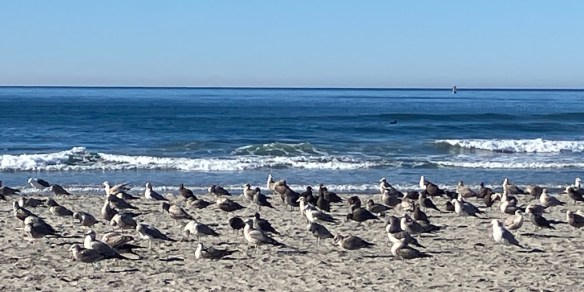
We’re getting ready for another storm but yesterday it still was sunny and warm. Check out these south-facing sandpipers, all looking in the same direction. I wonder what they’re thinking about…
Maybe they’re hoping 2026 will bring peace and harmony and love to the world. That’s my wish, too.
Do you know what a group of sandpipers is called?
There are many recognized collective nouns for a group of sandpipers:
𓅪 a bind
𓅪 a cluster
𓅪 a contradiction
𓅪 a fling
𓅪 a hill
𓅪 a time-step
My personal favorite is a “fling” of sandpipers.
𓅪 Happy 2026!
Hauʻoli Makahiki Hou
Now that 2025 is almost over and we’re looking for inspiration to start a new year, how about this one? It’s said that Buddha repeated it when he taught mindfulness…
Atapi sampajano satima
It’s in the Pali language, an ancient language central to Theravada Buddhism.
Atapi sampajano satima is from Buddhist texts and means “ardent effort, clear comprehension, and constant mindfulness,” a core formula for the path to liberation.
It emphasizes diligent, wise, and continuous awareness of reality (impermanence) to see phenomena as they truly are, dissolving self-illusion.
This is a call to practice intensely (Atapi), understand deeply (Sampajano), and stay present (Satima) by observing the arising and passing of sensations and mental states without reaction, which leads to wisdom and freedom.
We’re entering that dreaded holiday limbo zone between Christmas and New Year’s Eve, when time seems to almost stop moving in a sort of frenzied yet slightly depressed way.

If ever there was a time for meditation, calm, reflection, self care, and serenity, this is IT.
Atapi sampajano satima
And BREATHE…

 Enchanted Seashells | Princess Rosebud