Word Of The Day: Myrmecophobia — Fear of Ants

Myrmecophobia: that huge word describes a fear of ants.

I don’t mind if they stay outside and it’s not like I have intense physical reactions like panic attacks. but I do admit to compulsive cleaning and excessive use of toxic chemical sprays to prevent any possibility of an ant infestation.

I read some articles about how to overcome a fear of ants but I don’t really want to do that. Overcoming this phobia isn’t my goal. I like that I’m diligent about NOT allowing an army of ants to occupy my living space.

Updated ant saga: After I initially encountered the scout ants in my bathroom and quickly dispatched them, the next day I walked into the kitchen and was shocked to see a MILLION ants. I’m not exaggerating. Well, maybe I am, but only slightly.

I had been hopeful that the scouts found in the bathroom had been successfully “dealt” with, but I guess a message was still able to reach the collective.

The colony decided to retaliate in a big way and war was imminent. It seems as if they gathered their forces and decided to descend on my kitchen counters and sink during the night. I awoke to large-scale hostility.

I had to take immediate action, and I’m quietly optimistic that this will be the end of the 2026 ant assault. All surfaces have been compulsively scrubbed and bleached and there isn’t a single crumb of food in the sink to attract another interloper.

The part that terrifies me is when I ruminate about how they breached my defenses and found a way to stealthily sneak in the house while I was asleep and vulnerable. Was it revenge for the “scout” episode? Are their tiny ant minds capable of such machination?

But why me?

A couple days have passed and the enemy lines have been drawn. It’s the first thing I think about when I wake up in the morningvand I check to make sure my perimeters haven’t been breached.

However, it appears that these militant ants have honored the agreement to stay outside (at least for now). My fears have slightly subsided but I am on high alert.


Ahimsa: Word Of The Day + The Three Gates

Do no harm. It’s really a simple way to live.

Found on Pinterest

Ahimsa is an ancient Indian ethical principle meaning nonviolence, non-harm, or harmlessness toward all living creatures.

It’s a core virtue in Hinduism, Buddhism, and Jainism. It forms the first restraint (yama) in Patanjali’s Yoga Sutras, and inspired Mahatma Gandhi’s peaceful resistance movements.

Non-harming: Avoiding injury or pain to any living being, including animals and insects, through the smallest footprint possible.
Three Levels: Practiced through thoughts, words, and physical deeds.
Universal Benevolence: Cultivating an inner attitude of peace, empathy, and love instead of malice or aggression.

I think we need to include the Three Gates that I annoy the Ferals with on a regular basis.

When they’re being obnoxious to each other, I ask if what they’re saying passes through the three gates…

The three gates of speech are a mindful communication framework often attributed to Sufi mystic traditions and the poet Rumi, as well as Buddhist teachings.

They act as a filter to pause and evaluate our words before we speak:

Is it true?
Is it necessary?
Is it kind?

I think we all can benefit from the practice of Ahimsa and think before we speak, right?

Word Of The Day: Shindig

I hope nobody watched or streamed that demented orange POSs speech yesterday. There are other, more pressing matters to occupy ourselves with, like why can't we eat salads or fresh salsa with cilantro? Why is our food contaminated with cyclospora? Why did that POS remove the FDA  “Food Traceability Rule” and place us at risk?

ANYWAY, back to my form of reality (and therapy)…

Does anybody even know what “shindig” means?

The word originated in the United States in the mid-19th century. It’s believed to be a playful alteration of the older slang word shindy, which originally referred to a rowdy commotion or a street game similar to field hockey.

In modern, everyday use, it’s synonymous with words like “bash,” “blowout,” or “hoedown”. For example, you might say, “Are you going to the big neighborhood shindig this weekend?”

In the mid-60s, there was a TV show broadcast from Los Angeles called Shindig! It was a musical variety series hosted by DJ Jimmy O’Neill. I never watched it, maybe it wasn’t shown in my area, I dunno.

Most exciting for all of us who love him is that Leon Russell, the house band’s pianist, was often featured in solo performances.

(Learn more about Shindig! at https://en.wikipedia.org/wiki/Shindig)

I never get tired of wondering exactly how Leon went from THIS to the uber cool long-haired sunglass-wearing exuberant Master of Space and Time that filled stadiums. The butterfly definitely broke out of the chrysalis!

Photo credit from Pinterest

Check out Leon on the first song with Donna Loren (you can hear him before you see him, it’s unmistakably LEON) and something I’ve never seen before, Leon on organ with Bobby Sherman at 10:02.

Word Of The Day: Bedridden

I couldn’t think of anything to write today, so I looked at my recent situation and decided there was no other way to describe it: bedridden or bedbound.

From Pinterest

A bedbound person still retains some limited movement and can actively participate in their care, such as repositioning or feeding themselves. A bedridden person is completely confined to bed with minimal to no mobility, 

Let me reiterate and I’m not being melodramatic at all; shingles/herpes zoster is not something you can ignore.

Most things I don’t take very seriously; an injury, a fall, a brief bout of the flu or a sore throat, but THIS was lifechanging.

The pain is really indescribable, and now I understand why I felt paralyzed when I had it as a child; it’s really that overwhelming. I’d show you the photos I took of every stage of the rash that covered my entire right side, but it’s too gross to share.

For the past two weeks, I’ve literally not been able to walk, to move, to exist — without extreme torment, and that’s not an exaggeration. Waiting too long to inform my doc so that she could prescribe an antiviral was completely stupid of me.

Now that I’m nearing the end of this disease cycle, it’s time to reflect on what it means to be bedridden or bedbound, because for me, not being active is hell on earth.

Not being able to go for walks or work out is torture. I lay there in agony, thinking about how my muscles and joints were actively atrophying from disuse, and that just added to my depression. The garden suffered too, since I couldn’t water anything and we’ve had no rain for months. It looks sad and dismal, kind of how I feel.

The antiviral meds made me extremely fatigued, so I honestly couldn’t move no matter how badly I wanted to force myself.

I was bedridden, or more accurately, sofaridden, because the sofa was slightly more comfortable than my bed.

Spiritually, pain is widely viewed as a catalyst for growth, a profound teacher, or a signal of energetic imbalance. Rather than mere suffering, many traditions frame pain as an invitation to look inward, release resistance to change, and align more deeply with your authentic self.

I’m not too sure about that. What I have learned is to call for medical help sooner, to stop being so stubborn, and to get the shingles vaccine. No way I want to repeat this lesson. I got it. Message received.

Word Of The Day: Lethologica

Has this ever happened to you? Have you ever forgotten a word while you were in the middle of a conversation? Did you feel that it was on the tip of your tongue but oh so elusive?

I have, and it just happened to me today! I was chatting with a friend and completely lost the word I was searching for. It was so annoying,

I discovered there’s a word to describe that phenomenon. It’s lethologica, the technical term for the “tip-of-the-tongue” feeling—that frustrating moment when a specific word or name is on the tip of your tongue but you can’t quite retrieve it from memory.

The term combines lethe (meaning forgetfulness or oblivion, referencing the River Lethe in Greek mythology) and logos (meaning word or speech).

Every language seems to have a way to describe it; in German it’s Es liegt mir auf der Zunge (It’s lying on my tongue.)

While it happens to everyone, lethologica is a complex neurological event involving many factors that aren’t completely understood. Scientists believe one contributing element could be sleep levels, as lethologica tends to happen more often to those who are tired. Other factors might include how well the memory was encoded (the base memory of the word) and interference from other memories, which can cause confusion.

Studies have also found a positive correlation with age. Older adults might experience lethologica up to once a day, while younger adults experience it around once a week. The average native English-speaking American adult knows around 42,000 dictionary words; it’s only natural that some are forgotten from time to time.

The most common resolution for the failure to recall a specific word is to NOT think about it, which is often when the word suddenly “pops up” out of nowhere. This is referred to as a spontaneous resolution or one in which the state resolves itself.

Some content curated from: grandezza.seabreezecommunications.com and https://www.verywellmind.com/ Image credit to owner, from Pinterest.

Word of the Day: Excogitate (In/Out The Box)

EXCOGITATE: To think out; devise; invent. To study intently and carefully in order to grasp or comprehend fully.

TO THIINK IN OR THINK OUT…WHAT IS YOUR METHOD?

According to wiseGEEK, to think outside the box means means to “handle a situation or challenge in an unconventional manner. The origin of the phrase is believed to date back to the 1960s, and is often associated with a famous mental puzzle called The Nine Dots.”

I’ve had a lot of jobs over the years and I’ve found that no one really wanted me to think outside the box — independently, creatively, with imagination or compassion. I felt the overwhelming corporate mantra was to agree with everything and keep quiet.

And that leads us on to another outside the box obsession of mine…

I love boxes; cardboard boxes, wooden boxes, large and small boxes. Over the years, I’ve accumulated a massive collection. (I’m not a hoarder, I’m not a hoarder, I’m NOT a hoarder. Stop thinking that!)

But a box full of Bandit was my favorite. Our poor baby died of chronic renal failure. Wasn’t she soo beautiful? Sniff.

banditjuly10 003BOX
She’s speaking to me with her eyes, ” I don’t feel very good, Mommy.” Photo by Enchanted Seashells

Do you have a favorite box? What do you collect?

Word of The Day: Zipola

Zipola: Slang. Nothing at all; zip; zilch.

A monster has been created.

Almost ten-year-old Angel Boy 2.0 has become a rabid Scrabble player. Zipola is a word he used to gain a triple word score.

It’s a valid word in SOME Scrabble dictionaries, but not all. However, no one was going to take that pride and joy away from him, that’s for sure.

In fact, last night he surpassed 400 points in a one-on-one game, winning against his PhD literature professor dad, and it’s one of our proudest family moments.

It’s bad enough that I could NEVER win against the original Angel Boy; I can’t imagine the future as a total loser.

Word of The Day: Quiddity

It’s been a while since I posted about interesting and often archaic words that contribute to a fuller, richer vocabulary. Even though it’s been less than a year since that orange POS somehow took power, this country has turned into a shitshow of one horrible event after another and that seems to eclipse any sense of normalcy. 

Anyway…here’s one that’s quirky and will hopefully take our minds off this ugly reality for a minute or two.

Quiddity is such a great word: it’s the essence or unique nature that makes something the kind of thing it is and makes it different from any other.

Vague and not vague at the same time — I can sort of comprehend it only if I don’t allow my brain to delve too deeply into the intricacies of the meaning because then it becomes overwhelming and my mind takes off onto strange and faraway little tributaries. Sometimes it’s best not to overthink things.

From Shakespeare’s Hamlet, “Where be his quiddities now…?

To me: “Her passion for Leon Russell’s music is as much a quiddity as her curly hair.”

More examples:

“Many people share the quiddity of dipping their fries into their milkshakes.” which is a waste of a good milkshake and a good french fry.

For there is no knowledge of things insofar as they are external in effect, but insofar as their nature and quiddity is grasped by the mind.

When a politician avoids answering a question while pretending to answer it, he often does it using quiddity, or by bringing up irrelevant and distracting points.

Quiddity is a usefully sneaky tool if you want to evade an argument or question, and it’s often used by people like lawyers in court and teenagers angling for later curfews.

The noun quiddity has a philosophical meaning too, “the essential nature of something,” or the unique thing that makes it what it is. The Medieval Latin root, quidditas, translates literally as “whatness.”

I think we all need to incorporate quiddity into our daily language, written and verbal, don’t you?

Featured image from Pinterest

Word of the Day: Yutori

The concept of yutori speaks to me, especially right now in this scary political climate of gestapo-like kidnappings, Alligator Auschwitz, and a real sense of anticipatory dread.

“Yutori” (ゆとり) is a Japanese concept that broadly translates to spaciousness, room, or breathing room. 

It’s about creating intentional space in one’s life, both physically and mentally, to allow for relaxation, reflection, and a sense of ease. 

This can involve anything from leaving for appointments early to allow for a buffer, to simply taking moments throughout the day to pause and breathe

Yutori aligns with mindfulness practices and encourages a more balanced and less stressful approach to life. For me, that means going outside, watching a magnificent beachy sunset, cleaning the house, thoughtfully organizing a drawer — or my massive seashell collection.

Word of The Day: Tsundoku

This is the post I planned for Monday before we had that 5.2 earthquake. Since then, terra firma has been quiet around here, but I did finally install the earthquake warning app to be ready for the next one.

Here’s the word of the day…tsundoku.

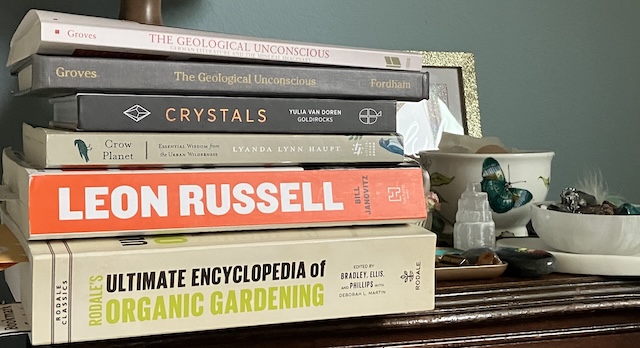
I had no idea there was a specific word to describe a pile of unread books.

In Japanese, “tsundoku” means collecting books and letting them pile up, not for neglect, but for the joy of knowing they’re there, full of untold stories.

The word “tsundoku” is a combination of “tsunde-oku” (to let things pile up) and “dokusho” (reading books). 

My professor son has stacks of books all over his house and is guilty of acquiring as many books as he does plants for the garden. Half of them are for teaching and the others are for pleasure, he says. They live sort of near the guy who won a lot of money on Jeopardy, Tom Nissley, and he opened Phinney Books, which is cool. Both of the kids have shelves of books, too, so it runs in the family.

Here’s what’s on my bedside table. I confess that I actually NEVER read AB’s book in its entirety, but since I proofed the first draft, there’s a bit of me in there somewhere. Of course there’s Leon (I know, I’m so predictable) and gifted books about crystals and gardening. I didn’t include all my chick lit books because they’re immediately devoured. I get most of those secondhand from DIL because we enjoy the same authors. She’s a neuroscientist and those reads are a way for her brainy brain to unwind.

My stack of ladies-in-waiting.

What titles are in your tsundoku?