Friday Tirade: Fevers and Gnats and Hammers

Have you ever experienced the feeling that you had a fever but you actually did NOT?

Somehow, as careful as I am, I got sick. It started with heavy congestion and a headache along with a low grade fever, then it spiked to 101.5 as all the other aches and pains descended upon my body.

After a couple of days of not getting any worse, I decided that I didn’t need to see a doc because my lungs were OK and that probably meant that it was a virus and not a secondary bacterial infection that would necessitate antibiotics as I’m prone to pneumonia.

I can see the light at the end of the tunnel, except for a cough and this annoying feeling that I have a fever but the thermometer says otherwise. I think I would be feeling a lot worse if I hadn’t been vaccinated for Covid and the flu, so I’m grateful for that. Ginger tea and Tylenol seem to help.

At the same time, my indoor plants are inundated with fungus gnats. They’re joyfully procreating and multiplying and are SO annoying. I sprayed the soil with a hydrogen peroxide solution that’s supposed to help–fingers crossed that it actually does. I’ve never had an infestation this severe and I’m not really happy about it.

If that wasn’t enough to put me in a foul mood, neighbors decided to build an absolute monstrosity of a remodel that looks more like an apartment building as it looms over my house. The construction noise has been ongoing for MONTHS and right now I’m listening to incessant sawing and hammering and nail guns along with an air compressor that goes off and on, off and on, off and on.

Closing the windows doesn’t do anything to muffle the noise and that’s almost impossible to do as temps are consistently in the 70s, so I suffer either way. When people drive or walk by, they look up at the giant structure and shake their heads, so I know it’s not just me.

Because of the way the wind blows (literally), all the sawdust and other building detritus comes my way so the side of my house was covered in sawdust, along with nails and paper from the insulation. I asked the neighbors to let their construction people know about it so they could clean it up and that didn’t happen so I sent them some pics and again asked to have something done about it, which they finally did about a month later.

Is there a real pervasive lack of basic courtesy and consideration nowadays, or am I the only one who thinks that?

Does everyone live in their own little bubble and not comprehend–or care — how their actions might affect others? Was I unreasonable to expect them to (promptly) clear away their construction mess? It’s definitely NOT my job to clean up after them and you can’t tell me that they didn’t look down from the scaffolding and see what was going on below them. Yes, SCAFFOLDING, because, like I said, it’s a huge, multi-story monstrosity.

Anyway…

I can’t take it much longer…I think I might have to scream into a pillow. SHUTUPSHUTUPSHUTUP!

Lost

Tell her to hold on. Tell her to hold on tight. Even through the darkest of night.

Sometimes
When we’re lost
We have to light our own candle
And find our way
Through the loneliest of places
Through the darkest of places
And when we’ve learnt from those places
Only then
Do we find our way
Back home to ourselves

Athey Thompson

I Had a Dream

It’s a bit unsettling to not be absolutely certain if something is real or a dream, right?

A couple days ago, I went to sleep about 10:30 pm or so. That morning I received my Covid booster and yearly flu vaccine. Because I have a sensitivity to vaccines, I usually get them separately, but this time I opted to try them at the same time just to get it over with.

At some point, my bed started shaking like we were having an earthquake, but I was also dreaming.

I was in the middle of a dream about my mom. I was in my bed and she was in her bedroom and when the earthquake started, she told me not to worry, everything will be OK, and I should stay in bed until it was over.

Since my mom died a long time ago, I guess that part was some sort of a dream, but in real life, the real or imagined earthquake woke me up to reality because at 11:00 pm I woke up/entered another dimension. I checked the earthquake app on my phone and there had been NO earthquake anywhere around here, which was slightly worrisome because whatever it was woke me up.

That’s crazy, right? When we are having an earthquake at night, my bed DOES shake back and forth just like it did in my dream state.

My heart was racing but I wasn’t scared. I kept going over the dream/not dream in my mind because I couldn’t figure it out. I felt what I felt, but if it wasn’t an actual earthquake, what was it?

Earthquakes in lucid dreams can also be a positive symbol reflecting a major shift or movement in our life. These can be personal changes that need the destruction of the old for the new to rebuild.

Houses in dreams are a symbolic representation of the dreamers sense of self. The bed can also be a symbol of what might lay dormant within, as being asleep is opposite to being awake. It might also suggest the symbol of death and rebirth. The bed as an ancient dream symbol has a wide range of interpretations attached to it, connecting the dreamer to intimacy, relationships, and security.

The earthquake part didn’t upset me, but what I couldn’t make sense of is why it felt so real. Maybe the vivid dream was caused by the vaccines?

Later that day, I did experience all the usual side effects that means my immune system is robust and working properly: aches, chills, low grade fever, fatigue, sore arm — so that might have been the reason, but I can’t shake (haha) the real-ness of it all…and how nice it was to see my mom again, no matter how it happened, and to know that she’s still looking out for me.

Word of The Day: Takiwātanga (Along With a Whole Lot of Other Stuff)

Yom Kippur starts at sundown and now we are embroiled in a government closure because the repubs are all insane and will do anything to NOT release the Epstein files, apparently at any cost.

Did you see the debacle of the gathering of generals in Virginia who had to sit there and listen to the felon and his drunken lapdog? Good for them for not applauding and for looking stoic and aghast. Maybe there’s SOME hope for us. Maybe.

Lately, we’ve heard a lot of talk from the orange POS and his worm-brained head of Health and Human Services (what a joke) about acetaminophen causing autism. The brand Tylenol came out with a classy response.


When I was in the teaching program, one of my student teaching experiences was in a classroom where the students had some form of autism. This was an area that I planned to focus on as an educator. I never pursued it, but I learned that all children learn in different ways and it’s up to teachers and parents to respect the differences and help them achieve academically as well as being compassionate to these special little beings.

The Māori word for autism is Takiwātanga, which translates to “in their own time and space”. Created by Māori linguist and rangatira (chief) Keri Opai, this term was developed to describe the unique experience of individuals on the autism spectrum. It reflects the idea that autistic people have their own unique timing, pacing, and way of experiencing the world. 

This sounds like the perfect time for another version of “A Song for You” by the Master of Space and Time, Leon Russell, of course. So mercurial, he added something special to every performance, in his own time and space.

Non-Thought: Thought-terminating Clichés Are All Around  

This blog is exactly like my personality: random

One minute I’m searching for seashells or a rock that speaks to my heart or I’m reveling in a designer treasure found at the local consignment shop after a day protesting that orange POS and the fall of democracy, yet at the same time, on any given day, I’m a voracious reader, whether it’s chick lit or poetry or something that catches my eye on social media, all the while obsessing over Leon Russell, Master of Space and Time. There are definitely many tabs open on my laptop screen (and in my head).

Like this…thought-terminating clichés.

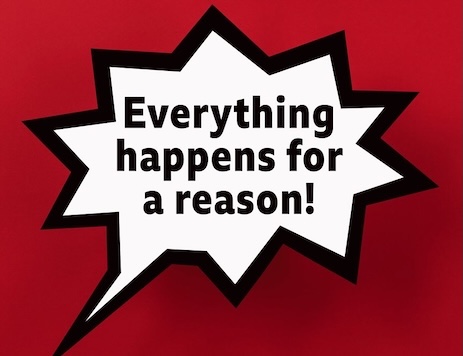
How many times have you heard this (or said it)? “Everything happens for a reason.” Did you find it helpful or frustrating? I find it frustrating and not helpful AT ALL. It makes me feel the person I’m talking to either doesn’t care about what I’m saying or is trying to act superior and patronizing.

For me, that attitude completely terminates the conversation. Sometimes I respond with “Does it really? Does everything REALLY happen for a reason?” but mostly I simply stop talking. There’s nowhere to go after that; for me It’s a convo-ender.

A thought-terminating cliché is a common saying or phrase used to shut down further critical thinking or debate about a topic. These phrases often present themselves as universally accepted truths or wisdom, discouraging deeper exploration or questioning. They can be used in various contexts, including conversations, debates, and even within workplaces or religious groups. 

The term was popularized by Robert Jay Lifton in his 1961 book Thought Reform and the Psychology of Totalism, who referred to the use of the cliché, along with “loading the language”, as “the language of non-thought”.

It’s also known as a semantic stop-sign, a thought-stopper, bumper sticker logic, or cliché thinking and is a form of loaded language—often passing as folk wisdom—intended to end an argument and quell cognitive dissonance with a cliché rather than a point. Some such clichés are not inherently terminating, and only becomes so when used to intentionally dismiss, dissent, or justify fallacies.

1. “It is what it is.” Used to dismiss any deeper inquiry into a situation or problem.

2. “You’ll figure it out.” Used to avoid helping or being asked for help. Condescending.

3. “Boys will be boys.” – Used to excuse or dismiss male behavior, often inappropriate or immature.

4. “Let’s agree to disagree.” Used to end a debate without resolving the underlying disagreement.

5. “Everything happens for a reason.” Used to shut down further questioning about why something occurred.

6.””Only time will tell.” Used to avoid making a decision or judgment about a situation.

7. “Such is life.” Used to dismiss the complexities or frustrations of a situation as being typical or unavoidable.

8. “What doesn’t kill you makes you stronger.”  Used to trivialize suffering or hardship without addressing its impact.

9. “God works in mysterious ways.”  Used to stop questions about religious or moral issues that are difficult to explain.

10. “It’s a free country.” Used to justify questionable actions or opinions without further discussion.

11. “You can’t win them all.” Used to discourage further effort or reflection after a failure or loss.

12. “Better safe than sorry.” Used to justify overly cautious behavior without considering the consequences of inaction.

13. “Everything in moderation.” Used to avoid discussing the nuances or dangers of certain behaviors or choices.

14. “That’s just your opinion.”  Used to dismiss someone’s perspective or argument without considering its merits.

15. “Let’s not rock the boat.” Used to discourage change or questioning of the status quo.

16. “This is the way we’ve always done it.” Used to resist change or new ideas without considering their potential benefits.

17. “Time heals all.” Completely puts a stop to any discussion that isn’t in agreement.

To transform thought-terminating clichés into conversation catalysts, we can create alternative phrases or questions that encourage further exploration and dialogue.

Here are some antidotes, each designed to open up rather than shut down conversations:

  1. Instead of “It is what it is”:  Ask, “What factors have led to this situation, and how can they be addressed?”
  2. Instead of “Boys will be boys”:  Query, “What behaviors are we accepting, and why, and how can we foster more responsible actions?”
  3. Instead of “We agree to disagree”:  Suggest, “Let’s delve into our differing viewpoints to understand each other better.”
  4. Instead of “Everything happens for a reason”:  Pose, “What can we learn from this situation, and how might it influence our future choices?”
  5. Instead of “Only time will tell”:  Consider, “What potential outcomes can we anticipate, and how can we prepare for them?”
  6. Instead of “Such is life”:  Reflect, “How does accepting this situation impact us, and are there aspects we can change or influence?”
  7. Instead of “What doesn’t kill you makes you stronger”:  Explore, “What challenges are we facing, and how can we grow or learn from them?”
  8. Instead of “God works in mysterious ways”:  Ask, “How can we find meaning or understanding in this situation?”
  9. Instead of “It’s a free country”:  Discuss, “How do our individual actions impact others, and where do we draw the line between freedom and responsibility?”
  10. Instead of “You can’t win them all”:  Consider, “What can we learn from this loss, and how can it inform our future efforts?”
  11. Instead of “Better safe than sorry”:  Ponder, “What are the risks and benefits of our choices, and how do we balance caution with opportunity?”
  12. Instead of “Everything in moderation”:  Question, “How do we find a healthy balance, and what does moderation look like in this context?”
  13. Instead of “That’s just your opinion”:  Offer, “I appreciate your perspective. Can you share more about how you arrived at this viewpoint?”
  14. Instead of “Let’s not rock the boat”:  Encourage, “What potential benefits and challenges could come from addressing this issue?”
  15. Instead of “This is the way we’ve always done it”:  Propose, “What new methods or ideas could we consider to improve this situation?”

Curated from desireebstephens.substack.com/p/the-power-of-silence-unpacking-thought, Wiki

Plant Seeds of Serenity

With all the powerful planetary energies at play right now and everything else in this country that almost too horrible to even think about, it seems like a great time to get grounded, to literally get back to what’s simple and healing — and that’s where you’ll find me, in the garden planting seeds of serenity (and flowers).

A garden must combine the poetic and the mysterious
with a feeling of serenity and joy.
– Luis Barragan

Photo by Enchanted Seashells

Faint, Not Feint | Part Two

Feinting is a deceptive or pretended blow, thrust, or other movement, especially in boxing or fencing.

Fainting, or syncope, is what I experienced a couple months ago. I definitely wasn’t feinting when I got dizzy, nauseous, fell, and hit the fireplace. The loss of consciousness felt really weird and not entirely unpleasant.

I thought it was simply an unexplained but strange incident, and finally told my doctor about it.

Her response to me was, “Of course you went to the ER, what did they say? I don’t see that in your notes.”

I replied, “Oh no, I didn’t go anywhere and I didn’t call the paramedics, either, because I was wearing my Hello Kitty jammies. No way was I going to let anyone see me.”

She shook her head and laughed as I explained to her that my RN mom had often drilled into my head that I should never EVER go to the doctor or a hospital unless I was well dressed and nicely groomed– and always with pretty underwear. I mean, there might be scenarios where that’s impossible, but her words are tattooed in my brain.

Of course I would have sought immediate medical help if it happened again, but so far I’ve been lucky.

My doc said her mom was exactly the same, so she understood. However, after asking me a lot of questions, she was concerned enough about my syncope episode to want to rule out any underlying and serious reasons, so she gave me an electrocardiogram and referred me to radiology for a carotid artery ultrasound.

The ECG looked OK and I’ve booked the appointment for the ultrasound to see how my four carotid arteries are performing. Most of the time I think I’m pretty smart but I didn’t know there were FOUR carotids–I thought there was only one, so I’ve learned something. Hopefully, we can rule out any underlying blockages to explain why I fainted. The worse case scenario is that a blocked artery can lead to an increased stroke risk or an aneurysm, but at least I’ll find out one way or another.

The best case scenario is that it was a singular vasovagal syncope episode with no lasting harm. Fingers crossed. Maybe I will actually have “feinted” and dodged a direct hit. That’s funny to think about, but then I’ve been accused of being easily amused…

Since then, my goal has been to mindfully dress for the emergency that might never happen; a personal version of disaster preparedness.

Watching The River Flow

Not exactly a river, but a little rivulet next to the lagoon that seems to have no beginning, goes nowhere, and abruptly ends without a trickle. We haven’t had rain for weeks, months even, so there’s no real explanation for the existence of this body of water.

I can relate to the meandering path of aimless inertia; of stagnant apathy. I guess that’s the feeling for today, likely generated by last night’s powerful full moon energy.

Photo by Enchanted Seashells

And of course because I’m obsessed, I searched for a Leon Russell musical connection. “Watching the River Flow” is a song by Bob Dylan; masterfully produced by Leon Russell. it was written and recorded in March 1971.

As always, I love Leon’s version the best…

Word of the Day: Yutori

The concept of yutori speaks to me, especially right now in this scary political climate of gestapo-like kidnappings, Alligator Auschwitz, and a real sense of anticipatory dread.

“Yutori” (ゆとり) is a Japanese concept that broadly translates to spaciousness, room, or breathing room. 

It’s about creating intentional space in one’s life, both physically and mentally, to allow for relaxation, reflection, and a sense of ease. 

This can involve anything from leaving for appointments early to allow for a buffer, to simply taking moments throughout the day to pause and breathe

Yutori aligns with mindfulness practices and encourages a more balanced and less stressful approach to life. For me, that means going outside, watching a magnificent beachy sunset, cleaning the house, thoughtfully organizing a drawer — or my massive seashell collection.

In Limbo

The days between Christmas and the new year are suspended in amber; a week of feeling in limbo — at least for me.

The frenzy leading up to Christmas that started at Halloween and progressed to Thanksgiving and finally to December 25 is a mess of cooking and baking and cleaning — and now it’s over, along with the twenty-four hour Christmas music on the radio.

It’s so so quiet outside, like a day during the pandemic.

It’s a great time to shop the after holiday sales, but I have enough wrapping paper and Christmas cards and decorations to last until the next century, so I’m not all that excited about the 75% off prices…although I DO love a bargain.

But — we’re not quite done because the end of the year is only a few days away and that occasion is supposed to be memorialized by some sort of celebration, whether you choose to go to a ball or a party or stay home by the fire with a glass of champagne and try to stay awake until midnight.

And then it’s over — but not until the idiots shoot guns in the air and set off more fireworks that scare all the animals.

I’m not sure I’d call this feeling a full fledged depression, but there’s a term that describes it pretty well… Post Holiday Blues. It sounds like it should be the title of a song, right? PHB refers to the letdown we might feel after all the excitement and anticipation leading up to the holidays.

I hope Santa brought you everything you asked for and enjoy this week in limbo, waiting for 2025.