
That’s what we call him because we don’t know his real name. All we know is that one day there were a whole lot of bananas perched on a picnic table at the beach.
I asked the gentleman who was sitting nearby if he knew who they belonged to and if we could have one. He said he had brought them and he had an organic farm nearby where bananas grew like weeds so he always brought them to share. He also grew cherries and peaches and loads of other yummy things, but we were fascinated by the bananas.

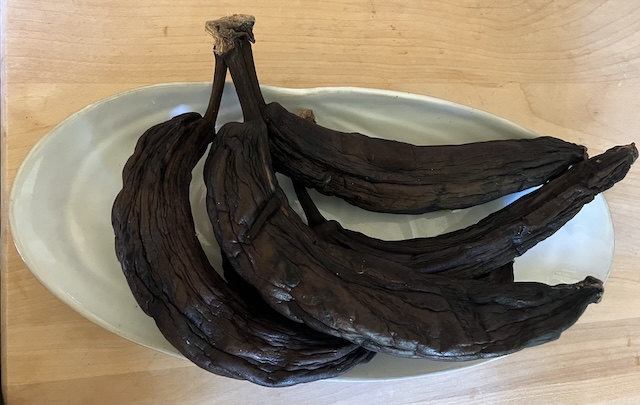
They looked exactly like this photo. They were the BEST bananas we had ever eaten. As we were packing up the car to go home, Banana Man (never got his name) told us to take some with us, so we thanked him and did just that.
Here at Casa de Enchanted Seashells, I have two banana plants that have never borne any fruit since they were planted, so I wish I knew what he was doing right..
I’ve been learning a lot about bananas. They’re an amazing creation by Mother Nature.
Bananas grow in a formation called a “bunch.” Each bunch contains multiple “hands,” and each hand consists of a line of bananas referred to as “fingers.”
The cluster of bananas we buy at the store is technically a “hand”. A full bunch—what grows on a single stem in banana plantations—can weigh more than a hundred pounds and contains several hands.
Most people have a total aversion to the white stringy things on a banana and meticulously pick them off, but not me, mostly because I’m too lazy to remove them.
They’re called phloem bundles, the plant’s internal plumbing system that transports nutrients (sugars, water, minerals) from the leaves to the developing fruit as it grows, acting like tiny veins. They’re completely edible, nutritious, packed with fiber, and safe to eat, often containing more complex fibers than the rest of the fruit, making them a bonus source of goodness, not to be discarded.
Can you eat banana peels? You shouldn’t eat a raw banana peel because it’s tough, bitter, and often coated in pesticides; however, it’s actually edible and nutritious (high in fiber/potassium) if thoroughly washed, preferably organic, and cooked to be blended in smoothies, baked into breads, or used in curries.
If totally organic, try boiling banana peels to drink as a nutritious tea.
Another use for banana peels is as a fertilizer, which I’ve done. Sometimes I save a bunch of banana peels, soak them in a gallon of water for a few days, strain, and use on the plants in the veggie garden.
Is there anyone who does NOT like bananas? I don’t think so, or at least I’ve never met anyone who doesn’t. It’s one of the universal first foods for babies; mashed and smashed.
Bananas are packed with essential nutrients: potassium, vitamins B6 and C, fiber, and magnesium, providing quick energy from natural sugars, low in fat and protein.
We all know what to do with overly ripe bananas, right? Banana bread never gets old. Check out my Recipes Category for several recipe ideas that incorporate ripe bananas.
🍌
 Enchanted Seashells | Princess Rosebud