
Vintage San Diego: Bays, Bars, and Books

I don’t talk much about the part of Southern California where I live; other than my beach, lagoon, and the stupid local government. I’m about thirty or forty miles or so from the city, and while I don’t often get down there, I do love old pictures that chronicle the history of San Diego far more accurately than words.

Here’s a photo of San Diego Bay taken in 1892 from the vantage point of State Street and Broadway. It all looks calm and free of tourists, exactly how we locals like our life here in SoCal.

San Diego Bay / Photo from Reddit

I always thought the oldest bar in San Diego was the Waterfront, but it’s not, because the Waterfront opened in 1933 when prohibition was repealed, 

The oldest bar in San Diego is the Tivoli Bar, opened as a saloon in 1885. It’s located on a lot originally owned by Alonzo Horton who helped develop most of downtown San Diego.
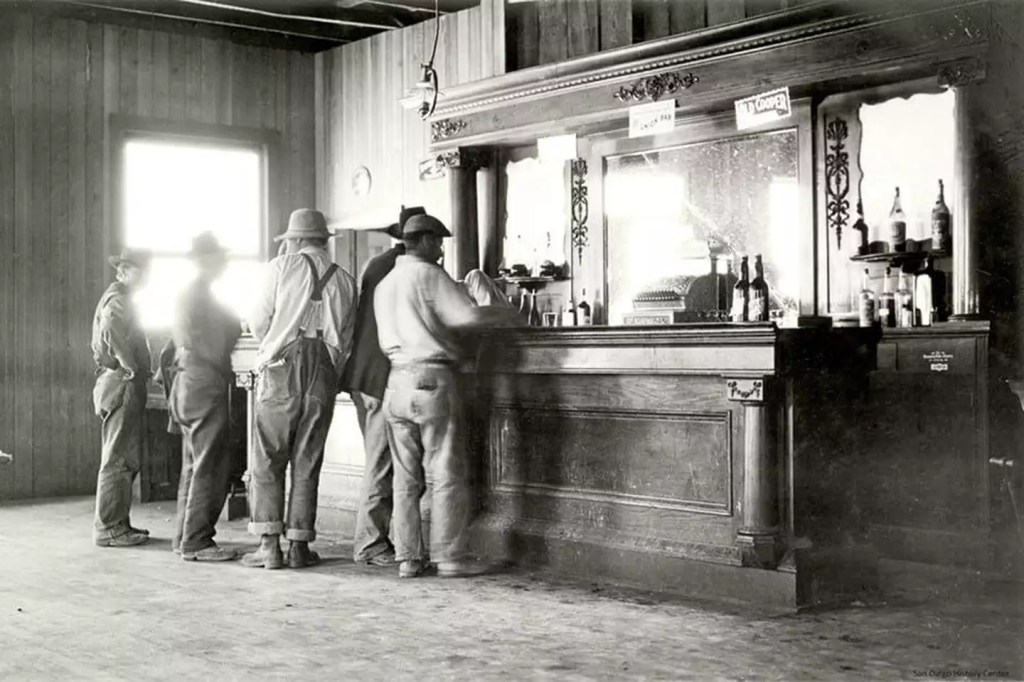
Tivoli Bar/Curated from SFGate

Built in 1864, the building was first called the Walker House and functioned as a boarding house, feed store, and blacksmith shop. The Walker House was converted into a saloon and kitchen in 1885. The original bar (still there) was built in Boston and brought to San Diego by ship around Cape Horn at the southern tip of South America, a journey which took three to four months.

The original cash register from the turn of the 20th century and the old safe are still displayed in the bar.

The Tivoli Bar has hosted many famous characters including Wyatt Earp and his wife Josephine, whose photos are prominently displayed over the entrance to the bar, along with Frank Sinatra and Sophia Loren.

The bar flourished during a time when San Diego was a boomtown and the Gaslamp was the city’s red light district, an area then known as the Stingaree. A warning sign from the time reads: “This area is known to be populated by anarchists, confidence men, cut throats, shady ladies, hop heads, perverts and thieves.”

Here’s an 1882 crime report from a local newspaper: “About 8 o’clock on Friday evening, a fracas occurred in the Tivoli Saloon between Gus Young and one Ballantine, in which the former was struck over the head with a chair in such a forcible manner that the latter is of no further service, and will have to be sent to a furniture store for repairs.”

I bet there were some wild times inside the Tivoli–if only the walls could talk! It’s a certified dive bar and I can’t believe I’ve never been there. I think it’d be fun to take the train downtown and check it out.

Have you heard of reporter and author Max Miller?

Max Miller was a reporter for the San Diego Sun and author of twenty eight books. In 1932, he wrote I Cover the Waterfront, an interesting account of San Diego’s port community that inspired Hollywood movies and became the title of a jazz standard sung by Billie Holliday, Frank Sinatra, and Sarah Vaughan, but sadly, NOT Leon Russell.

The book’s characters include true-life sea captains, Portuguese fishermen, flying squid, sparkling Garibaldi fish, movie stars, Charles Lindbergh, Babe Ruth, and a beautiful young woman who got away.

Miller also drew from his experiences living in Everett, Washington and when he attended the University of Washington. He also wrote Harbor of the Sun: The Story of the Port of San Diego, which is a fairly difficult book to locate. He died in La Jolla.

Here’s Sarah Vaughan with her 1946 version of I Cover The Waterfront (I couldn’t find a Leon Russell connection this time at all…LOL).


FYI: This is not a post written with the intention to extol any vacation virtues of San Diego. We REALLY have far too many visitors here but I’m sure there are other lovely places to choose for a holiday…

The Popcorn King 🍿 Orville Redenbacher

Last night I made some popcorn the old fashioned way — on the stovetop. I don’t often have popcorn, but I couldn’t think of anything to eat, so I made some and sprinkled it with pink Himalayan sea salt, which I know is uber trendy right now, but I’ve always used it primarily because it’s PINK and so pretty!

While eating the warm crunchy popped corn, I remembered that once upon a time, I met the Popcorn King himself, Orville Redenbacher.

During the America’s Cup races in San Diego. I was on a spectator boat and Orville was on board, too.

There was an undercurrent of chatter; buzz that someone famous was with us, and there he was, in his trademarked glasses and bow tie. Since we know by now that I’m not afraid of talking to anybody, whether it’s Willie Nelson or Vice President Al Gore or a rude Rob Reiner (Kauai), I had a sweet little chat with OR, who WAS a very nice man, by the way.

Did you know that Orville Redenbacher actually was a scientist? He developed a new strain of popcorn that kept that whole industry alive.

Back then, before smart phones, no one was as obsessed with documenting each and every moment of their lives, and while it WAS the America’s Cup and a pretty big deal, I still didn’t have a camera with me, so I don’t have photographic proof, I’m sorry to report.

Orville asked me for my address and I gave it to him because he said he was going to send me something. I had totally forgotten about our conversation until a gigantic box arrived a few weeks later, full of OR popcorn and products.

Sadly, I didn’t know that Orville Redenbacher died in 1995 at his home in Coronado, which is on the other side of San Diego Bay.

Belated, but RIP to the Popcorn King.🍿

Star of India Sails

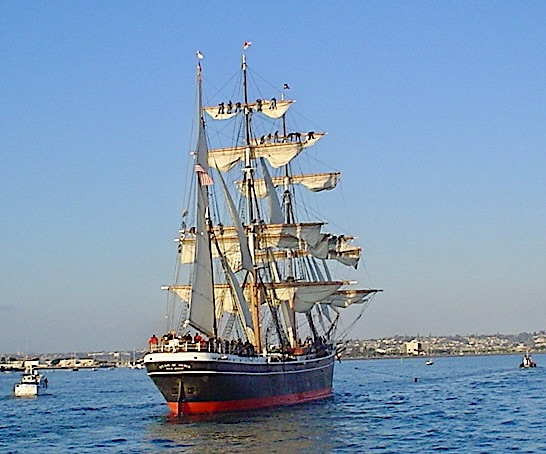
Every so often the Star of India sails in San Diego Bay. I was clearing out some old photos and discovered this one from a few years ago. If you have seen this ship at all, it was probably lining the dock in downtown San Diego, but in case you didn’t know, this is the world’s oldest active sailing ship and still sails a few times a year with an all volunteer crew.

The Star of India was built on the Isle of Man in 1863. Iron ships were experimental at that time with most vessels still being built out of wood. Within five months of laying her keel, the ship was launched. She was originally named Euterpe after the Greek muse of music and poetry.

Euterpe was a full-rigged ship and would remain so until 1901, when the Alaska Packers Association rigged her down to a barque, her present rig.

She began her sailing life with two near-disastrous voyages to India. On her first trip she suffered a collision and a mutiny. On her second trip, a cyclone caught Euterpe in the Bay of Bengal, and with her topmasts cut away, she barely made port. Shortly afterward, her first captain died on board and was buried at sea.

After such a hard luck beginning, Euterpe made four more voyages to India as a cargo ship. In 1871 she was purchased by the Shaw Savill Line of London.

Subsequently sold to the Alaska Packer Fleet, her name was changed in 1906 to the Star of India to match the other vessels in their fleet. The Star of India made over 22 Alaskan voyages before becoming obsolete in the 1920s as steam power propulsion became more reliable than wind.

The Zoological Society of San Diego purchased the ship in 1926 for use as the centerpiece of a planned maritime museum and aquarium. The Great Depression in the 30s and World War II caused those plans to be put on hold and the Star of India lay idle until she was restored in the late 50s and early 60s.

Fully restored by 1976, the Star of India set sail as part of the United States’ Bicentennial celebration. 

Interesting Facts:

  • Launched five days before Abraham Lincoln’s Gettysburg Address
  • Sailed twenty-one times around the world
  • Never fitted with auxiliary power
  • Went aground in Hawaii
  • Became an “American” ship by Act of Congress
  • Trapped in ice in Alaska
LOA212′
Sparred Length280′
Beam35′
Maximum Draft21.5′
Gross Tonnage1318
RigBark