It was a warm night and the patio doors were open…
I’m used to hearing coyotes and the occasional hoot of a pair of Great Horned Owls that live in the ‘hood, but last night I heard what could only be described as a MONKEY — but that’s crazy, right?
I turned off the TV, grabbed my phone, and pointed it outside.
You can hear it too, the monkey sounds in tandem with very faint owl hoots. The hoots didn’t get picked up as I was recording though the screen door, so you might not catch it. Definitely turn up the volume.
I did some research: What is a bird that sounds like a monkey — and thanks to the brilliance of Google, a zillion results popped up.
It turns out that I might have been lucky enough to hear a Barred Owl, which is more rare here. Or it’s another vocalization from the Great Horned Owl, one I’ve never before heard.
Barred Owls are huge, between 16 to 25 inches long, with a broad wingspan of up to 60 inches. Since I’m five feet tall, I cannot even fathom that.
Whoever it was, I’m overjoyed! It’s one more animal friend helping to rid my garden of disease-ridden rodents. Bon apetit!
Apologies again for the crappy video, as this was my screen door and I couldn’t turn off the flash because I didn’t want to mess around and lose the capture.
So what is it? Monkey? Owl? Monkey Owl? Or something else?
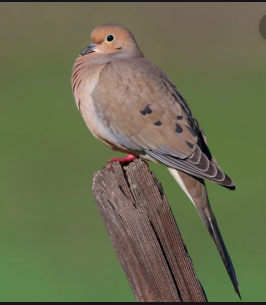
I hardly ever see my backyard friends during the day so this was a huge surprise, even more so because I was actually outside at the time.
I have no idea how I missed observing this beauty in real time, but it was such a treat to check the camera and discover my silent visitor up on the hill.
Isn’t his coloring beyond beautiful? I can’t wait to see him again…
The mournful song of my little dove reminded me of a poem by Becky Hemsley.
She walked along the pathway And she hadn’t walked for long When she met a little bird Who sang a melancholy song She listened for a moment To his sad, enchanting sound And she asked him why he sang his song When no-one was around “I sing to tell the forest That the day has just begun And I join the morning chorus As we’re welcoming the sun I sing so all the other birds Will know they’re not alone And I hum to all the trees To help their leaves and branches grow I sing for all the creatures As they go about their day And I whistle warnings to the sky That clouds are on their way” But why,” she asked him gently “Is your song so bittersweet? Why does it sound like longing And like yearning when you tweet?” “I sing to feel less lonely,” Said the tiny, little bird “And I tweet into the quiet Just so I can feel heard For when the sun is busy, When the other birds have flown, When the trees are climbing skyward Then I’m left here on my own And I sing to ask the questions That are tearing through my mind But I don’t know what I fear the most Silence… or the reply”
I’ve been getting calls and texts from the insurance company about filing claims about (future) storm damage, SDGE is calling and texting alerts about storm preparations and being ready for the power to go out, so I guess Hurricane Hilary is SERIOUS about visiting my little beachy town.
An emergency preparedness spokesperson said that we should not underestimate the impact of this storm, and called it possibly “the worst we’ve seen”.
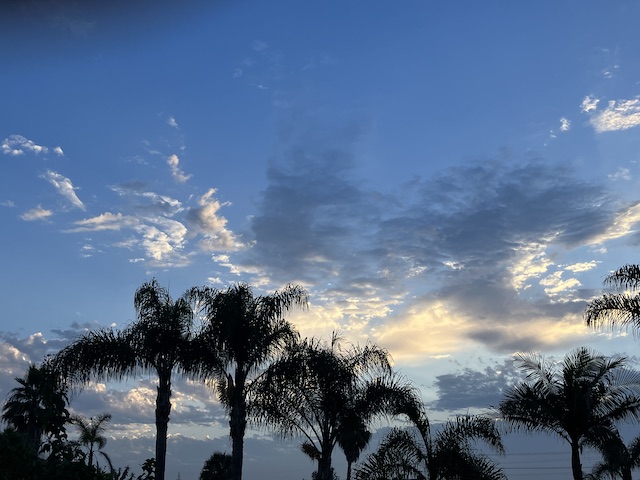
If his prediction is correct, this beautiful sunset is going to be replaced by lots of sky water and high winds.
It’s supposed to start raining in the afternoon, so I better focus on removing a few more windchimes before the real action kicks off on Sunday.
Looking west from the deck, the vibrant sunset is reminiscent of my favorite passionfruit and mango shave ice.
Rain might actually fall in a couple of days from Tropical Storm Hilary, the reason for those beautiful clouds. A new weather forecast says it might turn into a hurricane which would definitely bring stronger winds along with sky water. We would only feel the remnants–Baja California would bear the brunt–but I’d be really happy for the rain!
The new moon, under 1% illuminated, turns skies dark tonight as we anticipate the second full moon at the end of August.
This is what I saw when I looked up early this morning, an unfiltered tropical sky. There’s a 40% chance of rain tomorrow, but I don’t really think it’ll happen.
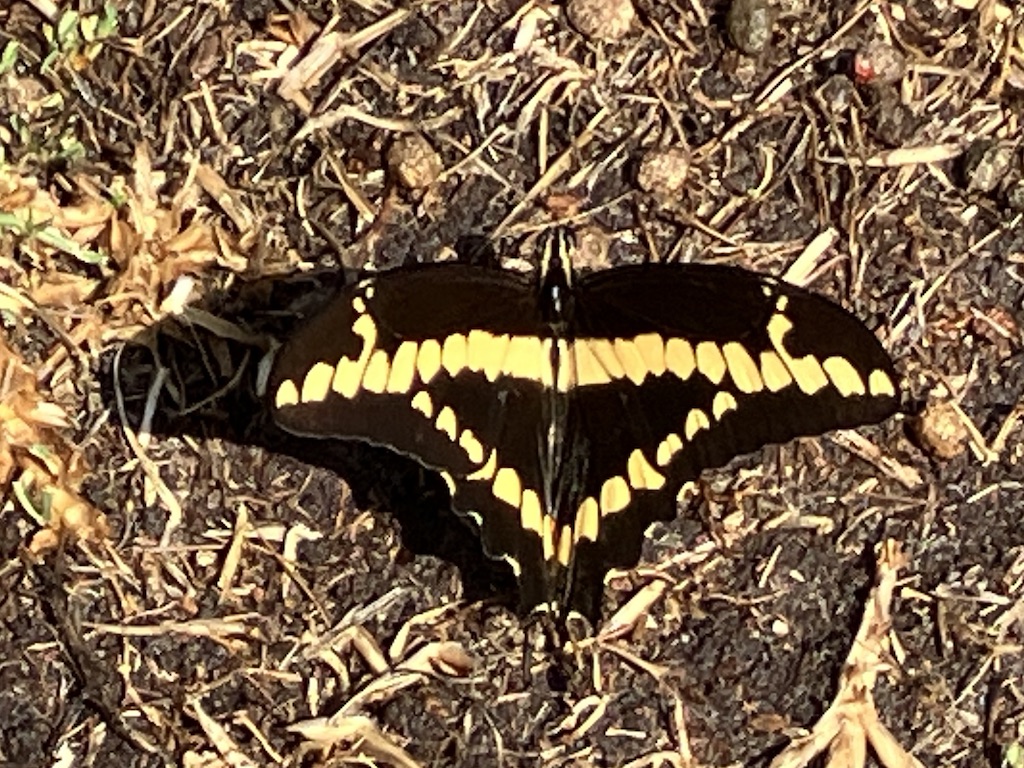
This giant followed me around the garden all afternoon. I’ve never seen this particular butterfly before, but I think he was attracted by my solar powered pond fountain, and that makes me very happy.
The Western Giant Swallowtail wingspan is about 5.5 to 7.4 inches, depending on gender.
I took a lot of great photos with my Canon but was disappointed to have some kind of error message with the SD card, so I can’t share those more pristine images.
The swallowtail butterfly is believed to represent transformation and embodiment of souls who have crossed over to the spiritual realm. It has also long been an animal that symbolizes joy, freedom, and honour of the soul.
Additionally, in many cultures, the swallowtail butterfly is believed to be a messenger of pleasant news and luck.
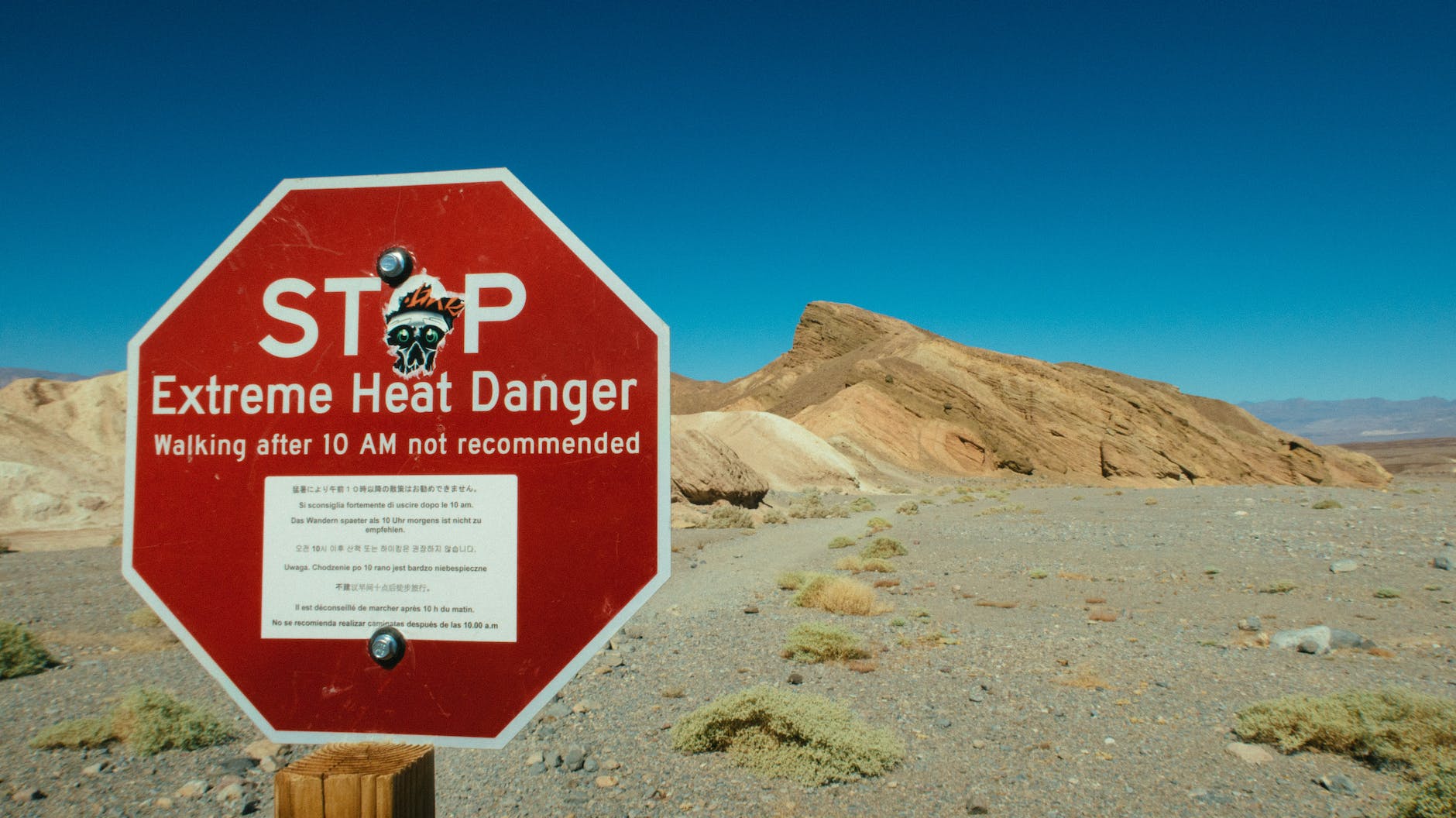
Right now, visitors are flocking to Death Valley National Park to experience the forecasted EXTREME heat.
Death Valley is projected to set a verified world record for the hottest temperature ever reliably recorded, with Furnace Creek expected to reach 131 degrees with a low temperature at night of 101 degrees.
I’ve been to Death Valley a few times. It’s an otherworldly and mysterious experience. It’s a whole mind/body connection, the kind of heat that permeates down to a soulful, cellular level. Along with the magnificent silence, there’s really nothing to compare to desert heat.
Ten thousand years ago, Badwater Basin, the lowest point in North America, was once a hundred-mile long lake. It’s now a vast expanse of salty ground.
When you visit Death Vally, make sure you stop at Artists Palette, a technicolor, kaleidoscopic display of multicolored rock in that makes you feel you’re at an art exhibit.
Of course, as with the rest of our country, there were Indigenous People here before us.
The Timbisha Shoshone Indians lived there for centuries before the first white man entered the valley. They hunted and followed seasonal migrations to harvest pinyon pine nuts and mesquite beans. To them, the land provided everything they needed and many areas were, and are, considered to be sacred places.
I always thank the first people when I camp or hike, no matter where I am.
The shamanic ground markings of Death Valley tend to be found in the more remote parts of this already remote region – probably the reason why any trace of them survives at all. They are ritual and magical features left by long-ago shamans, probably of the ancestral Pima and Shoshone peoples, and they are fragile, so much so that their precise locations are not advertised.
They take various forms – ritual pathways, shrines, vision quest beds, scraped ground markings, strange sinuous lines, and weird patterns of rocks.
Vision quest beds are remote, subtly-marked locations where an Indian brave or shaman would go to spend a solitary vigil seeking a vision – a personal spiritual gift. He would go without food or sleep for perhaps three or four days and nights until the vision came. If it came at all, it would most commonly be in the form of what we would call an auditory hallucination: he would hear a chant or song.
Ritual pathways are probably the rarest of the shamanic features. a loose group of boulders.
The most enigmatic of all the shamanic relics in the valley are markings etched into the hard, sunbaked ground (‘intaglios’) or laid out with small rocks on the surface of the ground (‘petroforms’). Such features are collectively known as ‘geoglyphs’. Both types in Death Valley mainly show meandering, abstract patterns, but a few seem to depict mythical creatures. (Curated from https://www.ancient-origins.net)
If you make it to Death Valley, no matter what season, take more water than you think you’ll need to stay well hydrated!





 Enchanted Seashells | Princess Rosebud