In my opinion, impeaching again and successfully this time would be a start, that’s for sure, along with #25th Amendment.
I’ve been saying this for four years. tRump never should have been elected, no matter how it happened. He brought out from the sewer every single horrible thing about this country.
Soon, but not soon enough, Joe Biden and Kamala Harris will be President and Vice President.
Best President and First Lady-Barack and Michelle Obama.
I thought I was going to watch Judge Judy; instead there’s coverage of a coup in DC, our seat of democracy–on the day we were to join both Houses and formally count the results of our election, another step in the process to January 20 where we inaugurate Joe Biden as President.
On the steps of the Capitol, on the Senate floor; shots fired, vandalism, violence. Nothing less than domestic terrorism.
Unbelievable.
It seems as if Capitol Police were apparently complicit in allowing these activities, taking selfies with the criminals, allowing them access to the Capitol.
This piece of shit president and his attempted coup will go down in history as the darkest hour in America’s 250 years of democracy. He called for a rally of his idiotic followers on this day, he stoked the fires of hatred and violence, he told the crowd to use force to change election results.
Today’s attempted coup began with Trump saying to the crowd: “If you don’t fight like hell, you’re not going to have a country anymore,” and then telling them to head to the Capitol to give Republican lawmakers the message.
Like President Biden said, “This is sedition. This is insurrection. Enough is enough is enough.”
Senator Duckworth said they are planning to resume the symbolic vote count as soon as Capitol is secured. Democracy will not be bullied!
Trump needs to be immediately removed from office and arrested for sedition and insurrection.
This is the day after Georgia saved our country by electing Jon Ossoff and Raphael Warnock. Thank goodness for Stacey Abrams. She is truly a national treasure.
From Dan Rather: “This is a win for decency and democracy. A new chapter in American history begins today.”
I’m writing this with tears in my eyes. It’s a very emotional time for us. We’ve been holding our breath for four years and can finally exhale.
We can breathe now.
The nightmare really is over. The planets have aligned.
Decency, integrity, and honor has been restored to the people’s White House.
The United States of America has been saved.
Democracy is back on track.
It’s OFFICIAL. They called it.
President Joe Biden and Vice President Kamala Harris will take over the helm and repair the damage of the last four years.
We are finally seeing the healing light at the end of a long, dark tunnel.
No fighting, no lawsuits, no rioting by his racist cultists can change the outcome. It’s a mathematical impossibility for them. In addition to winning the popular votes, at this time Electoral College votes are 284-214.
We have been led out of the heart of darkness.
I think we’re gonna shut down our street and have a socially distanced block party.
The nightmare of the last four years is almost over!
While the election hasn’t been officially called for Joe Biden as of 6:00 a.m. today, November 6, 2020, I have faith that it’s just a matter of time. The terrible black cloud we’ve been living under here in the United States for the last four years is dissipating, and there’s now HOPE on the horizon.
Democracy has been saved.
After we celebrate, we need to fix the Supreme Court and restore women’s right to choose what happens to our own bodies and hurry to repair the damage to our wildlife and our climate and our pristine wilderness. Get rid of the Electoral College!
Maybe the worst part of the last four years is the knowledge that there is still so much systemic racism here. It’s like a certain segment of society can’t get over the fact that the Civil War is over. Equal means EQUAL, no matter the color of our skin or religion, or whom you choose to love. It’s obvious there needs to be a lot more education. Racism and fascism shouldn’t be tolerated.
I’m here in California and we voted overwhelmingly for Joe Biden and Kamala Harris, but I want to take the time to express my appreciation to Georgia’s Stacey Abrams for tirelessly working to uphold honor and decency and integrity and to fight the good fight for all of us.
My parting words for that failed reality show sociopath… “YOU’RE FIRED!”
Here’s a few words from the late great John Lewis that seem especially appropriate right about now:
“About fifteen of us children were outside my aunt Seneva’s house, playing in her dirt yard. The sky began clouding over, the wind started picking up, lightning flashed far off in the distance, and suddenly I wasn’t thinking about playing anymore; I was terrified…Aunt Seneva was the only adult around, and as the sky blackened and the wind grew stronger, she herded us all inside.Her house was not the biggest place around, and it seemed even smaller with so many children squeezed inside. Small and surprisingly quiet. All of the shouting and laughter that had been going on earlier, outside, had stopped. The wind was howling now, and the house was starting to shake. We were scared. Even Aunt Seneva was scared.And then it got worse. Now the house was beginning to sway. The wood plank flooring beneath us began to bend. And then, a corner of the room started lifting up.I couldn’t believe what I was seeing. None of us could. This storm was actually pulling the house toward the sky. With us inside it.That was when Aunt Seneva told us to clasp hands. Line up and hold hands, she said, and we did as we were told. Then she had us walk as a group toward the corner of the room that was rising. From the kitchen to the front of the house we walked, the wind screaming outside, sheets of rain beating on the tin roof. Then we walked back in the other direction, as another end of the house began to lift.And so it went, back and forth, fifteen children walking with the wind, holding that trembling house down with the weight of our small bodies.More than half a century has passed since that day, and it has struck me more than once over those many years that our society is not unlike the children in that house, rocked again and again by the winds of one storm or another, the walls around us seeming at times as if they might fly apart.It seemed that way in the 1960s, at the height of the civil rights movement, when America itself felt as if it might burst at the seams—so much tension, so many storms. But the people of conscience never left the house. They never ran away. They stayed, they came together and they did the best they could, clasping hands and moving toward the corner of the house that was the weakest.And then another corner would lift, and we would go there.And eventually, inevitably, the storm would settle, and the house would still stand.But we knew another storm would come, and we would have to do it all over again.And we did.And we still do, all of us. You and I. Children holding hands, walking with the wind. . . . “
As if 2020 couldn’t be any worse with Covid, the death of Ruth Bader Ginsberg and oh, I don’t know, simply the death of our entire DEMOCRACY, THIS happened and I am truly distraught…
From my friend, Jamie Rappaport Clark, President of Defenders of Wildlife:
It’s a sudden and tragic end to what should have been one of the great wildlife comeback stories of all time. Today the U.S. Fish and Wildlife Service officially stripped gray wolves in the lower 48 states of their federal protection under the Endangered Species Act.
This ruthless decision leaves gray wolves at the mercy of states, some with increasingly hostile anti-wolf policies – even some where we’ve already seen wolves slaughtered. This isn’t over.
We’re taking this administration to court to defend gray wolves fighting for their lives. Will you help?
We cannot and will not allow wolves to be abandoned, and their recovery to be cut off after decades of work. Wolves occupy only 10% of their former range and need continued federal protection to fully recover. There are still vast areas of suitable habitat in the lower 48 states where wolves have not recovered, including Colorado.
As recently as last year, a wolf spotted in Colorado brought a spark of optimism for the future of wolves in the Southern Rockies. That hope could now be smashed. Delisting wolves is the wrong move at the wrong time. We’ve already seen a wave of violence as some anti-wolf states have allowed even more barbaric methods to trap, shoot and kill gray wolves – and things could get a lot worse for these wolves without our help.
We’ll never stop fighting against anti-wolf extremists and politicians working to turn back the clock on wolf recovery. Today’s setback isn’t the end of the gray wolf story.
Thanks for your compassion and your steadfast support for the wildlife we love.
On a personal note, I’ve been fighting to save and protect wolves pretty much my whole life and while we rejoiced when wolves were originally placed on the endangered species list, it didn’t stop the senseless murder of wolves and their families.
Time for a post and a plea about animals. Defenders of Wildlife needs our help to protect southern resident orcas!
Stop a proposal that could allow serious harm to over two thirds of the entire southern resident population of endangered orcas.
A proposed rule from the National Marine Fisheries Service (NMFS) would allow Naval sonar activities in the Northwest Training and Testing area to seriously harass up to 51 of these orcas (68% of the entire population!), putting the recovery and even survival of this population in jeopardySouthern resident orcas are still struggling to survive and recover – we can’t let this population go extinct on our watch!
Orcas are the largest member of the dolphin family, and just like their smaller cousins, orcas depend on echolocation to find prey and to communicate with other pod members. With so few salmon left, it’s essential that we reduce underwater noise as much as possible to make it easier for orcas to find the food they need to survive.The ear-splitting shrieks of the sonar can make life nearly impossible for these majestic and vulnerable animals.
These sonar activities can disrupt critical natural behaviors like feeding, nursing, surfacing, migration and more. These orcas already face dire threats from pollution, collapsing food supplies and climate change. They’re fighting for their lives – but if the NMFS approves this sonar disruption, it could be the threat that pushes them over the brink.
Time is running out to save these magnificent whales. Given this population’s already critically endangered status, we need to do all we can to help these orcas – including protecting them from disruptive sonar activity!
That’s a lot of exclamation points, but I love Defenders of Wildlife and hope you’ll help them save the southern resident orcas!!
P.S. For some crazy reason, WordPress is inserting unwanted horizontal lines in my post and I can’t delete them. I give up trying. WP, you baffle me.
Join me on yet another Odysseus-like journey through my town. I’m not sure what I’m searching for, but maybe like Odysseus, I’m trying to find my way home, facing challenges along the way.
This was an interesting morning.
When I began my pilgrimage, there was so much fog! It was coming down from the heavens like rain. Super cool for walking, not so good for curly hair, but I like to look on the bright side so I braided my curls and wore a hat.
Check out the Halloweeny spider webs on this pine tree, brought to life by the heavy fog.
For a while, I was a few houses behind a woman who was walking her Rottweiler. I was actually across the street, but couldn’t help but notice that she was roughly pulling on the poor creature’s leash/collar. The collar was one of those mean ones that have little barbs in them. I was already upset that the dog had a cropped tail. I believe that sort of mutilation is outlawed in other–more humane–countries, as is that nasty hurtful collar.
OK, I said to myself. Don’t say it, I said to myself. You know what to do, girl, I said to myself, keep walking and don’t speak. Don’t say a word this time, I said to myself. Just DON’T, I said to myself. Look away, I said to myself. Take a deep breath, I said to myself. You can’t protect every animal in the world, I said to myself. This might not go well, I said to myself. Take another deep breath, I said to myself. Mind your own business, I said to myself. Slow down your pace so you’re out of hearing distance, I said to myself. I mean it, have some impulse control; this time just don’t say it, I said to myself.
And then the woman and her dog slowed down, so they were within the range of my voice.
What do you think I did?
Yup. I really did. I couldn’t help myself. I TRIED really hard to get my Zen on, but my one little inner voice was joined by yet another little inner voice and the words spilled out…
“Umm, excuse me, but I couldn’t help but notice how you’re jerking your poor animal’s neck that way with that awful chain around its neck. It looks really painful from my point of view.”
“She needs to learn to listen. It’s just a little pinch.”
I said…”Well, you might want to learn another more positive method of training that poor girl because as I’ve observed during the last two blocks, your way isn’t working out very well.”
I concluded by saying, “I’ve trained a lot of animals, and actually think those types of chains with the hooks on them are banned in other countries. It’s abusive. You might want to research using a harness which doesn’t choke your beautiful dog.”
Well, she didn’t say anything else to me because at that point she walked up a side street, in all likelihood to get as far away from me as she could.
To her credit, we didn’t get into a screaming match. Walking away was her best choice, as she would have lost.
I took a deep breath and felt good that I had spoken truth and possibly opened her brain to a nicer way of training. Or not. Maybe I just ruined her day. Either way, job well done, in my opinion.
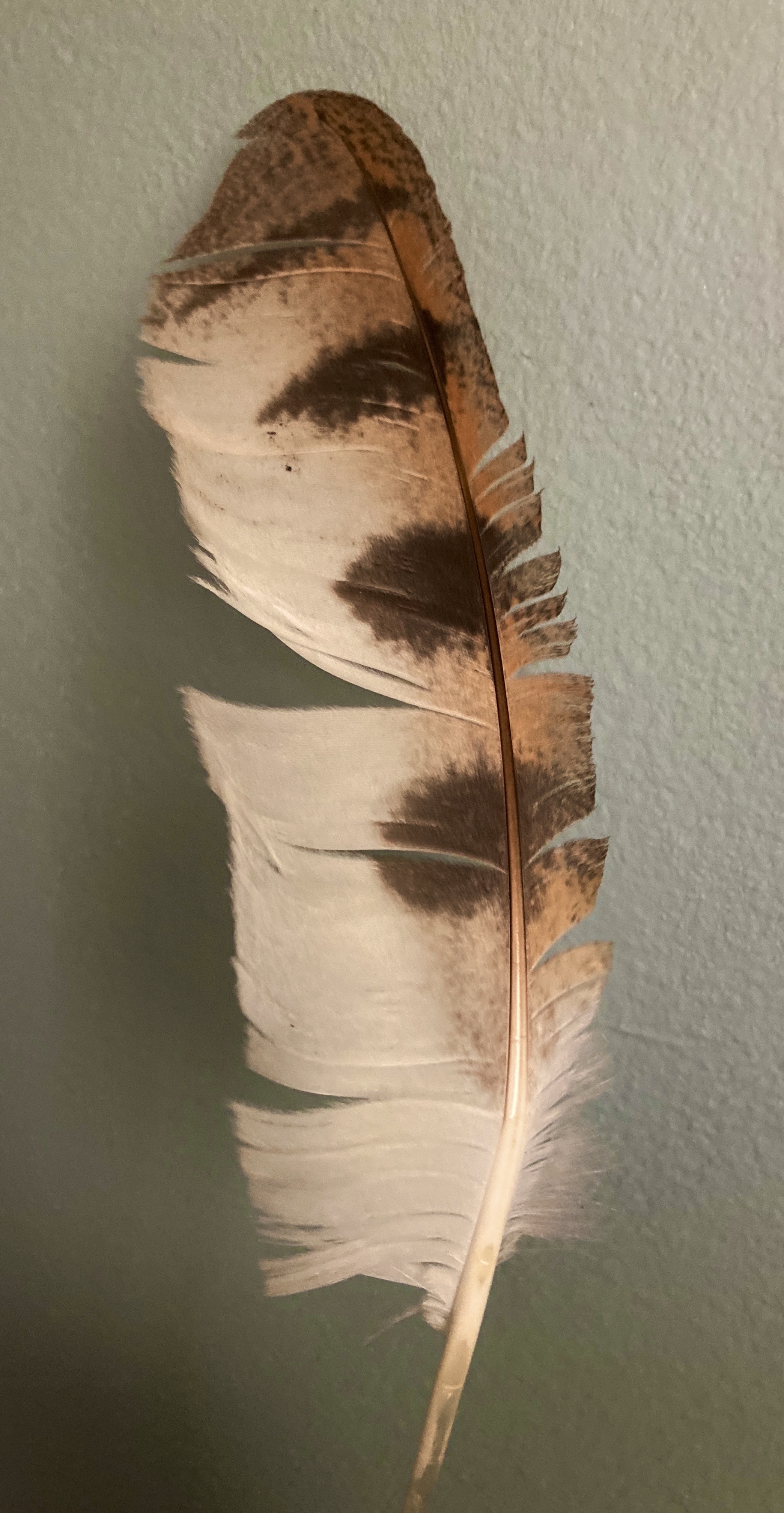
I looked down and was rewarded by a treasure! This is the most beautiful hawk feather. I carefully picked it up and placed it in my backpack. I think this might be a tail feather, don’t you?
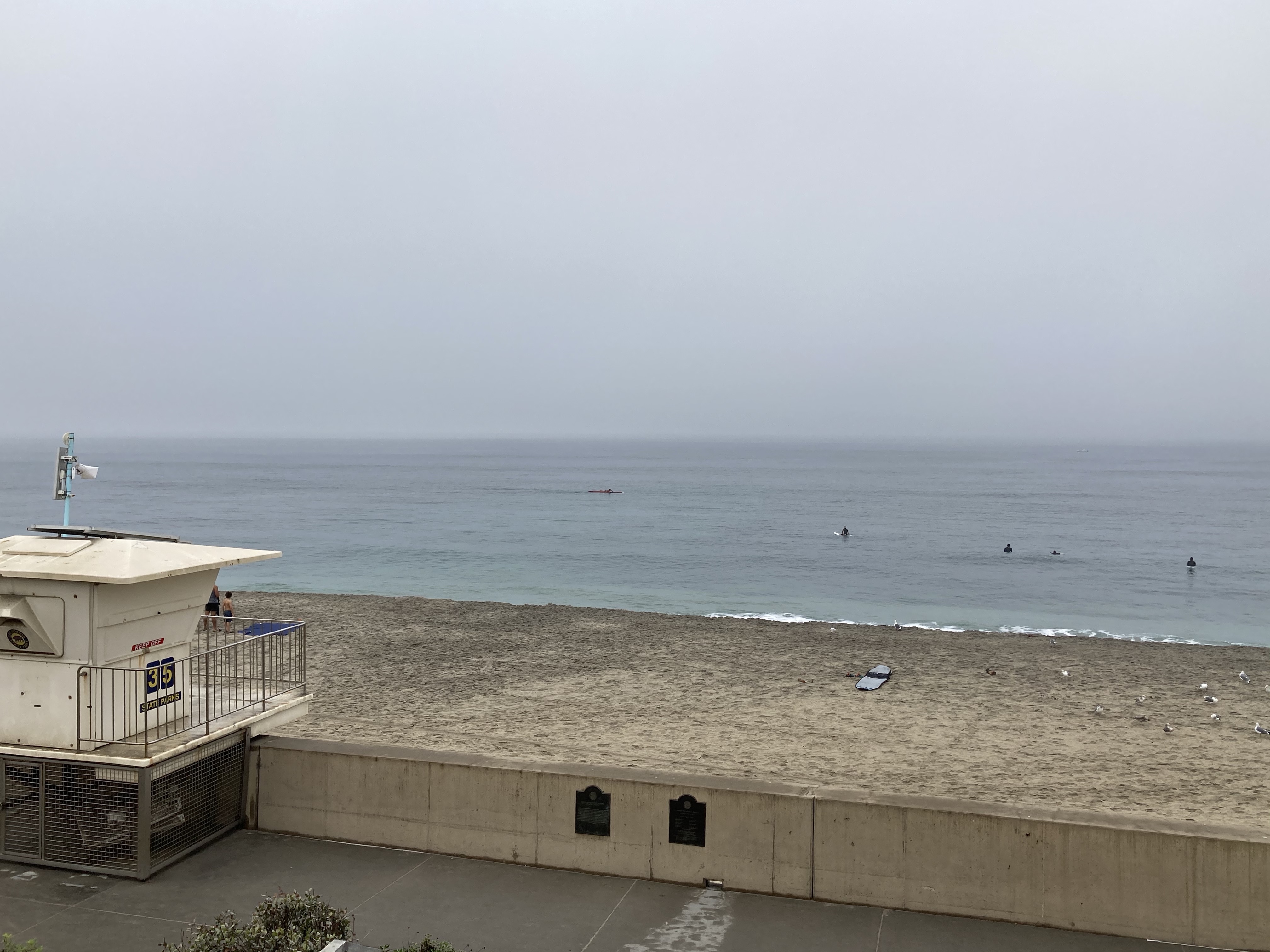
At the beach, there was the usual non-compliant non-mask wearers, but I wore mine, took my ocean photos, and turned back to walk home.
No wave too small if you’re on a SUP.Still foggy, but beautiful.
The lights were out at the intersection of Carlsbad Blvd. and Tamarack. There was utter chaos with cars and pedestrians, near misses, and impatient drivers. I crossed the street, defying a white SUV who was inching slowly toward running us all down, and saw a few police cars show up to direct the shitshow, so I thanked them for saving our lives and continued on my way.
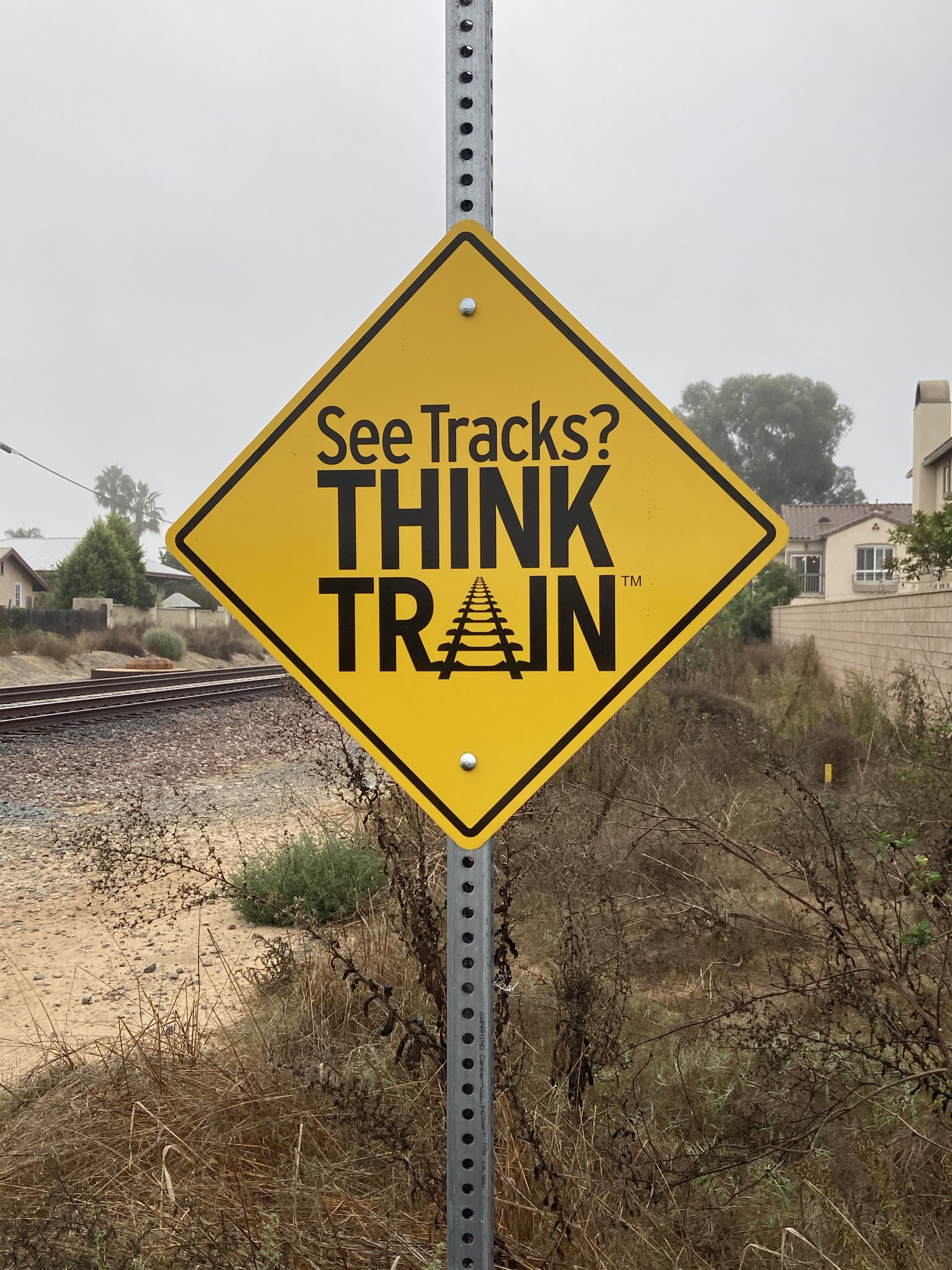
This was a new sign at the railroad tracks. I swear there’s a deeper, more profound meaning here, but I can’t figure it out. I don’t have a clue. What do you think?
I stopped at RiteAid and bought a couple of cute Halloween decorations to add to my display ‘cos they were on sale.
Six miles or so again. Except for a still sore left arm where I had the injections, I think I’ve fully recovered from the horrible side effects of these vaccinations. I’m no closer to answering life’s existential questions, but the song that came on as I was almost home was Sting’s If I Ever Lose My Faith in You, and I’m even more confused.
This year, October 10 is known as Columbus Day. Some states have proposed legislation to legally replace the holiday, but as of today, none have passed.
I don’t acknowledge Columbus Day because it’s more of the same; entitled males making unilateral decisions without regard for anything but their own selfishness.
They continually attempt to push candidates and legislation that will eventually completely strip women of any right to autonomy over our own body.
Even the grandkids know what this day really is all about: good for my son/DIL talking TRUTH.
This isn’t the post I had planned for Saturday but we have all heard the devastating news.
On Rosh Hashanah, Ruth Bader Ginsberg, Supreme Court Justice, died at the age of 87 from metastatic pancreatic cancer.
I think a lot of us had the same first thoughts; “Oh no, not HER” “Not now.””NOOO!!!”
We surely don’t need her gone, not now, not during this shitshow of a year that 2020 has become.
Hearing that horrible news (tragic for her family but tragic for our country and democracy, too) brought me back to the morning my mom (the original Charlotte) died of the same disease, metastatic pancreatic cancer.
Thanks to medical advancements, RBG was able to live a lot longer after diagnosis than my mom.
Hearing about her death brought up all those same traumatic feelings of loss that I felt when I found my mom had died. She lived with us and we had cared for her during her illness with the help of a great hospice.
I had checked on her at around 5am and she was fine, not in distress, still asleep, so I did a little cleaning and made my son’s breakfast so it’d be ready for him when he woke up ‘cos it was a school day. I don’t know what prompted me to check on her again so soon, but I did. She was still in the same position; she LOOKED like she was asleep, but there was a subtle difference. I had never seen a dead person in my entire 32 years on this earth, but I knew. I knew.
I checked her carotid artery and called the hospice nurse. I woke up Angel Boy (almost 7 years old) and managed to tell him all the right things. Hospice had suggested that I ask him if he’d like to kiss his grandma goodbye, so I did. And he did. That pretty much broke me, but I’m a stoic girl and you wouldn’t know I was broken. I can break on the inside but you won’t see it. Things had to be done so I did what needed to be done. I always do.
I miss my mom. Forever.
But this is about Ruth Bader Ginsberg, a brilliant woman whose entire life was inspirational. Her loss is an epic tragedy.
About RBG’s life, the film “On The Basis of Sex” featured a song written and performed by Kesha. Here’s an acoustic version. It needs to be the anthem of our revolution. First we mourn, then we fight.
Here Comes the Change
One day I’ll be gone The world will keep turning I hope I leave this place Better than I found it Oh it’s hard, I know it’s hard To be the lightning in the dark Hold on tight you’ll be alright You know it’s time Here comes the change We’re comin’ of age This is not a phase Here comes, here comes, the change Is it a crazy thought? That if I had a child I hope they live to see the day That everyone’s equal Oh it’s hard I know it’s hard To be the right inside the wrong Hold on tight we’ll be alright You know it’s time Oh here comes the change Oh we’re comin’ of age This is not a phase Here comes here comes the change Hope there’ll come a time when we We can live in and die free I hope…
#AnneFrank is trending today on Twitter; I wonder what she would have thought about social media? She never got the chance, though, did she, because she died in a concentration camp. I’m still angry and maybe that’s why I stand in solidarity with #blacklivesmatter and for the resistance against brutality.
I think I first read The Diary of Anne Frank when I was twelve or thirteen. The original version of the film is on Netflix, and today seems like a good day to watch it again and to honor her indomitable spirit and to remember what someone like Hitler can do to innocent people. Especially now.
Some of my favorite quotes:
–It’s difficult in times like these: ideals, dreams and cherished hopes rise within us, only to be crushed by grim reality…I still believe, in spite of everything, that people are truly good at heart.
–How wonderful it is that nobody need wait a single moment before starting to improve the world.
–No one has ever become poor by giving.
Human greatness does not lie in wealth or power, but in character and goodness.
–As long as this exists, this sunshine and this cloudless sky, and as long as I can enjoy it, how can I be sad?








 Enchanted Seashells | Princess Rosebud