SymphonyinYellow An omnibus across the bridge Crawls like a yellow butterfly And, here and there, a passer-by Shows like a little restless midge.
Big barges full of yellow hay Are moored against the shadowy wharf, And, like a yellow silken scarf, The thick fog hangs along the quay.
The yellow leaves begin to fade And flutter from the Temple elms, And at my feet the pale green Thames Lies like a rod of rippled jade. –Oscar Wilde
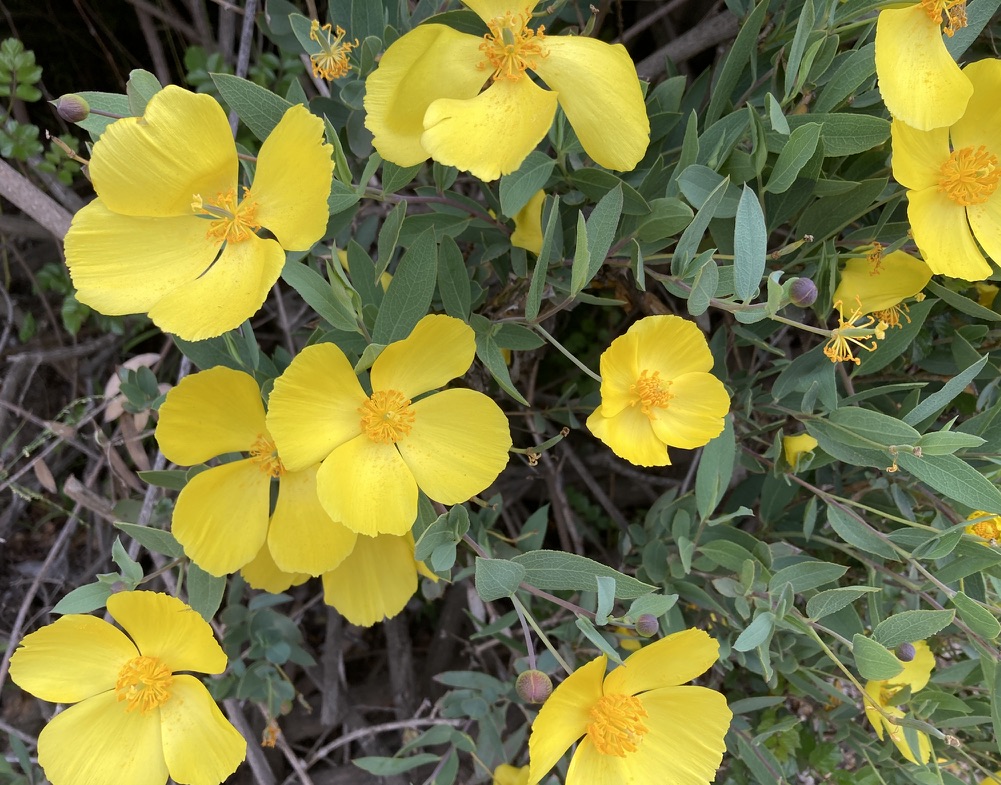
This Bush Poppy (Dendromecon rigida) is a California native shrub. It’s a tough and beautiful plant but only if planted in the right conditions. The Bush Poppy thrives on rocky clay slopes with excellent draining. If planted in sandier soils, it can handle supplementary water up to once a month. Prefers full sun. Flowers are beautiful, as are the long, thin, blue-green leaves.
Look at this lemony yellow azalea. I didn’t even know they came in yellow until I used the info app on my phone to identify this gorgeous girl. I think it’s actually called Rhododendron ‘Lemon Lights’.
This intense cosmic energy is not only messing with my sleep, but I was having strange battery issues with my laptop computer so I went back to the Apple store where I had once met Al Gore (yes, VICE PRESIDENT Al Gore) and asked the Genius Bar tech to perform a diagnostic check. The tech didn’t do much but it’s all better, so who really knew what caused the problem, whether it was a hardware glitch or a solar flare, or other planetary influences. The good thing is that it’s back to working perfectly.
There were lots of traffic accidents and horrible drivers everywhere yesterday. The freeway was completely shut down for hours because of an insane situation with a woman who allegedly vandalized a vehicle and carjacked a Lyft. She led the police on a short chase but finally, peacefully, surrendered to police after a prolonged standoff on Interstate 5. It looked like WW3 with all of the military-like Special Weapons and Tactics Team surrounding the vehicle. The woman was taken into custody on suspicion of felony vandalism, brandishing a weapon in a threatening manner, assault with a deadly weapon, carjacking, resisting arrest, and felony evasion of police.
That’s way too much negative energy for ME to deal with and I’m so glad I wasn’t stuck for hours on the freeway. I felt lucky that I had made a spontaneous last minute decision to take an alternate route home. I heard all the sirens though, but had assumed it was simply another accident.
Time to take a deep breath, stay home, work in the garden, listen to the birds, and read a poem or two while cultivating some zen as well as my veggies.
How I Go To The Woods by Mary Oliver
Ordinarily, I go to the woods alone, with not a single friend, for they are all smilers and talkers and therefore unsuitable.
I don’t really want to be witnessed talking to the catbirds or hugging the old black oak tree. I have my way of praying, as you no doubt have yours.
Besides, when I am alone I can become invisible. I can sit on the top of a dune as motionless as an uprise of weeds, until the foxes run by unconcerned. I can hear the almost unhearable sound of the roses singing.
If you have ever gone to the woods with me, I must love you very much.
From my native garden in the front yard, where we planted everything but a lawn. We have white and purple sages, buckwheat, coffeeberry, lemonade berry, ceanothus, and a sprawling wild Rock Rose.
I loved the way the sun was shining on these hot pink blooms. No filter, nothing but natural beauty.
Rock Rose
The flower is used to make medicine and is commonly used in Bach flower remedies. Rock Rose is purported to treat panic, stress, extreme fright or fear, and anxiety; and for promoting calmness and relaxation.
The oleo-resin obtained from the leaves and stems is used as a commercial food flavoring in baked goods, ice cream, and chewing gum.
Leaves, flowers, and stems can all be harvested and used to make tea. I haven’t tried it yet, but I plan to do it soon.
When I was in college, we lived across the street from a wild place, an abandoned and untended avocado grove blanketed with nasturtiums. Their long tendrils would wind up and around the gnarled trunks.
After school, my friends and I would sit under the trees and pick tiny avocados from the low hanging branches and gorge on them until we were full, and then we’d lie back in the pillowy nasturtium leaves and pretend we were forest fairies.
We’d sometimes weave orange and yellow tiaras through our hair, and always pick a bouquet to bring home.
I love their tangy but sweet fragrance and often add the flowers to salads, but only the ones from my garden that I’m sure are pesticide-free.
All the rain birthed my own enchanted nasturtium forest this year.
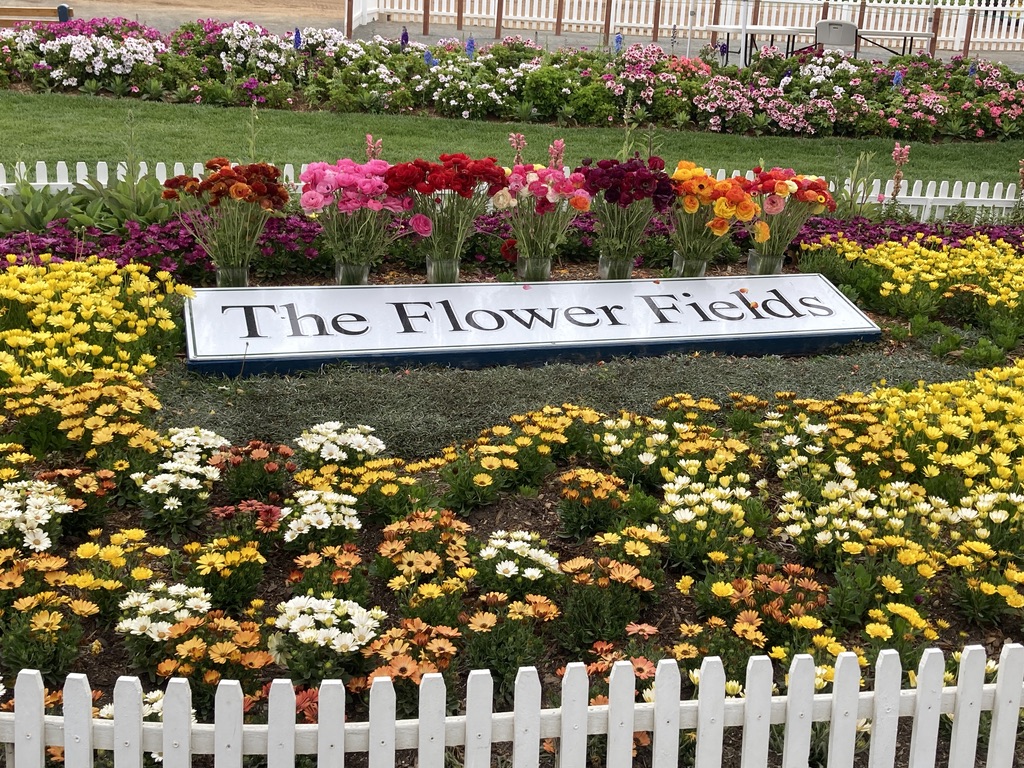
I remember when rows upon rows of a colorful flowering ranunculus tapestry was only a quirky, delightful curiosity we’d point at as we drove north along the freeway. Back then it was an annual locals-only kind of attraction and now The Flower Fields enchants visitors from all over the world.
I can’t believe that it took me this long to visit The Flower Fields in all its glory, but it’s a definite recommended destination. It was a truly enjoyable day and best of all, it’s simply impossible to take a bad photo there!
The Flower Fields are located off the freeway at Palomar Airport Road in Carlsbad. In addition to forty acres of beautiful ranunculus in peak bloom, there are tractor rides, wine tastings, food, yoga classes, a Mother’s Day picnic, and day-long educational and fun activities for children of all ages.
And a butterfly garden!
HISTORY: The Flower Fields today are a direct result of nearly eighty-five years of floral cultivation that began with Luther Gage, an early settler and horticulturist who settled here in the early 1920s. Mr. Gage brought ranunculus seeds to the area and began growing them in his fields next to Frank Frazee’s small vegetable farm in South Oceanside. In 1933 Frank Frazee also started growing ranunculus and introduced his son Edwin to the art of seeding, cultivating, and irrigating this beautiful flower.
This is what it used to look like — the fields of flowers grew close to the freeway:
1970s. Photo credit: Bob Gardner
INFO: Open daily from 9:00am-6:00pm until Mother’s Day (Sunday, May 14th, 2023) Ongoing Specials (Starting March 6th) Mondays – With the purchase of one adult or one senior/military, you receive one child’s ticket free (ages 3-10)| Tuesdays & Wednesdays – Between 1:00pm-4:00pm, receive $2 off adults, seniors/military and children’s tickets. Buy tickets online at theflowerfields.com
(Excluding the vintage photo, all photo credit to Enchanted Seashells.com) @the_flower_fields
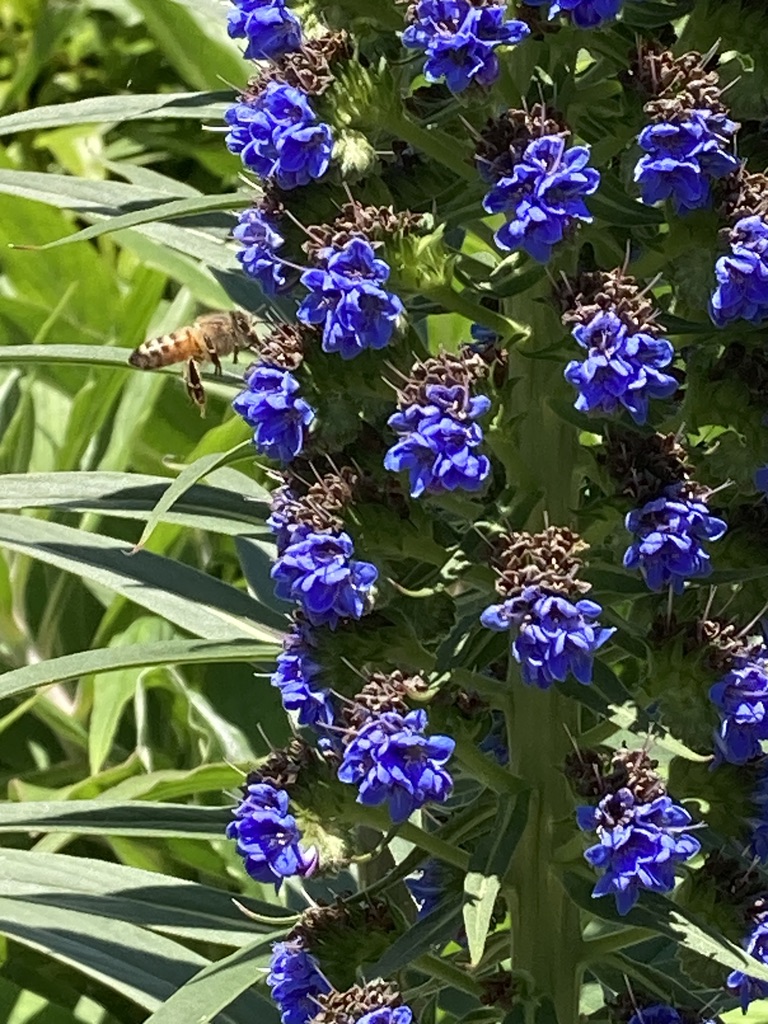
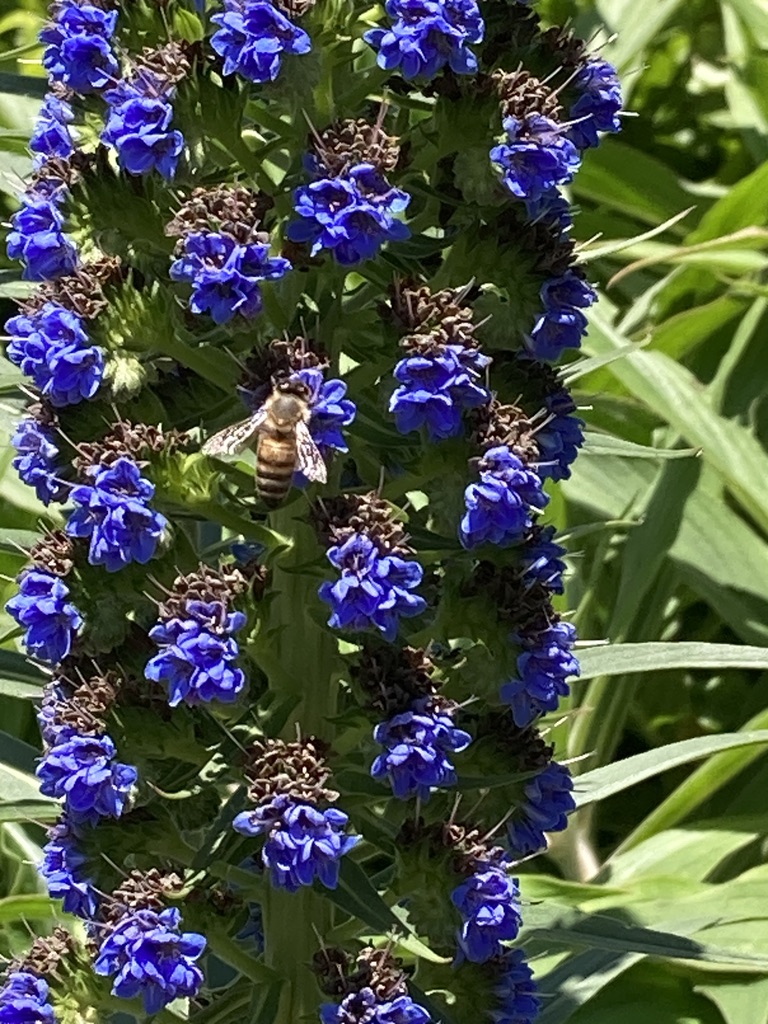
I’m referring to Pride of Madeira, the superstar of my garden!
This plant REALLY loves the environment here at Casa de Enchanted Seashells. I read that it’s becoming invasive in places along the coast and I can see how that could happen as it easily reseeds itself.
Native to Madeira Island, north of the Canary Islands, it’s a tough perennial and can survive all summer with little to no water. Since I think we’ve seen the last of our record-breaking rainfall here in SoCal, that’s exactly what they’ll have to do to survive.
And in a different part of the garden, a slightly different hue…It’s HUGE.
Bees love it too. So do hummingbirds and butterflies.
Pride of Madeira grows to about six feet tall and some of my specimens are twice as wide as they are tall.
I quite literally have dozens of baby Prides if anyone wants to plant them in their garden!
(I know that one is not really supposed to end a sentence with “in”, but the proper way sounded stilted and phony, so I made a decision based on this information: “never ending a sentence with a preposition is a myth. It’s something wrongly attributed to English that is actually a real rule in Latin.”)
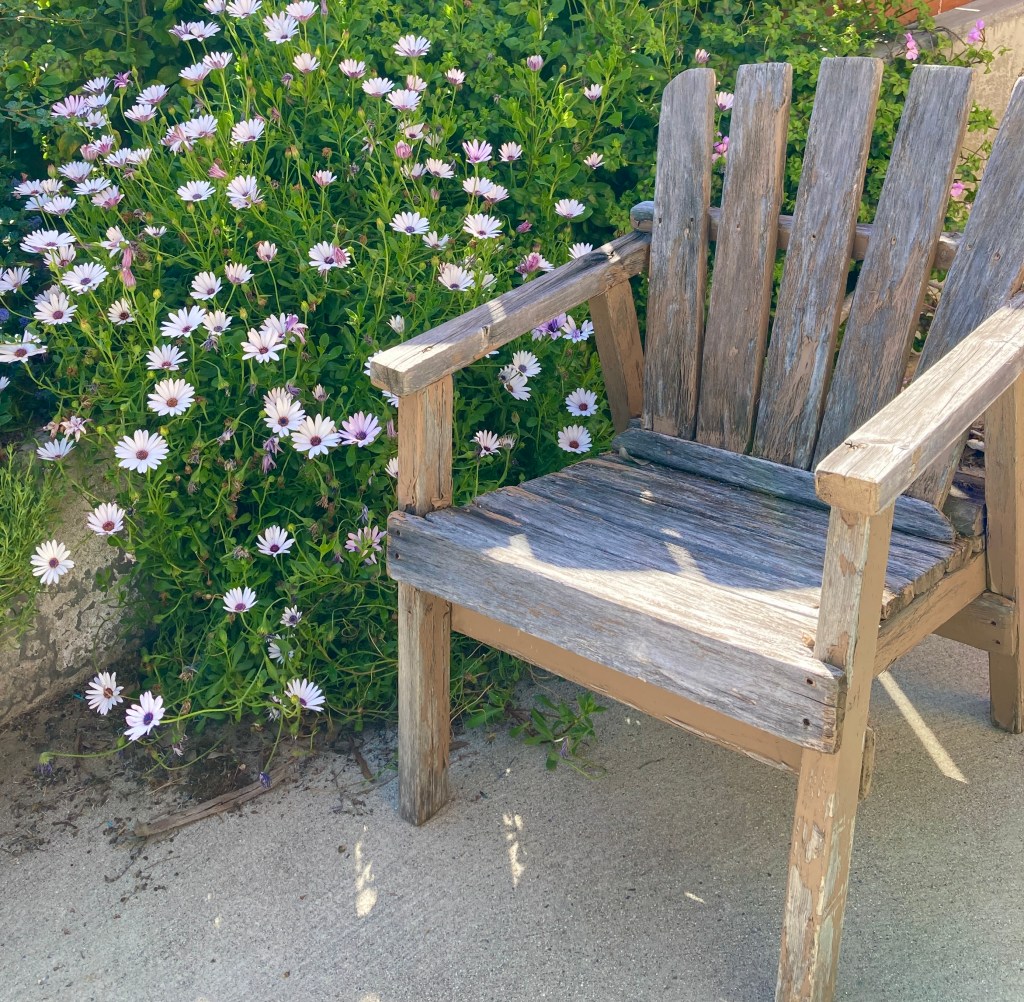
So…on a walk a couple years ago, I found this chair with its turquoise-painted partner tossed out on the street. They looked lonely and sad, so I went home to get my car and rescued them both.
I placed the chairs on the side of the house with every intention of brightening them up with a new coat of paint but their weary and worn character grew on me. I’ve left them to naturally weather every storm just as they are — honest and true — with nothing to camouflage their straightforward authenticity.
I like them just the way they are.
Funny enough, I get a lot of compliments from neighbors who walk by and comment about how they love the artful way the flowers seem to embrace this simple old chair.
The Chair That No One Sits In
You see them on porches and on lawns down by the lakeside, usually arranged in pairs implying a couple
who might sit there and look out| at the water or the big shade trees. The trouble is you never see anyone
sitting in these forlorn chairs though at one time it must have seemed a good place to stop and do nothing for a while.
Sometimes there is a little table between the chairs where no one is resting a glass or placing a book facedown.
It might be none of my business, but it might be a good idea one day for everyone who placed those vacant chairs
on a veranda or a dock to sit down in them for the sake of remembering whatever it was they thought deserved
to be viewed from two chairs side by side with a table in between. The clouds are high and massive that day.
The woman looks up from her book. The man takes a sip of his drink. Then there is nothing but the sound of their looking,
the lapping of lake water, and a call of one bird then another, cries of joy or warning— it passes the time to wonder which.
William James Collins, Poet Laureate of the United States from 2001 to 2003.
After all the rain we’ve had here in Southern California, every bit of land is awash in springtime color.
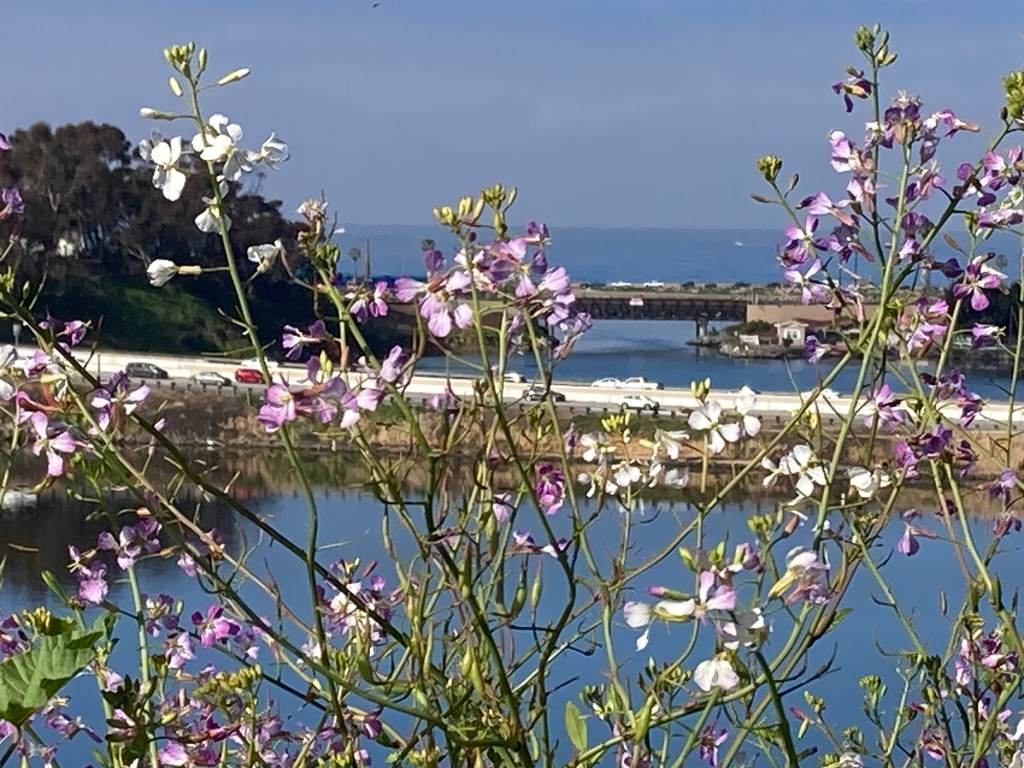
A picturesque view of the lagoon, train tracks, and Pacific ocean through Purple Mustard, an invasive weed:
I call this plant Beach Daisy, definitely a weed, if not also invasive…
And finally, I’m impossibly happy because the wildflower seeds I planted last year in my native garden decided to sprout and present me with lovely spires of lupine:
**All photo credit belongs to Enchanted Seashells.
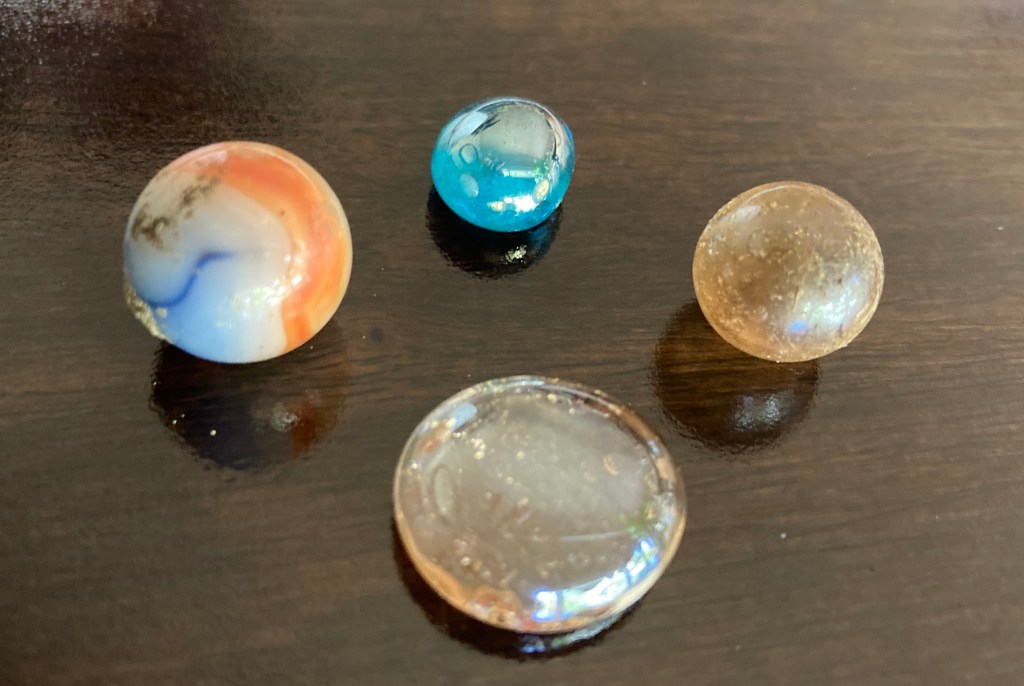
My crow cousins have been leaving gifts for me all around the garden and deck.
Shiny and sparkly!
So far I’ve discovered these four baubles. I always look up to see if I can catch the gift giver; so far I haven’t, but I say thank you out loud as I pocket my treasures.
Crows are known to give small gifts to people who pay attention to them or feed them. The phenomenon is actually called “gifting”. I don’t feed my local crow family as there is plenty to eat without my intervention, but I do talk to them and generally love their presence, so maybe they feel that emotion and return the affection. I’ve read that crows (and other corvids) remember the faces of those who are mean to them and those who are especially kind.
Some of my neighbors don’t appreciate our community of crows as much as I do, and I’m positive they aren’t receiving the same kinds of gifts like I am.
I’m full of gratitude to my bird family Thank you, cousins!






 Enchanted Seashells | Princess Rosebud