This is my one of my dry riverbeds. (The other one is in the front garden.)
I proudly carried each and every rock and placed them with loving intention.
It’s not so dry now! Yesterday’s relentless rain had other ideas.
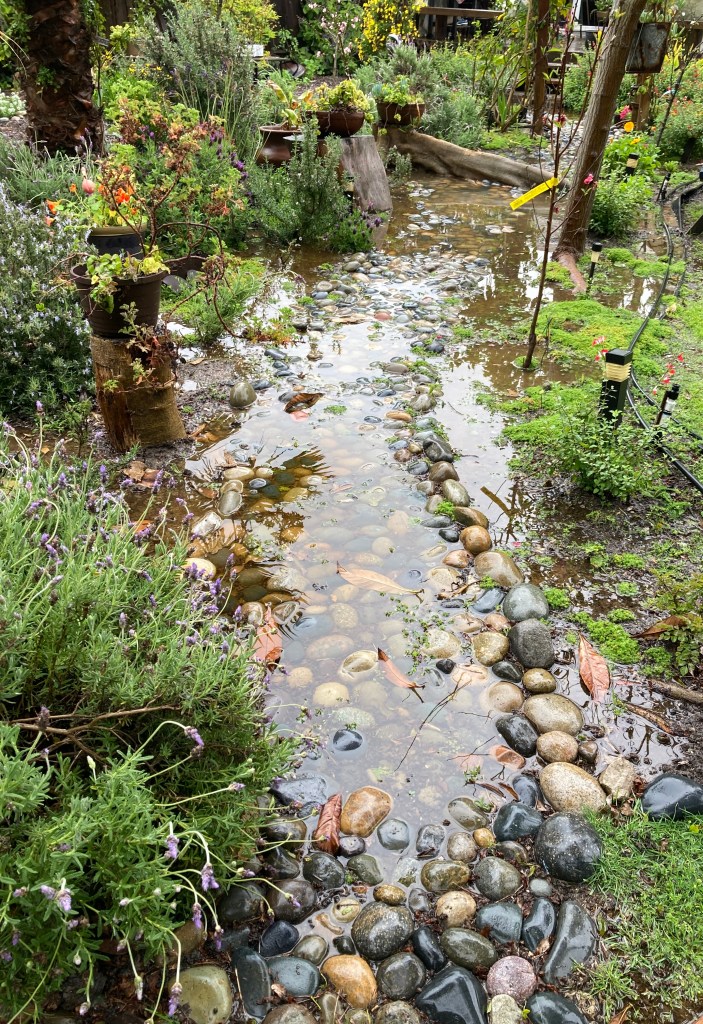
This is my one of my dry riverbeds. (The other one is in the front garden.)
I proudly carried each and every rock and placed them with loving intention.
It’s not so dry now! Yesterday’s relentless rain had other ideas.
Casa de Enchanted Seashells gardens are alive, blooming with color and fragrance.
In one week, since the last rain, most of the fruit trees are flowering and my florals are flourishing. It brings much joy to create a bouquet from the fruits of my own efforts, a labor of love.

This lavender is vibrant!

Peaches!

Plums!

More peaches!

Apples!

We’re expecting more rain this week. 2023 has been a crazy wet year in SoCal, but it’s just what we need to end the drought for a while. The only downside is horrible seasonal allergies, but that’s a small price to pay to live in paradise.
This Lemonade Berry tree has almost completely taken over my front yard, surpassing our wildest intentions.
Once again, my brilliant Angel Boy didn’t think far enough into the future when we turned our front garden from lawn into a haven for California native plants.

Lemonade Berry (Rhus integrifolia) is an evergreen shrub or small tree. It tends to grow upright (10- 30 feet tall), but sprawls next to beaches. It’s often found in coastal canyons where it sometimes dominates entire hillsides. (YES!)
The Lemonade Berry’s petioles are pink or brownish and leaf blades are leathery. The flowers appear from February to May. The fruit is red to gray and has a tart flavor which gives the plant its name. Lemonade Berry is an important wildlife plant and the berries are a significant food source for birds and small mammals.

The Cahuilla and other California native peoples ate the fruits of the lemonade berry raw. They soaked the berries in water to make a beverage, and ground the dried berries into flour for a mush or to add to soup. It also has medicinal uses.
As Food:
Ripe berries of the sugar bush or lemonade berry can be soaked in hot water to produce a tart lemon-tasting beverage. Steeping in almost boiling water produces a stronger drink than steeping in sun-heated water. For a strong drink, you will need a ratio of one-part berries to two parts water.
These berries make a tart snack if picked right off of the bush, but only if sucked for their juice; the pulp is not swallowed. The berries have small hairs that can upset your stomach. Enjoy the bitter refreshing taste and spit the berry out when done.
Medicine:
Tea made from the stems can be used to treat coughs. The tea made from the bark, berries, or leaves steeped in cold water can be gargled for sore throats and cold sores.Caution: Some people are allergic to the bark, roots, and leaves, so use it sparingly the first time.
Some info curated from Santa Monica Mountains Trail Council
California Lilacs, or Ceanothus, are some of our most fragrant and colorful shrubs here in California. They are also evergreen and very drought tolerant.
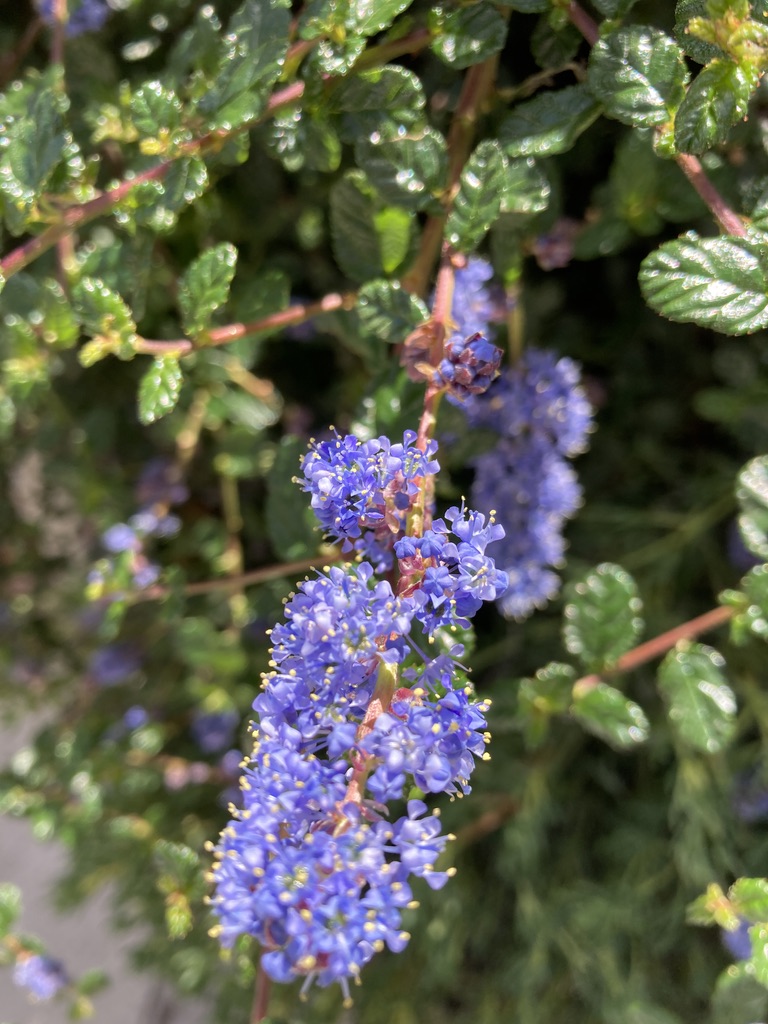
Our extreme rain has caused my prize ceanothus plant to bloom like it’s never bloomed before.
What’s even more amazing is that a few years ago I thought it had died and planted other things in its place. When I noticed a few sprouted leaves, I decided to watch and see what happened.
Magic happened where I couldn’t see; beneath the topsoil.
Today, it’s taken over the entire area next to my driveway. It’s a testament to tenacity, determination, and perseverance; great qualities to emulate.
This ceanothus is so vibrant and alive that it takes my breath away.


Whether they’re House Finches or Robins doesn’t really matter. They are adorable!
I was standing at the kitchen sink washing dishes and looked out at an amazing sight. There were literally dozens of chirpy birds invading my garden, SO MANY I couldn’t even count them all.
I no longer have feeders because of my arch nemeses, RATS, so what they’re feasting on here is actually an invasive species, a Brazilian Pepper tree that somehow sprouted into the neighbor’s yard and they didn’t get rid of it like we did.
There’s no way I could capture as many as there are, but I’d say definitely more than fifty of these lovely red breasted birds are visiting Casa de Enchanted Seashells.
This makes sense because they’re eating red berries from the pepper tree.
They stayed for about an hour, saturating my world with their most delightful song and chirpy calls to friends and family. Every tree in the garden is full of these guys as well the rosemary and lavender bushes.
I’ve never seen anything like this. For me, It’s as exciting as spotting a pod of whales or dolphin. I’m grateful they chose my garden to visit. Pure joy!
On an early morning walk before the rain started (yes, we’re getting more sky water!), I spied this colorfully striking succulent.

Sticks on Fire, sometimes called Firesticks (Euphorbia tirucalli), is a shrubby succulent with bright red, pink, orange, or yellow stems.
The more sun it gets, the more ‘fiery’ it appears. The sap of this plant is sticky/milky and may cause irritation to skin as there are mild toxins.
Many succulents in the euphorbia genus, such as the pencil cactus and crown of thorns, are also poisonous to both cats and dogs. Symptoms of poisoning from ingesting this succulent range from gastrointestinal upset to skin and eye irritation.
I made it home just in time! That’s not a speck on your screen, it’s an airplane heading to our local airport.
After a few very rainy days, it’s dry for a while until the next storm appears. I see a bit of blue sky as the contrasting backdrop to my Cape Honeysuckle trained to climb over an arbor.
The sweet nectar of its orange-red flowers attracts butterflies and hummingbirds.

The Cape Honeysuckle (Tecoma capensis) produces long, thin elongated fruit capsules that contain numerous seeds easily dispersed by the wind.
It’s easy to propagate from a cutting, so I have lots of them growing in different parts of the garden.
Yup, there’s a lot going on in this photo; a path leading to a pond, the arbor of Cape Honeysuckle and Peppermint-Striped Climbing Roses, and a giant Bird of Paradise.
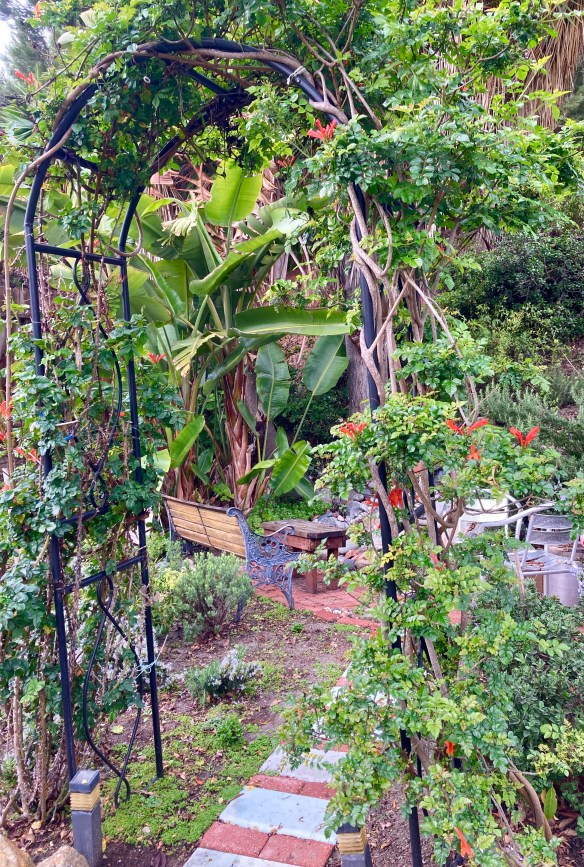
Everything needs some major work, but it’s a labor of love.
#WordlessWednesday
While other parts of the country feel the effects of a brutal winter storm, it’s sunny and relatively warm in SoCal.
Relatively, because I’m freezing even though it was in the mid-sixties today. I’m in a coat, scarf, and beanie. As much as I love to be outside, I HATE to feel cold.
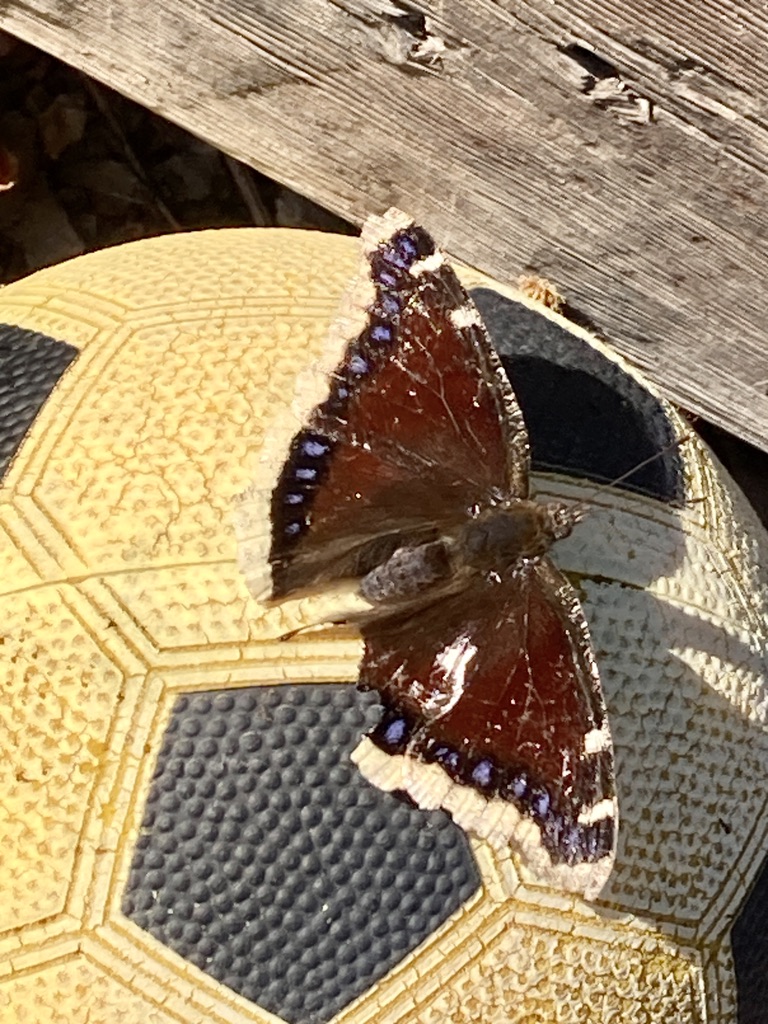
This courageous Mourning Cloak butterfly savors the rays of the afternoon sun on a random soccer ball just before the coastal fog rolled in.
Mourning Cloaks live longer than most butterflies—ten months or more— so I hope this one finds a sheltered spot during next week’s forecasted rainy weather.
Battered, bruised, but still beautiful, and glorious to behold as she warms her wings.


I wish I knew why this passionflower vine stopped growing; it’s one of my favorites.

Did you know that passionflower offers healing properties? I’ve never tried it, but according to Dr. Andrew Weil, passionflower is used for stress reduction, calming without sedation, and overcoming insomnia when combined with other calming herbs such as valerian and lemon balm.
Studies suggest that passionflower may reduce anxiety in patients undergoing surgery. Another study found that passionflower had similar affects as an anti-anxiety medication in reducing general anxiety. The properties in passionflower are thought to promote calming effects by increasing the levels of the chemical gamma-aminobutyric acid (GABA), which reduces the activity of some neurons that cause anxiety.
Disclaimer: DO NOT take passionflower if you are pregnant or breastfeeding. For others, passionflower is generally considered to be safe and nontoxic in recommended doses and for less than two months at a time.
Don’t let these gently flowing fronds in this photo deceive you.

Pampas grass is invasive and chokes out the growth of beneficial California native plants. This out of control stand of grass invaded all the scorched earth from the big fire in Carlsbad almost two years ago. Visit the link for that post: https://enchantedseashells.com/2021/01/20/fire-in-carlsbad/
Interesting fact: Pampas grass is not illegal in the United States, though it is illegal in Australia and carries a $10,000 fine.
Pampas grass is a quickly growing grass that forms massive clumps along roadsides, steep cliffs, river banks, and open areas that have been disturbed by human activities or natural disturbances. Introduced to Santa Barbara, California in 1848 by nursery operators, pampas grass has spread all over the state, threatening native plants and the animals that rely on them.
An individual pampas grass stand can produce millions of seeds annually that travel several miles, and because these grasses are very tolerant of intense sunlight, drought, and frost, they are very efficient at establishing in many habitat types. Due to the fact that pampas grass can live over a decade, it has become a favorable plant for people to grow in their gardens.
Invasive plants such as pampas grass displace native plants and create habitats that are lower in biodiversity. Furthermore, pampas grass has leaf blades that are highly undesirable as food or shelter to birds and other wildlife, and can actually cause physical harm to those animals, including humans, because the leaves are extremely sharp. Therefore, it is important that we do our part by not planting pampas grass in our gardens, but instead plant native plants that are comparably beautiful and provide the same utility.
Giant wildrye is a grass that, like pampas grass, forms dense stands in a variety of different soils. It remains green year-round and is drought tolerant, but will also survive in regularly watered locations, meaning little maintenance is required to keep this grass looking great in your garden throughout the changing seasons. Giant wildrye has beautiful blue-gray or dark green leaves that are topped by clusters of yellow flowers during the summer and although this grass prefers full sunlight, it can also tolerate shady locations.
Unlike pampas grass, Giant wildrye is native to California and does not readily outcompete other native plants for resources such as space, light, and nutrients. It also spreads slowly compared to pampas grass, and therefore, it is much easier to contain within your garden fences. Furthermore, while pampas grass is not desirable to most animal species, Giant wildrye attracts various birds that enjoy their seeds.
Giant wildrye is a great native alternative to invasive pampas grass because it provides the same beauty and utility in your garden, but unlike pampas grass, it contributes to higher biodiversity and does not negatively impact the natural environment or those animal species that rely on it. Try out this native plant alternative in your garden today!
For more information on any of the topics above, please contact the Native Plant Program at nativeplants@wildlife.ca.gov.
From: https://wildlife.ca.gov/Conservation/Plants/Dont-Plant-Me/Pampas-Grass

