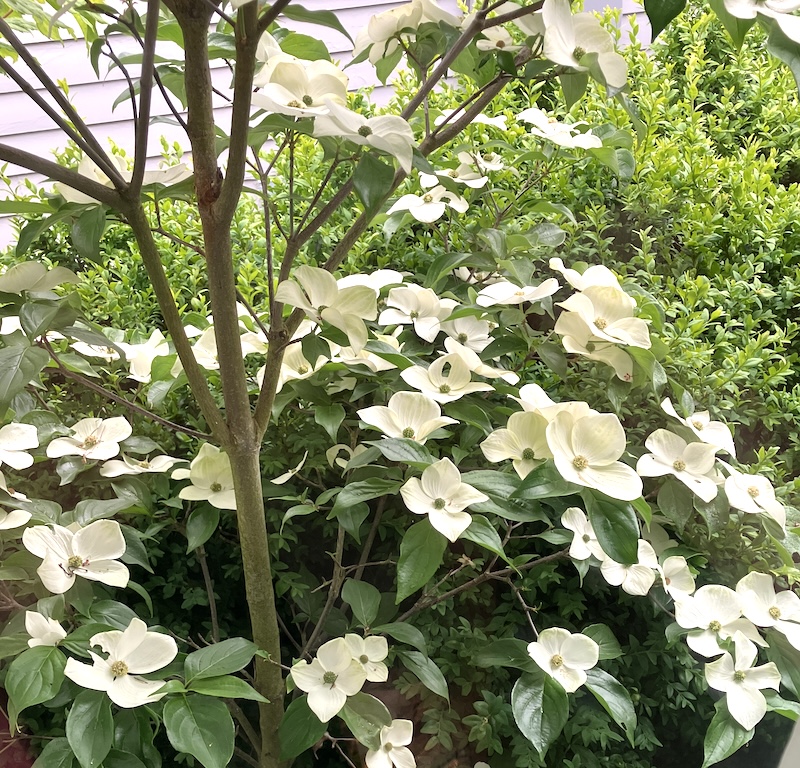
“Come spring, in the shaded forests near my home Blooms the elegant and lovely dogwood tree…” — Shakespeare
“In another world and another day. Moonlight turns the purple lilacs blue...” — Conrad Aiken
These are two of my favorite flowers. I really wish they thrived in Southern California, but sadly, they don’t. I have to see them in photos from the Pacific Northwest and try to recollect the alluring fragrance.
The first Saturday in May is World Naked Gardening Day.
We’re encouraged to wear NOTHING but a sunhat and sunscreen, to pick up a trowel or a rake, and seed and weed au naturale.
Why garden naked? Our culture needs to move toward a healthy sense of both body acceptance and our relation to the natural environment. Gardening naked is not only a simple joy, it reminds us–even if only for those few sunkissed minutes–that we can be honest with who we are as humans and as part of this planet. and that’s also a definitely NOT ME, whether it’s “world wide” or “worldwide”! Curated from https://naturisteducation.org/wngd/
Today, you’ll find me in the garden, fully clothed, planting peas and beans and mixed leafy greens.
However, if YOU choose to celebrate in your birthday suit, DO NOT send pics!
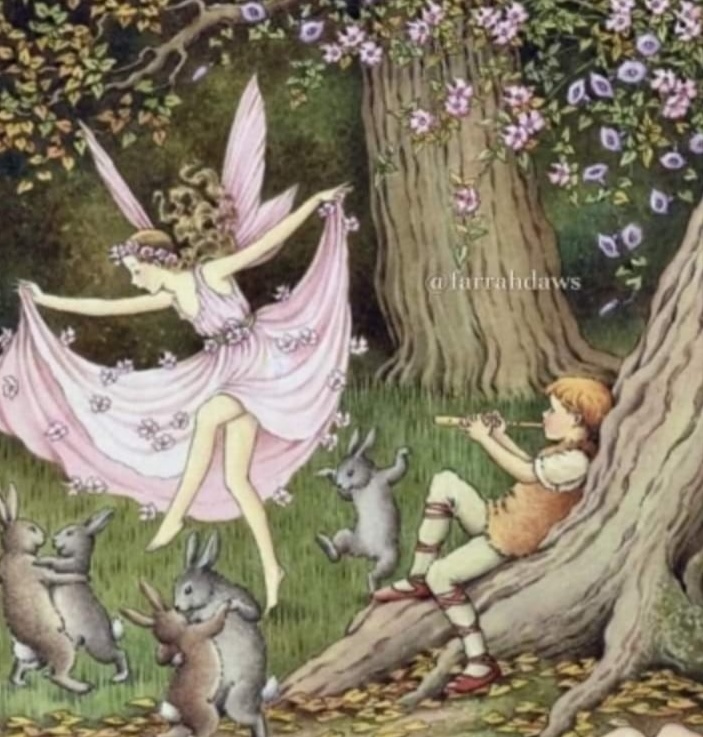
Gather all the little children With May flowers in their hair For they shall dance Around the maypole For they shall dance The day away
May Day blessings to all – A little May Day poem by Athey Thompson
For me, the month of May is the BEST not only because of Mother’s Day but it’s also my birthday month.
Last year Mother’s Day and my birthday fell on the same day. It’s an extra special treat for my two favorite days to be combined into one celebration.
The best known modern May Day traditions include dancing around the maypole and crowning the May Queen. Fading in popularity is the tradition of giving of “May baskets”, small baskets of candy or flowers. I think we should revive that adorable custom, don’t you?
Just in time for May Day, I found an adorable porcelain flower basket at Goodwill for about three dollars and I HAD to bring it home with me.
So far, this month started off in an ah-MAY-zing way.
Since it wasn’t a great video, I won’t post it, but THREE coyotes came to visit last night– THREE! — all together, and early this morning at first light, another coyote visit was captured on my wildlife camera. That’s NEVER happened before and I am soso excited.
The weather is warming up; all the fruit trees are flowering, the roses and ceanothus and lavender are in bloom, and baby birds are hatching.
Beltane, which takes also takes place on May 1st, is a celebration of the abundance of Earth and the forces of Nature. Bonfires are traditionally set to engender a sense of connection with ourselves and all living beings, but that wouldn’t be a smart thing to do in our wildfire ravaged state, so the flame from a safe candle must suffice.
I can’t post video any other way on WordPress so I hope you’ll be able to view this spectacular bobcat that came to my garden DURING THE DAY with a RAT in his mouth!
Here’s how the story unfolds: Yesterday morning around 6:30 a.m., I saw something on the lawn. I went out to look and it was a mangled rat. Hmmm, I said to myself, that’s gross, but I bet a hawk or owl dropped it. A little later, I walked up the stairs and took the SD card out of my wildlife camera that’s situated on the lower half of the hill and brought it inside to check, like I do on a weekly basis.
I was absolutely blown away by this video!
Bobcats (and coyotes) visit most nights, but this is the very first time I’ve captured video of a daytime stroll through here — with the added bonus of a meal.
It might look as if he walks away, but keep watching for his return along with an early dinner. As he makes his way down the steps, I realize the bobcat is the reason for the rodent remains I found on the lawn. This bobkitty is so jawdroppingly beautiful, I’ve watched the video at least a dozen times.
Bobcats are incredibly elusive animals and a bobcat sighting is a rare occurrence. Although bobcats are primarily nocturnal, they may be seen during the day while hunting/foraging for food, especially between April and July when they are most likely to have dependent young.
The only part of this momentous event that makes me a little sad is that I was HERE at that exact time and didn’t have a clue that I should have looked out the window that faces the garden as it would have been the greatest day in my life, right up there with seeing wolves in the Lamar Valley at Yellowstone, (although the temptation to want to run outside and say “here kitty, kitty” and pet him is strong.)
I am beyond grateful that these creatures feel that my garden (and me) are a safe haven to explore.
What might it mean? Seeing a bobcat carries a powerful spiritual message. It could be a sign that we need to tap into our inner strength and independence. The bobcat embodies resilience, encouraging us to stand our ground in the face of challenges.
Additionally, the presence of a bobcat might be a call to explore the mysteries of our life. It’s an invitation to delve deeper into our personal spirituality and uncover truths that may be hidden or suppressed. A bobcat can indeed be seen as a good luck spiritual symbol. https://lifeadventurously.com/spiritual-meaning-of-bob-cat/
This is a good time to remind us all about the horrors of using poison to control rodents:
Rat poisons don’t just kill rats; they kill wildlife too. Wildlife species are exposed to anticoagulant rat poisons when the poisons are used in urban and agricultural areas to target species such as rodents. But those who consume the poisons do not die immediately of the internal bleeding they are intended to cause. It can take more than a week for a poisoned rodent to die. In the meantime, the poisoned animal may be vulnerable to predators, and if a predator such as a bobcat preys on the poisoned rodent, the bobcat becomes poisoned too. Thus, poisons enter local food webs and become especially harmful to animals at the top of the food chain. Through a process called bioaccumulation, animals at the top of the food chain absorb toxins from eating lots of different prey animals, but their organs cannot filter out the toxins, causing the poisons to accumulate in their systems. As a result, some of the most iconic species in California – bobcats, coyotes, foxes, mountain lions, owls – are the most vulnerable to this indirect poisoning. https://panthera.org/blog-post/surprising-effects-rat-poison-bobcats
Let’s go To where the magic waits for us Where our hopes, our dreams Our wishes. Come true. Athey Thompson
Yesterday was a magical day full of miracles.
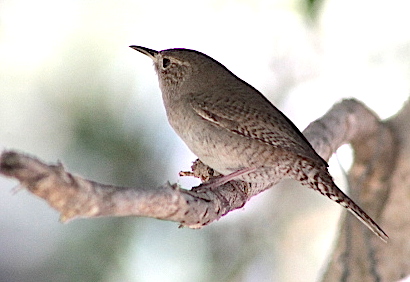
In the garden, I looked up in a tree and saw two hawks mating! (I didn’t take any photos to protect their privacy.) Last night one of the wild baby bunnies was on the deck and scratched at the screen door like it wanted to come in the house (I didn’t open the door, but I was tempted), and the third miracle is that my adorable little vireos are once again nesting in a brand new bird house!
Vireo
“And as to me, I know nothing else but miracles” — Walt Whitman
A new walking trail opened up in the city of San Marcos.
It’s inland and a bit of a drive, so it’s best to get there in the early morning or late afternoon because the temps are going up.
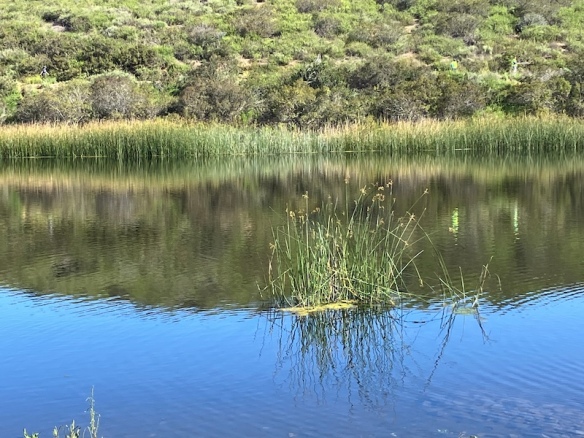
The trail is only a mile or so, not at all strenuous, but the views are magnificent with California lilacs and mature ceanothus surrounding the South Lake Reservoir — built in 1959, although it hasn’t been used as a source of drinking water since 1984.
I doubled back instead of completing the easier loop and that added an extra mile to the hike.
There’s a lot of coastal scrub, coots, ducks, redwing blackbirds, deer, bobcats, and coyotes. I wish I had seen deer; maybe next time! South Lake is also home to a rare native turtle; the Western Pond Turtle, and I’m sorry to say that I didn’t see them, either.
Definitely remember to bring water and a wide-brimmed hat as it gets super toasty in the sun!
It’s time to prepare the garden for spring vegetables. Every year I attempt to win the battle with rodents and bugs and lack of sky water; sometimes I win, sometimes they do…
I have a couple new ideas. I purchased coconut coir bricks to rehydrate and mix with the existing soil in my raised bed and I thought I’d try cardboard box planters, too, inside the raised bed.
Maybe one day I’ll be able to build my own Hügelkultur.
“Hügelkultur” (pronounced hyoo-gul-kulture) is a German word that means mound culture or hill culture. A hügelkultur is a sloped and raised planting bed filled with topsoil, wood, and organic materials. Germans and Europeans have practiced it as a gardening method for hundreds of years.
Instead of gathering branches, leaves and grass clippings for yard waste trash pickup or to toss in the compost, build a hugel bed. Mound logs, branches, leaves, grass clippings, straw, cardboard, petroleum-free newspaper, manure, compost, or whatever other biomass you have available, top with soil and plant your veggies.
The advantages of a hugel bed are many, including:
The gradual decay of wood is a consistent source of long-term nutrients for the plants. A large bed might give out a constant supply of nutrients for decades. The composting wood also generates heat which might extend the growing season.
Logs and branches act like a sponge. Rainwater is stored and then released during drier times. Actually you may never need to water your hugel bed again after the first year (except during long term droughts).
We had a bit of rain yesterday which is a perfect opportunity to prep the coconut coir and plant seeds. I’ll start with my favorites: mixed greens, tomatoes, beets, chard and kale, cucumbers, snap peas, beans, peppers, and zucchini (of course).
There’s nothing more adorable than watching the first little sprouts emerge, right? I can’t wait!
This isn’t the greatest photo; the sun kind of distorted the sharp lines and colors, but I was lucky enough to capture my lizard friend sunning himself on an orange tennis ball
This other guy visits every day; I can always tell who it is by his sort of mutilated tail. He seems to know when I’m in the garden and runs over to greet me.
Hello, handsome! They might be referred to as cold-blooded, but still have their own distinctive personalities.
Lizards like to snack on mealworms, but I never seem to remember to buy them at the pet store. I know they have enough to eat because they’re doing a great job cleaning the garden of unwanted grasshoppers, crickets, and beetles.






 Enchanted Seashells | Princess Rosebud