Wolves, Bears, Bison, Moose, Elk, and more…

Please join me in stopping  the insane murders of these magnificent creatures.

Please join me in stopping the insane murders of these magnificent creatures.

Hello!

We’re back from our journey — a circuitous route from SoCal to Yellowstone, Grand Tetons, and the Great Basin National Park.

I kept a journal to record every special moment of our vacation.

We hiked, we kayaked, we camped.

We were in a bison traffic jam.

The main purpose of our trip was to fulfill my desire to see wolves in the wild — and we were so lucky to view at least eight of the famous Lamar Valley wolf pack in Yellowstone, including the magnificent 755.

I’m even more passionate about stopping the ridiculous murder of wolves.

We met dedicated park rangers everywhere we went.

The Grand Tetons are AMAZING–we camped, hiked, and kayaked at Jenny Lake.

Our last day at the Great Basin National Park was breathtaking and exciting and scary — thunder, lightening, rain, hail, sleet, and snow; hiking at 10,000 feet. The temp went from the mid-eighties to low thirties in about an hour. AMAZING.

I’ll be downloading pics and writing about it all —

(We had tentative plans to meet up with another blogger in Idaho as we drove through, but we had stayed an extra day in the Tetons ‘cos it was so amazing and I was feeling kinda bad from the heat, so we couldn’t make it happen. Sorry, it would have been fun)

Hiking in Julian

Broken wrist notwithstanding, it was time for a back-to-nature adventure; this time a seven plus-mile, four-hour walk.

We drove up to our local mountain to the beautiful and historic town of Julian to hike the Santa Ysabel Open Space Preserve, East End. The Cedar Fire in 2003 caused some damage that’s visible in a few burnt out trees, but most of it was spared.

Santa Ysabel East End Open Space PreserveTo get to the starting point from Julian, drive two miles north on Farmer Road to Wynola Road, jog briefly right, and turn left to remain on Farmer Road. Continue 1.2 miles north to the Santa Ysabel Open Space Preserve staging area on the left.

Start heading west, alongside the upper reaches of Santa Ysabel Creek, on the Kanaka Loop Trail. This part of the trail doubles as a segment of the unfinished Coast to Crest Trail, which will ultimately stretch all the way to the coast at Del Mar. It would be so cool to hike that one day.

Right away you’ll notice cattle — as in COWS — grazing on the grassy hillsides overlooking the creek. Another not-quite-natural occurrence is the appearance of large flocks of wild turkeys. The 20,000 or so turkeys now roaming the Julian-Cuyamaca area descended from an initial population of about 300 that hunting enthusiasts  animal murderers introduced in 1993.

I forgot my camera in the car, so here’s my embarassingly poor rendering of the cows and turkeys we saw.

Don't I draw like I'm five-years-old?

Artist: Princess Rosebud …Don’t I draw like I’m five-years-old? Obviously, both sides of my brain are not evolved equally.  It’s a good thing I don’t shop like I draw.

We saw sycamores, black oaks, and blackberry thickets. It’s a very active site for mountain lions – prints were everywhere along with a lot of coyote and mule deer scat.

The cows have an amazing playground; why they chose to sit in the middle of the trail along the entire route and either give us dirty looks or cause us to walk into the brush to get out of their way or in one case, CHASE US, I have no idea. They are VERY large and appear malevolent as if they know how big they are and were laughing with each other at my FEARFUL screams of “Go away, go away, shoo, shoo, get out of here, you stupid Cow!”

Geez, we don’t even eat meat, so they should have been extra nice to us, don’t you agree?

If I had my camera, I would have taken pics like this…

Kanaka Loop

Other people’s pics

It was a beautiful hike, not too strenuous for my still-healing broken wrist, and we decided to drive the few miles into Julian and walk around like tourists. Julian is an old mining town and is quaint and cute. We went into a one hundred year old soda shop and had a yummy sarsaparilla.

Now I have my camera again.

We gave this guy a few dollars for his animal rescue, ‘cos his little mini-pony was adorable. 

minipony

Carriage ride
Julian realty
Our fun day ended with a stop at a farm stand. Twenty-five avocados for $5.00. Yay! Guess who’s making guacamole?
avocados

Hunters ; wolves kill for “fun and sport” : The Truth

Still suffering from my broken wrist which makes typing slightly awkward and painful, so I’m gonna reblog this post about killing wolves. In case you haven’t figured it out by now, I’m an assertive animal advocate.
**Stop killing wolves and coyotes and mountain lions
**Stop supporting any business/entertainment that uses elephants or other animals and profits by their abusive training and that includes Sea World
**Be kind to all animals and really, if you do care, stop eating them.

KEYSTONE SPECIES

Written by my brilliant son…
FEEDBACK…http://openhumanitiespress.org/feedback/newecologies/keystone-species/

Claire Pentecost,  "Proposal for a New American Agriculture"  vermicomposted cotton flag. 9' x 5'

Claire Pentecost,
“Proposal for a New American Agriculture
vermicomposted cotton flag. 9′ x 5′

As an apology for the push of The Nature Conservancy to form partnerships with major corporations, director Peter Kareiva recently made a statement that provoked several heated, high-profile conversations: “If one considers the planet earth and asks what are the keystone species for our global ecology, it is hard to conclude anything but major corporations.”

If Kareiva was trying to win over environmentalists to his cause, he could have perhaps chosen an ecological concept less evocative of big oil than “keystone species.”  Or could he have?  Is there any getting away from the reprogramming of reference in what has been called the petroleum space-time continuum? Put differently: can we extract ourselves from oil?  A slim insert tucked into the rear pocket of Petrochemical America, by photographer Richard Misrach and landscape architect Kate Orff, offers a post-petrochemical vocabulary.  But, as Richard Misrach’s accompanying images of environmental degradation suggest, a post-petrochemical culture will also involve knocking out major petrochemical corporations from their role as keystone species.

IMG_0927

The concept of a keystone species refers to those species whose loss would precipitate further extinctions, and in extreme cases a so-called extinction cascade.  The term was first mobilized to describe the unregulated behavior of a maritime ecosystem in the Pacific Northwest following the local extinction of sea otters. However, the current explosion of the debate around the Keystone Pipeline, further exacerbated by the E.P.A.’s unfavorable environmental impact report, spills into the ecological imaginary. With the Keystone Pipeline, the ecology of keystones becomes muddled with the economy of Big Oil. However, if we apply Kareiva’s logic, does it follow that the disappearance of Bechtel, Koch Industries, and TransCanada—major corporations which (or who) stand to profit immensely from the Keystone Pipeline—would lead to an extinction cascade?

Kareiva could have said just as much by referring to major corporations as the apex predators of our global ecology.

In any case, recent ecological studies show that many systems can tolerate knocking out the keystones and the apexes. In ecology, as opposed to architecture, keystones don’t necessarily hold everything together. The new ecologies are anarchitectural.Hegemonies are vermicomposted.

What will become of ”our” global ecology in the absence of keystone species? In the first place, one cannot truly speak of the global ecology. Global ecology is an invention of the Global North. It is a system of exclusion before it is one of ecological belonging. As Philip McMichael writes, the discourse of global ecology promises to “balance” a global system, but that system is one whose goals are firmly oriented around the politics of Northern security, goals which tend to reinforce the skewed international power relations that have resulted in curtailed access for most of the world to an increasingly degraded global commons (see the Gulf of Mexico, the Niger Delta).

Ecological thought, following Marx’s analysis of a metabolic “rift” between the social and the ecological, takes shape today in the bridging of that rift and the dismantling of the monolithic, domination-based episteme of global ecology- and in the development of egalitarian land-use practices that render corporate keystones redundant.

Claire Pentecost, “Proposal for a New American Agriculture”

But the deconstruction of keystones only goes so far. The agricultural turn in contemporary art, showcased at dOCUMENTA (13) and emblematized in Claire Pentecost’s Proposal for a New American Agriculture—a cotton flag transformed by worms into soil— is one important step in reinvigorating political economy with a political ecology. The task of these new ecologies, economies, and agricultures is to consider the extent to which human “life” is everywhere shaped and warped by the nonhuman (worms) and even the inorganic (oil). And the novel environments produced but no longer managed by human activity—from vacant lots to nuclear voids—demand equally novel ecologies.

And so we see today the spread of the ecological imagination beyond the natural world. Today’s literary ecologies, media ecologies, political ecologies, queer ecologies, urban ecologies, and other “dark ecologies” (Timothy Morton) register from different perspectives the often-disastrous transformations of our geophysical surround: the erosion of topsoil, the loss of biodiversity, the acidification of the oceans, destruction of the commons.  But these new ecologies are increasingly tracing the mutation of thought and culture beyond 20th century anthropomorphic models and beyond the destructive legacy of an anthropo-narcissism that still pervades many strands of ecological thought today, particularly in the current geological epoch now commonly known as the Anthropocene. This blog also proposes itself as one of these novel environments.

-Jason Groves

Fall + Break: Another Avoidable Injury

Triquetral avulsion fracture.

That’s the name of the break I sustained.xray

I slipped and fell in this ditch Sunday evening in our upper yard as I was looking for coyotes in the hill on the other side of our property.

I was wearing flip flops (not smart) and my hand broke my fall, but then I broke my hand.ditchAt first I thought it was just a sprain or torn ligaments, but the pain was really, really bad, so I had it X-rayed and the doc confirmed my suspicions.

I’m in a removable cast for about six weeks — no weightlifting but I can do anything else that doesn’t cause pain.

My hand is super swollen and all bruised up, too.

brokenhand

I might not be able to lift weights, but there’s nothing to prevent me from shopping!

I never did see any coyotes but I snapped a pic of this amazing hawk in our eucalyptus tree.

hawktree2

A Project-Based Life

peace-sign-flowersNope, this isn’t an inspirational life lesson about blessings or another sanctimonious diatribe about the rules of living harmoniously with peace signs and luv and future conditional acts of kindness that’ll result in good karma (although those are wonderful ideals.)

Nor is this a guide or doctrine or manual advising you about how to live a VALUE-based life or PLANT-based life (although those are great ideas, too)

In a way, you could say I live a PURPOSE-driven life because I’m on a MISSION.

I’m OBSESSED with buying the perfect wedge. That’s my purpose in life for right now.

As Paula Deen so eloquently waxed, “I izz what I izzz”.PaulaDeen

Butter, I mean but, I truly do live a project-based life.

I do a lot of projects. How’s that? Better?

Tee hee.

I mean, what else can I do to wile away the endless days and hours until my tugboat man comes home? And don’t judge me if you haven’t walked a block or two in my Louboutins.

It’s not like I can have a full-time job ‘cos then we’d never get to spend any time together and I haven’t found the right fit in a part-time position that would allow me enough shopping time. Oh, and project time. Cos I live a project-based life, remember?

Here’s my project du jour: Princess Rosebud shoe embellishment

I’ve been obsessively scouring the shops for the perfect wedge.

espadrillesI found these delightful slides but that just whetted my appetite for another pair. I’ve been everywhere in San Diego County. I went to Fashion Valley-nothing. I went to Saks Fifth Avenue-nothing. I stopped at University Towne Center in La Jolla-nothing. DSW, two locations — nothing.

Finally, I found the perfect lightweight wedge at Barneys Outlet in Carlsbad but they didn’t have my size. The sales associate informed me that they could have the right size sent to the store but I’d have to pay an extra $12.00 and the shoes were already a pricey $155.00. I thought that was totally ridiculous—I mean, it’s like I was being penalized for wanting to buy their stupid shoes. I told her to forget it and walked away dejectedly.

Life is SO tough for me.

Sigh.

Never one to admit defeat, I went to Famous Footwear mostly ‘cos I thought I’d get another pair of Nike cross trainers. I didn’t find anything I liked – yes, I’m THAT picky, in case you haven’t figured that out by now….but I did find these espadrilles for only $20.00, originally $50.00.

OK. You might think these are cute just the way they are, but I see a blank canvas that needs some sparkle, a little dressing up, a little beautification. It’s not that I’m never happy with the way things are; I believe almost everything can be made just a bit better with a little creativity and effort. Maybe that IS a life lesson…

espadrilleswhiteI went to Michael’s Crafts with a single shoe in hand, wandering up and down each aisle waiting for the muse to strike. Nothing seemed right until I found these flowery things (on sale). I couldn’t wait to get home and get started on this project.
espadrilleshowflowers

I embellished the embellishment, and added a sparkle in the middle.
Glue guns RULE!

espadrilleswhiteflowers2

espadrillescloseup

Cute, right? It seems to be the perfect finishing touch for a casual shoe.
Can’t wait to pin these on Pinterest.

espadrilleswhitefinal

BUT I still NEED that elusive perfect wedge. Maybe these Louboutins?
Now THAT’S such an awesome shoe that doesn’t need me to do a thing do it.
It’s so perfect I could kiss it. MWAH.
Louboutin
Since it appears that I’ll be a single woman for another week or so, I’ll be heading north to the holy grail — the the only place on earth that’ll fulfill my desires —
South Coast Plaza.  If I can’t find the perfect wedge there, I can’t find it anywhere.

And that’ll be my purpose for next week. Now I have to think of another project or two; seashells perhaps?

Here We Go Round The Mulberry Bush (Tree)

Bird droppings make great jam.

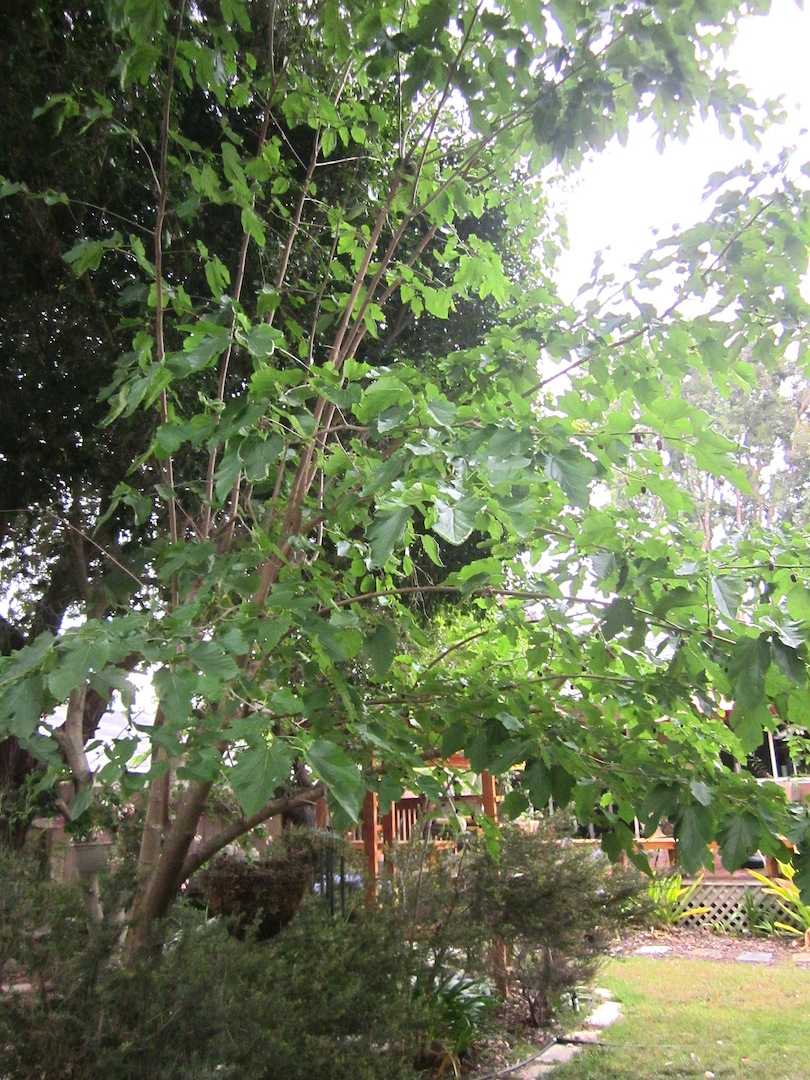
Perhaps generated by seeds embedded in bird poop; I’m not sure where this tree came from — I never planted it  — but one day there was a little sprout and a few years later it bore its first harvest.

We have two mulberry trees in our yard; the volunteer is fruit-bearing, the other that provides shade to the deck, is not.

silkwormcloseupSilkworms eat mulberry leaves; maybe I could raise a few silkworms and spin my own fabric — except worms are kinda gross, so I guess not.

mulberry tree3

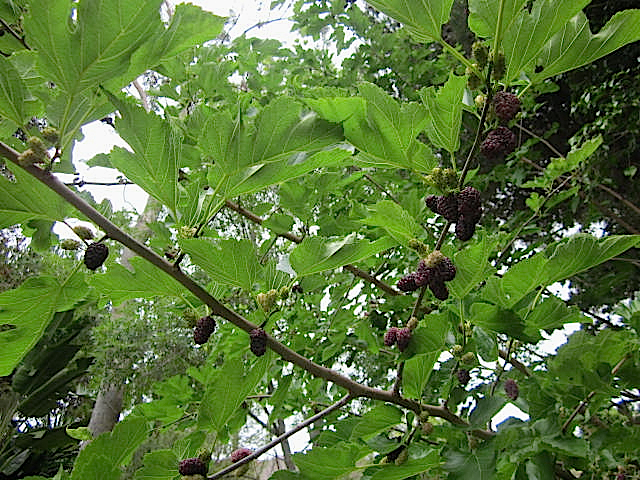
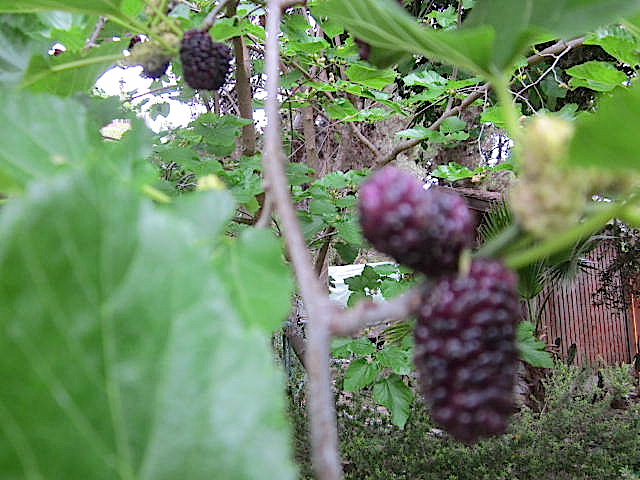
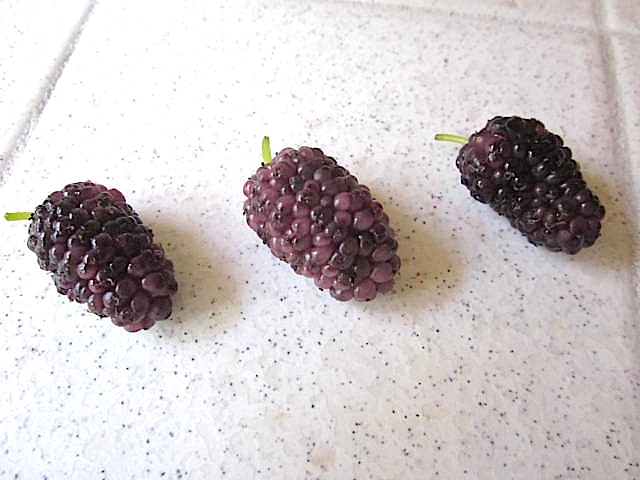
Technically, the fruit of a mulberry is not a berry but a collective fruit, in appearance like a swollen loganberry. When the flowers are pollinated, they and their fleshy bases begin to swell. Ultimately, they become completely altered in texture and color, becoming succulent, fat and full of juice.

In appearance, each tiny swollen flower roughly resembles the individual drupe of a blackberry. Mulberries ripen over an extended period of time unlike many other fruits which seem to come all at once. {Wiki} They’re very sweet and mild.

mulberry tree2

mulberry tree

I learned from Martha Stewart to spread an old sheet on the ground and shake the tree. All the ripe fruit fall; I wash, dry, and freeze in quart bags. So far, I have about eight quarts and the tree’s not done. Raccoons come by at night and gorge themselves;  during the day, crows and other birds eat from the very highest branches.

mulberrysheetA bowl of mulberries.mulberrybowl

Three beautiful specimens. I add them right from the freezer to smoothies and cobblers and I’ll make a batch of jam, too. If I have enough, I’ll make a pie.

mulberry3

Mulberry Jam
(This recipe uses no pectin)

  • 2 1/2 cups mulberries, rinsed (the tiny green stems do not need to be removed)
  • Approximately one cup granulated sugar (I start with a very small amount of sugar and keep tasting. You can try agave, too.)
  • 3 tablespoons water
    Bring a large pot of water to a boil over high heat. Drop heat to medium-low and add jars and their lids. Simmer for 10 minutes to sterilize. Using tongs, remove jars and lids and place on a clean towel to let cool.
    In a medium, heavy-bottomed saucepan set over medium heat, combine mulberries, sugar, and water. Bring to a boil, boil for one minute, then drop to a simmer. Cook fruit, stirring occasionally, until foam subsides and mixture thickens slightly, about 7 minutes.
    Using a ladle, carefully transfer hot jam to sterilized jars. Wipe mouths of jars clean and screw on lids very tightly. Let cool at room temperature for at least 8 hours before using.

Sunday Blues

Happy Father’s Day

Happy Baby Daddy Day

Happy Deadbeat Dad Day

There are only a few blues in my garden — I wish I could successfully grow hydrangeas, but I think the soil would need a major overhaul.

I found these blues on my morning tour (to see if any more sick squirrels came to visit.)

Lily of the Nile, also known as Agapanthus…
against a backdrop of neon-pink Sweetpea Bush.

LilyoftheNile2 LilyoftheNile

An artichoke that didn’t get picked in time to eat. 

artichoke2

Lots of unpicked artichokes.

artichoke1

The only other blue is the flower from Ajuga, a ground cover.

ajuga


The Sad Saga of Spirit Squirrel™

THIS IS PART THREE
Read Part One: “Spirit Squirrel™ is Back”
Read Part Two: “More Adventures of Spirit Squirrel™”
_
________________________________________________________________________

“Hello, there’s a sick squirrel slowly walking around my yard. His tail is dragging. He doesn’t look right.  He’s all squinty. He’s not bright-eyed and bushy tailed. Now he’s reclining under a rose bush. Can you please come and rescue him? “

squirrelRIPSitting on a comfy boat cushion with a garden spade in my hand, I was in a state of Zen transplanting clary sage seedlings in the rear part of our yard. A lovely day; quiet except for the crows, I see out of the corner of my eye  — less than a foot away from my hand — something that doesn’t look like a plant, but it’s not moving. At the exact moment my brain registers that it’s a squirrel, I can tell there’s something really, really wrong with it. Here in SoCal, we’re used to ground squirrels digging holes in our yard, eating bird seed, and being annoying. They always run away when a human’s around. But not this poor little guy.

What are you supposed to do when you find a sick adult squirrel?

Now we’ll proceed to commence the frustrating and annoying round of telephone calls to useless governmental agencies who pass you on and on like a game of “Hot Potato”.

“No” says the City of Carlsbad Environmental Services,
“We don’t do that”. “You should call Animal Control.”

Nope, San Diego County Animal Control can’t do anything either, but they say that because it could possibly have or carry the bubonic plague, I should call the County of San Diego Vector Control. Vector Control specialist Chris informs me with a chuckle that only the squirrels on Palomar Mountain test posiitve for the plague and it’s impossible this one has the plague, maybe he “ate some bad food”  but they won’t help this little critter.

“Let Mother Nature take its course”, he says.

When I tell him that, as a compassionate animal advocate, I’m having a hard time grasping that concept, and while I’m at it, I’m wondering what exactly it is that Vector Control does,…he suggests I try to call Project Wildlife — but, he cautions, I shouldn’t get my hopes up because squirrels don’t rate very highly on their list of animals they like to rescue. However, if I could trap it in a box and bring it to them, they would have to accept it.

If you can’t picture me somehow trapping a potentially extremely sick animal and putting it in my car and driving it to Project Wildlife, that’s because it would never happen in a zillion years. A bird, yes; a dog, cat, coyote, bobcat even, but not a squirrel or a rat or a racoon that’s listlessly walking around in circles with squinty eyes.

Isn’t that what these city/county agencies are for? Isn’t that why we pay taxes?

I called Chris back, unwilling to believe that he can’t see the potential public harm from a squirrel that is obviously not acting like a normal squirrel, and he suggests that I “get a family member or a neighbor to put it out of its misery or just wait until it dies and put it in the trash.”

I hung up before I said anything that could be classified as a threat.

I called a few exterminators and no one seemed interested in humanely trapping the little guy.

Finally, I went next door and told my neighbor about this situation because they always have grandkids around and asked him if he wanted to come over and take a look at it.
He came over and kind of shooed it with a broom under the fence into his yard and went back home.

A few minutes later he returned and said it was gone — as in GONE  — as in GONE FOREVER and I owed him a pan of brownies or chocolate chip cookies or something…

I didn’t want details; I’m just glad the little guy isn’t suffering anymore.

And that’s the end of Spirit Squirrel™…. RIP little buddy.
Spirit Squirrel Tombstone

UPDATE: On the news this morning…a segment about squirrels and the plague, referring everyone to the San Diego County Department of Health’s News Release.

SQUIRREL ON PALOMAR MOUNTAIN TESTS POSITIVE FOR PLAGUE
Campers and Hikers Warned to Take Precautions

DIY Part Two: Outdoor Swing Canopy Sewing Project

closeupcushionDo-it-yourself…This is the second part of the project — I recovered the torn cushion — click HERE for that DIY post.

After that refurbishment, it was clear that I needed to find a way to create a matching canopy. There was no way I could be satisfied with two different patterns and color schemes.

There are tons of online tutorials, but I decided to freestyle it — I took a bunch of measurements and went back to JoAnn‘s Fabrics.

First I cut and pinned the striped material to the top; then I hemmed all the raw edges; repinned, and sewed it all together. It was sooo difficult to work with that much canvas material, especially the way it bunched up on the sewing machine, but I persevered because I’m stubborn that way.

It feels good to try new things, but I’ll definitely NOT take on this project again!

The corners were tricky…but from far away it looks fine!
swingcanopycloseup

Under the shade of a non-fruiting mulberry tree…with an orange orchid photobombing the picture.

swing canopy

It looks great if you don’t get too close…matching up the stripes is always a challenge; one side’s perfect — the other not so much. Oh well…

swingcanopy2

What do you think? Have you ever tackled a job or a project even though it’s incredibly difficult? Were you proud of yourself for meeting the challenge or did you give up before it was completed?