The opposite of rain is sun. It rained all week here in SoCal, heavily at times. We received an official total of 6.20 inches of rain. That’s a LOT of rain for a mostly desert climate.
At times, it seemed as if it would never end. That’s the way a lot of things feel. Sometimes, you can endure so much pain and sadness that it seems as if it will never go away, that you’ll never be happy again.
I think it’s like going through a tunnel. When you enter, the light becomes dark and you are so immersed in it that everywhere you look, everywhere you turn–is darkness. It’s so dark you can’t even see your hand in front of your face. Every once in a while, someone might light a candle and you feel a momentary sharp stabbing pain to remind you of what it used to be like, but then the flame’s snuffed out and you’re thrust back into complete and total darkness. Which way is the exit? Is there a light at the end of the tunnel or will I simply stay here in limbo, in pitch-black inky hopeless melancholy? What’s the point of anything?
That was a heavy detour; my mind devolved and digressed and rambled through a rabbit hole of despondency. So there’s that familiar dark night of the soul too, that black spiraling tunnel of anguish.
Maybe I hit replay too many times on Kesha’s Praying. (see link below).
All I really set out to do with this post was share some pics of how much rain we had and how flooded my gardens were, in contrast to one day later, when we enjoyed a shiny sunny blue sky.
When author Alex Banayan interviewed Maya Angelou, it is alleged that she told him to write this sentence on his notepad and to never forget it. “Every storm runs out of rain.”
I hope so. I really do.
Here ya go:
Thursday’s rain…my arroyo seco, dry river bed, wasn’t so dry anymore!
It was around noon. I was in the garden, watering because it’s uncomfortably hot here in SoCal. Not as bad as Paris, cos there’s still a bit of an ocean breeze, but HOT.
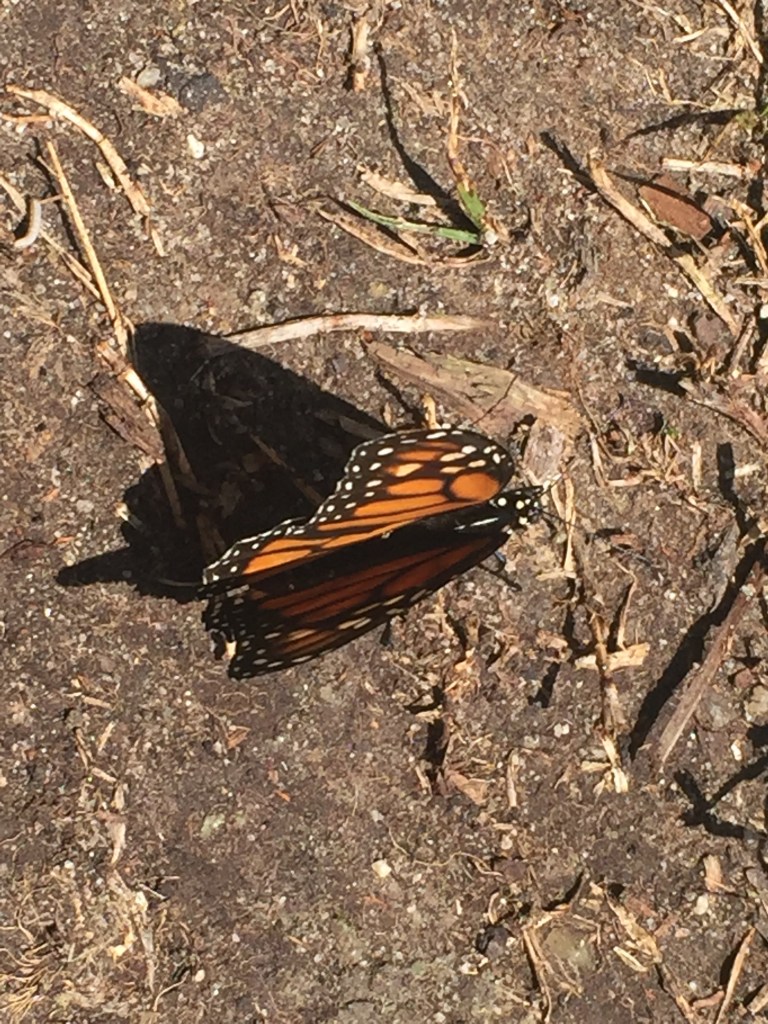
A pretty orange and black spotted Monarch butterfly began to follow the spray of water from the hose, and she and I had a little chat.
Well, she listened while I talked to her.
“Hey, pretty girl, are you thirsty?”
By way of response, she floated to the ground and folded up her wings like a beautiful fan. Or like pressed together hands in namaste.
“Are you OK?”“Are you injured anywhere?” At the same time I wondered how in the world I could take a butterfly to the emergency vet.
I turned off the water and crouched down to get a closer look.
“What do you need? Are you having a little rest?”
Again, no response, but I inched closer and slowly sat down, hardly daring to breathe.
We stayed that way for a moment or two, each of us motionless.
“Can I touch you?” I asked. “I won’t hurt your wings, I promise.”
(By the way, the powder on the wings of a butterfly or moth is actually tiny scales made from modified hairs, and it doesn’t actually damage them if they’re touched.)
Ever so tentatively I reached out my right hand and ever so gently touched the charcoal gray folded up underside of her fan wings, and then I simply sat still as a statue.
After a few seconds in which time stopped, she opened her wings once, twice, three times, and then lifted off the ground and fluttered away.
Thank you” I whispered, and held my heart to keep the love from spilling out.
It was nothing short of an amazing encounter, don’t you agree? One of my most enchanting and enchanted days.
This is the first color video of my nightly visitor. It was about 6:00 a.m. Isn’t he absolutely gorgeous?
In this black and white video, there are now two coyotes and since we know they mate for life, I have my fingers crossed waiting to see if they bring me any grandchildren! Wouldn’t that be amazing?
Some coyote facts:
Urban coyotes can create territories out of a patchwork of parks and green spaces.
While many urban coyotes make their homes in large parks or forest
preserves, this isn’t the case in all situations. Urban coyotes don’t need one
cohesive piece of green space like a single park or a single golf course to
call home. They manage to make do with surprisingly small patches of hunt-able
land woven together as a whole territory.
Coyotes can thrive in a small territory if there is enough food
and shelter, but if there isn’t — such as in sections of a city with only a
handful of small parks, soccer fields, green spaces and the like — then they
will expand the size of their territory to include enough places to hunt for
food to sustain themselves. The size of an urban coyote’s range is dependent on
the abundance of food and can be anywhere from two square miles to ten square
miles or more. Urban coyotes tend to have smaller territory sizes than rural
coyotes because there is so much more food packed into smaller areas, even if
that area has only a few scattered parks.
Studies have shown that coyotes much prefer forested areas and large parks where they can steer clear of humans, and they try to avoid residential areas. But when that’s not available, they still figure out how to make do. In a large-scale study of urban coyotes by the Urban Coyote Research Program, it was discovered that “29 percent of collared coyotes have home ranges composed of less than 10 percent of natural land and 8 percent having no measurable patches of natural land within their home ranges.”
Urban coyotes may live in family packs or on their own at
different points in their lives.
It’s common to see a single coyote hunting or traveling on its
own, but that doesn’t necessarily mean it is alone. Coyotes are highly social
animals and this didn’t change when they entered the urban ecosystem. Coyotes
may live as part of a pack, which usually consists of an alpha male and female,
perhaps one or two of their offspring from previous seasons (known as a
“helper”) and their current litter of pups. The pack may also welcome in a
solitary traveler if their territory can support another member. Packs living
in sizable protected areas can have as many as five or six adults in addition
to that season’s pups.
However, a coyote may also spend part of its life on its own,
known as a solitary coyote. This is common when young coyotes disperse from
their pack and go in search of their own territory, a new pack to join, or a
mate with whom to start their own pack. A coyote may also spend a stretch of
time as a loner if it was an alpha in a pack but lost its mate. According to
Urban Coyote Research Program, between a third and half of coyotes under study
are solitary coyotes, and they are usually youngsters between six months and
two years old.
Because coyotes hunt and
travel alone or in pairs, it is often thought that they don’t form packs. The
study of urban coyotes has helped to correct this misconception and has
revealed much about the social lives of coyotes.
Urban coyotes mate for life and are monogamous.
Speaking of mates, coyotes mate for life and are 100 percent
faithful to that mate. A 2012 study published in the Journal of Mammalogy found
that “among 18 litters comprising 96 offspring, [researchers] found no evidence
of polygamy, and detected a single instance of a double litter (pups from
different parents sharing the same den).”
This loyalty holds even when there are other coyotes in adjacent
territories and plenty of opportunity for cheating. But coyote pairs stay
faithful and faithful for life. Some of the pairs followed by the research team
were together for as long as 10 years, only moving on when one mate died.
The researchers believe that this monogamy plays an important role
in the success of urban coyotes. Because a female can adjust her litter size
based on the availability of food and other factors, she can have larger
litters of pups in a city where there is a buffet of rodents, reptiles, fruits,
vegetables and so much else in a relatively small area. She also has a
dedicated mate to help her feed and raise the pups, so these large litters have
a higher survival rate, resulting in more coyotes reaching an age to disperse
to other areas of a city.
Even when food is less
abundant or there is territory pressure from other coyotes, the couple stays
together year after year. Coyotes may be opportunistic about matters of food
and shelter, but not when it comes to love.
Urban coyotes do not feast on pets and garbage; they typically stick to a natural diet.
Due to sensationalistic reporting, many urban residents think all
coyotes are out to eat their dog or cat at the first opportunity, or that
they’re dumpster divers of the first degree. On the contrary, studies have
shown that urban coyotes stick mainly to a natural diet.
Coyotes are opportunistic omnivores and will eat fruits and
vegetables along with animal prey. A study by Urban Coyote Research
Program analyzed over 1,400 scats and found that “the most common food items
were small rodents (42%), fruit (23%), deer (22%), and rabbit (18%).” Only
about 2 percent of the scats had human garbage and just 1.3 percent showed
evidence of cats. “Apparently, the majority of coyotes in our study area do
not, in fact, rely on pets or garbage for their diets,” say the researchers.
This aligns logically with urban coyotes’ preference of sticking
to parks, preserves, cemeteries, and other out-of-the-way areas as much as
possible. The food available in these locations is rodents, reptiles, fallen
fruit and other food items that are part of a natural diet.
Coyotes of course take feral cats or the occasional domestic cat
that has been left outdoors, and there is certainly evidence that coyotes that
have become habituated and overly bold will go after small dogs. However pets
are not primary prey for them, not by a long shot.
Urban coyotes often switch from naturally diurnal and
crepuscular activity to nocturnal activity.
When urban residents see coyotes “in broad daylight” it is often
assumed that the coyote has grown overly bold or is ill in some way. Actually,
it is perfectly normal for a coyote to be out during the day, as this is their
natural time for hunting.
Urban coyotes have made a behavior change to avoid humans,
switching from being active at dawn and dusk or during daylight hours, to being
mostly active at night. This strategy lowers their risk of encountering a
species of which they are naturally afraid while still hunting in an urban
territory.
However, if a coyote needs
to be out during the day to hunt or to get from one place to another, there
isn’t necessarily anything wrong or odd about the coyote’s behavior. In fact,
in the spring and summer when raising their pups, coyotes need to find more
food and so may be more active during the day and thus spotted more often.
Urban residents frequently misinterpret daytime sightings as a rise in the
urban coyote population or that the coyote could be rabid, neither of which are
usually true.
Urban coyotes help control the populations of other problematic urban wildlife like rodents.
It’s so easy to think of urban places as home to humans, pigeons,
crows and raccoons, and that’s about it. But our cities are increasingly home
to an ever more diverse array of wildlife species rats have been an issue in
cities ever since cities were invented. Coyotes play a role in limiting the
populations of these species and more, helping to keep a balance and increase
biodiversity in urban ecosystems.
Rodents are the primary food source for coyotes in rural and urban
areas alike, and studies have shown an increase in the rodent population in
areas where coyotes are removed.
The easiest way for city residents to avoid
negative interactions with coyotes is to avoid feeding them, either
accidentally or on purpose, and otherwise habituating them to humans.
When coyotes become overly bold or aggressive, and in the rare
instances when coyotes have bitten humans, it usually is discovered that they were
being fed.
Coyotes have a natural fear of humans, and like most wildlife,
will start to lose that fear and even become aggressive if they are being fed.
This is the reason wildlife managers warn people to never feed wildlife, and
there is the saying, “A fed coyote is a dead coyote.”
Once a coyote loses its fear, it is likely to become a problem
animal and that means animal control will have little choice but to lethally
remove it.
Feeding coyotes sometimes happens on purpose, but it can also be
done accidentally when people leave pet food on their porches intending it for
cats or dogs, when they leave scattered seeds under the bird feeder, or even
when they leave fallen fruit or compost in their yards.
Educating the public on the
importance of not feeding wildlife and removing any food sources, as well as
educating them on safe and humane coyote hazing strategies to maintain coyotes’
fear of humans, is the best way a city can avoid negative interactions and
instead enjoy quiet coexistence.
Trapping and killing or relocating urban coyotes does not
reduce the overall population of coyotes.
A common reaction from urban and suburban residents when they
learn coyotes are living in their area is to ask for the removal of the
coyotes, either through lethal means or by trapping and relocating them.
However, animal control officers have learned through a lot of experience that
this is not only a lot harder to do than it sounds, but it does nothing to
reduce the number of coyotes living in an area. In fact, it has the opposite
effect.
Coyotes are territorial and keep other coyotes out of their home range.
The larger the territory of a coyote pack, the fewer coyotes are present
overall. Removing coyotes from an area opens that location up for new coyotes
to come in and claim it as their own (and there will always be more coyotes
coming in to fill a void), often resulting in a short-term increase in coyotes
as the territory lines are redrawn by the newcomers. Additionally, when there
is less pressure from neighboring coyotes and more food available, female
coyotes will have larger litters of pups, again creating a short-term increase
in the number of coyotes in that area.
There are other problems with trapping coyotes. As the Humane
Society points out, “The most common devices used to capture coyotes are
leg-hold traps and neck snares. Both can cause severe injuries, pain, and
suffering. Leg-hold traps are not only cruel and inhumane for coyotes, but may
also injure other wildlife, pets, or even children. Non-target wild
animals are also caught in traps, and many sustain injuries so severe that
they die or must be killed.”
If a city wants to limit or reduce the number of urban coyotes
living there, the easiest thing to do is allow existing coyotes to work out
their own territories, naturally stabilizing the coyote population. There will
never be more coyotes in an ecosystem than that ecosystem can support, so
(despite what some may think) a city can never become “overpopulated” or
“infested” with coyotes.
We can take extra steps to make an area less appealing to coyotes by removing all extra food sources – from fallen fruit or ripe vegetables from backyard gardens to pet food left on back porches – and removing sources of water. The fewer resources available, the larger the territories need to be to support the resident coyotes, and the fewer coyotes there are overall.
Coyotes are here to stay and removing them is not and will never be an option. Our one and only path forward is coexistence.https://urbancoyoteinitiative.com
Learn more about coyotes and support the great work of Projectcoyote.com
Sorry, no pics to share ‘cos the video is grainy and black and white, but these were my three visitors last night at Casa de Enchanted Seashells.
In that order. The first video shows a cat sitting on the steps, looks to be dark gray and I’ve seen him before. The next is of a very large rat running down the steps, and the third one is a bat flying directly across the camera lens.
It sounds like it could be the start of a joke…”A cat, a rat, and a bat walked into a bar…” (Although I have no idea what kind of a punchline to write. Maybe Mrs. Maisel or Suzie could help.)
Or a children’s book, “The Tall Tale (Tail) of the Cat, the Rat, and the Bat”,
Or as Theo would say, “Grandma, that rhymes!”
Since I don’t have any decent pics of last night’s guests, here’s our beloved Bandit who ruled us all for thirteen years before she died of chronic renal failure.
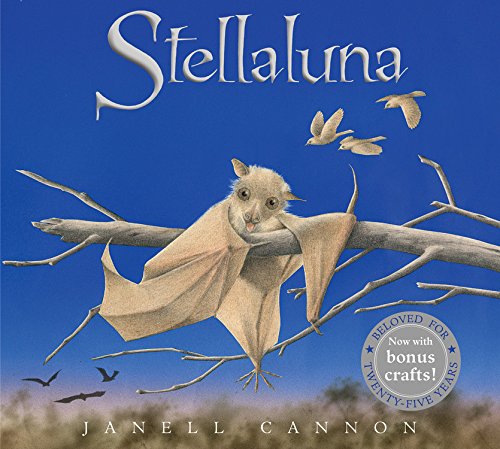
The bat is from one of my favorite books, Stellaluna, by (my friend) Janell Cannon.
And the rat, well, this gif says it all…
(There were no coyotes this time, but I’m happy to report that I’ve been seeing TWO beautiful creatures in the garden, which is awesome as coyotes mate for life. I would be even happier if one day they brought some little ones to visit. It would be a dream come true. I could be their grandma, too!)
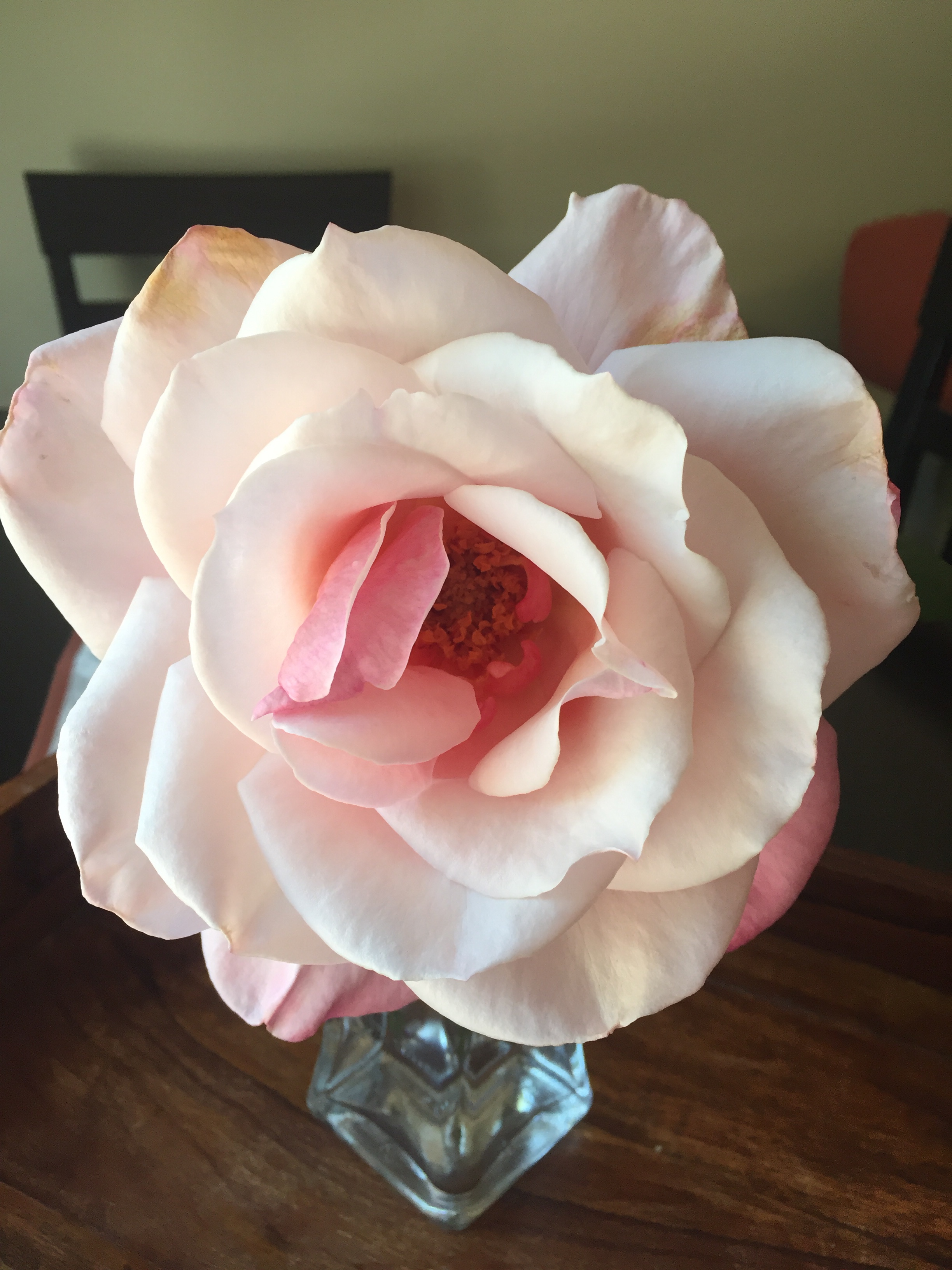
Not about ME, haha, but check out this most delicate ballet pink rose I’ve ever grown in the garden here at Casa de Enchanted Seashells.
The life cycle up to this point has been about a week long journey.
Just picked. The fragrance is so light and delicate. The very essence of a rose.
The petals are starting to open a tiny bit more in response to the sun and being indoors.
See the outer petals beginning to turn color? Still beautiful, though.
This morning, in her full glory at five inches across. More discolored, faded, and less pink petals.
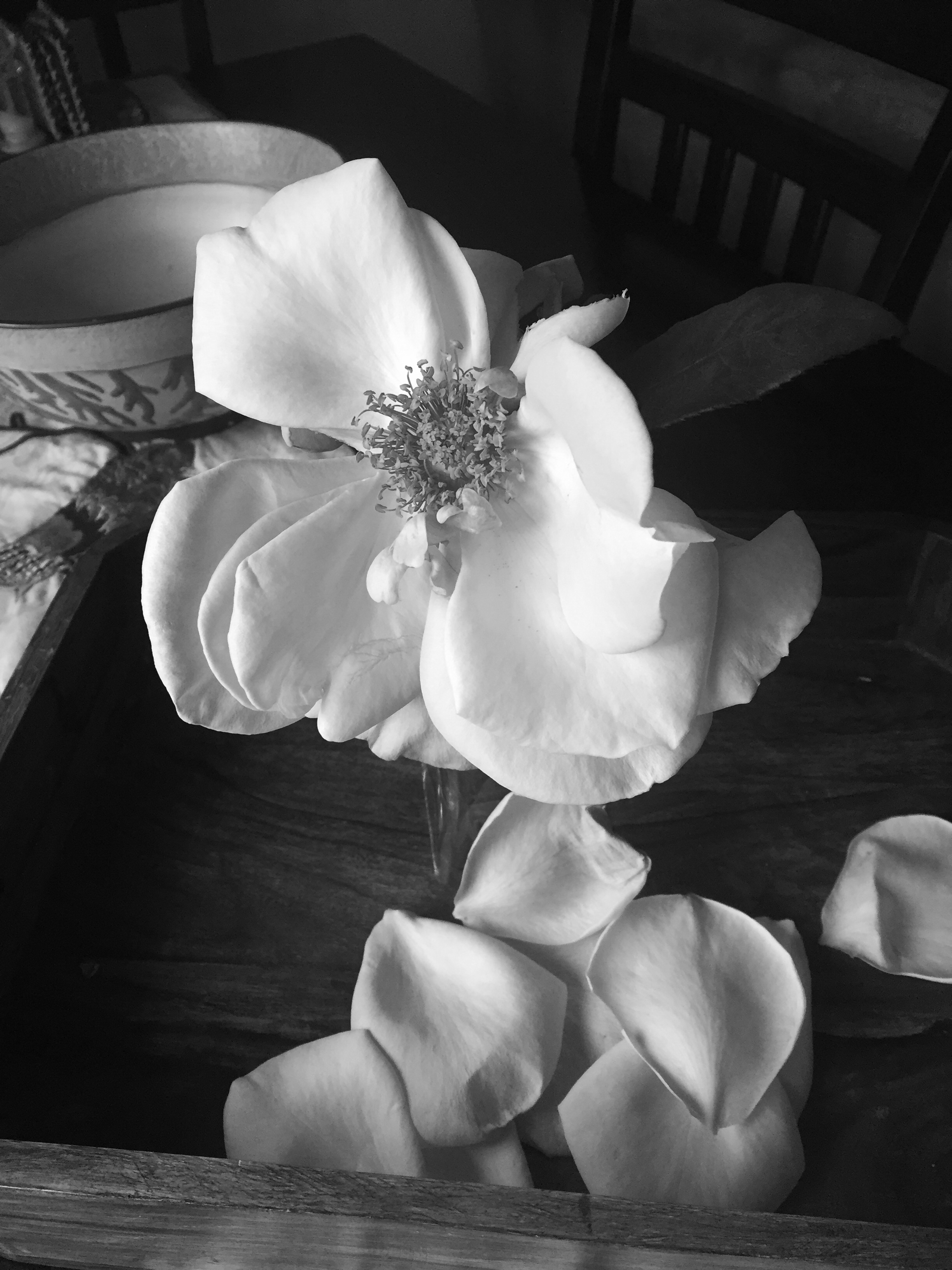
Sweet rose. Almost at the end of her life, she selflessly shared all the joy and beauty she had to give. Soon, her petals will fall to the table and she’ll be gone.
How did this all get so depressing? Just like The Giving Tree by Shel Silverstein. Sheesh. I need to lighten up!
And now this, the finality and death of a once beautiful and vibrant rose.
Shaking off THAT doomed train of thought, here are more roses that I left unpicked in the garden.
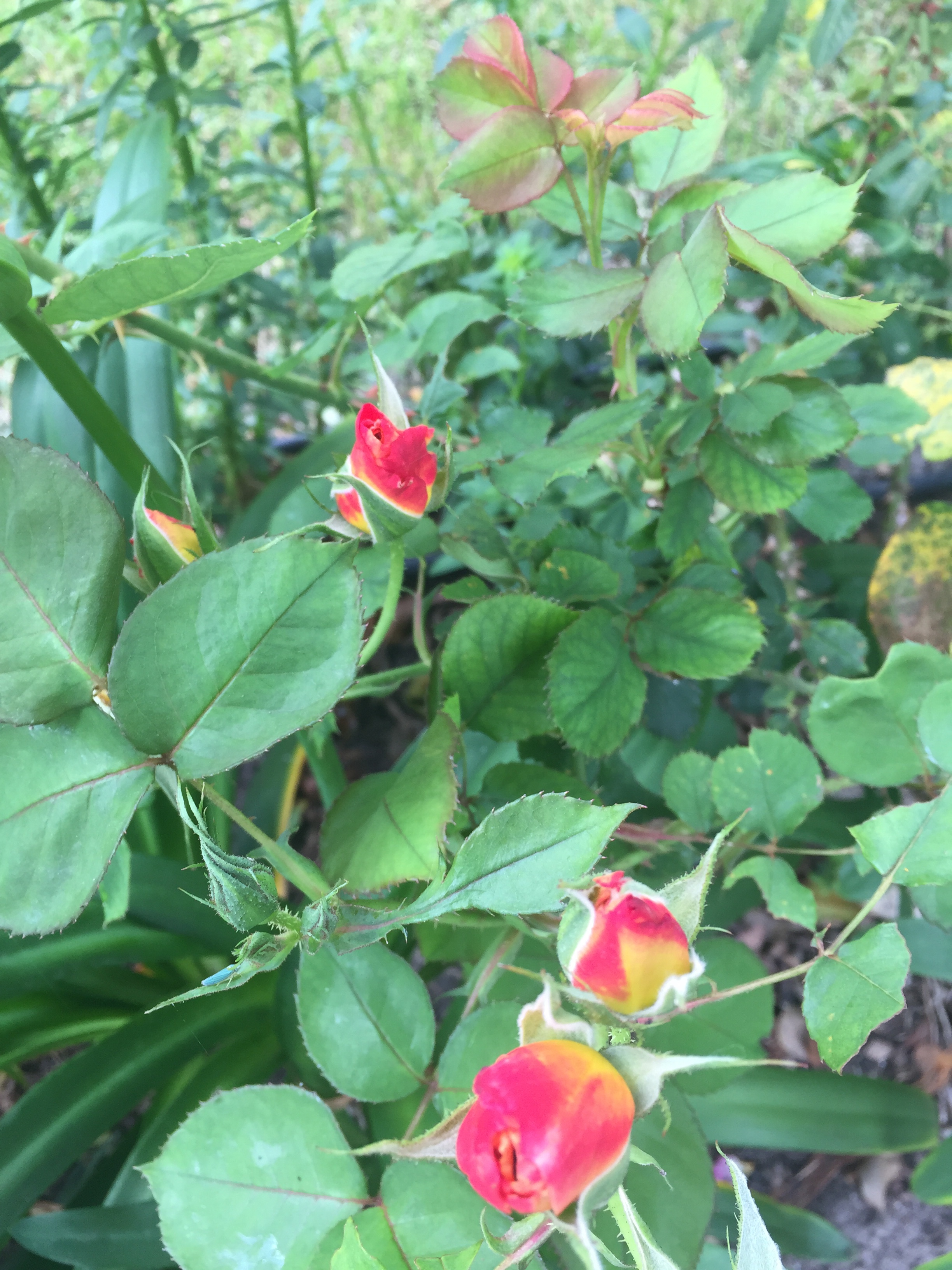
Buds. Babies.
I love the peach and red dual tone of these roses.
Peppermint striped climbing roses. Very spicy fragrance.
Finally, a rock rose, California native.
All the rain we had in SoCal made a joyful garden.
Rain of any kind in SoCal is something to be grateful for because for a brief moment, we can enjoy green and lush hills and gardens.
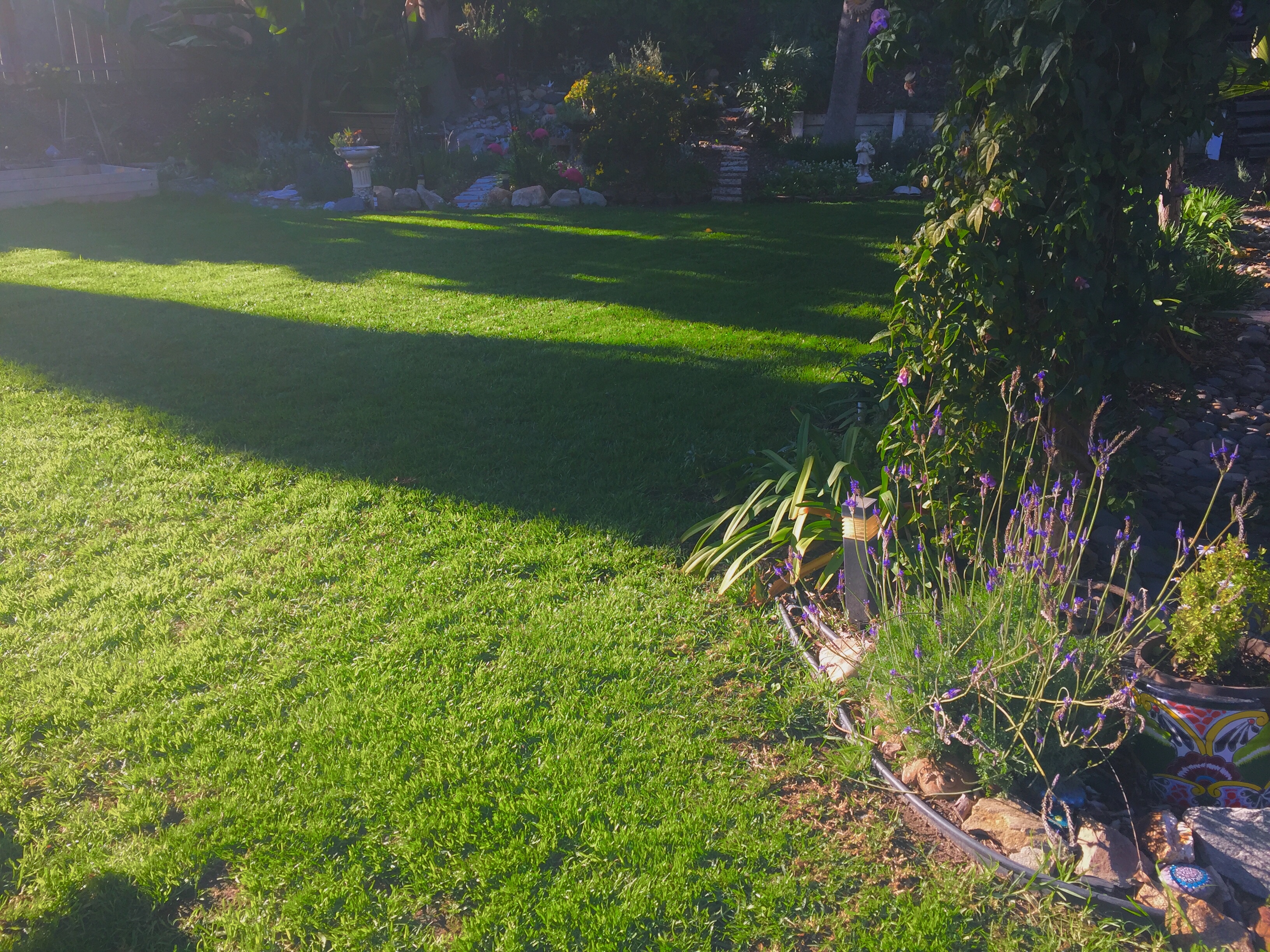
Now that we’re back to sunshiny blue skies again, I took pics of the lawn ‘cos it’ll never look this velvety smooth again.
Even though I have the flu or some version of it in spite of a flu shot, no way would I miss spending an entire day working in the garden. Dirty hands, twigs in my hair, muddy shoes. HEAVENLY.
But I wasn’t alone.
This happy gangsta butterfly not only followed me everywhere I was, but sat on my head for a few marvelous seconds, too! It’s too bad I couldn’t snap a pic but it was impossible, so you’ll have to trust me. Fluttering and flapping wings all around my face and head. And listen to the birds! So much joy.
Was there a message or a lesson the butterfly was attempting to convey? Or maybe just a shared joie de vivre?
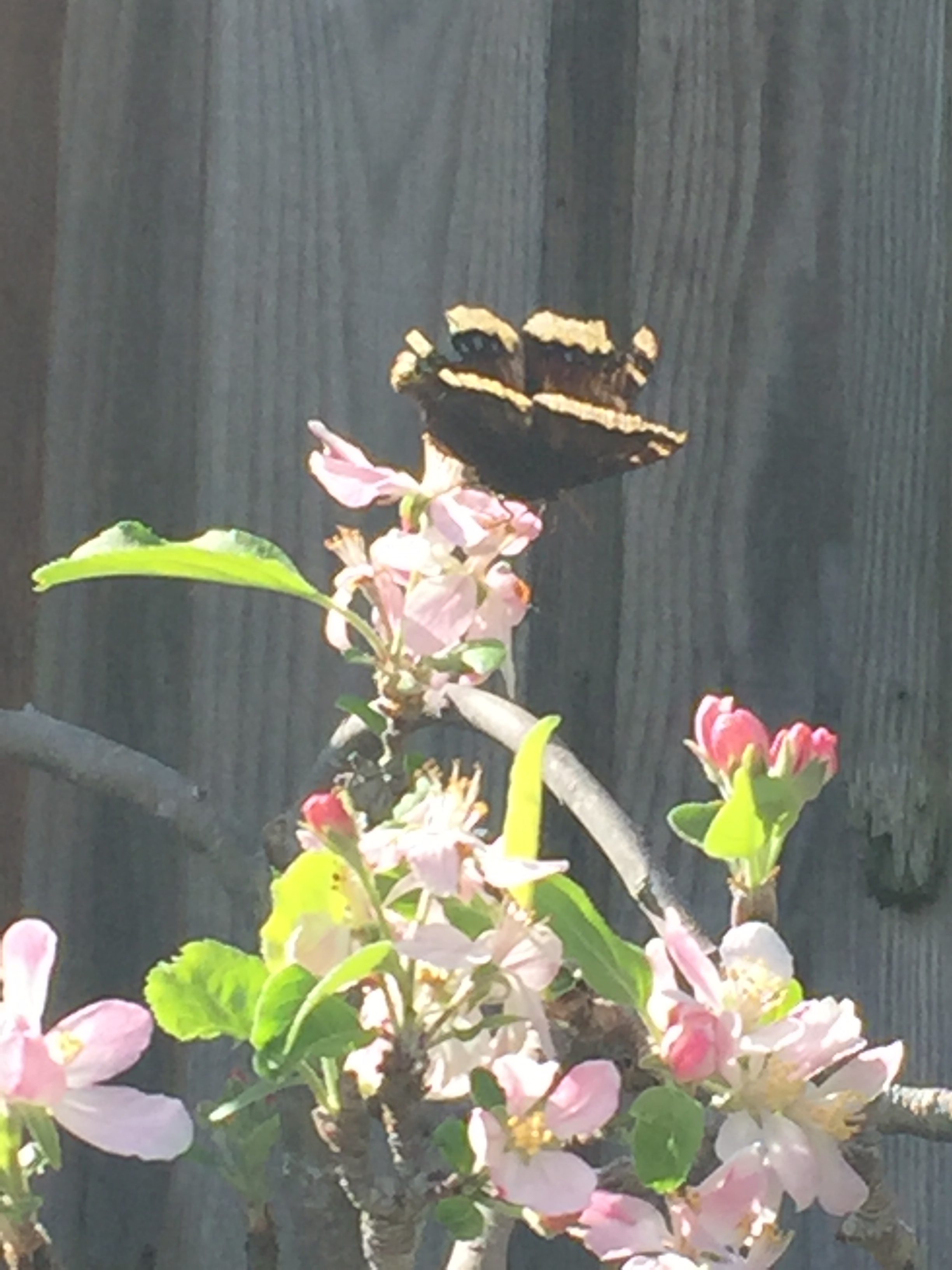
We can coexist in peace, my friendly Mourning Cloak butterfly.
Yes, s/he was upside down or maybe I was upside down? It’s all in your perspective. Totally LOVING the apple blossoms.
Knowing that our rains are brief, all the plants put their best foot forward. The rosemary is a riot of blue flowers and bees.
Bees, so many bees!
Happy all planets direct and Super Blood Wolf Moon eclipse tonight!
Although he passed away in 1938, Clarence Darrow, U.S. lawyer, leading member of the American Civil Liberties Union and prominent advocate for Georgist economics, said this–as true now as it was when he first uttered the words:
–When I was a boy I was told that anybody could become President. Now I’m beginning to believe it.
–You can only protect your liberties in this world by protecting the other man’s freedom. You can only be free if I am free.
That was my wisdom sharing for today—now for the pics:
FAUNA
This is an annoyingly elusive Scott’s Oriole eating some mulberries.
For the last week or so, there’s been something otherwordly going on in the gardens at Casa de Enchanted Seashells.
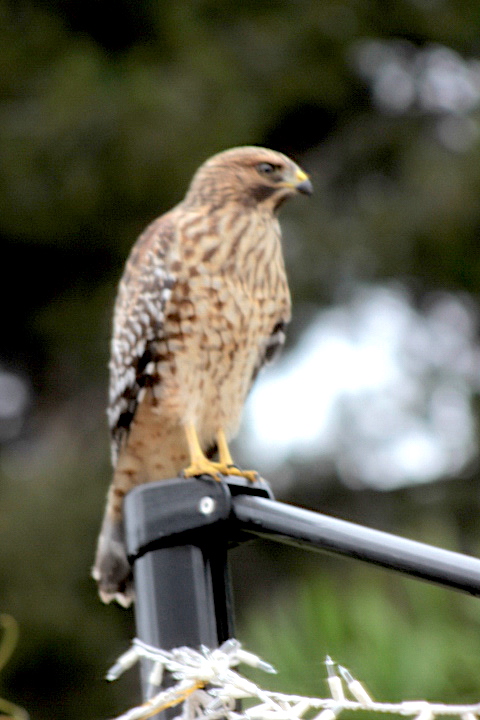
At approximately 6:30 on another beautiful and shiny blue sky morning, I was on the verge of that first gratifying sip of freshly ground and brewed French roast coffee (no Starbucks for me, I like to be in total control of my java) and as I looked out the kitchen window, THIS was perched on my patio umbrella:
I could barely hold my camera steady as you can see by the blurriness. I mean, that was just a few feet away from me!
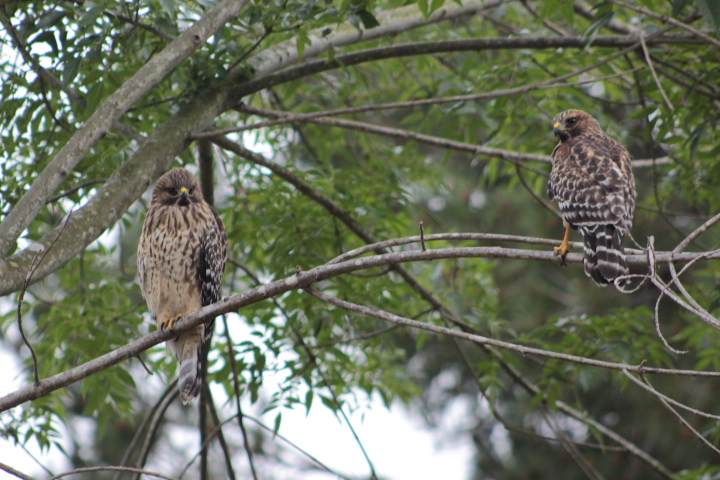
As she flew away from the deck to the ash tree, she was joined by another one!
Now there were two hawks!
And they were VERY interested in this juvenile crow who was all alone, very unconcerned, blithely eating his fill of mulberries one by one from the tree and the grass:
Hello, Mr. Crow!
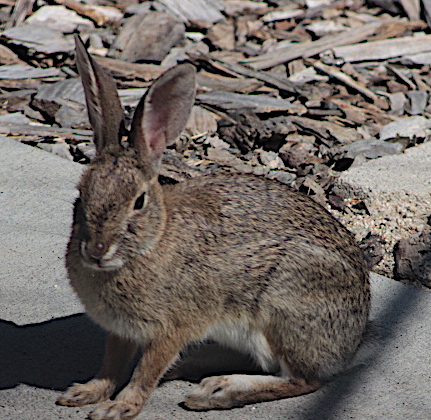
Just hanging out…along with one of the bunnies that lives under the deck…
The bunny ran away,
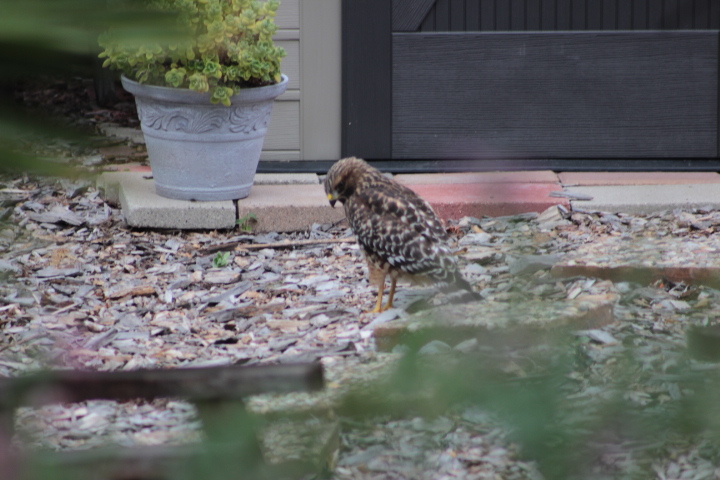
For a couple of hours, there was a lot of drama, some of it happened so fast, I couldn’t catch it with a camera. The hawks hung around, flying from one spot to the next, here on the roof of the shed…
…walking around on the GROUND in front of the shed!!!
And picking up a mulberry leaf that had fallen on the lawn. He flew away with it in his beak! Again, sorry for the bad photos, but it was impossible to capture it all perfectly.
There seemed to be a sort of relationship emerging between the crow and the hawks.. Although typically they’re not known to be friendly with each other, but when it does occur, there are mystical and magical meanings attached to the encounters.
First, the hawks would swoop and dive at the crow who seemed fearless; totally ignoring the faux attack, but then did the same exact thing to the two hawks perched on that same branch. It looked like they were playing and having fun; there was no aggression.
And then they shared a branch together. All in harmony!
I did a little research on the phenomenon of crows and hawks playing, and found this: http://www.thenerge.com/bird-nerge/crows-and-hawks-playing/
Crazy, huh?
This similar scenario replayed for the next few mornings; the crow is still here, but I haven’t seen the hawks.
However, one thing’s for sure, it doesn’t take much to make me happy, but I think I really really need to hone my photography skills. Hee hee.
The epic rains that soaked SoCal this year gave birth to a springtime of lush floral beauty and emerald lawns, something I don’t think I’ve experienced in the thirty-two years I’ve lived at Casa de Enchanted Seashells.
Before that, I lived in the area and there were definitely some heavy rains, but I didn’t notice nor did I appreciate the luxuriant plant life like I do now.
Flowers that previously lay dormant for seasons now burst forth in riotous color and perfume, like the lovely freesias, stock, Jupiter’s Beard, and borage.
This slideshow requires JavaScript.
Most exciting for me is the herb garden.
Just look at the abundance of this patch of lemon balm. Planted directly under a bedroom window, the lemony fragrance wafts up and in with even the slightest breeze.
Ahhhh.
Heavenly!
Lemon balm was traditionally used to uplift the spirits and to enhance memory. Some of its healing properties were spiritual in nature. This herb was used in spells to heal broken hearts and also to attract romantic love. It was believed that a lemon balm bag put under the pillow could help promote sleep and put in the bath would promote relaxation. (https://www.mountainroseherbs.com)
Easy to grow Lemon balm (Melissa officinalis), a member of the mint family, is considered a calming herb. It was used as far back as the Middle Ages to reduce stress and anxiety, promote sleep, improve appetite, and ease pain and discomfort from indigestion (including gas and bloating, as well as colic). help heal wounds, and treat venomous insect bites and stings. Today, lemon balm is often combined with other calming, soothing herbs, such as valerian, chamomile, and hops, to promote relaxation. It is also used in creams to treat cold sores. http://umm.edu/health/medical/altmed/herb/lemon-balm
Lemon Balm is useful for nursing mothers that want to reduce overproduction of breast milk or when in the process of weaning and drying up milk supply. DIL added it to her sage tea when she weaned Angel Boy 2.0 and it worked!
Add it to any dish that might benefit from a little lemony flavor, including cookies. I’m going to experiment on a vegan Lemon Balm & Lavender cookie, and will let you know how it turns out.
Seven Ways to Use Lemon Balm
1. Chop a couple tablespoons of lemon balm and add to your favorite salsa.
2. Chop together with cilantro in guacamole.
3. Lemon balm salad dressing is yummy and so easy! Combine your favorite oil with white balsamic or champagne vinegar, 2 TBS chopped lemon balm, pepper, Pink Himalayan sea salt, and whisk!
4. Pour hot water over lemon balm leaves. Let steep and enjoy!
5. I add a few sprigs to a pitcher of water with ice cubes and sliced lemon.
6. Lemon Balm Pesto:
2 cloves garlic
1/4 cup almonds or pine nuts (or both)
2 cups fresh basil
1/4 cup fresh lemon balm
1/4 cup freshly grated Parmesan cheese (don’t add if vegan)
2 TBS fresh lemon juice
1/4 to 1/2 cup olive oil
In food processor, add all ingredients except oil and pulse. Pour oil in steady but thin stream while pulsing until very smooth. Add salt and pepper to taste, along with dried red peppers if you like it spicy.
If you Google it, there are loads of DIY recipes on the internet and Pinterest using lemon balm, but I chose this one to share with you ‘cos it’s cool and seems fairly easy:
7. Lemon Balm Extract Combine your favorite carrier oil (sweet almond oil or sunflower or grapeseed with chopped lemon balm leaves in a small jar. Make sure the leaves are submerged in the oil.Cover and place in a sunny spot for two weeks, turning/shaking every so often while still making sure the leaves are submerged. Strain out the leaves and the oil is now ready to use.
**While it’s generally considered safe for most people, lemon balm might inhibit thyroid function. If you’re on thyroid medication, check with your doctor or pharmacist before using internally. As always, if you’re pregnant, nursing, or have any other questions, talk with your doctor.“Melissa Officinalis produced a significant inhibition of TSH binding to its receptor and of antibody binding to TSH”http://www.ncbi.nlm.nih.gov/pubmed/14759065























 Enchanted Seashells | Princess Rosebud