I’ve been posting a lot about the beautiful flowers in my garden because I know how short lived it al is and I want to enjoy it while I can…soon the hot sun and blistering Santa Ana winds will dry up all the lush blooms. We had so much rain this season that it really looks like a floral fairyland at Casa de Enchanted Seashells.
Another day, another rose, a very red one, not yet open.
A Red, Red Rose
by Robert Burns
O my luve’s like a red, red rose, That’s newly sprung in June; O my luve’s like the melodie That’s sweetly played in tune.
As fair art thou, my bonnie lass, So deep in luve am I; And I will luve thee still, my dear, Till a’ the seas gang dry.
Till a’ the seas gang dry, my dear, And the rocks melt wi’ the sun: O I will love thee still, my dear, While the sands o’ life shall run.
And fare thee weel, my only luve, And fare thee weel awhile! And I will come again, my luve, Though it were ten thousand mile.
And almost completely gone but still drunk with a dancer’s graceful elegance:
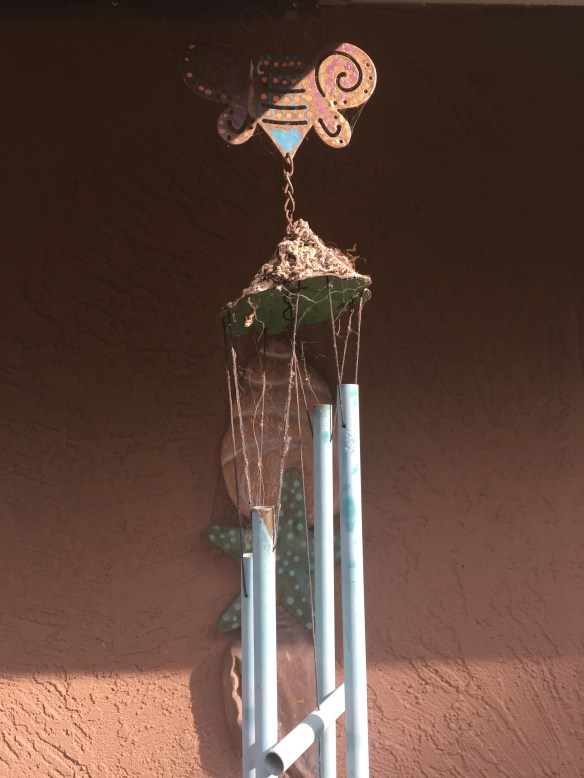
It’s been five long years since I’ve been lucky enough to be chosen by a hummingbird as a sanctuary site to build her nest on one of my windchimes.
The last time it was built on hummingbird chimes (very witty, mama hummy, very witty) and this time it’s butterfly chimes, but in the same exact location right outside the kitchen window.
Mama works pretty much around the clock bringing feathers and spider webs and other soft little bits and pieces glued together with her own birdy poop.
I’ll update as the nest grows and mom lays her two precious eggs:
All the rain we had in SoCal a couple weeks ago caused my roses to grow like crazy.
Planted at least six feet apart in order to comply with all social distancing orders, here’s a couple of little bouquets displayed in a Waterford crystal sugar and creamer, just because…
…and my magical secret garden with a working windmill…
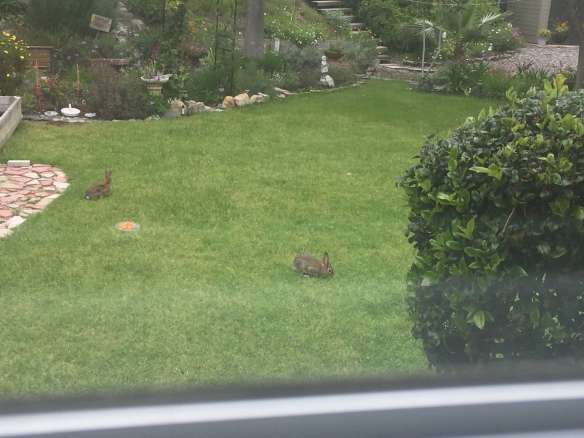
…as well as an afternoon visit for snacks from Mr. and Mrs. Bunny, also complying with social distancing directives!
It’s Easter Sunday and that always meant a traditional day hike or walk to the beach or a camping trip to the desert.
This year was a bit different because of the pandemic, isolating to protect ourselves and others from Covid-19.
But the beach always beckons. Well, not exactly the beach because it’s now closed, but non one can deprive me of a view of the magnificent Pacific Ocean.
My round-trip walk is about 6.5 miles, maybe a bit longer because I took a detour to include pics of Agua Hedionda Lagoon.
For those of you that didn’t get out for a walk today, here ya go!
It looks like an advert for a hallucinogenic (LSD) but that’s an ALTERED PERCEPTION haha. That’s just the way the light hit it. The sign really said “Beach closed.”
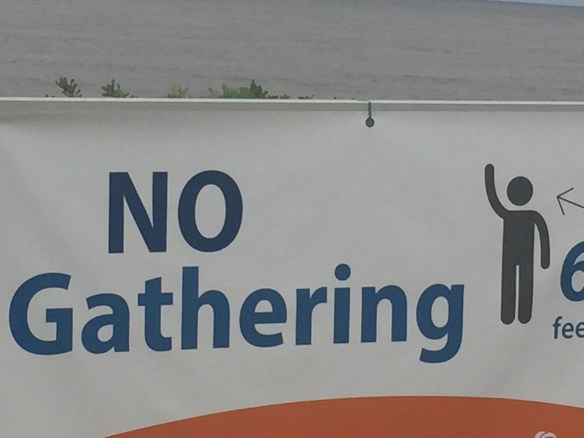
And just in case you didn’t take the hint, this signage made it extremely clear…
And if anyone is STILL clueless, this sign and caution tape is even more specific…
But here she is. Mother Nature. The Pacific Ocean. No waves. I bet a million dollars if there was a solid 4-6 swell, those waves would be packed. No one can keep a surfer from the water. That’s essential to life.
I took the long way home around our Agua Hedionda Lagoon. Pretty daisies, the lagoon, and the power plant off in the distance.
One of my favorite views; the lagoon and the ocean.
All the rain created a mudslide on Adams, the street around the lagoon.I’ve never before seen Adams closed at Park due to a landslide! Crazy times we’re in.
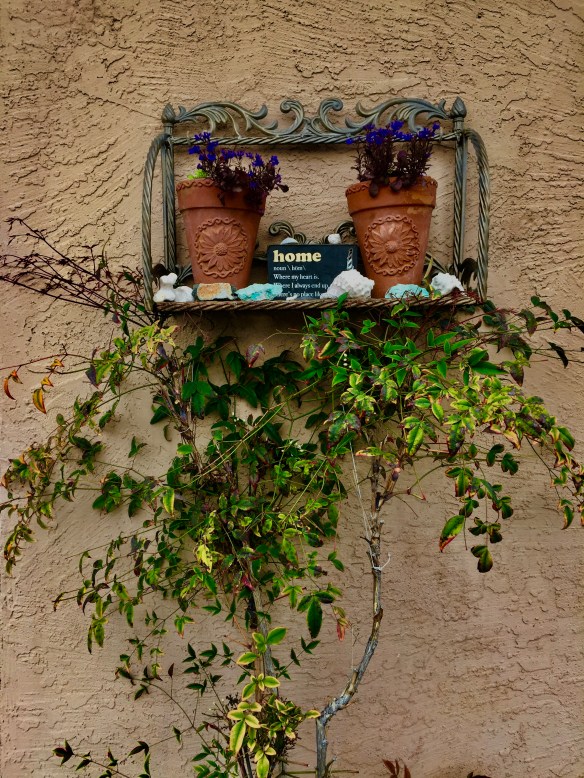
And finally back home. There’s really no place like home. Dorothy was right.
After our week-long rainstorm, it was sunny and warm; a perfect time to pick weeds and do some heavy lifting in the garden.
Picture this: Our backyard can be divided into threes. There’s the level part with a lawn, and then there are twenty-eight steps that lead to the first hill, with more winding steps that ascend to the summit.
I took a break, eating a tangerine while I sat at the top of the mid-steps. From this vantage point, I could survey the entire level of the garden below. Birds were singing, butterflies were fluttering around in the soft breeze, and my eye caught the progression of something floating down from the palm trees in the neighbor’s yard to land on my lawn.
What was it?
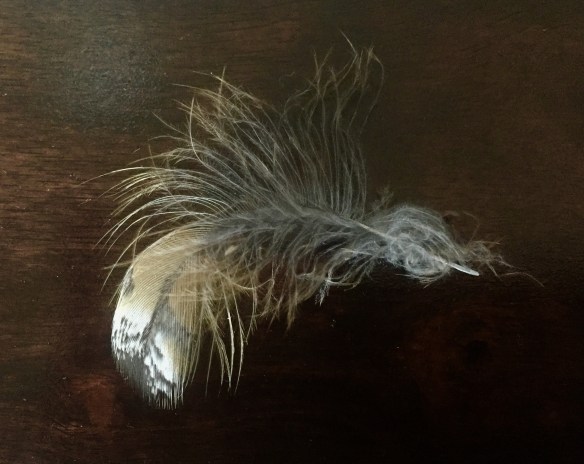
I ran down and found a soft and beautiful hawk feather. It almost seemed to glow in the early morning light.
What a joyous treasure, don’t you think?
According to Native Americans, a feather from a hawk symbolizes guardianship, strength, and far-sightedness. Another meaning : You are being asked to listen to the advice that friends and family are giving you. The messages you are receiving about the decision you must make is correct and only comes from love. Allow yourself to let go of the control and surrender. I like this one, too: Your life is taking a turn that will lead you on the path to happiness, joy, success, and love.
Hmmm, that certainly gives me something to think about, you know?
“The dove represents peace of the deepest kind. It soothes and quiets our worried or troubled thoughts, enabling us to find renewal in the silence of the mind. … The dove’s roles as spirit messenger, maternal symbol and liaison impart an inner peace that helps us to go about our lives calmly and with purpose.” (http://www.pure-spirit.com/more-animal-symbolism/602-dove-symbolism)
Walking up the steps to the third level in my garden, I came upon this sad sight, a pile of dove feathers. It was obviously the work of one of our resident hawks.
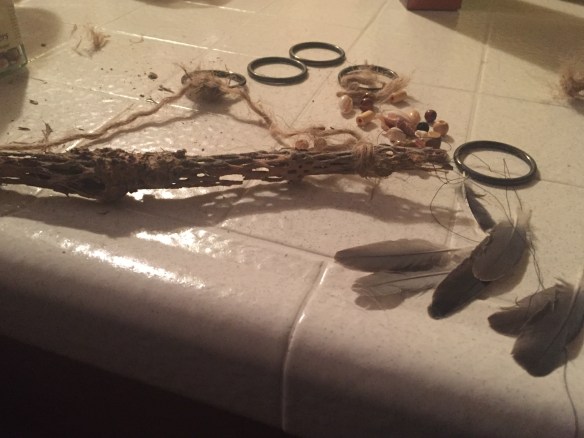
As I mourned the loss of the mourning dove and pondered on the circle of life, I thought I should gather the feathers and create something to honor this little bird’s life.
It’s been quite a while since I felt crafty, but I found my beads and shells along with a perfectly delicate piece of latticed wood that I had brought back home from my last camping trip. I plugged in my trusty glue gun and got to work.
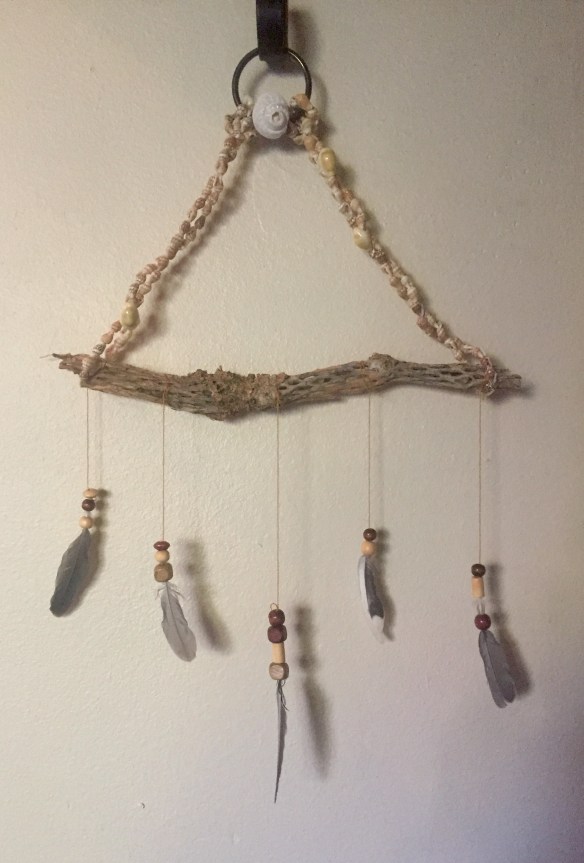
Almost finished. Now I need to figure out how to hang it up. Delicate and sweet, just like the sad, plaintive song of the dove.
The completed project. I LOVE the way the feathers create their own shadow on the wall.
It was around noon. I was in the garden, watering because it’s uncomfortably hot here in SoCal. Not as bad as Paris, cos there’s still a bit of an ocean breeze, but HOT.
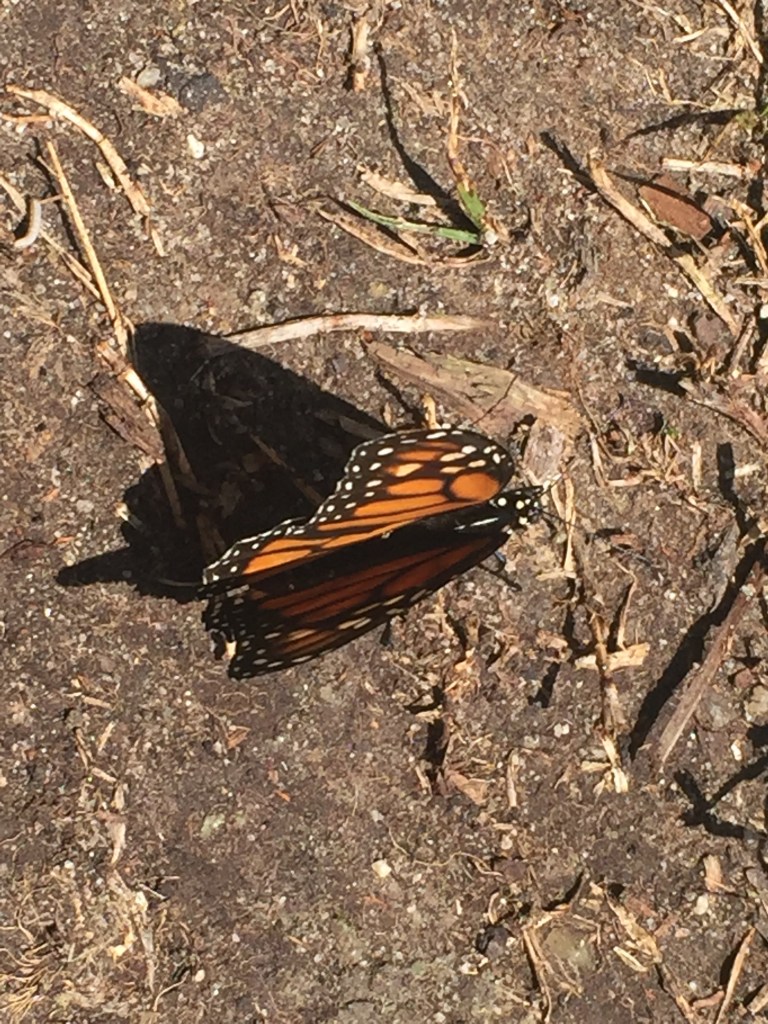
A pretty orange and black spotted Monarch butterfly began to follow the spray of water from the hose, and she and I had a little chat.
Well, she listened while I talked to her.
“Hey, pretty girl, are you thirsty?”
By way of response, she floated to the ground and folded up her wings like a beautiful fan. Or like pressed together hands in namaste.
“Are you OK?”“Are you injured anywhere?” At the same time I wondered how in the world I could take a butterfly to the emergency vet.
I turned off the water and crouched down to get a closer look.
“What do you need? Are you having a little rest?”
Again, no response, but I inched closer and slowly sat down, hardly daring to breathe.
We stayed that way for a moment or two, each of us motionless.
“Can I touch you?” I asked. “I won’t hurt your wings, I promise.”
(By the way, the powder on the wings of a butterfly or moth is actually tiny scales made from modified hairs, and it doesn’t actually damage them if they’re touched.)
Ever so tentatively I reached out my right hand and ever so gently touched the charcoal gray folded up underside of her fan wings, and then I simply sat still as a statue.
After a few seconds in which time stopped, she opened her wings once, twice, three times, and then lifted off the ground and fluttered away.
Thank you” I whispered, and held my heart to keep the love from spilling out.
It was nothing short of an amazing encounter, don’t you agree? One of my most enchanting and enchanted days.
This is the first color video of my nightly visitor. It was about 6:00 a.m. Isn’t he absolutely gorgeous?
In this black and white video, there are now two coyotes and since we know they mate for life, I have my fingers crossed waiting to see if they bring me any grandchildren! Wouldn’t that be amazing?
Some coyote facts:
Urban coyotes can create territories out of a patchwork of parks and green spaces.
While many urban coyotes make their homes in large parks or forest
preserves, this isn’t the case in all situations. Urban coyotes don’t need one
cohesive piece of green space like a single park or a single golf course to
call home. They manage to make do with surprisingly small patches of hunt-able
land woven together as a whole territory.
Coyotes can thrive in a small territory if there is enough food
and shelter, but if there isn’t — such as in sections of a city with only a
handful of small parks, soccer fields, green spaces and the like — then they
will expand the size of their territory to include enough places to hunt for
food to sustain themselves. The size of an urban coyote’s range is dependent on
the abundance of food and can be anywhere from two square miles to ten square
miles or more. Urban coyotes tend to have smaller territory sizes than rural
coyotes because there is so much more food packed into smaller areas, even if
that area has only a few scattered parks.
Studies have shown that coyotes much prefer forested areas and large parks where they can steer clear of humans, and they try to avoid residential areas. But when that’s not available, they still figure out how to make do. In a large-scale study of urban coyotes by the Urban Coyote Research Program, it was discovered that “29 percent of collared coyotes have home ranges composed of less than 10 percent of natural land and 8 percent having no measurable patches of natural land within their home ranges.”
Urban coyotes may live in family packs or on their own at
different points in their lives.
It’s common to see a single coyote hunting or traveling on its
own, but that doesn’t necessarily mean it is alone. Coyotes are highly social
animals and this didn’t change when they entered the urban ecosystem. Coyotes
may live as part of a pack, which usually consists of an alpha male and female,
perhaps one or two of their offspring from previous seasons (known as a
“helper”) and their current litter of pups. The pack may also welcome in a
solitary traveler if their territory can support another member. Packs living
in sizable protected areas can have as many as five or six adults in addition
to that season’s pups.
However, a coyote may also spend part of its life on its own,
known as a solitary coyote. This is common when young coyotes disperse from
their pack and go in search of their own territory, a new pack to join, or a
mate with whom to start their own pack. A coyote may also spend a stretch of
time as a loner if it was an alpha in a pack but lost its mate. According to
Urban Coyote Research Program, between a third and half of coyotes under study
are solitary coyotes, and they are usually youngsters between six months and
two years old.
Because coyotes hunt and
travel alone or in pairs, it is often thought that they don’t form packs. The
study of urban coyotes has helped to correct this misconception and has
revealed much about the social lives of coyotes.
Urban coyotes mate for life and are monogamous.
Speaking of mates, coyotes mate for life and are 100 percent
faithful to that mate. A 2012 study published in the Journal of Mammalogy found
that “among 18 litters comprising 96 offspring, [researchers] found no evidence
of polygamy, and detected a single instance of a double litter (pups from
different parents sharing the same den).”
This loyalty holds even when there are other coyotes in adjacent
territories and plenty of opportunity for cheating. But coyote pairs stay
faithful and faithful for life. Some of the pairs followed by the research team
were together for as long as 10 years, only moving on when one mate died.
The researchers believe that this monogamy plays an important role
in the success of urban coyotes. Because a female can adjust her litter size
based on the availability of food and other factors, she can have larger
litters of pups in a city where there is a buffet of rodents, reptiles, fruits,
vegetables and so much else in a relatively small area. She also has a
dedicated mate to help her feed and raise the pups, so these large litters have
a higher survival rate, resulting in more coyotes reaching an age to disperse
to other areas of a city.
Even when food is less
abundant or there is territory pressure from other coyotes, the couple stays
together year after year. Coyotes may be opportunistic about matters of food
and shelter, but not when it comes to love.
Urban coyotes do not feast on pets and garbage; they typically stick to a natural diet.
Due to sensationalistic reporting, many urban residents think all
coyotes are out to eat their dog or cat at the first opportunity, or that
they’re dumpster divers of the first degree. On the contrary, studies have
shown that urban coyotes stick mainly to a natural diet.
Coyotes are opportunistic omnivores and will eat fruits and
vegetables along with animal prey. A study by Urban Coyote Research
Program analyzed over 1,400 scats and found that “the most common food items
were small rodents (42%), fruit (23%), deer (22%), and rabbit (18%).” Only
about 2 percent of the scats had human garbage and just 1.3 percent showed
evidence of cats. “Apparently, the majority of coyotes in our study area do
not, in fact, rely on pets or garbage for their diets,” say the researchers.
This aligns logically with urban coyotes’ preference of sticking
to parks, preserves, cemeteries, and other out-of-the-way areas as much as
possible. The food available in these locations is rodents, reptiles, fallen
fruit and other food items that are part of a natural diet.
Coyotes of course take feral cats or the occasional domestic cat
that has been left outdoors, and there is certainly evidence that coyotes that
have become habituated and overly bold will go after small dogs. However pets
are not primary prey for them, not by a long shot.
Urban coyotes often switch from naturally diurnal and
crepuscular activity to nocturnal activity.
When urban residents see coyotes “in broad daylight” it is often
assumed that the coyote has grown overly bold or is ill in some way. Actually,
it is perfectly normal for a coyote to be out during the day, as this is their
natural time for hunting.
Urban coyotes have made a behavior change to avoid humans,
switching from being active at dawn and dusk or during daylight hours, to being
mostly active at night. This strategy lowers their risk of encountering a
species of which they are naturally afraid while still hunting in an urban
territory.
However, if a coyote needs
to be out during the day to hunt or to get from one place to another, there
isn’t necessarily anything wrong or odd about the coyote’s behavior. In fact,
in the spring and summer when raising their pups, coyotes need to find more
food and so may be more active during the day and thus spotted more often.
Urban residents frequently misinterpret daytime sightings as a rise in the
urban coyote population or that the coyote could be rabid, neither of which are
usually true.
Urban coyotes help control the populations of other problematic urban wildlife like rodents.
It’s so easy to think of urban places as home to humans, pigeons,
crows and raccoons, and that’s about it. But our cities are increasingly home
to an ever more diverse array of wildlife species rats have been an issue in
cities ever since cities were invented. Coyotes play a role in limiting the
populations of these species and more, helping to keep a balance and increase
biodiversity in urban ecosystems.
Rodents are the primary food source for coyotes in rural and urban
areas alike, and studies have shown an increase in the rodent population in
areas where coyotes are removed.
The easiest way for city residents to avoid
negative interactions with coyotes is to avoid feeding them, either
accidentally or on purpose, and otherwise habituating them to humans.
When coyotes become overly bold or aggressive, and in the rare
instances when coyotes have bitten humans, it usually is discovered that they were
being fed.
Coyotes have a natural fear of humans, and like most wildlife,
will start to lose that fear and even become aggressive if they are being fed.
This is the reason wildlife managers warn people to never feed wildlife, and
there is the saying, “A fed coyote is a dead coyote.”
Once a coyote loses its fear, it is likely to become a problem
animal and that means animal control will have little choice but to lethally
remove it.
Feeding coyotes sometimes happens on purpose, but it can also be
done accidentally when people leave pet food on their porches intending it for
cats or dogs, when they leave scattered seeds under the bird feeder, or even
when they leave fallen fruit or compost in their yards.
Educating the public on the
importance of not feeding wildlife and removing any food sources, as well as
educating them on safe and humane coyote hazing strategies to maintain coyotes’
fear of humans, is the best way a city can avoid negative interactions and
instead enjoy quiet coexistence.
Trapping and killing or relocating urban coyotes does not
reduce the overall population of coyotes.
A common reaction from urban and suburban residents when they
learn coyotes are living in their area is to ask for the removal of the
coyotes, either through lethal means or by trapping and relocating them.
However, animal control officers have learned through a lot of experience that
this is not only a lot harder to do than it sounds, but it does nothing to
reduce the number of coyotes living in an area. In fact, it has the opposite
effect.
Coyotes are territorial and keep other coyotes out of their home range.
The larger the territory of a coyote pack, the fewer coyotes are present
overall. Removing coyotes from an area opens that location up for new coyotes
to come in and claim it as their own (and there will always be more coyotes
coming in to fill a void), often resulting in a short-term increase in coyotes
as the territory lines are redrawn by the newcomers. Additionally, when there
is less pressure from neighboring coyotes and more food available, female
coyotes will have larger litters of pups, again creating a short-term increase
in the number of coyotes in that area.
There are other problems with trapping coyotes. As the Humane
Society points out, “The most common devices used to capture coyotes are
leg-hold traps and neck snares. Both can cause severe injuries, pain, and
suffering. Leg-hold traps are not only cruel and inhumane for coyotes, but may
also injure other wildlife, pets, or even children. Non-target wild
animals are also caught in traps, and many sustain injuries so severe that
they die or must be killed.”
If a city wants to limit or reduce the number of urban coyotes
living there, the easiest thing to do is allow existing coyotes to work out
their own territories, naturally stabilizing the coyote population. There will
never be more coyotes in an ecosystem than that ecosystem can support, so
(despite what some may think) a city can never become “overpopulated” or
“infested” with coyotes.
We can take extra steps to make an area less appealing to coyotes by removing all extra food sources – from fallen fruit or ripe vegetables from backyard gardens to pet food left on back porches – and removing sources of water. The fewer resources available, the larger the territories need to be to support the resident coyotes, and the fewer coyotes there are overall.
Coyotes are here to stay and removing them is not and will never be an option. Our one and only path forward is coexistence.https://urbancoyoteinitiative.com
Learn more about coyotes and support the great work of Projectcoyote.com
















 I’ve never before seen Adams closed at Park due to a landslide! Crazy times we’re in.













 Enchanted Seashells | Princess Rosebud