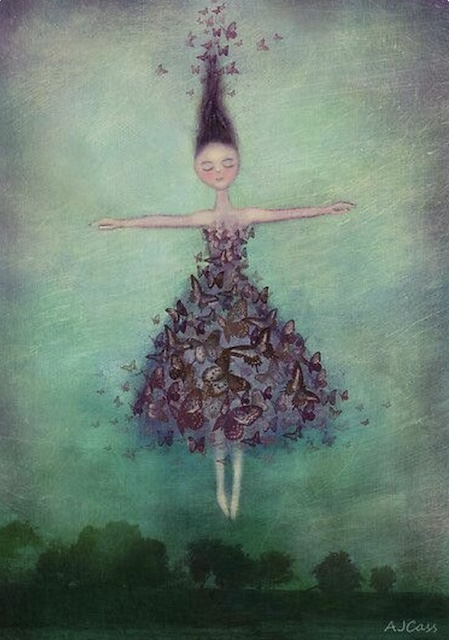
“Trade me a memory,” the butterfly said
A memory that’s heavy and harsh,
And I’ll sit and I’ll listen and try my sweet best
To lighten the load on your heart.
From a poem by Becky Hemsley+Art by Amanda Cass

“Trade me a memory,” the butterfly said
A memory that’s heavy and harsh,
And I’ll sit and I’ll listen and try my sweet best
To lighten the load on your heart.
From a poem by Becky Hemsley+Art by Amanda Cass
I don’t think I ever knew there were more verses. I’m not sure if this is the original or if someone added to it, but it’s lovely.

Twinkle, twinkle, little star,
How I wonder what you are,
Up above the world so high,
Like a diamond in the sky.
When the blazing sun is set,
And the grass with dew is wet,
Then you show your little light,
Twinkle, twinkle, all the night.
Then the traveler in the dark
Thanks you for your tiny spark,
He could not see where to go
If you did not twinkle so.
In the dark blue sky you keep,
And often through my curtains peep,
For you never shut your eye
Till the sun is in the sky.
As your bright and tiny spark
Lights the traveler in the dark,
Though I know not what you are,
Twinkle, twinkle, little star.
The Star by Jane Taylor
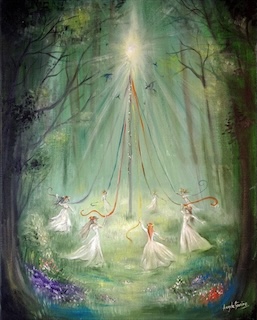
Art from Pinterest
If you look, this is where you’ll find me...
They be the Enchanted places.
That whisper our name.
And no one shall know.
These places we go.

A Little Poem by Athey Thompson.
Credit to the artist, curated via Pinterest

I heard a whisper
Coming from the trees
And, in that moment
I was gone,
Gone away
To return, to where I’d come from
By Athey Thompson

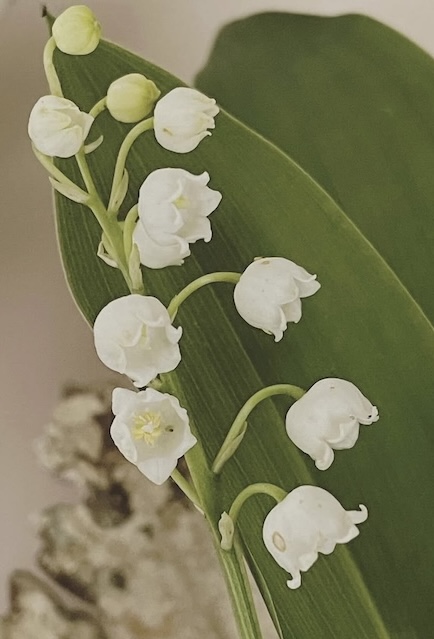
May’s birth flower is Muguet de Bois, Lily of the Valley. Every year on my birthday, my mom would give me a brand new set of Coty perfume and dusting powder. I felt SO grown up! I savored its divine fragrance as long as I could, and then stashed the empty bottle in my drawers to scent my clothes.
A favourite flower in my garden to see, if you ask me, just has to be The Lily of the Valley.
Known to be the May Lily, this sweet scented, dainty white bell represents a return to happiness and innocence. How delighted I be to see my Lily of the Valley, as blooming it be in ye month of May.
Often found neath leafy bushes, or hidden away within the nooks and crannies. Tread carefully mind. As under its flapping green leaves you’ll find its wee white bells dangling on a tiny stem.
The Lily of the Valley symbolises Pure Love…They say Lucky in Love it be that’s why it be tradition for brides to have Lily of the Valley amongst their wedding flowers.
There be many an old Myth told about the faery folk and the Lily of the Valley. In Ireland it is known to be “The Faery Ladder”.
Little thoughts written by Athey Thompson
Photos taken at home by Athey Thompson

The day returns, but nevermore
Returns the traveler to the shore,
And the tide rises, the tide falls.
Henry Wadsworth Longfellow

Love shall always
Find a way
Even through
The darkest of day
Love shall always
Find a way
Even through
The darkest of day
A Little Poem by Athey Thompson
Pic curated from Pinterest. Credit to the artist.
Sometimes the only healing modality for all this stress and anxiety is to go outside and work in the garden. Flowers don’t care if democracy is crumbling; there is regenerative rebirth every spring, no matter what or whom is orchestrating our demise.
After the rain, all my fruit trees burst forth with glorious flowers. It’s a small tree, but full of life. I’m continually fascinated with photographing raindrops.
Infinite peach-blossom shades,
her rouged and powdered cheeks.
Spring breezes help her break my heart,
blowing peach petals from her dress. — Yuan Zhen

We are living in sad and scary times. Lawrence Ferlinghetti wrote the poem “Pity the Nation” in 2007, drawing inspiration from Khalil Gibran’s original work of the same title, published in 1933. Their words are a reminder about the cycles of history.
We’ve been warned.
PITY THE NATION
Pity the nation whose people are sheep
And whose shepherds mislead them
Pity the nation whose leaders are liars
Whose sages are silenced
And whose bigots haunt the airwaves
Pity the nation that raises not its voice
Except to praise conquerers
And acclaim the bully as hero
And aims to rule the world
By force and by torture
Pity the nation that knows
No other language but its own
And no other culture but its own
Pity the nation whose breath is money
And sleeps the sleep of the too well fed
Pity the nation oh pity the people
who allow their rights to erode
and their freedoms to be washed away
My country, tears of thee
Sweet land of liberty!
Lawrence Ferlinghetti, 2007
PITY THE NATION
By Khalil Gibran, 1933
Pity the nation that is full of beliefs and empty of religion.
Pity the nation that wears a cloth it does not weave, eats a bread it does not harvest, and drinks a wine that flows not from its own wine-press.
Pity the nation that acclaims the bully as hero, and that deems the glittering conqueror bountiful.
Pity the nation that despises a passion in its dream, yet submits in its awakening.
Pity the nation that raises not its voice save when it walks in a funeral, boasts not except among its ruins, and will rebel not save when its neck is laid between the sword and the block.
Pity the nation whose statesman is a fox, whose philosopher is a juggler, and whose art is the art of patching and mimicking.
Pity the nation that welcomes its new ruler with trumpetings, and farewells him with hootings, only to welcome another with trumpetings again.
Pity the nation whose sages are dumb with years and whose strong men are yet in the cradle.
Pity the nation divided into fragments, each fragment deeming itself a nation.
I had another lucid dream about my kitty, Bandit. She was seated on the sofa, paws tucked up under her body, and she was simply looking at me.
When she was alive, she would often stare at me, right through to my bones, with such intense love in her eyes that I’d have to stop whatever I was doing and bask in the feeling of being so very loved. SIGH. I surely do miss that girl.

And, there
In the mists of my memory
I see you.
And, there
In the mists of my memory
You shall always be.
A little poem written by Athey Thompson