As long as there are bluebirds, there will be miracles and a way to find happiness.

Quote curated from Pinterest: Credit to the writer.
Art by Ida Rentoul Outwaite
As long as there are bluebirds, there will be miracles and a way to find happiness.
Quote curated from Pinterest: Credit to the writer.
Art by Ida Rentoul Outwaite
Early this morning, I opened the back door and walked on the deck. Near the steps, I saw a motionless bee which I gently nudged with a stick and found him able to move ever so slightly. I brought him a small amount of water in a jar lid and watched as he thirstily inhaled a few drops. As soon as he had enough, he stumbled down the rest of the steps to a shady area on the ground.
I’m not sure if I helped him or simply prolonged the inevitable, but at least I did something to aid a living creature and that always feels good.
Later that morning, I went to the grocery store where I picked up some yummy cherries and cucumbers and avocados.
The woman in front of me had a lot of items and it looked like she was making a special dinner, maybe anniversary, or at least that was the little story I told myself as I patiently waited my turn.
I noticed that she didn’t have her own shopping bags and I watched the clerk take out a couple “store” bags and fill them with her food. After the food was paid for, the employee asked her for thirty cents to pay for the bags, which was really odd because usually they’ll ask before, so they can add it to the total. Right??? So my spidey senses were on alert as I observed the conversation.
The lady became flustered as she looked in her handbag because she didn’t have any cash or change. I could see that she was super embarrassed and I could totally relate. It didn’t seem as if she was unsheltered or didn’t have money; she was well dressed with great jewelry (I always notice stuff like that).
I said, “Let me check. I think I have thirty cents.” I usually don’t have ANY cash or coins either, but I did locate enough to pay for her store bags.
The poor woman was beside herself with gratitude, wanted to pay me back, couldn’t believe I would do that for a complete stranger, asked me my name, WAY overly intensely thankful and appreciative for a mere handful of coins.
I told her it was my pleasure to help and it wasn’t as if I offered to buy her food (haha) and she could pay it forward to someone else in the future and keep the good deed moving along.
Because her gratitude seemed oddly disproportionate, I thought it was possible that she had a bad day and my minor act of kindness gave her a bit of hope — who knows.
She did seem close to breaking down, poor dear. And all for THIRTY CENTS! I wonder if this was some sort of low rent scam so the employee could pocket the money, but that was most likely not the case. Anyway, it was a strange encounter and I was glad to help because it did seem that was the only way I was going to get out of the store, haha. (BTW, I had my own bags.)
Sometimes I’ll see someone do a kind but simply mundane gesture and I’ll just get filled with this unexplainable joy that someone did something nice for someone else with no strings attached; no ulterior motives, no agenda.
After that experience, I went to Sprouts because I was out of probiotics (I love probiotics). The woman in front of me in line (same scenario!) turned to me. She held out a couple pieces of candy wrapped in shiny gold foil and asked me if I wanted them. She said they were free and pointed to where she got them, somewhere else in the store.
I told her how much I LOVE free things (I really do) but asked why she didn’t want them. She explained that she had tasted another one and they were milk chocolate and she only likes dark chocolate. I said I like all variety of chocolate (except white) and gladly accepted her little gifts.
Two acts of kindness were immediately repaid by another; what a great (and sweet) day!
Featured image credit to oechsli.com
If you look, this is where you’ll find me...
They be the Enchanted places.
That whisper our name.
And no one shall know.
These places we go.
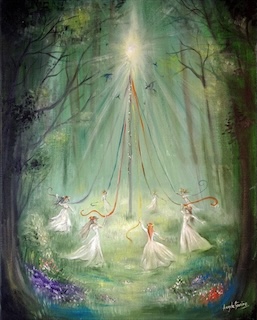
A Little Poem by Athey Thompson.
Credit to the artist, curated via Pinterest

“Happiness is a butterfly, which when pursued,
is always just beyond your grasp,
but which, if you will sit down quietly,
may alight upon you.”
Nathaniel Hawthorne
🦋
Artwork by Elisabeth Ladwig (Elisabeth on Earth)
I wish that I could show you,
when you are lonely or in darkness,
the astonishing light of your own being.
— Hafiz

Not too long ago, the Angel Kids’ parents went to a social function. They weren’t too happy about Mom and Dad leaving because they rarely do, but as soon as the door closed, everything was OK ‘cos Grandma was there.
The kids have a solid bedtime routine: bath, night snack, brush teeth, read, and sleep. After their baths and a bowl of yogurt and applesauce, teeth were brushed and we snuggled together for reading time, my favorite part.
We began with a book for Angel Girl about a ballerina who loves to wear sparkly tiaras. I was peppered with questions and comments, “You love to wear a tiara, don’t you, Grandma!” “I have a sparkly tiara, too.” After her book, she turned on her side, clutching her stuffed unicorn, ready to drift off to sleep.
When it was time to read to Angel Boy, Dad had kindly left me with a chapter book they were halfway through, and I planned to read to the lovely child who was curled up against me.
I wasn’t prepared for what came next…and I can genuinely say that it was one of the happiest moments of my entire life…
“Hey, Grandma, how about if I read to YOU this time instead of YOU reading to ME?”
That had NEVER happened before. He’s gifted in math, but reading was sometimes frustrating for him, totally unlike his dad, who was an early and brilliant reader. T tested at grade level in school, but it wasn’t with the joy that reading brings to our lives. I always told him that reading was the gateway to the world. In my opinion, reading is EVERYTHING.
So of course I said that would be the most wonderful idea EVER in the history of wonderful ideas.
He read four chapters of his book while I watched; eagle-eyed, to observe (scrutinize) his reading prowess as a second grader, and his ability to successfully sound out words that weren’t familiar. The best part was that he didn’t want to stop reading; he wanted to keep going, but he was so tired, he agreed to finish the book the next day.
I was absolutely blown away, not only by his skills, but the way he read with humor and expression.
“Did you like that, Grandma? I knew you would because you love reading so much.”
“T, I am so incredibly proud of you! C is too, and we both loved to hear you read. How did it make you feel to read to US?”
“Grandma, I was reading and the words were like, just in my head as I saw them, and I couldn’t believe it, they came out so fast!”
At that moment, I think I almost squeezed the very life out of him, and I was more than grateful to be able to experience his “lightbulb” moment where everything clicked into place.
“T, that is what’s called REAL READING! I told you it would happen soon, where words you see instantly translate from your eyes to your brain — and you totally GOT IT!”
“I wanted to make you happy, Grandma.”
And he did. That was an understatement!
T whispered, “I love you, Grandma.”
“I love you too, so, so much. See you in the morning for buckwheat pancakes!” I whispered back to him.
For me, this definitely qualifies as a memorable, momentous watershed event.
I feel like I’m the luckiest grandma in the whole world.
Some Wednesday wisdom.
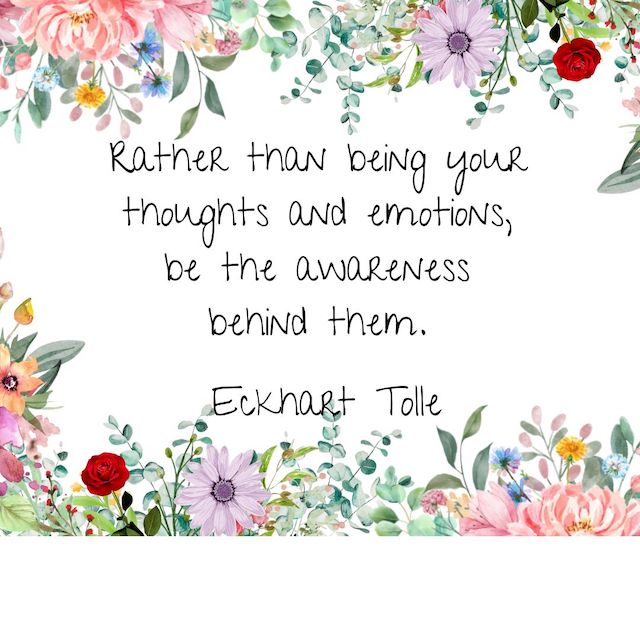
“Rather than being your thoughts and emotions, be the awareness behind them.” Eckhart Tolle
Born in Germany and educated in the UK, Tolle’s teachings focus on the power of present moment awareness, which he believes is key to achieving a sense of inner peace and fulfillment. Tolle encourages us to focus on the present moment and to let go of negative thoughts and emotions, in order to experience a deeper sense of self-awareness and connection to the world.

What are glimmers?
Glimmers are small moments that spark joy or peace, which can help cue our nervous system to feel safe or calm. I’ve become fascinated with finding, paying attention to, and appreciating these small joys.
We all know what triggers are…those sensory reminders that cause painful memories or certain symptoms to resurface. If you experienced a traumatic event, you most likely remember certain sounds, smells, or sights related to that experience. but few people know about their opposite: glimmers.
Experts say this mindset shift can make a positive impact on our mental health. The term was first coined by Deb Dana, a licensed clinical social worker who specializes in complex trauma.
In her 2018 book, The Polyvagal Theory in Therapy, “glimmers” refers to small moments when our biology is in a place of connection or regulation, which cues our nervous system to feel safe or calm.
This isn’t about big, expansive experiences of joy or safety or connection. These are micro moments that begin to shape our system in very gentle ways.
🌟 Being in nature
🌟 Wrapping our bodies in a big blanket
🌟 Interaction with our furbabies
🌟 Gardening
🌟 Freshly baked bread
🌟 Sharing a smile with a stranger
🌟 Hearing your favorite song
Here are just a few of my small and simple joys:
🌠 The sound of two little voices calling “Grandmagrandmagrandma!”
🌠 Hearing a hawk or coyote
🌠 Finding a hawk or owl feather
🌠 My crow family
🌠 Noticing a beautiful flower or moon or sunset or sunrise
🌠 Smelling the ocean or coffee brewing first thing in the morning
🌠 My garden
🌠 Butterflies
🌠 Wind through the trees
🌠 Of course seashells, rocks, and beach glass!
What are your glimmers?
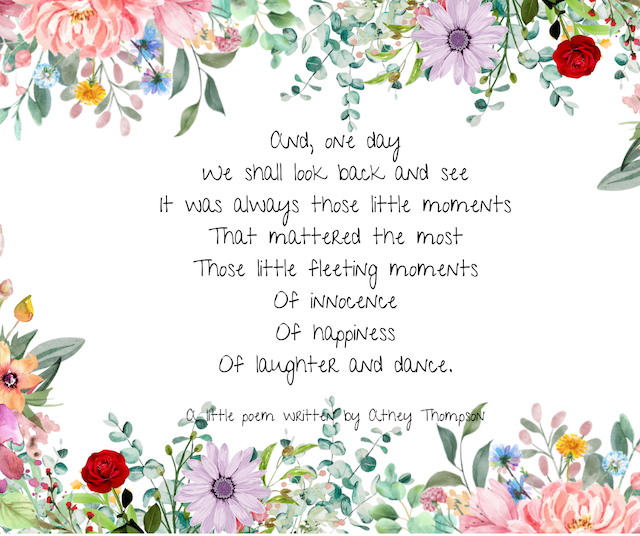
And, one day
We shall look back and see
It was always those little moments
That mattered the most
Those little fleeting moments
Of innocence
Of happiness
Of laughter and dance.
A little poem written by Athey Thompson
We had been playing house with her dolls and I styled their hair with braids or headbands and even a sparkly tiara, when Angel Girl said,
“Grandma, take your hair down.”
“Why?”
Those giant eyes scrutinized me with piercing discernment.
(This not-quite-four-year-old is actually quite judgy and has no problem letting me know if I’m wearing the right clothes or if my shoes are tied properly. Definitely some of my DNA, haha.)
“I don’t like it up in a scrunchie, I want to brush your hair.”
Uh oh, I thought to myself. I remember another little girl who used to love to brush my hair and it always turned out to be an exquisite disaster.
When hair is as curly as mine, it’s next to impossible to brush. The only time I can attempt it is when it’s freshly washed and I comb in product.
But will I say no? Not on your life.
“OK, I replied, “but PLEASE be as gentle as I am with your hair and T’s hair. You know it hurts to pull.”
Eye roll. “OK, Grandma. Sit down and turn around.”
Yes, ma’am! These are definitely two bossy boots angel kids.
For the next few minutes, while the angel stands behind me, all is silent as her brush unsuccessfully attempts to glide its way through my hair. She was intensely concentrating on arranging my hair into a semblance of “style.”
I feel her little hands twisting and pulling and puffing up certain areas. I’m afraid to look.
“What are you doing back there? Can I look?”
“Not yet. Grandma, hand me your scrunchie.”
“Here you go.”
Somehow the scrunchie is now imbedded in all of that twisting and spiraling and brushed out tangled up curly bird’s nest of her creative endeavors.
I know it’s going to be a long hard road to untangle the knots, but when she finally tells me she’s done and I can look, the pride (and love) in her eyes was totally worth every bit of it.
“Am I beautiful now?”
“Yes, you ARE beautiful now, Grandma.”
In her eyes, I am, and that’s all that matters.
Later, after the kids were tucked away in bed, I slathered conditioner on my hair, took my wide tooth comb and spent a good half hour or so untangling the knots, and fell asleep with a smile on my face.
These are the rare moments that weave a tapestry of joyful memories. However, I wouldn’t dare share a photo of my medusa-like hair catastrophe!
 Enchanted Seashells | Princess Rosebud