It’s the time of year for parent-teacher conferences in most school districts. I was thinking about the time my parents went to a meeting and they were told that I wasn’t living up to — or performing to — “my highest potential” which has been the story of my life’s path.
I was VERYVERY smart but I wasn’t doing as well as my teachers expected, especially in math and science. According to all of them, I was capable of great things and should pursue a career as a doctor and my dad also thought I’d be a great lawyer, following in his footsteps. I’m not exactly sure why I didn’t finish either of those life paths, although I sort of started down that road, maybe because there were obstacles in the way, like studying. lol. “I wasn’t applying myself” became the repetitive theme.
Those thoughts sent me on a rabbit hole to learn more about my own life path and numerology.
Numerology is the belief in the mystical relationship between numbers and events, used to interpret character or divine the future by calculating a person’s key numbers from their name and birth date. It is a system that assigns numerical values to letters and uses these values, along with your birth date, to provide insight into your personality and life path.
Modern numerology is often based on the ideas of the ancient Greek philosopher Pythagoras, who believed the physical world is a manifestation of the energetic vibrations of numbers.
In a crazy coincidence, I realized that I initially wrote about this subject exactly one year ago. Or maybe it’s not a coincidence, whatcha think?
Anyway, I have no regrets because It all worked out as it should.
Due to my not exactly poor, but not exactly stellar academic performance, and especially since I declined the gifted program because I saw how those kids were ridiculed for being nerds and I wanted to be COOL, I instinctively knew how to encourage the Original Angel Boy to love learning and reading and offered supportive nurturing opportunities anywhere he expressed an interest.
For example, when he was six-years-old and interested in dinosaurs, I took it a step further and brought him to the Natural History Museum so he could meet with the paleontologists. They included him in a project categorizing dino bones and gave him some fossils to bring home.
When he realized that the local paper had misnamed a dinosaur found around here, I called the paper and they sent a reporter and photographer to the house to interview him…and yes I still have about a dozen or so of the articles which I’ve shown to the Angel Kids. “Look at Daddy!”
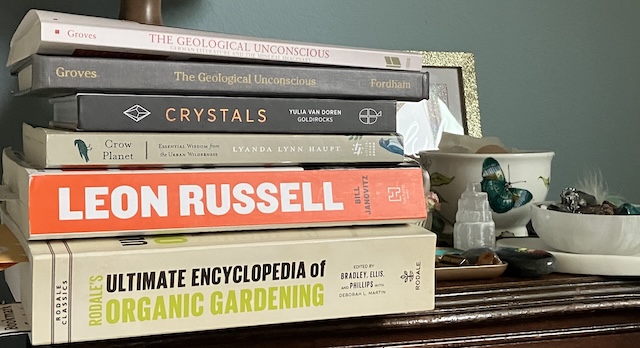
When he wanted to be a reporter, I called the local radio station and set up a meeting with one of his favorite bands that were in town, Trixter, (don’t judge, it was the 90s). After he interviewed them on-air, they gave us backstage passes to the show and we hung out in their tour bus. They were really nice guys and very kind to the Angel Boy, only now I’m thinking to myself, why didn’t I do the same thing with Leon Russell? Another missed opportunity. SIGH.
Since Reading Rainbow with LeVar Burton was AB’s favorite TV show, he wrote a poem for a contest hosted by the local PBS station. All the local kids who participated were brought to the station and I still have the group photo. He won something, but not the national award. The only thing that mattered to me was that he TRIED, not whether he won or lost.
I did all this so he wouldn’t end up like me and it worked. He’s still passionate about learning, reading, and writing, and now he pays it forward by teaching the next generation, so I’m very proud of myself, and AB of course. His bright future was actualized and came to fruition.
Do you know how to figure out your Life Path and Master Numbers?
Add your birth date/day/year.
For example, if your date of birth is 2/12/1938…2+1+2+1+9+3+8 = 26, which is reduced to 2+6=8.
The Life Path number of 8 indicates someone with natural leadership skills, wealth potential, and management talent, but must always use that power for good and avoid greed. They excel at business and finance.
In this case, there is no Master Number because a MN is is a special type of life path number that is a double-digit (11, 22, or 33) and is not reduced to a single digit. I don’t really understand much of this, but it’s so interesting!
My own Life Path Number is 2 and my Master Number is 11, one of the most rare of all numbers, as it can be reduced to 2, my Life Path Number.
Here’s what it’s supposed to mean for me:
- Diplomacy: Natural ability to mediate conflicts and bring people together.
- Empathy: A deep emotional intelligence that allows them to understand and connect with others.
- Cooperation: Thrive in partnership and group settings, working to create harmony.
- Peacekeeping: Driven to seek and maintain peace, acting as a stabilizer in relationships and situations.
Master Number 11 is associated with high intuition, spiritual insight, and a duality that requires balancing a spiritual path with material life. It’s sometimes called the “Illuminator” or “Spiritual Messenger” and represents a gateway to higher dimensions. Individuals with this number may experience challenges such as confusion and indecision, which emanates from a struggle to trust their intuition and a pendulum-like oscillation between extremes.
To be completely honest, I literally have no idea what that means.
Why is the number 11 so powerful?
The number 11 symbolizes the potential to push the limitations of the human experience into the stratosphere of the highest spiritual perception; the link between the mortal and the immortal; between human and spirit; between darkness and light; ignorance and enlightenment. This is the ultimate power of the 11.
Once again, I’m reminded that I really never did reach my full promise, so those early teachers were obviously correct in their assessment.
Check out your own Life Path and Master Numbers so you can decide if you are living up to your maximum potential. It’s never too late.



 Enchanted Seashells | Princess Rosebud