Mindfulness Mantra for 2026

Now that 2025 is almost over and we’re looking for inspiration to start a new year, how about this one? It’s said that Buddha repeated it when he taught mindfulness…

Atapi sampajano satima

It’s in the Pali language, an ancient language central to Theravada Buddhism.

Atapi sampajano satima is from Buddhist texts and means “ardent effort, clear comprehension, and constant mindfulness,” a core formula for the path to liberation.

It emphasizes diligent, wise, and continuous awareness of reality (impermanence) to see phenomena as they truly are, dissolving self-illusion.

This is a call to practice intensely (Atapi), understand deeply (Sampajano), and stay present (Satima) by observing the arising and passing of sensations and mental states without reaction, which leads to wisdom and freedom. 

We’re entering that dreaded holiday limbo zone between Christmas and New Year’s Eve, when time seems to almost stop moving in a sort of frenzied yet slightly depressed way.

If ever there was a time for meditation, calm, reflection, self care, and serenity, this is IT.

Atapi sampajano satima 

And BREATHE…

Seijaku: Word of The Day

Photo by Pixabay on Pexels.com

Seijaku: stillness in the midst of activity, is an advanced and powerful form of T’ai Chi Chih.

“The Japanese speak of Seijaku as serenity in the midst of activity. Not escaping from the world to some mountaintop as is taught in the Indian teachings. But finding the real meaning, fulfillment, energy and wisdom in the midst of everyday hustle and bustle – building a silent and imperturbable center while active in the disappointments and triumphs of our busy lives. This is real fulfillment.” Justin Stone Speaks on T’ai Chi Chih®

Seijaku (stillness, tranquility, solitude): The principle of seijaku emphasizes the fundamental Zen theme of emptiness, which implies an inexhaustible spirit.

It is in states of active calm, tranquility, solitude, and quietude that we find the very essence of creative energy. Silent pauses in music, as well as motionlessness in dance and theater, illustrate the power of seijaku.

In meditation, we strive to achieve self-awareness and focus, to learn how to quiet our mind.

I think that’s why it’s called a practice, because it’s a daily exercise to try and attain and actualize that state of being.

Some days it works; often it does NOT, but it’s a life goal. My brain often goes off on a tributary, thinking of funny things like the Seinfeld episode where George Costanza’s dad screams “Serenity, NOW!” (I’m working on that; like I said, it’s a practice…)

Satori: Word of the Day

In Zen Buddhism, satori defines the inner, intuitive experience of enlightenment, perhaps similar to having an epiphany.

Satori is said to be unexplainable, indescribable, and unintelligible by reason and logic.

It is comparable to the experience undergone by Gautama Buddha when he sat under the Bo tree and is the central Zen goal.

It’s a moment of total presence, of no mind and no thought but a flash of insight and awakening of the light of our own consciousness.

I also discovered that in Japanese folklore, Satori are mind-reading monkey-like monsters said to dwell within the mountains of Hida and Mino. That sounds pretty scary to me, so I’ll stick to the other definition of satori as instant enlightenment.

Have you experienced satori?

“Satori is the sudden flashing into consciousness of a new truth hitherto undreamed of. It is a sort of mental catastrophe taking place all at once, after much piling up of matters intellectual and demonstrative. The piling has reached a limit of stability and the whole edifice has come tumbling to the ground, when, behold, a new heaven is open to full survey.”

D.t. Suzuki, An Introduction to zen Buddhism

Ma…The Space Between Things

I’m inspired by the spartan aesthetic of Zen Buddhism.

Is less really more?

Ma (pronounced “maah”) is a celebration of not things, but the space between them. It’s negative space, voids, emptiness. The place you get to (if you’re lucky) in meditation. Like the space where that tree used to be.

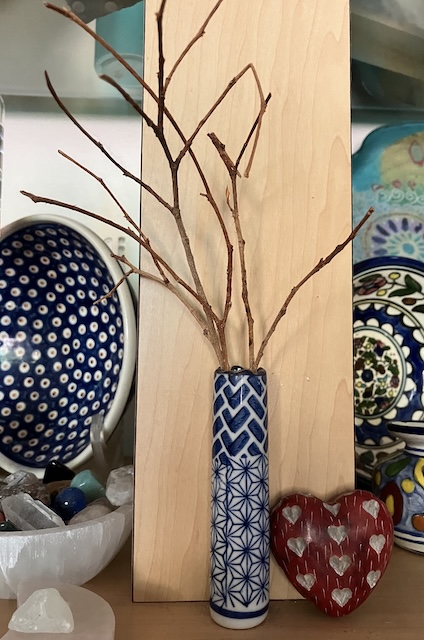
I’m not exactly sure why this tiny little ceramic vase IS. Like why it even exists.

Only four inches tall, it holds about a tablespoon of water and I continued to replace flower after flower until I got the brilliant idea of searching around the garden for beautifully shaped little twigs.

These are the last remnants of the ficus tree that is no longer there, and I decided it would be a simple way to honor that once living entity by saving a little part of it.

At first I was going to embellish the tiny branches with faux gems, pearls, and seashells–like I usually do–but the more I looked at it, the more I loved the bare simplicity. I didn’t want to detract from the design of the vase.

I should write a haiku about the tree and these twigs. Being a minimalist with words is just as difficult for me as NOT gluing shiny things to those tiny little branches.

So this is zen — ma, the serene space between things.

Nasturtiums in Orange #WordlessWednesday

So much is upsetting at WordPress…the change in the Reader and the format of the write/edit/publish page–whoever thought one could HATE to see “beepbeepboop” as much as I do — so in order to recapture my ZEN, here’s one of my favorite pictures of nasturtiums from the garden.

Because ORANGE.

It looks like a painting.

Enjoy this mostly #wordlesswednesday

Nastursiums orange

enchantedseashells.com