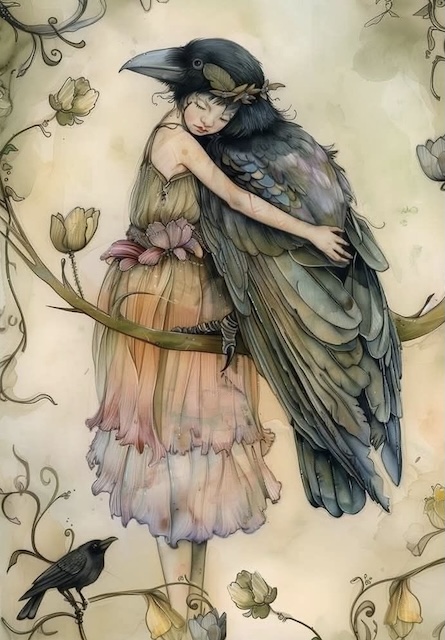
A little timeline cleanse right now seems appropriate. At the end of the day, there is only love.


A little timeline cleanse right now seems appropriate. At the end of the day, there is only love.
Lately, I’ve been thinking about T-I-M-E. Time flies. I hate to be late; I like to be ON TIME. Does time really exist at all or have we been brainwashed to think iit does?
Too much thinking about time as ephemeral makes me anxious. Too much thinking about anything does the same thing. My non-logical mind has determined that TIME itself isn’t the issue; THINKING about it IS and it makes my brain melt, just like Dali’s clocks.

“Time doesn’t exist, clocks exist. Time is just an agreed upon construct.”
— David Foster Wallace
“It takes just one unattended moment for an hour to pass.”
― Sherod Santos, Square Inch Hours: Poems
Santos was born in South Carolina, graduated from San Diego State University, and studied at the University of California, Irvine. I never met him when I attended SDSU, but I knew ABOUT him; all of us who studied creative writing and poetry knew about “Rod” Santos and W.S. Merwin and Glover Davis, who was actually my professor.
David Foster Wallace was an acclaimed American writer known for his fiction, nonfiction, and critical essays that explored the complexities of consciousness, irony, and the human condition. Wallace wrote the novel Infinite Jest.
“The Persistence of Memory” is an iconic 1931 surrealist oil painting by Salvador Dalí, famous for its “melting” clocks draped over a desolate, dream-like landscape inspired by his Catalonian home. The painting uses a paranoiac-critical method to explore the subconscious, with the distorted clocks symbolizing the fluidity and subjectivity of time, influenced by Freudian psychology and potentially Einstein’s theory of relativity. From Google.
Could Leon Russell’s version of As Time Goes By be the best ever? I think so…mature Leon was awesome, too.
I don’t think I ever knew there were more verses. I’m not sure if this is the original or if someone added to it, but it’s lovely.

Twinkle, twinkle, little star,
How I wonder what you are,
Up above the world so high,
Like a diamond in the sky.
When the blazing sun is set,
And the grass with dew is wet,
Then you show your little light,
Twinkle, twinkle, all the night.
Then the traveler in the dark
Thanks you for your tiny spark,
He could not see where to go
If you did not twinkle so.
In the dark blue sky you keep,
And often through my curtains peep,
For you never shut your eye
Till the sun is in the sky.
As your bright and tiny spark
Lights the traveler in the dark,
Though I know not what you are,
Twinkle, twinkle, little star.
The Star by Jane Taylor
Art from Pinterest
As long as there are bluebirds, there will be miracles and a way to find happiness.

Quote curated from Pinterest: Credit to the writer.
Art by Ida Rentoul Outwaite
I’m at #3 with Angel Boy, #2 with Angel Girl.

I remember that the original Angel Boy was about fourteen years old when he entered the final stage, taller than me. Now I have to get on my tiptoes to hug him and HE bends down to me.
In my mind, he’s still and forever #1 or #2, so it doesn’t seem right that the roles have reversed, and it won’t be long before the Angel Kids will also be taller than me, because mostly everyone else is.
I guess that’s why they call me Little Grandma.
**I found this on Pinterest, but credit goes to artist Giselle Dekel.**
“Here, beneath this tree, she had lain on her back in the sun and watched the butterflies. Part of her would linger there for ever: a footstep running tip-toe to the creek, the touch of her hand on a tree, the imprint of her body in the long grass. And perhaps one day, in after years, someone would wander there and listen to the silence, as she had done, and catch the whisper of the dreams that she had dreamt there, in midsummer, under the hot sun and the white sky.”
— Daphne du Maurier, Frenchman’s Creek.

Three of my favorites in one painting: a wolf, a raven, and trees. I’d love to curl up and hibernate in a mighty oak guarded by my beloved animal family — to dream of butterflies and seashells and other simple but profound bearers of joy.
If you look, this is where you’ll find me...
They be the Enchanted places.
That whisper our name.
And no one shall know.
These places we go.
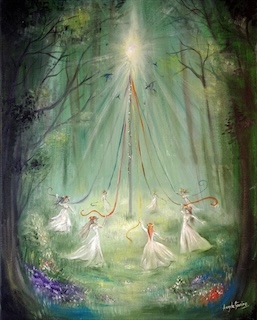
A Little Poem by Athey Thompson.
Credit to the artist, curated via Pinterest
Keep some room in your heart for the unimaginable. —Mary Oliver

Words by Mary Oliver – Art by Leonardo Di Aetherhart – Curated from Novelicious
Kintsugi is a Japanese method for repairing broken ceramics with a special lacquer mixed with gold, silver, or platinum.
The philosophy behind the technique is to recognize the history of the object and to visibly incorporate the repair into the new piece instead of disguising it.
The process usually results in something more beautiful than the original.
Kintsugi is rooted in the Japanese philosophy of wabi-sabi, which appreciates the beauty of imperfection and impermanence. It encourages embracing flaws and seeing them as part of a unique history rather than something to be concealed.
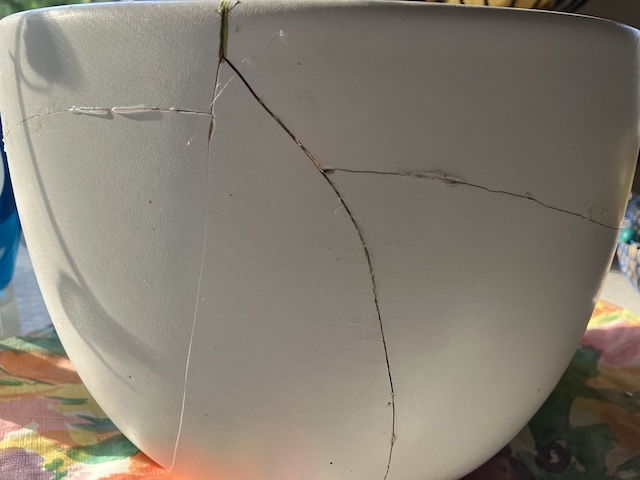
When I had my recent fainting (syncope) episode, my fall smashed one of my favorite planters. It was white, simple, pure, and had a twin, which makes my OCD happy. When I cleaned up the mess, I saved the broken pieces. I wasn’t sure what I could do with them but I wasn’t ready to toss it out, especially as it created an imbalance with its sibling.
Yesterday, finally, I decided to see if I could repair it. I used E6000 to glue all the pieces back together. I thought I could use it outside in the garden even if it was too destroyed to be brought back in the house. It didn’t look great, but then I remembered that I had a gold permanent marker.
Instead of hiding the damage, I used the kintsugi concept and revealed the beauty in its brokenness.

I love the way it looks and the rattlesnake plant is once again displayed in a perfectly, now imperfect setting.
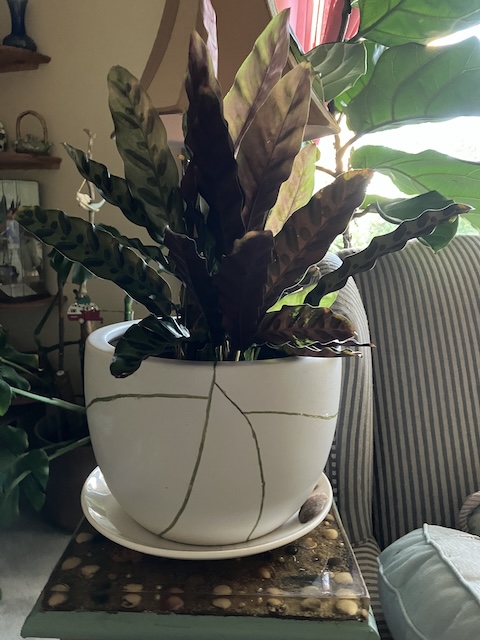
I know you can buy kintsugi repair kits, but my little gold marker did a great job.
While traditionally used for ceramics, the philosophy of kintsugi has been applied to various aspects of life, including personal healing. It offers a perspective on how to find beauty in the brokenness and learn from life’s experiences.
Since I break things all of the time, I’m fairly certain I’ll be able to attempt more kintsugi in the future. I’m slightly tempted to break something on purpose. I won’t, but maybe I will!