From Seed to Harvest | The Essential and Humble Beet

Have you ever grown beets? They’re humble and rustic, sweet and solid, packed full of heart healthy nutrition, even the leaves.

Beets are full of antioxidants that fight cell damage and reduce the risk of heart disease. They’re one of the few vegetables that contain betalains, a powerful antioxidant that gives beets their vibrant color. Betalains reduce inflammation and may help protect against cancer and other diseases.

No part of this beauty is wasted, whether it’s cooked or shaved raw in a salad.

My mom used to make borscht, a Ukrainian cold beet soup, because my dad loved it, but I thought it looked and tasted disgusting, especially since she topped it with a dollop of sour cream.

I now think that I might have been mistaken about my revulsion for borscht, well maybe…except for the sour cream, which I still don’t like.

I’ll scrub and slice the beets, then steam them with the leaves just until tender, to enjoy eating unadorned just like they are, fresh and wholesome. YUM!

Purple + White

Doomed to live and die on the same day, the morning glory is a symbol of resilience and rebirth.

This enchanted morning glory is thriving near a bunch of Natal plum bushes and their fragrant white five-petaled flowers.

The Natal plum is a tropical shrub grown mostly as a flowering landscape specimen, but also known for its small fruits which taste like cranberries and are used in jams and jellies.

Once upon a time when I was in high school, I picked a bushel of the fruits from an empty field and made the most delicious jam but the thorns on the plant almost tore my arms up so I’ve never done it again.

This is a Blue Potato Bush: The flowers are gorgeous but all parts of this part are toxic!

The sweetly scented flowers of Lycianthes rantonnetii, also known as Solanum rantonnetii, blue potato bush, and Paraguay nightshade, grows near a fence in the garden. I cut it back every year which it seems to love because it returns full of flowers that attract bees, hummingbirds, and other pollinators.

Peppermint Party Climbing Rose

This was one of my most successful transplanting of a mature plant.

I moved this Peppermint Party Climbing Rose from one arbor to another a couple years ago, and it’s been thriving ever since. They smell spicy, too!

Late afternoon sun on these stripey petals caught my eye:

And a closer view…

Nature’s Fractal Beauty

As I walked around the neighborhood I had to snap a pic of this mndblowing geometric perfection.

Agave

Falling Stars | Crocosmia

I was enchanted by the yellow to intense lipstick red blooms against the bright green leaves on this crocosmia. Hummingbirds, butterflies, and bees love them, too!

It’s said that dipping dry crocosmia flowers in water releases a saffron-like aroma. Crocosmia plants grow from corms, which are closely related to bulbs.

The spiritual meaning of this beautiful plant encourages us to playfully engage our emotional strength, power, and will to express ourselves confidently and with enthusiasm.

#FOTD

Matilija Poppy

My son has the greenest thumb EVER. I lovelove the Matilija poppy but have never been able to keep a single plant alive, and this beauty is more than six feet tall in its first year. He told me that everyone who walks by stops to take pics and a selfie in front of this incredible specimen.

This morning a fried egg appeared in the backyard,
a startling yellow ball floating
on a white round of wide petals.
Officially: Matilija Poppy.
It hovers,
this hint of perfection,
above mostly unadorned foliage. — Kari Wergeland’

Romneya coulteri: A shrubby perennial that grows to eight feet, found on dry slopes and sandy washes in coastal sage scrub and chaparral, generally away from the coast (mountain foothills and Santa Ana Mountains). 

Like many others in this family this species is a fire follower. While it’s on the California Native Plant Society List 4.2, a watch list for species with limited distribution in California, it’s thriving in Washington state.

I guess I’ll keep trying until I achieve success.

Not Too Shy Shasta Daisy

A couple years ago, I rescued a sad and wilted Shasta daisy from the garden center and tended it with love and care. Since then, I’ve divided it into enough plants to fill an entire bed under the dining room windows.

It wasn’t at all reticent about outgrowing container after container until I had no choice but to allow it to freely spread.

Named after the snowy peaks of Mount Shasta in California, the perennial Shasta daisy (Leucanthemum x superbum) seems to be extremely hardy.

Once established, they are vigorous growers and easily spread via rhizomes. They make lovely cut flowers, but I also learned these daisies are toxic to dogs and cats.

They’re not shy about how bold and beautiful they are!

Blooming Cups of Gold

I don’t know when this Cup of Gold (Solandra maxima) vine will stop growing but I’m going to allow it to live freely without pruning.

It’s already outgrown the arbor and now stretches like a canopy from tree to tree…The flowers are about six inches wide with a light tropical fragrance.

For the first time this year, it looks like the sun is almost ready to come out. We’ve had a very gloomy first half of 2023 with a heavy marine layer and unseasonably cool weather.

I’m looking forward to blue sky again!

White Sage

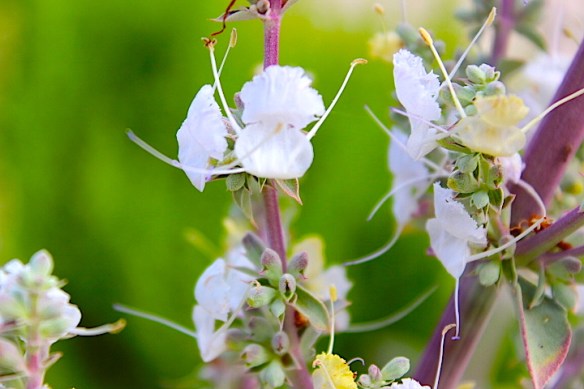
Thanks to all the rain we had this year, all of my sage plants are healthy and flowering, but this white sage is especially full of delicate lavender-colored sticky blooms.

In fact, the entire plant is more than six feet tall and equally as wide.

This is the variety of sage that’s made into smudging bundles tied with string. “Saging” is the term for burning the leaves of the white sage to cleanse, purify, and protect by dissipating negative energy and spirits. 

Smudging (or smoke cleansing) with white sage is sacred to many Indigenous nations of California and Mexico,

I also learned that scientists have observed that sage can clear up to ninety-four percent of airborne bacteria and disinfect the air.

My method is to gather the leaves that naturally fall to the ground and create a smudge stick from them. Sometimes I’ll add lavender, but I prefer the fragrance of white sage all by itself.

Have you ever smudged or is it just a SoCal thing?