I’m reading bell hooks (yes, all lower case) All About Love.
To truly love we must learn to mix various ingredients—care, affection, recognition, respect, commitment, and trust, as well as honest and open communication.
“The wounded child inside many males is a boy who, when he first spoke his truths, was silenced by paternal sadism, by a patriarchal world that did not want him to claim his true feelings. The wounded child inside many females is a girl who was taught from early childhood that she must become something other than herself, deny her true feelings, in order to attract and please others. When men and women punish each other for truth telling, we reinforce the notion that lies are better. To be loving we willingly hear the other’s truth, and most important, we affirm the value of truth telling. Lies may make people feel better, but they do not help them to know love.”
“…nothing haunts us like the things we didn’t buy.” Quote from Becky Bloomwood/Confessions
There’s sad news to report from the literary world.
Author Sophie Kinsella died yesterday. I didn’t know that she had been diagnosed with a glioblastoma in 2022, which is one of the deadliest and most aggressive types of brain cancer.
I loved all of her books and probably have read everything she’s ever written. The first two novels in the Shopaholic series were adapted for the 2009 film Confessions of a Shopaholic, starring Isla Fisher. It’s one of my all-time favorites.
“That moment. That instant when your fingers curl round the handles of a shiny, uncreased bag–and all the gorgeous new things inside it becomes yours. What’s it like? It’s like going hungry for days, then cramming your mouth full of warm buttered toast.” Becky Bloomwood/Confessions
Those who dismiss her books as merely frivolous rom-com or chick lit don’t take into consideration the amount of work and talent it takes to write great dialogue and create characters that come to life.
RIP Sopie Kinsella. She’s survived by her husband and their five children.
And me? I’m still searching for that perfect green scarf. IYKYK
“You speak…PRADA?” Becky Bloomwood/Confessions
Here’s a trailer for the film, Confessions of a Shopaholic. I’m going to watch it again this weekend.
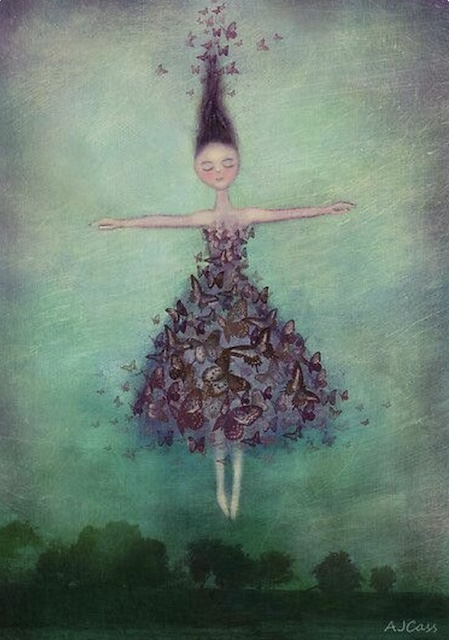
“Trade me a memory,” the butterfly said A memory that’s heavy and harsh, And I’ll sit and I’ll listen and try my sweet best To lighten the load on your heart.
She felt vaguely upset and unsettled. She was suddenly tired of outworn dreams. And in the garden the petals of the last red rose were scattered by a sudden little wind. Summer was over — it was Autumn.
“She felt vaguely upset and unsettled. She was suddenly tired of outworn dreams. And in the garden the petals of the last red rose were scattered by a sudden little wind. Summer was over — it was Autumn.” L.M. Montgomery
Rainbow Valley is the seventh book in the chronology of the Anne of Green Gables series of novels by Lucy Maud Montgomery. Photos by Enchanted Seashells.
Lately, I’ve been thinking about T-I-M-E. Time flies. I hate to be late; I like to be ON TIME. Does time really exist at all or have we been brainwashed to think iit does?
Too much thinking about time as ephemeral makes me anxious. Too much thinking about anything does the same thing. My non-logical mind has determined that TIME itself isn’t the issue; THINKING about it IS and it makes my brain melt, just like Dali’s clocks.
Salvador Dalí
“Time doesn’t exist, clocks exist. Time is just an agreed upon construct.” — David Foster Wallace
“It takes just one unattended moment for an hour to pass.” ― Sherod Santos,Square Inch Hours: Poems
Santos was born in South Carolina, graduated from San Diego State University, and studied at the University of California, Irvine. I never met him when I attended SDSU, but I knew ABOUT him; all of us who studied creative writing and poetry knew about “Rod” Santos and W.S. Merwin and Glover Davis, who was actually my professor.
David Foster Wallace was an acclaimed American writer known for his fiction, nonfiction, and critical essays that explored the complexities of consciousness, irony, and the human condition. Wallace wrote the novel Infinite Jest.
“The Persistence of Memory” is an iconic 1931 surrealist oil painting by Salvador Dalí, famous for its “melting” clocks draped over a desolate, dream-like landscape inspired by his Catalonian home. The painting uses a paranoiac-critical method to explore the subconscious, with the distorted clocks symbolizing the fluidity and subjectivity of time, influenced by Freudian psychology and potentially Einstein’s theory of relativity. From Google.
Could Leon Russell’s version of As Time Goes By be the best ever? I think so…mature Leon was awesome, too.
It’s been a while since I posted about interesting and often archaic words that contribute to a fuller, richer vocabulary. Even though it’s been less than a year since that orange POS somehow took power, this country has turned into a shitshow of one horrible event after another and that seems to eclipse any sense of normalcy.
Anyway…here’s one that’s quirky and will hopefully take our minds off this ugly reality for a minute or two.
Quiddity is such a great word: it’s the essence or unique nature that makes something the kind of thing it is and makes it different from any other.
Vague and not vague at the same time — I can sort of comprehend it only if I don’t allow my brain to delve too deeply into the intricacies of the meaning because then it becomes overwhelming and my mind takes off onto strange and faraway little tributaries. Sometimes it’s best not to overthink things.
From Shakespeare’s Hamlet, “Where be his quiddities now…?
To me: “Her passion for Leon Russell’s music is as much a quiddity as her curly hair.”
More examples:
“Many people share the quiddity of dipping their fries into their milkshakes.” which is a waste of a good milkshake and a good french fry.
“For there is no knowledge of things insofar as they are external in effect, but insofar as their nature and quiddity is grasped by the mind.“
When a politician avoids answering a question while pretending to answer it, he often does it using quiddity, or by bringing up irrelevant and distracting points.
Quiddity is a usefully sneaky tool if you want to evade an argument or question, and it’s often used by people like lawyers in court and teenagers angling for later curfews.
The noun quiddity has a philosophical meaning too, “the essential nature of something,” or the unique thing that makes it what it is. The Medieval Latin root, quidditas, translates literally as “whatness.”
I think we all need to incorporate quiddity into our daily language, written and verbal, don’t you?
“Here, beneath this tree, she had lain on her back in the sun and watched the butterflies. Part of her would linger there for ever: a footstep running tip-toe to the creek, the touch of her hand on a tree, the imprint of her body in the long grass. And perhaps one day, in after years, someone would wander there and listen to the silence, as she had done, and catch the whisper of the dreams that she had dreamt there, in midsummer, under the hot sun and the white sky.” — Daphne du Maurier, Frenchman’s Creek.
Art by Lucy Campbell
Three of my favorites in one painting: a wolf, a raven, and trees. I’d love to curl up and hibernate in a mighty oak guarded by my beloved animal family — to dream of butterflies and seashells and other simple but profound bearers of joy.
I don’t talk much about the part of Southern California where I live; other than my beach, lagoon, and the stupid local government. I’m about thirty or forty miles or so from the city, and while I don’t often get down there, I do love old pictures that chronicle the history of San Diego far more accurately than words.
Here’s a photo of San Diego Bay taken in 1892 from the vantage point of State Street and Broadway. It all looks calm and free of tourists, exactly how we locals like our life here in SoCal.
San Diego Bay / Photo from Reddit
I always thought the oldest bar in San Diego was the Waterfront, but it’s not, because the Waterfront opened in 1933 when prohibition was repealed,
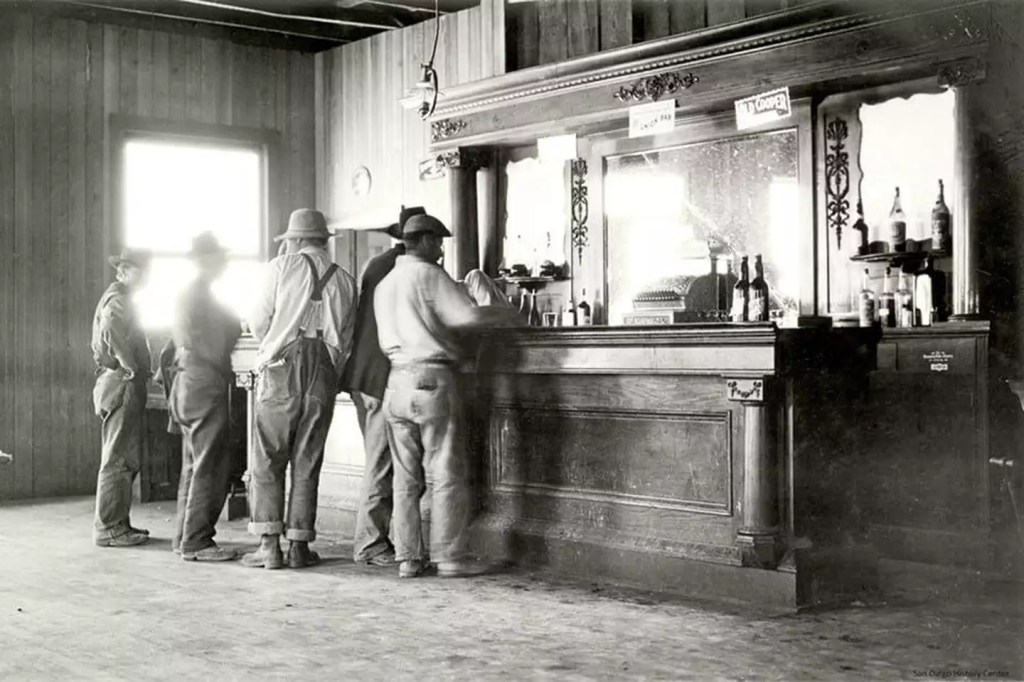
The oldest bar in San Diego is the Tivoli Bar, opened as a saloon in 1885. It’s located on a lot originally owned by Alonzo Horton who helped develop most of downtown San Diego.
Tivoli Bar/Curated from SFGate
Built in 1864, the building was first called the Walker House and functioned as a boarding house, feed store, and blacksmith shop. The Walker House was converted into a saloon and kitchen in 1885. The original bar (still there) was built in Boston and brought to San Diego by ship around Cape Horn at the southern tip of South America, a journey which took three to four months.
The original cash register from the turn of the 20th century and the old safe are still displayed in the bar.
The Tivoli Bar has hosted many famous characters including Wyatt Earp and his wife Josephine, whose photos are prominently displayed over the entrance to the bar, along with Frank Sinatra and Sophia Loren.
The bar flourished during a time when San Diego was a boomtown and the Gaslamp was the city’s red light district, an area then known as the Stingaree. A warning sign from the time reads: “This area is known to be populated by anarchists, confidence men, cut throats, shady ladies, hop heads, perverts and thieves.”
Here’s an 1882 crime report from a local newspaper: “About 8 o’clock on Friday evening, a fracas occurred in the Tivoli Saloon between Gus Young and one Ballantine, in which the former was struck over the head with a chair in such a forcible manner that the latter is of no further service, and will have to be sent to a furniture store for repairs.”
I bet there were some wild times inside the Tivoli–if only the walls could talk! It’s a certified dive bar and I can’t believe I’ve never been there. I think it’d be fun to take the train downtown and check it out.
Have you heard of reporter and author Max Miller?
Max Miller was a reporter for the San Diego Sun and author of twenty eight books. In 1932, he wrote I Cover the Waterfront, an interesting account of San Diego’s port community that inspired Hollywood movies and became the title of a jazz standard sung by Billie Holliday, Frank Sinatra, and Sarah Vaughan, but sadly, NOT Leon Russell.
The book’s characters include true-life sea captains, Portuguese fishermen, flying squid, sparkling Garibaldi fish, movie stars, Charles Lindbergh, Babe Ruth, and a beautiful young woman who got away.
Miller also drew from his experiences living in Everett, Washington and when he attended the University of Washington. He also wrote Harbor of the Sun: The Story of the Port of San Diego, which is a fairly difficult book to locate. He died in La Jolla.
Here’s Sarah Vaughan with her 1946 version of I Cover The Waterfront (I couldn’t find a Leon Russell connection this time at all…LOL).
FYI: This is not a post written with the intention to extol any vacation virtues of San Diego. We REALLY have far too many visitors here but I’m sure there are other lovely places to choose for a holiday…






 Enchanted Seashells | Princess Rosebud