Divine Transmutation

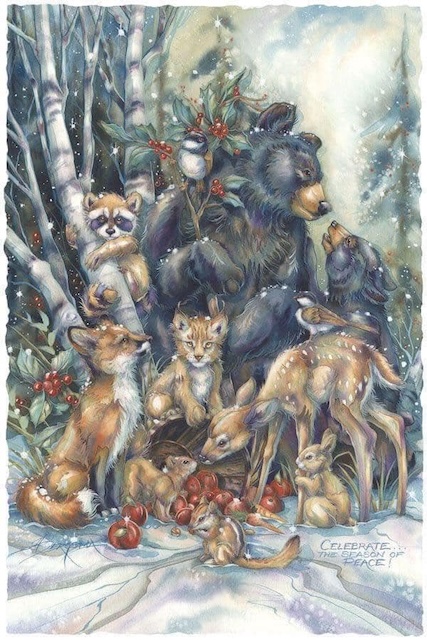
“Once every people in the world believed that trees were divine, and could take a human or grotesque shape and dance among the shadows; and that deer, and ravens and foxes, and wolves and bears, and clouds and pools, almost all things under the sun and moon, and the sun and moon, were not less divine and changeable.” — W.B. Yeats

Artist~ Jody Bergsma

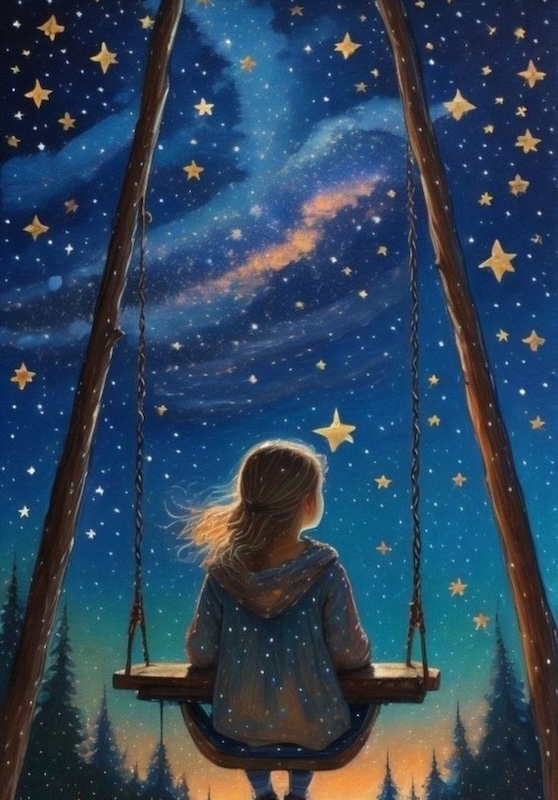
To Live Among The Stars ⭐

These are such exquisite words, it almost hurts my heart to read them.

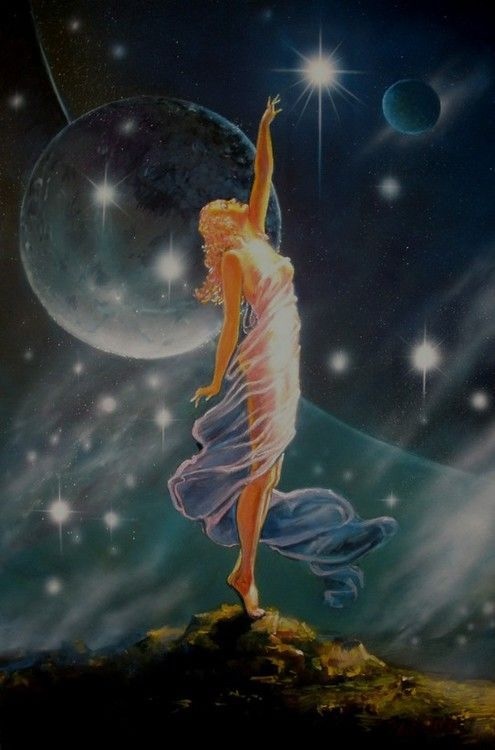
“And at night you will look up at the stars. My star will just be one of the stars, for you. In one of those stars I shall be living. In one of them I shall be laughing. And so it will be as if all the stars were laughing, when you look at the sky at night. And when your sorrow is comforted (time soothes all sorrows) you will be content that you have known me. I shall not leave you. There is sweetness in the laughter of all the stars….and in the memories of those we love.”
Antoine de Saint-Exupéry, The Little Prince

Curated from Pinterest-Credit to artist


Goethe’s Wisdom

I’m not sure there’s a whole lot to celebrate this year; I don’t feel entirely full of the joy of the holidays, and I’m not all that excited about buying presents for anyone. The depressing election results seem to have cast a pall on our future and what’s going to happen in just a few short weeks.

I found these Goethe quotes which make a lot of sense to me right now. Even though I really only know about Goethe because of my German professor Angel Boy, and despite the fact that Goethe died in 1832, his words are timeless…

Man sieht nur das, was man weiß.” (You only see what you know.)

“We do not have to visit a madhouse to find disordered minds; our planet is the mental institution of the universe.”

“The soul that sees beauty may sometimes walk alone.”

“You must, in studying Nature, always consider both each single thing and the whole.”

It is said that the following words were Goethe’s last as he lay on this deathbed, “More light, more light! Open the window so that more light may come in.” 

Johann Wolfgang von Goethe is widely regarded as the greatest and most influential writer in the German language, his work having a profound and wide-ranging influence on Western literary, political and philosophical thought from the late 18th century to the present day.

A Little Fairy Magic

I don’t know about you, but I need some fairies to perform a little magic right about now.

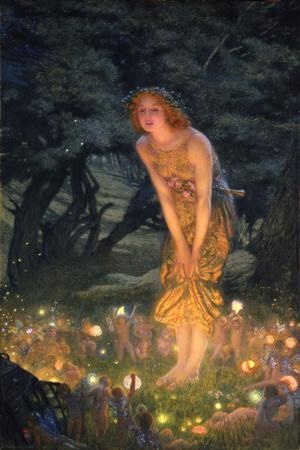
The Fairy Forest

The faery forest glimmered
Beneath an ivory moon,
The silver grasses shimmered
Against a faery tune.

Beneath the silken silence
The crystal branches slept,
And dreaming thro’ the dew-fall
The cold white blossoms wept.
Sara Teasdale

Art credit: Midsummer Eve by Edward Robert Hughes

Autumn Leaves

And Autumn did say.
“Why the hurry, such a hurry
Why such haste to end the day
Slow down, slow down I say
Look around
For there’s so much beauty,
just waiting to be found.”
Athey Thompson

It’s time to take a few deep breaths, slow down, and discover joy in fallen crimson leaves, joined together by a sudden gust of wind.

Photo by Enchanted Seashells

It seems like eons ago that we had that heatwave I thought would never end, but the temp has cooled down quite a bit.

We still haven’t had any rain, but it’s a comfortable Southern California autumn with cool evenings and pleasantly warm days, not too hot or too cold.

Like Goldilocks found Baby Bear’s bowl of oatmeal in The Three Bears, it’s “just right.”

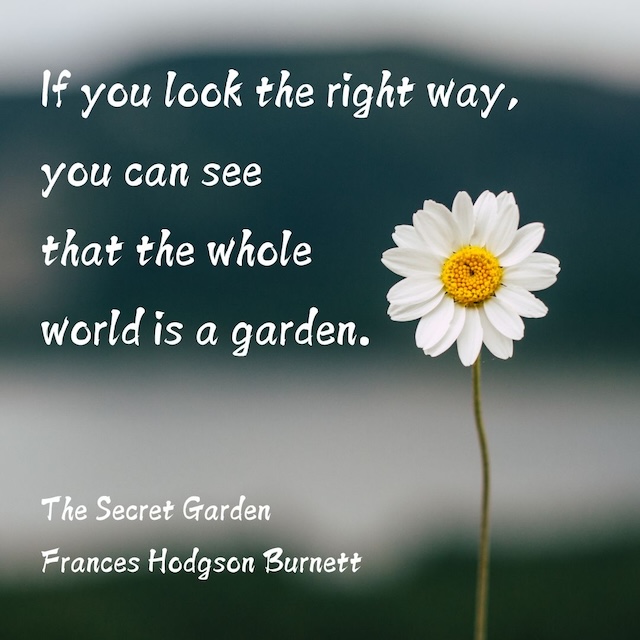
Perspective

Text over art by Enchanted Seashells

Irreplaceable

Has everyone read The Little Prince? It’s packed full of wisdom, like this quote from the book:

For nothing, in truth, can replace a lost companion. Old friends cannot be created out of hand. Nothing can match the treasure of shared memories, so many bad times endured together, so many quarrels, reconciliations, heartfelt impulses. Friendships like that cannot be reconstructed.  
The Little Prince by Antoine de Saint-Exupéry

The Little Prince visits various planets, including Earth, and addresses themes of loneliness, friendship, love, and loss. The story of the prince and his rose is a parable about the nature of enduring love.

I only recently learned that the same month that the book was published, Saint-Exupéry joined the Free French Air Force, and in July 1944 he disappeared while flying a reconnaissance mission, reportedly shot down. Isn’t that unbelievably sad?

Art by Andrea Hrnjak

Etidorhpa | Aprhodite

Have you heard of this novel?

Etidorhpa: The End of Earth (1895) by John Uri Lloyd

Complete subtitle: “The strange history of a mysterious being and the account of a remarkable journey as communicated in manuscript to Llewellyn Drury who promised to print the same, but finally evaded the responsibility which was assumed.”

This is so strange. I can’t remember how or when I scrolled past this title but it reminded me of when I was little, my dad started talking about this book. He read the title to me and, since we both loved wordplay, helped me read it backwards to reveal the mirrored magic.

I can’t remember anything else about our conversation other than that, and I don’t have the book and don’t know what happened to it, so it’s simply an amorphous slip of a memory.

 it was written over a hundred years ago yet it contains absolutely profound theories about electromagnetism and gravity.

Since my dad was an attorney and lived among facts, reality, and documentation, it’s interesting to learn that he was drawn to the esoteric, but he was REALLY smart and loved to read, so maybe he was more complex than I realized.

According to Wiki, Etidorhpa belongs to a subgenre of fiction that shares elements of science fiction, fantasy, utopian fiction, and scientific (or pseudoscientific) speculation. Jules Verne’s Journey to the Center of the Earth is the most famous book of this type, though many others can be cited. It imagined another world in the center of a hollow earth. Since Lloyd was a pharmacologist, his novel has provoked speculation that drug use may have contributed to its fantastic and visionary nature.

The book is available here: https://www.gutenberg.org/files/37775/37775-h/37775-h.htm

I started to read the first chapter. For me, it’s not an easy read, not like my romantic chicklit, so it hasn’t really grabbed my interest, other than as a vague but sweet moment in time with my dad.

If you have read it, or intend to, let me know what you think, and WHY Aphrodite is important…

Enjambment | Measure: Robert Hass

A few years ago UC Berkeley hosted an Eco-Poetics Conference. My son was invited to participate and while there he was honored to meet the poet, Robert Hass.

Hass served as Poet Laureate of the United States from 1995 to 1997. He won the 2007 National Book Award and shared the 2008 Pulitzer Prize for the collection Time and Materials: Poems 1997-2005. In 2014 he was awarded the Wallace Stevens Award from the Academy of American Poets.

I love the way his mind works, it’s as simple as that.

From Hass: “This poem is called measure – I think it belongs to my learning as a young writer as to where I felt poems were coming from.”

Measure 

Recurrences.
Coppery light hesitates
again in the small-leaved

Japanese plum. Summer
and sunset, the peace
of the writing desk

and the habitual peace
of writing, these things
form an order I only

belong to in the idleness
of attention. Last light
rims the blue mountain

and I almost glimpse
what I was born to,
not so much in the sunlight

or the plum tree
as in the pulse
that forms these lines.

FYI: Enjambment…From the French meaning “a striding over,” a poetic term for the continuation of a sentence or phrase from one line of poetry to the next. An enjambed line typically lacks punctuation at its line break, so the reader is carried smoothly and swiftly—without interruption—to the next line of the poem.

The World of Literature Lost a Great One – Cormac McCarthy

“Keep a little fire burning; however small, however hidden.”
—Cormac McCarthy, The Road

While his raw, savage, and uncompromising style of writing wasn’t REALLY my cup of tea as I’m an unashamed fan of happily-ever-after chick lit, I have read a couple of books by Cormac McCarthy.

MY habit of skipping over sections that contain any sort of violence probably causes me to miss a lot of narrative, but I think I come away with the gist of his message regarding the human affinity for brutality, which I personally abhor.

Even so, I can still be awed by his ability to convey the darkest sides of humanity (inhumanity) and his unflinching bare bones descriptions of people and places I’m happy I never met.

I read that McCarthy was very much influenced by William Faulkner, one of my favorite authors.

I haven’t seen the films adapted from his novels for the same reason I only touched the outer edges of his published works — the dark side doesn’t appeal to me.

Wiki recalls McCarthy this way: “Cormac McCarthy was an American writer who authored twelve novels, two plays, five screenplays, and three short stories, spanning the Western and postapocalyptic genres. He was known for his graphic depictions of violence and his unique writing style, recognizable by a sparse use of punctuation and attribution.”

Cormac McCarthy won the Pulitzer Prize for The Road. It was recently reported that another of his novels, Blood Meridian, will be made into a feature film directed by John Hillcoat, who directed the film adaptation of The Road.