I’m reading bell hooks (yes, all lower case) All About Love.
To truly love we must learn to mix various ingredients—care, affection, recognition, respect, commitment, and trust, as well as honest and open communication.
“The wounded child inside many males is a boy who, when he first spoke his truths, was silenced by paternal sadism, by a patriarchal world that did not want him to claim his true feelings. The wounded child inside many females is a girl who was taught from early childhood that she must become something other than herself, deny her true feelings, in order to attract and please others. When men and women punish each other for truth telling, we reinforce the notion that lies are better. To be loving we willingly hear the other’s truth, and most important, we affirm the value of truth telling. Lies may make people feel better, but they do not help them to know love.”
“…nothing haunts us like the things we didn’t buy.” Quote from Becky Bloomwood/Confessions
There’s sad news to report from the literary world.
Author Sophie Kinsella died yesterday. I didn’t know that she had been diagnosed with a glioblastoma in 2022, which is one of the deadliest and most aggressive types of brain cancer.
I loved all of her books and probably have read everything she’s ever written. The first two novels in the Shopaholic series were adapted for the 2009 film Confessions of a Shopaholic, starring Isla Fisher. It’s one of my all-time favorites.
“That moment. That instant when your fingers curl round the handles of a shiny, uncreased bag–and all the gorgeous new things inside it becomes yours. What’s it like? It’s like going hungry for days, then cramming your mouth full of warm buttered toast.” Becky Bloomwood/Confessions
Those who dismiss her books as merely frivolous rom-com or chick lit don’t take into consideration the amount of work and talent it takes to write great dialogue and create characters that come to life.
RIP Sopie Kinsella. She’s survived by her husband and their five children.
And me? I’m still searching for that perfect green scarf. IYKYK
“You speak…PRADA?” Becky Bloomwood/Confessions
Here’s a trailer for the film, Confessions of a Shopaholic. I’m going to watch it again this weekend.
Lately, I’ve been thinking about T-I-M-E. Time flies. I hate to be late; I like to be ON TIME. Does time really exist at all or have we been brainwashed to think iit does?
Too much thinking about time as ephemeral makes me anxious. Too much thinking about anything does the same thing. My non-logical mind has determined that TIME itself isn’t the issue; THINKING about it IS and it makes my brain melt, just like Dali’s clocks.
Salvador Dalí
“Time doesn’t exist, clocks exist. Time is just an agreed upon construct.” — David Foster Wallace
“It takes just one unattended moment for an hour to pass.” ― Sherod Santos,Square Inch Hours: Poems
Santos was born in South Carolina, graduated from San Diego State University, and studied at the University of California, Irvine. I never met him when I attended SDSU, but I knew ABOUT him; all of us who studied creative writing and poetry knew about “Rod” Santos and W.S. Merwin and Glover Davis, who was actually my professor.
David Foster Wallace was an acclaimed American writer known for his fiction, nonfiction, and critical essays that explored the complexities of consciousness, irony, and the human condition. Wallace wrote the novel Infinite Jest.
“The Persistence of Memory” is an iconic 1931 surrealist oil painting by Salvador Dalí, famous for its “melting” clocks draped over a desolate, dream-like landscape inspired by his Catalonian home. The painting uses a paranoiac-critical method to explore the subconscious, with the distorted clocks symbolizing the fluidity and subjectivity of time, influenced by Freudian psychology and potentially Einstein’s theory of relativity. From Google.
Could Leon Russell’s version of As Time Goes By be the best ever? I think so…mature Leon was awesome, too.
Back when the original Angel Boy began to walk and talk, my default response when the “I’m bored, I have nothing to do” complaints started, has always been, “Go read a book.”
Now I do the same thing to the grandkids, especially Angel Boy 2.0 who has become a wonderful reader.
Recently we were in a baseball card shop and he was TAKING LITERALLY FOREVER to look at cards and decide which ones he wanted to buy and figure out how much of HIS money he was willing to spend and how much he could get from me. That scenario brought up happy deja vu memories of his parsimonious dad at the same age. The thrifty apple didn’t fall too far from THAT tree, haha.
I walked outside, I walked back in, I pulled on his shirt and whined, “Are you almost done? I’M SO BORED!!”
Without skipping a beat, he said, “Hey Grandma, why don’t you go read a book!”
And then he laughed and I laughed but I got the last laugh because that proved that he had really listened to me. A total win for Grandma!
I gotta confess though, I was SO BORED in that card shop, every minute seemed like an hour. Memories.
It’s really funny, because the original AB is NEVER without a book and leveraged that love of reading into a Yale PhD, writing his own book (published by a prestigious house), and tenure at a major uni, so I guess my annoying mantra helped guide his path to success.
Grandma’s Mantra: 📚 If you’re bored, read a book! 📚 If you have a minute before school starts, read a book! 📚 If you’re waiting for a doctor’s appointment, read a book! 📚 If you can’t think of anything productive to do, read a book!
“Here, beneath this tree, she had lain on her back in the sun and watched the butterflies. Part of her would linger there for ever: a footstep running tip-toe to the creek, the touch of her hand on a tree, the imprint of her body in the long grass. And perhaps one day, in after years, someone would wander there and listen to the silence, as she had done, and catch the whisper of the dreams that she had dreamt there, in midsummer, under the hot sun and the white sky.” — Daphne du Maurier, Frenchman’s Creek.
Art by Lucy Campbell
Three of my favorites in one painting: a wolf, a raven, and trees. I’d love to curl up and hibernate in a mighty oak guarded by my beloved animal family — to dream of butterflies and seashells and other simple but profound bearers of joy.
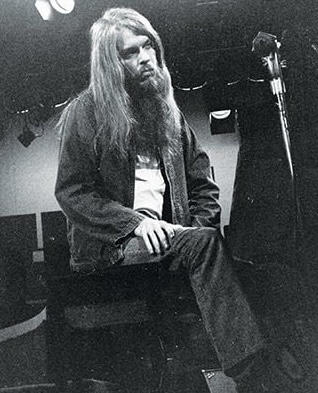
Written by Bill Janovitz, this nearly 600 page New York Times bestselling biography of Leon Russell, Leon Russell: The Master of Space and Time’s Journey Through Rock & Roll History was a gift from the original Angel Boy.
I don’t think he (or the Angel Kids) quite understand my passionate interest (read obsession) with the one and only Claude Russell Bridges (Leon Russell), but he’s supportive in his own way, although he wouldn’t play “A Song For You” on our piano because he said it had been too long since he tickled the ivories and it might have looked simple to play, but it was a very complex piece of music and he didn’t feel he could do it justice. Or at least that’s the excuse he gave me.
So…this BOOK. It’s comprehensive, it’s respectful, and it delves into areas of Leon’s life that even I didn’t know. Yes, there’s some sex, drugs, and rock and roll, but the overarching theme of Leon’s life and music is LOVE.
The life path that took a child born with cerebral palsy during the Second World War, who overcame his physical challenges to become a classically trained pianist — and was catapulted to the top of the music scene–is inspirational. He was and always will be the Master of Space and Time — a visionary.
One of my favorite quotes from the book is from his friend and fellow musician, Ann Bell:
“One night everybody had gone to bed, and it was about four o’clock in the morning. All of a sudden, I woke up; I could hear him playing. It was a classical piece; he’s in the living room, where he had a piano, and he’s playing this piece that’s forty minutes long, from memory. There was no sheet music. I sat down on the bench, and I didn’t say a word. I just thought, ‘They didn’t understand the depth of his well.’ And when he was done, I was crying. He goes, ‘Girl, what’s wrong witchoo?'”
From the Rock & Roll Hall of Fame: The definitive New York Times bestselling biography of legendary musician, composer, and performer Leon Russell, who profoudly influenced George Harrison, the Rolling Stones, Eric Clapton, Elton John, Willie Nelson, Tom Petty, and the world of music as a whole.
Leon Russell is an icon, but somehow is still an underappreciated artist. He is spoken of in tones reserved not just for the most talented musicians, but also for the most complex and fascinating. His career is like a roadmap of music history, often intersecting with rock royalty like Bob Dylan, the Stones, and the Beatles. He started in the Fifties as a teenager touring with Jerry Lee Lewis, going on to play piano on records by such giants as Frank Sinatra, The Beach Boys, and Phil Spector, and on hundreds of classic songs with major recording artists. Leon was Elton John’s idol, and Elton inducted him into the Rock and Roll Hall of Fame in 2011. Leon also gets credit for altering Willie Nelson’s career, giving us the long-haired, pot-friendly Willie we all know and love today.
In his prime, Leon filled stadiums on solo tours, and was an organizer/performer on both Joe Cocker’s revolutionary Mad Dogs and Englishmen tour and George Harrison’s Concert for Bangladesh. Leon also founded Shelter Records in 1969 with producer Denny Cordell, discovering and releasing the debut albums of Tom Petty, the Gap Band, Phoebe Snow, and J.J. Cale. Leon always assembled wildly diverse bands and performances, fostering creative and free atmospheres for musicians to live and work together. He brazenly challenged musical and social barriers. However, Russell also struggled with his demons, including substance abuse, severe depression, and a crippling stage fright that wreaked havoc on his psyche over the long haul and at times seemed to will himself into obscurity. Now, acclaimed author and founding member of Buffalo Tom, Bill Janovitz shines the spotlight on one of the most important music makers of the twentieth century.
I give this book all the stars ⭐⭐⭐⭐⭐⭐ and tophats 🎩🎩🎩🎩🎩🎩🎩🎩
In my opinion, if you don’t know who Leon Russell was, you should, and reading Janovitz’s biography is a good way to learn about him and to be amazed at his musical genius. You’ll understand why he’s referred to as the Master of Space and Time.
Leon Russell and the GAP band on The Midnight Special with Wolfman Jack:
Lately it seems that I see POGs popping up everywhere on social media.
Do you remember them?
For a brief, crazy intense moment in the ’90s, POGs and slammers were everywhere. If you grew up during that era, you might remember collecting the colorful cardboard discs, the thrill of slamming your favorite POG stack, and swapping the ones you didn’t want with friends on the playground.
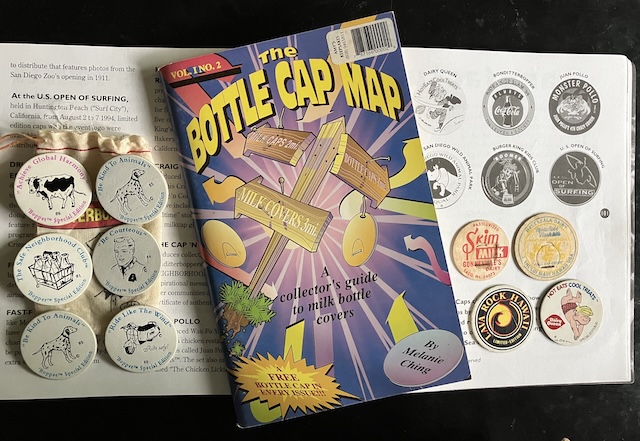
During that frenzied time, I was involved in a business that not only produced POGs (milkcaps) as business promotional giveaways but created a line of them called The Safe Neighborhood Club, complete with an inserted educational booklet. Some of these designs were included in books about POGs.
Photo by Enchanted Seashells
For a time, POGS were even outlawed in a few school districts, that’s how popular they were.
The story of POGs began in Hawaii, where children used caps from Haleakala Dairy’s POG juice (passionfruit-orange-guava) to play a simple flipping game.
Alan Rypinski bought the POG trademark in 1993 and transformed it into a global brand. With the World POG Federation at the helm, POGs exploded into toy aisles and schoolyards, becoming an integral part of ’90s culture. POGman, the game’s cartoon mascot, became as recognizable as the discs themselves. He made millions during the craze but was out of the game when the bubble burst.
By 1997, the POG market had imploded. Oversaturation, school bans, and changing fads pushed the once-beloved game into obscurity. The discs that once sparked heated debates and trades among kids now sat forgotten.
Now, nearly three decades later, whispers of a POG revival are surfacing. Can a nostalgia-driven resurgence bring this playground staple back into the mainstream?
Why Revive POGs Now?
I can’t explain it, but POGs definitely ARE making a comeback, not just as a nostalgic collectible but also with a digital component and a focus on both physical and digital gaming.
The World Pog Federation launched new physical sets and online games to engage a new generation of players. They are also exploring partnerships and collaborations to expand the POG brand.
I’ll have to dig around in the garage ‘cos I know I still have a massive collection stored in binders and I can’t wait to show them to the Angels. Maybe they could start it up again at their school; wouldn’t that be awesome?
A while back I wrote about the 1970s TV show, Emergency!, a favorite of mine to watch with my RN mom. A little research revealed that one of the stars, Julie London, was an amazing vocalist and her husband in real life, Bobby Troup (also on Emergency!), was not only an accomplished musician but he wrote the hit song, Route 66.
Since it’s no secret that I have an ongoing OBSESSION with Leon Russell that doesn’t seem to be abating any time soon, I was listening to some of the tracks on the Mad Dogs and Englishmen CD and watched the videos where LR is prominent.
I’m not a huge fan of Joe Cocker, never have been, and still think that Leon’s versions of his own songs can’t be surpassed (like Delta Lady), but then I heard JC sing “Cry Me a River” by Arthur Hamilton, and realized that it’s the same song Julie London sang a while back, but this was a completely light years different arrangement by….you guessed it, the one and only Master of Space and Time, the magical visionary himself, Leon Russell.
It’s actually not that crazy because a little more digging revealed that Leon was often a Wrecking Crew first call session pianist for some of Julie London’s recordings, so there was a connection.
Listen to Julie London (amazing for sure)…
…and now watch this video. I confess that for me, one of the best parts besides seeing Leon’s magical hands on the piano is when he counts off “1-2-3-4“. No shame in owning my obsession, is there? If only Leon had sung this himself…
Do you have a preference? Both awesome versions of the song, but the talents of Leon Russell forever blow my mind. How did he even think of arranging the song that way? Sadly, we’ll never know, but his magic lives on.
And then there’s Ella Fitzgerald’s version…OMG! They are all incredible interpretations, aren’t they?
“Accustom yourself every morning to look for a moment at the sky and suddenly you will be aware of the air around you, the scent of morning freshness that is bestowed on you between sleep and labor.
You will find every day that the gable of every house has its own particular look, its own special lighting.
Pay it some heed…you will have for the rest of the day a remnant of satisfaction and a touch of coexistence with nature.
Gradually and without effort the eye trains itself to transmit many small delights.” –Hermann Hesse
The 1946 Nobel Prize in Literature was awarded to the German author Hermann Hesse. Photos by Enchanted Seashells






 Enchanted Seashells | Princess Rosebud