When Your Gallbladder Isn’t Your Friend

GALL…

Of all the unmitigated gall!” “He sure has a lot of gall!”

Have you heard that? My mom used to say it about certain people. I don’t think it’s used very much now, but it still has a relevant place in our language.

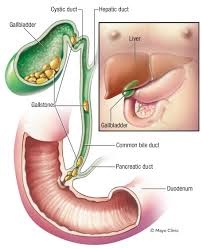
Gall is a digestive juice secreted by the liver, stored in the gallbladder, and aids in the digestion of fats. vocabulary.com

If someone has gall, they’re irritating. In fact, as a verb, gall means “to irritate” like new tight jeans that gall your thighs. Gall is “bile,” too, like what’s in a gall bladder. Back in the days of Hippocrates, if the four humors of the body were out of whack, it affected your spirits. If you had too much bile, or gall, then you’d be aggressive or depressed. It’s also a noun for “deep feeling of ill will.”

I’m reminded of this because I’m on my way for a yearly ultrasound to check on the status of a growth on my gallbladder.

Prior to my first ultrasound, I experienced right upper quadrant abdominal pain and that’s how I initially learned about the cyst/polyp.

Adenomyomatosis: An abnormal overgrowth of the gallbladder lining that forms cysts in the gallbladder wall. Scientists aren’t sure why it occurs, but it isn’t usually harmful.

So far (knock on wood), it hasn’t really changed size enough to cause alarm, but my doctor asked me why I haven’t had it removed. She thought it was easier to have it removed than to monitor it on a yearly basis.

No one had suggested that before, especially since it hasn’t reached the size protocol for removal. I’m also thinking that if I did that, it could grow back and anything invasive seems to increase the probability of creating something new and different and perhaps even malignant.

I told her my prudent course of action is to continue to get a yearly ultrasound and if stays the same, to continue to do nothing. I don’t believe in slicing and dicing my body parts unless it’s a thousand percent medically necessary.

Waiting for the ultrasound report is always stressful and I hope when it finally gets emailed to me, it’ll reveal no significant change in size or location to the little cyst valiantly clinging to my gallbladder wall — which would be great news and I’ll be able to stop worrying about it — until next year.

In Limbo

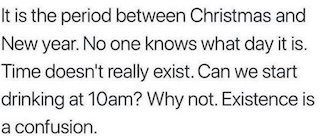
The days between Christmas and the new year are suspended in amber; a week of feeling in limbo — at least for me.

The frenzy leading up to Christmas that started at Halloween and progressed to Thanksgiving and finally to December 25 is a mess of cooking and baking and cleaning — and now it’s over, along with the twenty-four hour Christmas music on the radio.

It’s so so quiet outside, like a day during the pandemic.

It’s a great time to shop the after holiday sales, but I have enough wrapping paper and Christmas cards and decorations to last until the next century, so I’m not all that excited about the 75% off prices…although I DO love a bargain.

But — we’re not quite done because the end of the year is only a few days away and that occasion is supposed to be memorialized by some sort of celebration, whether you choose to go to a ball or a party or stay home by the fire with a glass of champagne and try to stay awake until midnight.

And then it’s over — but not until the idiots shoot guns in the air and set off more fireworks that scare all the animals.

I’m not sure I’d call this feeling a full fledged depression, but there’s a term that describes it pretty well… Post Holiday Blues. It sounds like it should be the title of a song, right? PHB refers to the letdown we might feel after all the excitement and anticipation leading up to the holidays.

I hope Santa brought you everything you asked for and enjoy this week in limbo, waiting for 2025.

Unlock The Power of The 12/12 Portal

This is a lucky day to manifest our hopes and dreams. The 12/12 portal of conscious awareness is one of the most potent energetic alignments of the year—a cosmic gateway carrying the frequency of divine alignment, spiritual awakening, and ascension.

Number ONE symbolizes individuality, leadership, ambition, and new beginnings. Reflects masculine energy: action, drive, and assertiveness.

Number TWO represents duality, partnership, cooperation, and intuition. Reflects feminine energy: nurturing, sensitivity, and balance.

Together as 1212, these numbers symbolize the harmonization of these opposing but complementary forces. Repeated, the sequence amplifies the need for equilibrium in all aspects of life — within ourselves, our relationships, and the collective consciousness.

The energy of the 1212 Portal doesn’t immediately dissipate — it can serve as a catalyst for shifts leading to the full moon on December 15 and the Winter Solstice on December 21. (Don’t forget we’re still under the influence of Mercury Retrograde until December 15, too!)

A full moon, retrograde, a solstice, and the 12/12 portal — that’s a LOT of potent planetary energy that’s happening at the same time. Take care of yourselves!

Here are some things we can do to access this dynamic 12/12 energy:

Set Intentions
Take time to reflect on what you want to create or release in your life. Write your intentions down or say them aloud—there’s power in putting your desires into words.

Meditate or Visualize
Quiet your mind and imagine stepping through a symbolic portal. What does your ideal life look and feel like? Visualizing it can help make it more tangible.

Practice Gratitude
Gratitude raises your vibration and aligns you with abundance. Reflect on what you’re thankful for and notice how it shifts your perspective.

Engage in Ritual
Light a candle, take a salt bath, or do something meaningful to mark the occasion. Rituals help anchor your intentions in the physical world.

Stay Open
Pay attention to synchronicities, dreams, or sudden insights around this time. Trust that these moments are guiding you toward clarity and growth.

Curated from Google and alteredhealing.com

Word of The Day: Komorebi

Komorebi is a Japanese word that’s more of a feeling, that of “sunlight leaking through trees”. It describes the loveliness and wonder of rays of light dappling through overhead leaves, casting shadows on the forest floor.

Photo by Johannes Plenio on Pexels.com

There is a profound peace and sense of tranquility with komorebi. It creates a mood of calming gentle energy, reminding us of our connection to the earth.

Komorebi is comprised of several parts of different words: “Ko” means tree or trees. “More” means: something that comes through, something that shines through or seeps through. “Bi” means: sun or sunlight.

I’m grateful for these transitory moments of beauty, as if time stands still in abeyance of SOMETHING, as we observe nature’s simple but profound tenuity and we can deeply, finally– fully breathe.

What’s YOUR Guilty Pleasure?

We still have a few days left in November to observe World Vegan Month and it’s perfect timing to share a guilty snacky pleasure that’s actually guilt-free.

My current guilty pleasure is this: Everything But The Bagel seasoned bite size crackers from Trader Joe’s.

They are crunchily yummy with hummus and flavorfully satisfying all by themselves.

Best of all, they’re vegan (not gluten-free FYI).

Each serving of 14 crackers is 140 calories and contains 3 grams of protein, so it really seems like an innocent indulgence.

What’s YOUR guilty pleasure?

*This is an honest review; I received no free product nor any compensation.

Wetiko: Disease of The Soul

Paul Levy writes: “Wetiko is a virus of the mind that cultivates and feeds on fear and separation.”

I lost a few followers here on WordPress since the US presidential election. I guess some people don’t like my absolute hatred for that orange POS, but it’s never been a secret how I feel about repression and criminal behavior and loss of reproductive rights, oh well…I’m grateful they chose to delete themselves. We are not the same.

Along with the results of the election where the decent candidate, Kamala Harris, conceded her apparent loss, there’s been an uptick in chat about wetiko. I’ve written about it before but now theres a resurgence of interest in anything that could possibly explain the toxic world we inhabit.

Wetiko is a disease of the soul, a parasite of the mind, currently being acted out en masse on the world stage via a collective psychosis of titanic proportions.

This mind-virus-which Native Americans have called “wetiko”-covertly operates through the unconscious blind spots in the human psyche, rendering people oblivious to their own madness and compelling them to act against their own best interests.

Drawing on insights from Jungian psychology, shamanism, alchemy, spiritual wisdom traditions, and personal experience, author Paul Levy shows us that hidden within the venom of wetiko is its own antidote, which once recognized can help us wake up and bring sanity back to our society.

A Tibetan Buddhist practitioner for more than thirty years, he has intimately studied with some of the greatest spiritual masters of Tibet and Burma.

“For millennia, humanity has struggled to understand the manifestation of evil in our world. In this regard Dispelling Wetiko is an extraordinary book, and author Paul Levy has made a great contribution to our understanding of the evil that is happening in our world today, as well as who and what we are.” says Hank Wesselman PhD., anthropologist and author of The Bowl of Light Previously reviewed here: https://enchantedseashells.com/2022/12/15/what-im-reading-the-bowl-of-light/

Wetiko in a Nutshell

by Paul Levy, author of Wetiko: Healing the Mind-Virus That Plagues Our World

A contagious psycho-spiritual disease of the soul is currently being acted out en masse on the world stage via an insidious collective psychosis of titanic proportions. This mind-virus—which Native Americans have called “wetiko”—covertly operates through the unconscious blind spots in the human psyche, rendering people oblivious to their own madness and compelling them to act against their own best interests. Wetiko is a psychosis in the true sense of the word, “a sickness of the spirit.” Wetiko covertly influences our perceptions so as to act itself out through us while simultaneously hiding itself from being seen.

Wetiko bewitches our consciousness so that we become blind to the underlying, assumed viewpoint through which we perceive, conjure up, and give meaning to our experience of both the world and ourselves. This psychic virus can be thought of as the “bug” in “the system” that informs and animates the madness that is playing out in our lives, both individually and collectively, on the world stage.

Before being able to treat this sickness that has infected us all, we have to snap out of our denial, see the disease, acknowledge it, name it, and try to understand how it operates so as to ascertain how to deal with it—this is what my book Wetiko is all about.

The Normalization of Wetiko

A few years ago I ran into a friend whom I hadn’t seen for a while. He asked me what I had been up to. I answered that I was writing about the collective psychosis that our species had fallen into. His response was telling. He asked me what made me think there was a collective psychosis going on. His question left me speechless; I literally didn’t know how to respond. What made him think there wasn’t a collective psychosis going on, I wondered. Could he give me one piece of evidence? Our collective madness had become so normalized that most people—my friend was extremely bright, by the way—didn’t even notice.

Many of us have become conditioned to thinking that if we were in a middle of a collective psychosis it would mean that people would be doing all sorts of “crazy” things such as running around naked and screaming, for instance. This ingrained idea, however, gets in the way of recognizing the very real collective insanity in which all of us are—both passively and actively—participating. If we want to envision what a collective psychosis could actually look like, it might be a real eye-opener to realize it would look exactly like what is happening right now in our world.

What Is Wetiko Really?

Wetiko is a cannibalizing force driven by insatiable greed, appetite without satisfaction, consumption as an end in itself, and war for its own sake, against other tribes, species, and nature, and even against the individual’s own humanity. It is a disease of the soul, and being a disease of the soul, we all potentially have wetiko, as it pervades and “in-forms” the underlying field of consciousness. Any one of us at any moment can fall into our unconscious and unwittingly become an instrument for the evil of wetiko to act itself out through us and incarnate in our world. If we see someone who seems to be taken over by wetiko and we think they have the disease and we don’t, in seeing them as separate we have fallen under the spell of the virus ourselves.

Wetiko induces in us a proclivity to see the source of our own pathology outside of ourselves—existing in “the other.” Wetiko feeds off of polarization and fear—and terror—of “the other.” Seeing the world through a wetiko-inspired lens of separation/otherness enlivens what Jung calls “the God of Terror who dwells in the human soul,” and simultaneously plays itself out both within our soul and in the world at large. Wetiko subversively turns our “genius” for reality-creation against us in such a way that we become bewitched by the projective tendencies of our own mind.

Falling under wetiko’s spell, we become entranced by our own intrinsic gifts and talents for dreaming up our world in a way that not only doesn’t serve us, but rather is put at the service of wetiko (whose agenda is contrary to our own). Our creativity then boomerangs against us such that we hypnotize ourselves with our creative genius, which cripples our evolutionary potential. To the extent we are unconsciously possessed by the spirit of wetiko, it is as if a psychic tapeworm or parasite has taken over our brain and tricked us, its host, into thinking we are feeding and empowering ourselves while we are actually nourishing the parasite (a process which will ultimately kill its host—us).

In wetiko disease, something that is not us surreptitiously, beneath our conscious awareness, takes the place of and plays the role of who we actually are. Shape-shifting so as to cloak itself in our form, this mercurial predator gets under our skin and “puts us on” as a disguise. Miming ourselves, we become a copy, a false duplicate of our true selves. We are then truly playing out a real version of the imposter syndrome.

The Sickness of Exploitation

Wetiko is powerless to control our true nature, but it can control and manipulate this false identity that it sets up within us. When we fall under the sway of wetiko’s illusion, we simultaneously identify with who we are not, while dissociating from and forgetting who we actually are—giving away our power, not to mention ourselves, in the process.

Disconnecting from our own intrinsic agency, we open ourselves to be used, manipulated, and exploited by outside forces. Indigenous author Jack Forbes, who wrote the classic book about wetiko entitled Columbus and Other Cannibals, refers to wetiko as “the sickness of exploitation.” Wetiko can be conceived of as being an evil, cannibalistic, vampiric spirit that inspires people under its sway to take and consume another’s resources and life-force energy solely for their own profit, without giving anything of value back from their own lives. Wetiko thus violates the sacred law of reciprocity in both human affairs and the natural world as a whole.

The main channel of wetiko’s transmission is relational. It exists through our relationships with ourselves, each other, and the world at large. Like a vampire that can’t stand the light of day, the wetiko virus can’t stand to be illumined. However, in seeing how it covertly operates through our own consciousness, we take away its seeming independence, autonomy, and power over us, while at the same time empowering ourselves. The way the vampiric wetiko covertly operates within the human psyche is mirrored by the way it works in the outside world.

Jung never tired of warning us that the greatest danger threatening humanity today is the possibility that millions—even billions— of us can fall into our unconscious together in a collective psychosis, reinforcing each other’s madness in such a way that we become unwittingly complicit in creating our own destruction. When this occurs, humanity finds itself in a situation where we are confronted with—and battered by—the primal, primordial, and elemental forces of our own psyche.

The Internal Origins of Wetiko

The most depraved part of falling under the thrall of wetiko is that, ultimately speaking, it involves the assent of our own free will; no one other than ourselves is ultimately responsible for our situation. There is no objective entity called wetiko that exists outside of ourselves that can steal our soul—the dreamed-up phenomenon of wetiko tricks us into giving it away ourselves.

People under the sway of wetiko are implicated in and willingly subscribe to their own enslavement. They do this to the point that when offered the way out of the comfort of their prison they oftentimes react violently. They symbolically—and sometimes literally—try to kill the messenger who is showing them the path to freedom. Ultimately speaking, in wetiko disease we are not being infected by a physical, objectively existing virus outside of ourselves. Rather, the origin and genesis of the wetiko psychosis is endogenous; its roots are to be found within the human psyche. The fact that wetiko is the expression of something inside of us means that the cure for wetiko is likewise within us.

If we don’t understand that our current world crisis has its roots within and is an expression of the human psyche, we are doomed to unconsciously repeat and continually recreate endless suffering and destruction in increasingly amplified forms, as if we are having a recurring nightmare. In my language, the inner situation within ourselves is getting “dreamed up” into materialized form in, through, and as the world.

In waking life we are continually dreaming right beneath the threshold of consciousness, especially when we are under the influence of our unconscious complexes. In other words, when we are “under the influence” of our activated unconscious, we will unknowingly recreate our very inner landscape via the medium of the outside world. What can be more dreamlike than that?

Recognizing the correlation between the inner and the outer, between the micro and the macro, is the doorway into being able to see wetiko and wake up to the dreamlike nature that wetiko is simultaneously hiding and revealing depending on our point of view and level of awareness. Recognizing the connection between what is happening out in the world with what is taking place within our minds becomes a channel or secret doorway that leads beyond our merely personal psychological issues, empowering us to deal with the essential problem of our time.

To “heal wetiko,” which refers to a concept describing a deep-seated psychological pattern of greed, selfishness, and destructive behavior, according to author Paul Levy, you can focus on practices like increased self-awareness, shadow work, mindfulness, cultivating gratitude, connecting with community, and actively working to counter destructive behaviors by integrating your unconscious aspects and projecting positive intentions into the world; essentially, by consciously choosing compassion and generosity over self-serving actions. 

https://www.innertraditions.com/blog/wetiko-in-a-nutshell

Key aspects of healing wetiko:

  • Recognize and acknowledge wetiko within yourself: Pay attention to your thoughts, emotions, and behaviors where you might be acting out of greed, envy, or a desire to exploit others. 
  • Shadow work: Explore and integrate your shadow aspects, the parts of yourself that you might disown or project onto others. 
  • Mindfulness practice: Regularly practice mindfulness to observe your thoughts and emotions without judgment, allowing you to catch wetiko tendencies early on. 
  • Inner work through therapy or spiritual practices: Seek support from a therapist or engage in spiritual practices that encourage self-reflection and healing. 
  • Cultivate gratitude: Focus on the positive aspects of your life and express gratitude to shift your perspective away from negativity. 
  • Compassion and service to others: Actively seek opportunities to serve others and demonstrate compassion, counteracting the self-centered nature of wetiko. 
  • Community building: Surround yourself with supportive people who share similar values and encourage your growth. 

Full Moon in Taurus

“Three things cannot be long hidden: the sun, the moon, and the truth.” —Buddha

Photo by Enchanted Seashells

The future of democracy might be uncertain but we can always count on the moon to wax and wane and become full again.

November’s full super moon is in my sign of Taurus and that brings us to a moment of deep release, grounded empowerment, and unexpected transformation.

This Full Moon isn’t a typical Taurean lunation—it’s charged with electrifying energy because of the moon’s conjunction with Uranus, the planet of rebellion and liberation.

In this, we are being shaken from our comfort zones and propelled toward needed change.

Alongside this energetic framework is a potent T-square involving Jupiter, Mercury, and Saturn urging us to re-evaluate our beliefs, thoughts, and the structures we live by.

Adding further intensity, Pluto sits at the critical 29th degree of Capricorn, a karmic placement pushing us to transform old patterns that no longer serve our growth.

This full moon is an invitation to step into our most empowered self while remaining grounded in our values and truth.  risingwoman.com

Easy full moon rituals:
Reflect on what you want to release.
Create a gratitude list for the past year.
Set intentions for personal growth.

Here’s a little reminder about some beneficial crystals :
Black Tourmaline for protection.
Amethyst for spiritual growth.
Moonstone to enhance intuition.
Sodalite for emotional balance.

Happy Full Moon!

A Wasted Day

Seasonal allergies (rhinitis) are horrible this time of year and I can usually deal with it by taking Claritin, but yesterday the sneezing wouldn’t stop and I had to, albeit reluctantly, pop a Benadryl because nothing else worked.

I knew what that would mean… the day would be totally lost; completely wasted. I’m pretty sensitive to all meds, and for me, the affect of the antihistamine Diphenhydramine is similar to being so drunk and impaired that all I can do is sleep.

It didn’t take long before I began to feel numb and drowsy. I couldn’t keep my eyes open and slept the day away which I loathe doing; I hate to squander any second of a day, however, when my allergies get that bad, nothing else works.

When I finally woke up, my allergies were gone and so was my Saturday. There was nothing left to salvage.

It wasn’t nearly as devastating as that 1945 film, The Lost Weekend, about the desperate life of a chronic alcoholic as he’s followed through a four-day drinking bout, but I felt useless and unproductive, even guilty for doing absolutely nothing. It’s not an enjoyable feeling.

Angel Numbers (514) and Life Path Numbers (11)

It’s so weird. I’ve been seeing this sequence of numbers (514) for a couple of years.

I see it all the time; on clocks, my phone, the oven, a timer, auto license plates — any and everywhere one might observe a series of numbers.

Since I was already aware of the significance of 11:11 and 1:11, I figured it might be symbolic to see recurring numbers — and especially 514, which is personally significant since it’s my birthdate.

I’ve always loved my birthday because every few years it falls on Mother’s Day, so I get a double celebration. A friend with psychic abilities told me that 514 could be a sign that my mom is around, offering love, support, and guidance. Whether it’s true or not (the jury’s still out on all that stuff), I appreciate the thought.

My life path number is 11 which means I’m supposed to be nurturing, highly sensitive, intuitive, a natural leader, an old soul, and a healer. That’s all good and fairly accurate, I guess.

What’s your life path number? Add up all the numbers in your birthdate including the year, and check it out. Is it accurate for you?

Sweet Potato Brownies | VEGAN

I make these so often, I can probably do it in my sleep. They are always requested by my son and DIL. The kids don’t eat chocolate, so it’s a grownup treat ONLY.

It’s SOOO easy and SOOO yummy.

Even if you’re not #vegan, don’t skip this recipe. I bet you’ll find it’s worth a try, especially if you love chocolate as much as I do.

It was so good, I’ve made it twice. The first time I used only five ingredients:

*Sweet potato, one cup cooked VERY SOFT and mashed
*Nut butter (I used almond), 1/2 cup
*Maple syrup, 1/3 cup
*Vanilla, one teaspoon
*Cocoa, 1/3 cup

Blend all ingredients by hand or in a food processor. Spread in a pie plate or small square baking dish.

Bake at 350 degrees for about twenty minutes. Let sit until completely cool.

If you have the time, the flavors are enhanced if it’s refrigerated or even frozen. I cut them into bite-sized pieces ‘cos it’s really rich.

You don’t actually NEED frosting, but who ever said no to more chocolate? Here’s my best baking hack for that…
https://enchantedseashells.com/2014/09/17/best-baking-hack-ever/

The results can be a bit dense; sometimes I add 1/4 cup all-purpose flour or buckwheat flour. It would also be easy to blend some oats for oat flour, so that’s definitely an option.

YUM. Delicious AND healthy!

P.S. This recipe isn’t overly sweet, so if you want to add more maple syrup or even a LITTLE sugar, go ahead. I thought it was perfect without any additional sweetener, but I’m a choco-holic.