To find the universal elements enough; to find the air and the water exhilarating; to be refreshed by a morning walk or an evening saunter… to be thrilled by the stars at night; to be elated over a bird’s nest or a wildflower in spring – these are some of the rewards of the simple life. ~ John Burroughs
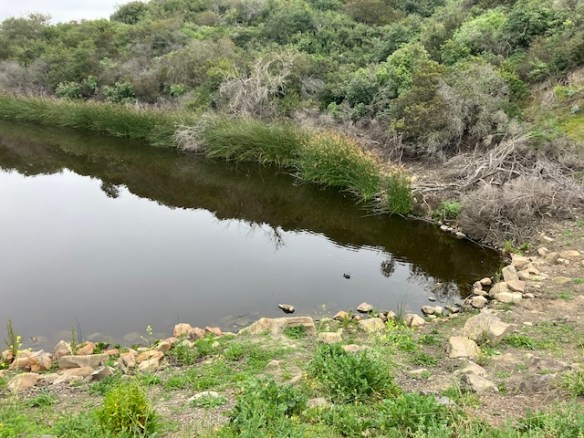
Join me on an early morning walk around the lake trails.
There’s a familiar fragrance of tule, which some people don’t like, but I love love the way it smells. Tule grows in dense stands along freshwater wetlands.
Indigenous peoples ate tule roots and seeds, while the reeds were used to make baskets, cord, sandals, and clothing. P.S. Here’s how to say it: “too-lee”
With all the rain we’ve had, everything was uncharacteristically green…as far as the eye could see…
Pretty Black-eyed Susan flowers!
It’s a human-made lake, not natural, intended to be a reservoir, but the ducks and coots don’t seem to mind a bit.
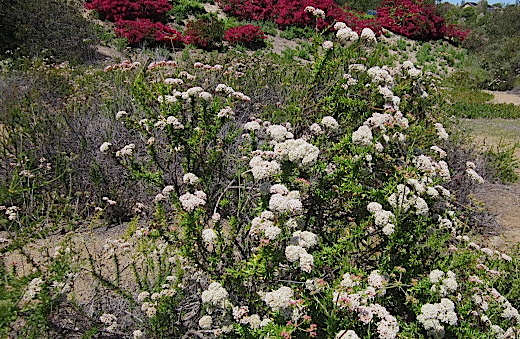
Native buckwheat.
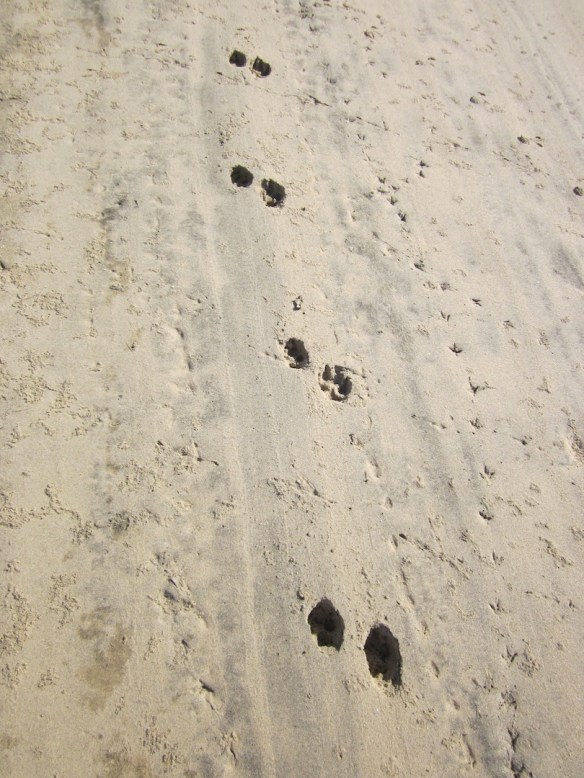
I didn’t see any coyotes this time, but it was still a lot of fun!
This year, Project Coyote launches the first Annual Coyote Awareness Week, March 17-23, to celebrate America’s song dogs.
I can’t think of a better way to officially recognize the arrival of SPRING and the vernal equinox than by highlighting the importance of the beautiful coyote, especially on March 23rd which has been designated National Coyote Day.
My backyard camera captures their frequent visits, along with bobcats and sometimes both in the same night, which makes me very, very happy. I know they’re helping to deplete the rodent population that’s exploded in the last few years.
(And because a couple of readers have asked where “song dog” comes from, I learned that the word coyote comes from the Aztec word coyotl, meaning Song Dog or Barking Dog.)
The purpose of this new holiday is to raise awareness about the intense persecution and misunderstanding coyotes face and the importance of compassionate coexistence.
Coyotes represent the pinnacle of unethical and unscientific wildlife “management” in the United States. Increased awareness of and appreciation for coyotes are critically needed to reform outdated wildlife policies and end the unjust and unscientific persecution of coyotes deeply rooted in American culture ever since European colonization.
Predator extermination campaigns in the 1800s–mid 1900s nearly wiped wolves, mountain lions, and bears off the map. But when the focus turned to coyotes, they responded to this persecution with resilience and adaptability, tripling their range in the last century and filling vacant niches left where wolves were extirpated. Rather than celebrating their resilience to adapt to a human dominated world and the important roles they play in our urban and rural communities, our society has often labeled the coyote as a “pest” or a threat to human communities.
Coyote’s ability to adjust to changing conditions and diverse environments, along with their resiliency to survive and thrive in the face of relentless persecution, has left them vulnerable to insufficient legal protections. In almost every region of the United States, coyotes are legally allowed to be killed, sometimes incentivized through bounties, in unlimited numbers 365 days of the year, using almost any means, including killing contests, trapping, poisoning, hounding, and unregulated recreational killing.
“If we can change hearts and minds about coyotes, the world will be a more compassionate place for all wildlife. That is why coyotes are our flagship species at Project Coyote. And that is why we launched the first annual Coyote Awareness Week,” said Camilla Fox, Project Coyote Founder & Executive Director.
The inadequate protections for coyotes lead to at least 500,000 killed each year, of which over 55,000 are killed annually by the USDA’s Wildlife Services agency at taxpayer expense (as of 2022). Accurate numbers do not exist for how many coyotes are killed through “sport” or wildlife killing contests, because state agencies often do not track or monitor the killing of coyotes, and this number is likely a very low estimate. Even with this underestimate, it translates to: 41,666 coyotes killed every month, 9,615 coyotes killed every week, 1,370 coyotes killed every day, 57 coyotes killed every hour, and 1 coyote killed every minute.
It is vital to foster coexistence with coyotes in both urban and rural communities. Coyotes play critical roles in our multispecies communities including regulating disease transmission by managing rodent populations and culling sick animals, keeping our communities clean by scavenging carrion, and limiting mesocarnivore populations (e.g. raccoons, skunks and foxes) thereby increasing bird diversity and abundance.
Coexisting with coyotes and other wild carnivores can reduce conflict. Decades of scientific literature demonstrate the ineffectiveness of lethal “management” for reducing conflict and for reducing population size. Indiscriminate killing disrupts social systems and subsequently encourages more breeding and migration, which can lead to increases in livestock conflict. Additionally, higher survivability of coyote pups can follow brief population declines due to a temporary increase in available prey, allowing coyote populations to quickly rebound and even increase in number. Despite this data, the default reaction to coyote sightings is too often fear mongering that leads to lethal management. To combat this, citizens across the country can empower their fellow community members to instead interpret coyote behavior, reduce attractants (like unsecured garbage, compost, and pet food), and humanely haze bold coyotes.
It is well past time to replace lethal “management” with compassionate coexistence. Coyotes, like everyone, belong and have a right to exist. Coyotes are sentient, family oriented beings who deserve protection from unscientific and unethical persecution.
We encourage supporters to promote coyote coexistence in their community this week- and every week. It’s a community wide effort to keep coyotes wild and safe from unintended habituation.
“Coyote power: surviving by one’s intelligence and wits when others cannot; embracing existence in a mad, dancing, laughing, sympathetic expression of pure joy at evading the grimmest of fates; exulting in sheer aliveness; recognizing our shortcomings with rueful chagrin.” ~ Dan Flores, author, Coyote America and Project Coyote Ambassador
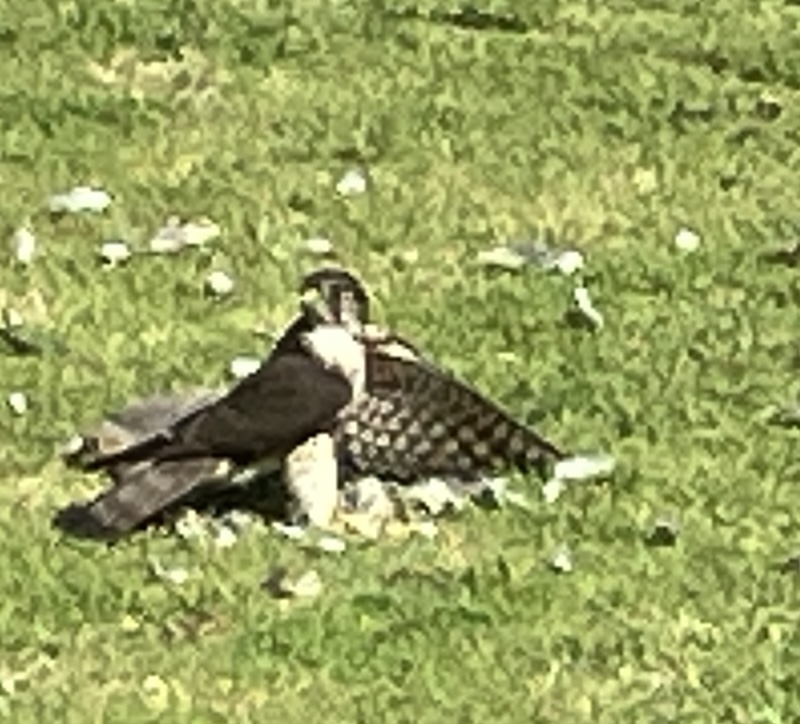
This was one of the most heartwrenching scenarios I’ve witnessed in a really long time.
Picture me in my bedroom, folding and putting away clean laundry, when from the corner of my eye, I see movement through the window. My bedroom overlooks the garden, so I have a clear view.
I had a front row seat to watch a red tailed hawk snatch a dove out of the air, mid-flight, wrestle him to the ground, and proceed to do what birds of prey do.
It all happened in a split second as I watched, mouth agape, frozen in place. I managed to grab my phone and take one not very good photo; it’s through the screen and out of focus.
Just like this guy, most hawks practice what is known as mantling. This involves the bird spreading out its wings and covering its prey, hiding it from the eyes of other animals or larger predators that may want to steal their catch.
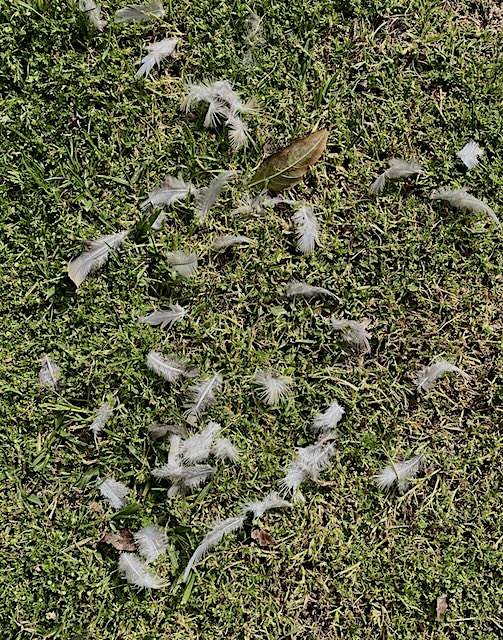
As quickly as it started, the drama was over, and I’m left with a circle of feathers. His/her spouse was looking all over the garden for her/him for a couple of hours, which made it all even more sad.
Predator versus prey. Rest in peace, little dove.
Later on, a tiny baby bunny was sniffing the feathers with his mom nearby, at least I think it was mom. I clapped my hands so they’d run for cover because I really didn’t want to see it happen all over again. The circle of life can be brutal.
There’s some online discussion regarding whether or not novalunosis is a “real” word, but there’s no disagreement about the feeling of looking up in wonderment at the night sky.
Is Earth the only inhabited planet? With the vastness of the unexplored cosmos, is it even possible to think we are the only living, breathing, sentient creatures?
It’s an overwhelming feeling; novalunosis, but it can spark deep thoughts and conversations about infinity and the cosmos.
“The Cosmos is all that is or was or ever will be. Our feeblest contemplations of the Cosmos stir us; there is a tingling in the spine, a catch in the voice, a faint sensation, as if a distant memory, of falling from a height. We know we are approaching the greatest of mysteries.” — Carl Sagan
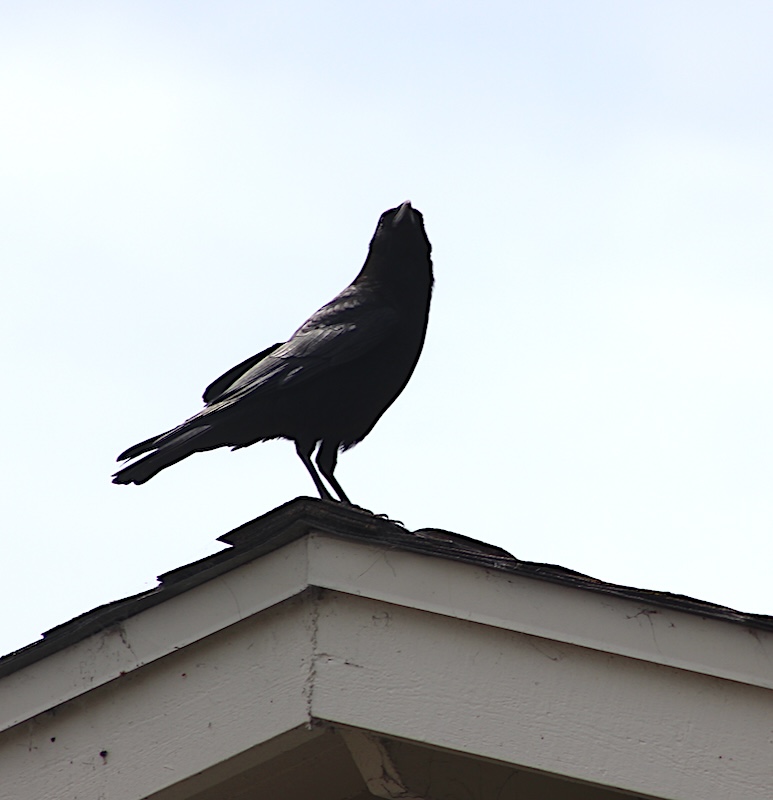
My crow family (I refer to them as my cousins) are getting ready for spring by building nests in the backyard trees in preparation for the next gen. They return to the same location every year.
Did you know that crows are among the smartest animals in the world? Their intelligence is similar to that of chimpanzees. A crow’s brain accounts for almost two percent of its body mass, similar to that of humans.
I talk to them all the time and it seems as if they accept me and don’t even blink an eye when we’re together in the garden, and have brought me many shiny gifts throughout the years.
This crow cousin was gathering twigs and grasses for her nest. If you look closely, you’ll see she likes pine needles, too.
Nest construction begins in early March and will continue through about June. It takes one to two weeks to finish a nest after which the female will lay a clutch of two to six eggs.
Crow nests are made mostly of pencil-width twigs. A new nest is usually about 1.5 feet across and 8-10 inches deep. After the bulk of construction is complete, they’ll line the cup of the nest with soft materials like grass, tree bark, moss, flowers, paper, or fur.
Both partners participate in nest construction. Helpers might aid to some degree but most of the work is left to the parents. https://corvidresearch.blog/
I help too, and gave them the fringe I cut off a pillow that I planned to recover in a different fabric.
It’s raining today, unexpectedly, because all that was forecasted was some light drizzle, and now everything is wet. I hope my crow cousin’s nest is somewhere warm and dry. I’m going to look for more nesting material they might like to use because it makes me happy to think I’m kinda sorta like THEIR family, too.
Bob Dylan and Aldous Huxley say pretty much the same thing!
“The secret of genius is to carry the spirit of the child into old age, which means never losing your enthusiasm.” — Aldous Huxley
May your heart always be joyful May you always know the truth And see the lights surrounding you May you always be courageous Stand upright and be strong May you stay forever young — Bob Dylan
It’s my secret too, not that I think I’m a genius, but I’ve retained the childlike (not childish, there’s a difference) ability to revel in simple joys.
This is me at three and it’s really no different than the current me; same hair and same happy smile as I display a kitty balloon for the camera in my flower-sprigged nightgown.
Only now it’s Hello Kitty and whales and butterflies and seashells and daymoons that spark that pure bliss! (And Chanel.) And the Angels, of course.
Wishing a very happy International Woman’s Day to all strong, intelligent, talented, and simply wonderful women of this world!
Today is International Women’s Day, but really, EVERY DAY should be a day to celebrate women, to encourage a world where difference is valued and celebrated with all the ways we can forge women’s equality.
IWD began in New York City on March 8, 1857 when female textile workers marched in protest of unfair working conditions and unequal rights for women. It was one of the first organized strikes by working women, during which they called for a shorter work day and decent wages.
For me, even more important than a single day set aside to commemorate women, March 8 is the day to rejoice in the birth of Angel Boy 2.0 on his eighth solar return.
I don’t know how it happened, but that child I love with all my heart is eight years old today! How is that even possible?
I still think of him as he was learning to walk…
and now running as fast as he can.
He’s an awesome soccer player; obsessed with Minecraft, (no longer Ninjago or even Pokemon), so his presents reflected that: a giant Minecraft Lego set, Minecraft underwear, a Minecraft joke book, and as many Minecraft t-shirts as I could find, all wrapped up in a Minecraft bag with a musical Minecraft birthday card. He doesn’t have any Minecraft video games, I’m happy to report.
“There is a garden in every childhood, an enchanted place, where colors are brighter, the air is softer, and the morning more fragrant than ever again.”
Quote by Elizabeth Lawrence Art by Jessie Willcox Smith (1863 – 1935) Curated from Ravenous Butterflies











 Enchanted Seashells | Princess Rosebud