It’s time to prepare the garden for spring vegetables. Every year I attempt to win the battle with rodents and bugs and lack of sky water; sometimes I win, sometimes they do…
I have a couple new ideas. I purchased coconut coir bricks to rehydrate and mix with the existing soil in my raised bed and I thought I’d try cardboard box planters, too, inside the raised bed.
Maybe one day I’ll be able to build my own Hügelkultur.
“Hügelkultur” (pronounced hyoo-gul-kulture) is a German word that means mound culture or hill culture. A hügelkultur is a sloped and raised planting bed filled with topsoil, wood, and organic materials. Germans and Europeans have practiced it as a gardening method for hundreds of years.
Instead of gathering branches, leaves and grass clippings for yard waste trash pickup or to toss in the compost, build a hugel bed. Mound logs, branches, leaves, grass clippings, straw, cardboard, petroleum-free newspaper, manure, compost, or whatever other biomass you have available, top with soil and plant your veggies.
The advantages of a hugel bed are many, including:
The gradual decay of wood is a consistent source of long-term nutrients for the plants. A large bed might give out a constant supply of nutrients for decades. The composting wood also generates heat which might extend the growing season.
Logs and branches act like a sponge. Rainwater is stored and then released during drier times. Actually you may never need to water your hugel bed again after the first year (except during long term droughts).
We had a bit of rain yesterday which is a perfect opportunity to prep the coconut coir and plant seeds. I’ll start with my favorites: mixed greens, tomatoes, beets, chard and kale, cucumbers, snap peas, beans, peppers, and zucchini (of course).
There’s nothing more adorable than watching the first little sprouts emerge, right? I can’t wait!
This isn’t the greatest photo; the sun kind of distorted the sharp lines and colors, but I was lucky enough to capture my lizard friend sunning himself on an orange tennis ball
This other guy visits every day; I can always tell who it is by his sort of mutilated tail. He seems to know when I’m in the garden and runs over to greet me.
Hello, handsome! They might be referred to as cold-blooded, but still have their own distinctive personalities.
Lizards like to snack on mealworms, but I never seem to remember to buy them at the pet store. I know they have enough to eat because they’re doing a great job cleaning the garden of unwanted grasshoppers, crickets, and beetles.
Up at dawn, the dewy freshness of the hour, the morning rapture of the birds, the daily miracle of sunrise, set her heart in tune, and gave her Nature’s most healing balm. ~ Louisa May Alcott
Because of all the rain we’ve had, spring blossoms in the garden are exceptionally lush. My Cup of Gold vine (Solandra guttata/Solandra maxima) is bursting with flowers and this gigantic dinner-plate sized golden chalice looked right at me as if to say “good morning.”
This is NOT about that giving tree, Shel Silverstein’s sad apple tree who was abused and abandoned after she gave all that she had for years in her attempts to please a narcissistic little boy.
Taking a bit of a detour and as an aside to that, Angel Girl read The Giving Tree to me — well, not really READ it, but she had memorized every single word and wanted to “read” to me, just like her big brother reads to me. Too adorable, right?
Angel Boy, sitting on my other side, was quick to report in a loud whisper, “She’s not really reading like ME, Grandma, you know that, don’t you?”
I replied, “I know, T, but she wants you and I to be proud of her, so we’re just going to go along with it and praise her efforts, aren’t we?”
After she finished “reading”, we chatted a bit about what the story was all about and Angel Boy said how much he didn’t like it because it was too sad for him to think about the poor tree and Angel Girl chimed in with the same sort of commentary, “He took it all, Grandma, and all she had left was a trunk for him to sleep on when he was old. That wasn’t very nice.”
I was impressed by their empathy and compassion.
And then, because these children NEVER miss an opportunity to point things out to me, she said, “And the man in the book is WAY OLDER than you are, Grandma.”
Ha Ha Ha. Thanks for that, my angel.
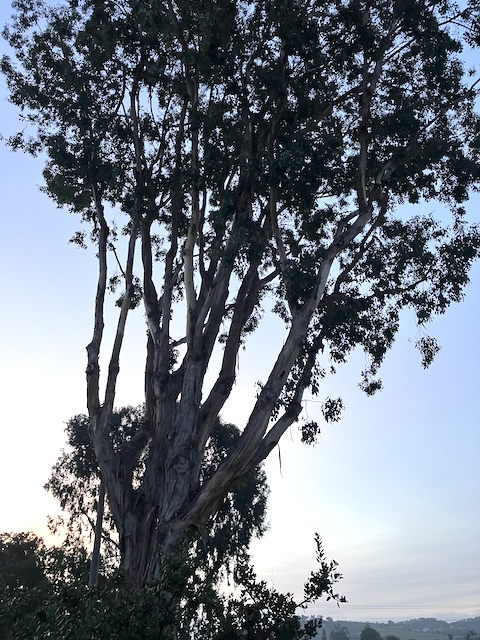
Back to my rant, but before I begin, I need to make sure everyone is completely aware about how much I love trees. I don’t even hate eucalyptus trees, but they’re a menace and never should have been planted as a residential street tree, especially so close to houses. I mean, it’s not like I have a colony of koalas in my backyard that need a regular source of food, don’t you agree?
What I’m going on a tirade about is a gigantic eucalyptus tree lives in the space between my house and my next door neighbor’s driveway. It’s a city-owned tree so we can’t do anything about it. No birds nest here; even THEY don’t like it.
The California Invasive Plant Council (CAL-IPC) classifies certain eucalyptus as a “moderate” invasive.
They’re a real fire hazard and can disrupt ecological relationships among species that co-evolved over millennia, which is why many groups work to remove eucalyptus and restore coast live oaks. If that’s not bad enough, limbs fall during storms, and the euc’s shallow root system contributes to the whole tree falling, both of which have killed people.
Volatile oils in eucalyptus trees fuel more intense fires which is enough of a reason to permanently remove this tree.
They are a hazard in every sense of the word. Back in the 1900s, these trees were imported from Australia and planted with the hope that they could be harvested and sold as railroad ties. Unfortunately, eucalyptus is a brittle wood and cracks easily, therefore was unsuitable.
Eucalyptus limbs, branches, and trees regularly fall with potential catastrophic injuries. Recently, one eucalyptus as large as mine fell near our elementary school and was removed.
Last January in San Diego at Balboa Park, a eucalyptus tree was uprooted and fell on top of a woman, obviously causing injuries.
In 2017, A man in his seventies was killed by a branch that fell from a eucalyptus tree at Holiday Park in Carlsbad.
This tree continually drops leaves and other litter on the street, our yards, the sidewalk, and rain gutters. Roots are invasive. The leaves and other tree litter can damage vehicle paint.
I’m really sick and tired of cleaning up this kind of tree debris every week or so.
A few neighbors and I wrote letters to the city expressing all of that and requested the tree be removed. That request was denied. This isn’t the first time we’ve made an effort to get the city to do something about it, and you would think they would be intelligent enough to remove a potentially dangerous hazard, but all they suggested was that If we wanted to spend more than one hundred dollars, we could appeal the decision, but so far, we have not done that.
I met with our councilmember and to no one’s surprise, received no help at all. I’m working on a little show-and-tell with exhibits for a future city council meeting to prove my point and will update you to share all the details about well my plan was or was NOT received. Heehee.
This tree doesn’t give apples; it gives me angst and frustration.
The full moon and lunar eclipse again wreaked havoc with my sleep – I woke up several times seemingly for no reason, but I looked out the window and said “goodnight, moon“, as if I were in Margaret Wise Brown’s classic book where the bunny says goodnight to various objects and creatures before drifting off to sleep.
I thought the earth remembered me, she took me back so tenderly, arranging her dark skirts, her pockets full of lichens and seeds. I slept as never before, a stone on the river bed, nothing between me and the white fire of the stars but my thoughts, and they floated light as moths among the branches of the perfect trees. All night I heard the small kingdoms breathing around me, the insects, and the birds who do their work in the darkness. All night I rose and fell, as if in water, grappling with a luminous doom. By morning I had vanished at least a dozen times into something better. –Mary Oliver
To find the universal elements enough; to find the air and the water exhilarating; to be refreshed by a morning walk or an evening saunter… to be thrilled by the stars at night; to be elated over a bird’s nest or a wildflower in spring – these are some of the rewards of the simple life. ~ John Burroughs
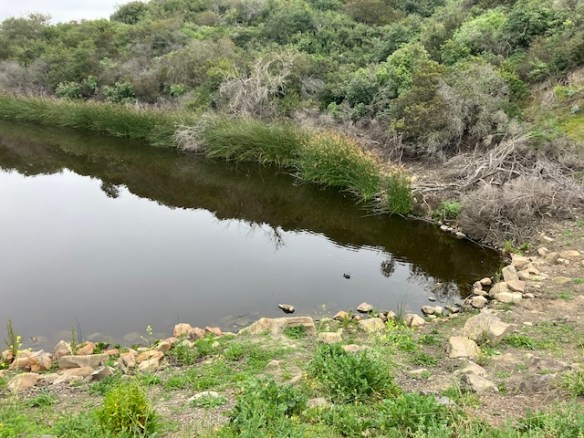
Join me on an early morning walk around the lake trails.
There’s a familiar fragrance of tule, which some people don’t like, but I love love the way it smells. Tule grows in dense stands along freshwater wetlands.
Indigenous peoples ate tule roots and seeds, while the reeds were used to make baskets, cord, sandals, and clothing. P.S. Here’s how to say it: “too-lee”
With all the rain we’ve had, everything was uncharacteristically green…as far as the eye could see…
Pretty Black-eyed Susan flowers!
It’s a human-made lake, not natural, intended to be a reservoir, but the ducks and coots don’t seem to mind a bit.
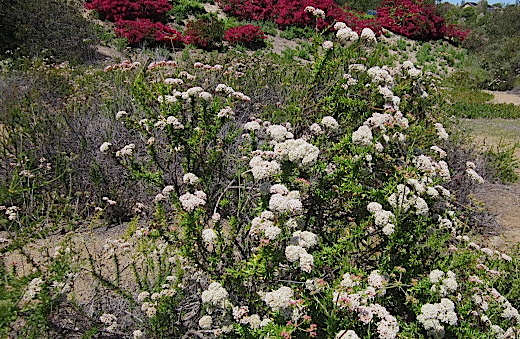
Native buckwheat.
I didn’t see any coyotes this time, but it was still a lot of fun!
This year, Project Coyote launches the first Annual Coyote Awareness Week, March 17-23, to celebrate America’s song dogs.
I can’t think of a better way to officially recognize the arrival of SPRING and the vernal equinox than by highlighting the importance of the beautiful coyote, especially on March 23rd which has been designated National Coyote Day.
My backyard camera captures their frequent visits, along with bobcats and sometimes both in the same night, which makes me very, very happy. I know they’re helping to deplete the rodent population that’s exploded in the last few years.
(And because a couple of readers have asked where “song dog” comes from, I learned that the word coyote comes from the Aztec word coyotl, meaning Song Dog or Barking Dog.)
The purpose of this new holiday is to raise awareness about the intense persecution and misunderstanding coyotes face and the importance of compassionate coexistence.
Coyotes represent the pinnacle of unethical and unscientific wildlife “management” in the United States. Increased awareness of and appreciation for coyotes are critically needed to reform outdated wildlife policies and end the unjust and unscientific persecution of coyotes deeply rooted in American culture ever since European colonization.
Predator extermination campaigns in the 1800s–mid 1900s nearly wiped wolves, mountain lions, and bears off the map. But when the focus turned to coyotes, they responded to this persecution with resilience and adaptability, tripling their range in the last century and filling vacant niches left where wolves were extirpated. Rather than celebrating their resilience to adapt to a human dominated world and the important roles they play in our urban and rural communities, our society has often labeled the coyote as a “pest” or a threat to human communities.
Coyote’s ability to adjust to changing conditions and diverse environments, along with their resiliency to survive and thrive in the face of relentless persecution, has left them vulnerable to insufficient legal protections. In almost every region of the United States, coyotes are legally allowed to be killed, sometimes incentivized through bounties, in unlimited numbers 365 days of the year, using almost any means, including killing contests, trapping, poisoning, hounding, and unregulated recreational killing.
“If we can change hearts and minds about coyotes, the world will be a more compassionate place for all wildlife. That is why coyotes are our flagship species at Project Coyote. And that is why we launched the first annual Coyote Awareness Week,” said Camilla Fox, Project Coyote Founder & Executive Director.
The inadequate protections for coyotes lead to at least 500,000 killed each year, of which over 55,000 are killed annually by the USDA’s Wildlife Services agency at taxpayer expense (as of 2022). Accurate numbers do not exist for how many coyotes are killed through “sport” or wildlife killing contests, because state agencies often do not track or monitor the killing of coyotes, and this number is likely a very low estimate. Even with this underestimate, it translates to: 41,666 coyotes killed every month, 9,615 coyotes killed every week, 1,370 coyotes killed every day, 57 coyotes killed every hour, and 1 coyote killed every minute.
It is vital to foster coexistence with coyotes in both urban and rural communities. Coyotes play critical roles in our multispecies communities including regulating disease transmission by managing rodent populations and culling sick animals, keeping our communities clean by scavenging carrion, and limiting mesocarnivore populations (e.g. raccoons, skunks and foxes) thereby increasing bird diversity and abundance.
Coexisting with coyotes and other wild carnivores can reduce conflict. Decades of scientific literature demonstrate the ineffectiveness of lethal “management” for reducing conflict and for reducing population size. Indiscriminate killing disrupts social systems and subsequently encourages more breeding and migration, which can lead to increases in livestock conflict. Additionally, higher survivability of coyote pups can follow brief population declines due to a temporary increase in available prey, allowing coyote populations to quickly rebound and even increase in number. Despite this data, the default reaction to coyote sightings is too often fear mongering that leads to lethal management. To combat this, citizens across the country can empower their fellow community members to instead interpret coyote behavior, reduce attractants (like unsecured garbage, compost, and pet food), and humanely haze bold coyotes.
It is well past time to replace lethal “management” with compassionate coexistence. Coyotes, like everyone, belong and have a right to exist. Coyotes are sentient, family oriented beings who deserve protection from unscientific and unethical persecution.
We encourage supporters to promote coyote coexistence in their community this week- and every week. It’s a community wide effort to keep coyotes wild and safe from unintended habituation.
“Coyote power: surviving by one’s intelligence and wits when others cannot; embracing existence in a mad, dancing, laughing, sympathetic expression of pure joy at evading the grimmest of fates; exulting in sheer aliveness; recognizing our shortcomings with rueful chagrin.” ~ Dan Flores, author, Coyote America and Project Coyote Ambassador










 Enchanted Seashells | Princess Rosebud