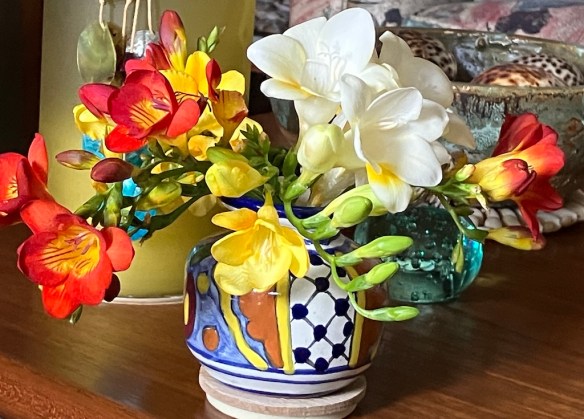
I really wish you could close your eyes and inhale the fragrance of these freesias. Our weather’s been hot here in SoCal and all the flowers bloomed at the same time.
Photo by Enchanted Seashells
Isn’t that vase adorable? I found it at a thrift shop and it’s one of my favorite things.
EXCOGITATE: To think out; devise; invent. To study intently and carefully in order to grasp or comprehend fully.
TO THIINK IN OR THINK OUT…WHAT IS YOUR METHOD?
According to wiseGEEK, to think outside the box means means to “handle a situation or challenge in an unconventional manner. The origin of the phrase is believed to date back to the 1960s, and is often associated with a famous mental puzzle called The Nine Dots.”
I’ve had a lot of jobs over the years and I’ve found that no one really wanted me to think outside the box — independently, creatively, with imagination or compassion. I felt the overwhelming corporate mantra was to agree with everything and keep quiet.
And that leads us on to another outside the box obsession of mine…
I love boxes; cardboard boxes, wooden boxes, large and small boxes. Over the years, I’ve accumulated a massive collection. (I’m not a hoarder, I’m not a hoarder, I’m NOT a hoarder. Stop thinking that!)
But a box full of Bandit was my favorite. Our poor baby died of chronic renal failure. Wasn’t she soo beautiful? Sniff.
She’s speaking to me with her eyes, ” I don’t feel very good, Mommy.” Photo by Enchanted Seashells
I say it every year, but this is more than simply a day to celebrate Angel Boy’s TENTH birthday, March 8 is International Women’s Day 2026.
“When women thrive, we all rise.” The initiative highlights that empowering women brings collective progress.
This year’s theme is “Give To Gain”, a campaign that urges collaboration and generosity to accelerate gender equality.
The theme highlights that by giving support—through funding, knowledge, or advocacy—we gain a more inclusive world.
The campaign encourages taking concrete actions, such as investing in women, providing resources, increasing visibility, and fostering mentorship.
Of course we’ll commemorate Angel Boy’s ten years around the sun, especially since this is the year he becomes a double-digiter. No longer a baby, he enters the world of the pre-teen with my same shoe size and he’s nearly as tall as me. I predict by the end of summer, he’ll have surpassed my sixty inches. Happy Birthday, Angel Boy!
It’s a bit late I guess, but better late than never, right? Did you watch?
Since I am now compelled to be on Team Seattle Seahawks and this was such a special day, I proudly wore a Seahawks hat, shirt, and sweatshirt to fully REPRESENT!
It was a slow start and we were all wondering who would eventually score.
The halftime show with Bad Bunny was amazing with the perfect message of Latin unity and love: “Together, We Are America” displayed on a football, and the uplifting quote: “The only thing more powerful than hate is love”.
The second half was all Seahawks and we were ecstatic.
The final score was 29-13. The right team won the Superbowl. Sam Darnold, Jaxon Smith-Njigba, and Kenneth Walker III were superstars.
The Seattle Seahawks Super Bowl LX victory parade took place on Wednesday in downtown Seattle, drawing an estimated 700,000 to 1 million fans.
In a world where sordid and evil depravity is coming to light, the innocence of rooting for a sports team is even more valued.
Go ‘Hawks!
Check out this time-lapse of the Super Bowl Victory Parade:
(And if the rumors are true that the Seahawks declined a visit to the White House, that’s even more of a WIN!)
Almost ten-year-old Angel Boy 2.0 has become a rabid Scrabble player. Zipola is a word he used to gain a triple word score.
It’s a valid word in SOME Scrabble dictionaries, but not all. However, no one was going to take that pride and joy away from him, that’s for sure.
In fact, last night he surpassed 400 points in a one-on-one game, winning against his PhD literature professor dad, and it’s one of our proudest family moments.
It’s bad enough that I could NEVER win against the original Angel Boy; I can’t imagine the future as a total loser.
UPDATE 2026: Here’s yet another missed opportunity to meet the MOSAT. This is an update to a post I wrote in 2020. I was purging old posts, read this one, and have no idea how I missed the connection between Tom Petty’s guitarist and Leon Russell, but I did, and now that I know, I’m going to contact him and hopehopehope he’ll be amenable to sharing stories about Leon and not be too annoyed with my LR obsession.
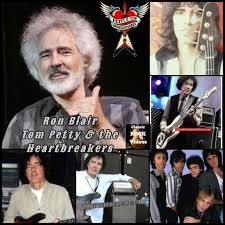
Ron Blair, the original bassist for Tom Petty and the Heartbreakers, has a direct connection to Leon Russell through the band’s early career and record label, Shelter Records.
Leon Russell’s Shelter Records was the platform that signed and released the early music of Tom Petty and the Heartbreakers, featuring Ron on bass.
In the mid-1970s, Tom Petty signed with Shelter Records, a label co-owned by Leon Russell and Denny Cordell.
Ron Blair joined the Heartbreakers in 1976 after Mudcrutch (Petty’s previous band) disbanded. During this period, the band was under the Shelter Records umbrella, which Russell founded.
Before forming the Heartbreakers, members of the group, including those who worked with Blair, were part of the Los Angeles music scene where Leon Russell was a prominent figure. Ron Blair was the bassist for the band from 1976 to 1981, during which time the band established its sound, often described as a mix of rock, country, and blues.
Original post…
I just saw an old video of Tom Petty and the Heartbreakers and it reminded me of something from my past.
When my son was around eight or ten years old (early 1990s), I’d bring him along with me to the gym and he’d go (reluctantly) to the babysitting room for an hour or so. It was mostly other doubledigiters so he didn’t have a real problem with it, and eventually became friendly with a boy about the same age.
Their friendship progressed beyond the gym to birthdays and sleepovers. For a while, these two boys were inseparable.
One day, out of the blue, and I’m a bit fuzzy on the details, the boy’s dad asked if I could give him a ride to LAX. It’s a ninety minute drive and I’m not sure why I said yes ‘cos I seriously HATE to drive, especially if it involves LA traffic, but I loaded the boys and the dad (along with his guitar) in my car.
I can’t pinpoint the exact moment when I learned that his dad was actually superstar guitarist Ron Blair of Tom Petty and the Heartbreakers, but when I did, I was suitably impressed and starstruck. All I do remember is that he was always quiet but courteous and appreciated the airport ride. However, he looked EVERY bit a rock and roll superstar.
A couple weeks pre-Covid, a friend invited me to a fundraiser for the local food bank. It was an outdoor venue with a lot of musical guests. The headliner’s name was a familiar one. Lo and behold, it was Ron Blair, who now lives in my little town.
We chatted a bit; I can’t honestly say that he remembered me, but he did remember my son which was cool.
Still quiet, humble, friendly, and amazingly talented.
We’ve all aged and I’m obviously way too old to be a groupie (sigh), but I do remember THOSE good old days, haha.








 Enchanted Seashells | Princess Rosebud