Wings of Magic

Meet Princess Aurora!

A couple days ago I was shopping with a girlfriend who was actually looking for Halloween decor for a party but as soon as I saw her tucked away on a shelf alongside sparkly lights and baubles, I knew she had to come home with me.

I had to name her, so she will forever be Princess Aurora. Isn’t she the most magical, adorable girl you’ve ever seen?

I guess this creation was meant to be a holiday decoration, but she’ll live on that chair all year long, or until a special little titian-haired Angel Girl claims her.

Princess Aurora’s magical wings light up, too. Beyond precious. Innocence personified.

Magical Places

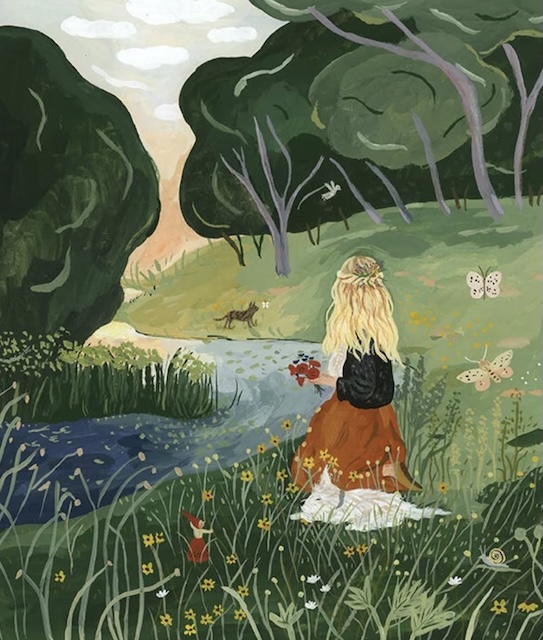
“Magical places are always beautiful and deserve to be contemplated.
Always stay on the bridge between the invisible and the visible.”
Paolo Coelho

Found on Pinterest

This is heavenly…no phones, no social media, no distractions; simply a butterfly-filled meadow alongside a sunshiny, babbling brook.

This pic reminds me of one of my favorite songs by (who else) Leon Russell, Down On Deep River. It evokes the perfect, serene mood…

“Hear the crickets singing for a mile
And the sound of the bullfrogs make you smile
So lead me beside the still waters
Let me love you down on deep river.

Won’t you sit by my side
And hold to my hand and love me all the way?

And we’ll leave all the highways far behind
And just take a little blanket with the wine.”

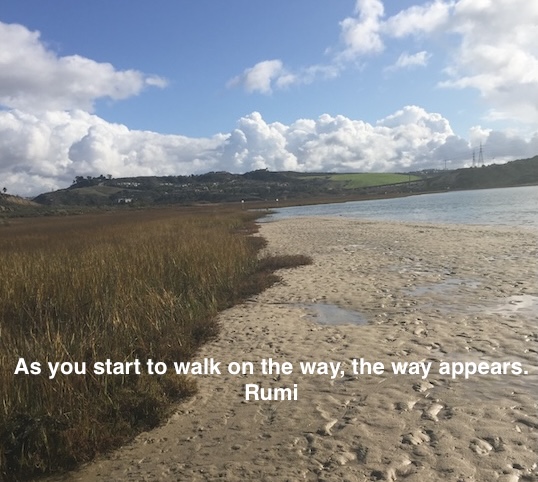
Take The First Step

Photo of Agua Hedionda Lagoon by Enchanted Seashells

Word of The Day: Takiwātanga (Along With a Whole Lot of Other Stuff)

Yom Kippur starts at sundown and now we are embroiled in a government closure because the repubs are all insane and will do anything to NOT release the Epstein files, apparently at any cost.

Did you see the debacle of the gathering of generals in Virginia who had to sit there and listen to the felon and his drunken lapdog? Good for them for not applauding and for looking stoic and aghast. Maybe there’s SOME hope for us. Maybe.

Lately, we’ve heard a lot of talk from the orange POS and his worm-brained head of Health and Human Services (what a joke) about acetaminophen causing autism. The brand Tylenol came out with a classy response.


When I was in the teaching program, one of my student teaching experiences was in a classroom where the students had some form of autism. This was an area that I planned to focus on as an educator. I never pursued it, but I learned that all children learn in different ways and it’s up to teachers and parents to respect the differences and help them achieve academically as well as being compassionate to these special little beings.

The Māori word for autism is Takiwātanga, which translates to “in their own time and space”. Created by Māori linguist and rangatira (chief) Keri Opai, this term was developed to describe the unique experience of individuals on the autism spectrum. It reflects the idea that autistic people have their own unique timing, pacing, and way of experiencing the world. 

This sounds like the perfect time for another version of “A Song for You” by the Master of Space and Time, Leon Russell, of course. So mercurial, he added something special to every performance, in his own time and space.

The End of Roses


She felt vaguely upset and unsettled.
She was suddenly tired
of outworn dreams.
And in the garden
the petals of the
last red rose
were scattered by
a sudden little wind.
Summer was over

— it was Autumn.

“She felt vaguely upset and unsettled. She was suddenly tired of outworn dreams.
And in the garden the petals of the last red rose were scattered by a sudden little wind. Summer was over — it was Autumn.” L.M. Montgomery

Rainbow Valley is the seventh book in the chronology of the Anne of Green Gables series of novels by Lucy Maud Montgomery.
Photos by Enchanted Seashells.

Time As a Construct

Lately, I’ve been thinking about T-I-M-E. Time flies. I hate to be late; I like to be ON TIME. Does time really exist at all or have we been brainwashed to think iit does?

Too much thinking about time as ephemeral makes me anxious. Too much thinking about anything does the same thing. My non-logical mind has determined that TIME itself isn’t the issue; THINKING about it IS and it makes my brain melt, just like Dali’s clocks.

Salvador Dalí

 “Time doesn’t exist, clocks exist. Time is just an agreed upon construct.”
— David Foster Wallace

“It takes just one unattended moment for an hour to pass.”
― Sherod Santos, Square Inch Hours: Poems

Santos was born in South Carolina, graduated from San Diego State University, and studied at the University of California, Irvine. I never met him when I attended SDSU, but I knew ABOUT him; all of us who studied creative writing and poetry knew about “Rod” Santos and W.S. Merwin and Glover Davis, who was actually my professor.

David Foster Wallace was an acclaimed American writer known for his fiction, nonfiction, and critical essays that explored the complexities of consciousness, irony, and the human condition. Wallace wrote the novel Infinite Jest.

“The Persistence of Memory” is an iconic 1931 surrealist oil painting by Salvador Dalí, famous for its “melting” clocks draped over a desolate, dream-like landscape inspired by his Catalonian home. The painting uses a paranoiac-critical method to explore the subconscious, with the distorted clocks symbolizing the fluidity and subjectivity of time, influenced by Freudian psychology and potentially Einstein’s theory of relativity. From Google.

Could Leon Russell’s version of As Time Goes By be the best ever? I think so…mature Leon was awesome, too.

Word of The Day: Quiddity

It’s been a while since I posted about interesting and often archaic words that contribute to a fuller, richer vocabulary. Even though it’s been less than a year since that orange POS somehow took power, this country has turned into a shitshow of one horrible event after another and that seems to eclipse any sense of normalcy. 

Anyway…here’s one that’s quirky and will hopefully take our minds off this ugly reality for a minute or two.

Quiddity is such a great word: it’s the essence or unique nature that makes something the kind of thing it is and makes it different from any other.

Vague and not vague at the same time — I can sort of comprehend it only if I don’t allow my brain to delve too deeply into the intricacies of the meaning because then it becomes overwhelming and my mind takes off onto strange and faraway little tributaries. Sometimes it’s best not to overthink things.

From Shakespeare’s Hamlet, “Where be his quiddities now…?

To me: “Her passion for Leon Russell’s music is as much a quiddity as her curly hair.”

More examples:

“Many people share the quiddity of dipping their fries into their milkshakes.” which is a waste of a good milkshake and a good french fry.

For there is no knowledge of things insofar as they are external in effect, but insofar as their nature and quiddity is grasped by the mind.

When a politician avoids answering a question while pretending to answer it, he often does it using quiddity, or by bringing up irrelevant and distracting points.

Quiddity is a usefully sneaky tool if you want to evade an argument or question, and it’s often used by people like lawyers in court and teenagers angling for later curfews.

The noun quiddity has a philosophical meaning too, “the essential nature of something,” or the unique thing that makes it what it is. The Medieval Latin root, quidditas, translates literally as “whatness.”

I think we all need to incorporate quiddity into our daily language, written and verbal, don’t you?

Featured image from Pinterest

I Am Feral

Today’s mood…

In my mind I am always the feral woman wearing a white nightdress with a mud-stained hem and twigs in my hair, running through a forest bathed in moonlight, screeching along with the owls and foxes.

Unknown, curated from She’s Magic & Midnight Lace
Image from Pinterest

The Bluebird Promise

As long as there are bluebirds, there will be miracles and a way to find happiness.

Quote curated from Pinterest: Credit to the writer.
Art by Ida Rentoul Outwaite

Non-Thought: Thought-terminating Clichés Are All Around  

This blog is exactly like my personality: random

One minute I’m searching for seashells or a rock that speaks to my heart or I’m reveling in a designer treasure found at the local consignment shop after a day protesting that orange POS and the fall of democracy, yet at the same time, on any given day, I’m a voracious reader, whether it’s chick lit or poetry or something that catches my eye on social media, all the while obsessing over Leon Russell, Master of Space and Time. There are definitely many tabs open on my laptop screen (and in my head).

Like this…thought-terminating clichés.

How many times have you heard this (or said it)? “Everything happens for a reason.” Did you find it helpful or frustrating? I find it frustrating and not helpful AT ALL. It makes me feel the person I’m talking to either doesn’t care about what I’m saying or is trying to act superior and patronizing.

For me, that attitude completely terminates the conversation. Sometimes I respond with “Does it really? Does everything REALLY happen for a reason?” but mostly I simply stop talking. There’s nowhere to go after that; for me It’s a convo-ender.

A thought-terminating cliché is a common saying or phrase used to shut down further critical thinking or debate about a topic. These phrases often present themselves as universally accepted truths or wisdom, discouraging deeper exploration or questioning. They can be used in various contexts, including conversations, debates, and even within workplaces or religious groups. 

The term was popularized by Robert Jay Lifton in his 1961 book Thought Reform and the Psychology of Totalism, who referred to the use of the cliché, along with “loading the language”, as “the language of non-thought”.

It’s also known as a semantic stop-sign, a thought-stopper, bumper sticker logic, or cliché thinking and is a form of loaded language—often passing as folk wisdom—intended to end an argument and quell cognitive dissonance with a cliché rather than a point. Some such clichés are not inherently terminating, and only becomes so when used to intentionally dismiss, dissent, or justify fallacies.

1. “It is what it is.” Used to dismiss any deeper inquiry into a situation or problem.

2. “You’ll figure it out.” Used to avoid helping or being asked for help. Condescending.

3. “Boys will be boys.” – Used to excuse or dismiss male behavior, often inappropriate or immature.

4. “Let’s agree to disagree.” Used to end a debate without resolving the underlying disagreement.

5. “Everything happens for a reason.” Used to shut down further questioning about why something occurred.

6.””Only time will tell.” Used to avoid making a decision or judgment about a situation.

7. “Such is life.” Used to dismiss the complexities or frustrations of a situation as being typical or unavoidable.

8. “What doesn’t kill you makes you stronger.”  Used to trivialize suffering or hardship without addressing its impact.

9. “God works in mysterious ways.”  Used to stop questions about religious or moral issues that are difficult to explain.

10. “It’s a free country.” Used to justify questionable actions or opinions without further discussion.

11. “You can’t win them all.” Used to discourage further effort or reflection after a failure or loss.

12. “Better safe than sorry.” Used to justify overly cautious behavior without considering the consequences of inaction.

13. “Everything in moderation.” Used to avoid discussing the nuances or dangers of certain behaviors or choices.

14. “That’s just your opinion.”  Used to dismiss someone’s perspective or argument without considering its merits.

15. “Let’s not rock the boat.” Used to discourage change or questioning of the status quo.

16. “This is the way we’ve always done it.” Used to resist change or new ideas without considering their potential benefits.

17. “Time heals all.” Completely puts a stop to any discussion that isn’t in agreement.

To transform thought-terminating clichés into conversation catalysts, we can create alternative phrases or questions that encourage further exploration and dialogue.

Here are some antidotes, each designed to open up rather than shut down conversations:

  1. Instead of “It is what it is”:  Ask, “What factors have led to this situation, and how can they be addressed?”
  2. Instead of “Boys will be boys”:  Query, “What behaviors are we accepting, and why, and how can we foster more responsible actions?”
  3. Instead of “We agree to disagree”:  Suggest, “Let’s delve into our differing viewpoints to understand each other better.”
  4. Instead of “Everything happens for a reason”:  Pose, “What can we learn from this situation, and how might it influence our future choices?”
  5. Instead of “Only time will tell”:  Consider, “What potential outcomes can we anticipate, and how can we prepare for them?”
  6. Instead of “Such is life”:  Reflect, “How does accepting this situation impact us, and are there aspects we can change or influence?”
  7. Instead of “What doesn’t kill you makes you stronger”:  Explore, “What challenges are we facing, and how can we grow or learn from them?”
  8. Instead of “God works in mysterious ways”:  Ask, “How can we find meaning or understanding in this situation?”
  9. Instead of “It’s a free country”:  Discuss, “How do our individual actions impact others, and where do we draw the line between freedom and responsibility?”
  10. Instead of “You can’t win them all”:  Consider, “What can we learn from this loss, and how can it inform our future efforts?”
  11. Instead of “Better safe than sorry”:  Ponder, “What are the risks and benefits of our choices, and how do we balance caution with opportunity?”
  12. Instead of “Everything in moderation”:  Question, “How do we find a healthy balance, and what does moderation look like in this context?”
  13. Instead of “That’s just your opinion”:  Offer, “I appreciate your perspective. Can you share more about how you arrived at this viewpoint?”
  14. Instead of “Let’s not rock the boat”:  Encourage, “What potential benefits and challenges could come from addressing this issue?”
  15. Instead of “This is the way we’ve always done it”:  Propose, “What new methods or ideas could we consider to improve this situation?”

Curated from desireebstephens.substack.com/p/the-power-of-silence-unpacking-thought, Wiki