The Bluebird Promise

As long as there are bluebirds, there will be miracles and a way to find happiness.

Quote curated from Pinterest: Credit to the writer.
Art by Ida Rentoul Outwaite

It’s A Tofu Miracle!

Yes, an actual tofu miracle!

Tofu Tip: Save tofu water; do NOT discard it!

Photo from Pinterest

Tofu water can be used to water plants, add to compost, or as a substitute for aquafaba or other liquids in recipes. 

My mind is completely blown. I’ve drained tofu water ever since I started eating it, and that’s been a long long time.

Truthfully, I never thought it was anything but messy and annoying. Now I’ll save every single drop and tonight, I’ll try a DIY Tofu Facial.

Here’s what I learned: tofu water contains beneficial nutrients like protein, fat, carbohydrates, and minerals (N, P, K) which fertilize plants and promote growth. You can also drink it, use it in soups, or even for DIY facials due to its soothing properties. 

Some things you can do with tofu water:

  • Plant Fertilizer: Pour it onto your houseplants or in your garden to provide nutrients and help them grow. 
  • Compost Additive: The liquid can be added to a compost heap to enhance the organic material and nutrient content. 
  • Aquafaba Substitute: Use it in recipes that call for aquafaba (the liquid from canned chickpeas) as a vegan alternative for binding ingredients in sweets or savory dishes. 
  • Cooking Liquid: Incorporate it into dishes like soups or stocks, especially if the liquid has been reduced to a thicker consistency. 
  • Baking: Add it to the overall liquids.
  • Beverage: Some people boil tofu water with flavorings like vanilla almond milk, stevia, or cocoa for a nutritious drink. 
  • Smoothies: Add to blender with juices, plant milks.
  • Facials: Tofu water contains compounds that can have soothing and calming effects on sensitive skin. 

Let me know if you tried any of those suggestions, or if you plan to!

Walking Wisdom

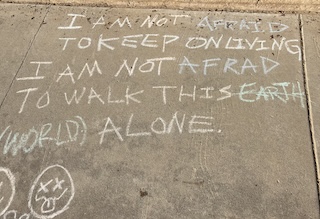
This was chalked into the sidewalk near my lagoon. It’s been there for a while and so far no one has tampered with it, so I decided to memorialize the words in a photo. I don’t know who wrote it, but I would like to meet them, because it’s sad yet profoundly hopeful at the same time.

I am not afraid to keep on living,
I am not afraid to walk this earth (world) alone.

Photo by Enchanted Seashells

Evolution of The Mom Hug

I’m at #3 with Angel Boy, #2 with Angel Girl.

I remember that the original Angel Boy was about fourteen years old when he entered the final stage, taller than me. Now I have to get on my tiptoes to hug him and HE bends down to me.

In my mind, he’s still and forever #1 or #2, so it doesn’t seem right that the roles have reversed, and it won’t be long before the Angel Kids will also be taller than me, because mostly everyone else is.

I guess that’s why they call me Little Grandma.

**I found this on Pinterest, but credit goes to artist Giselle Dekel.**

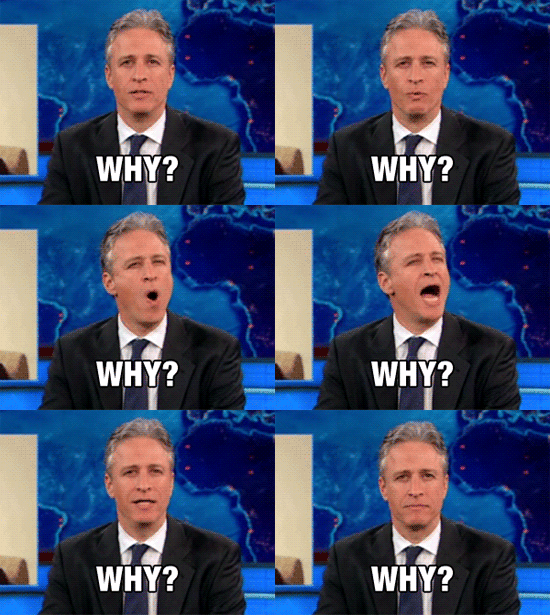
“Why are you always in the kitchen?”

These incredibly observant Angel Kids of mine are full of nonstop chat as they watch my every move with their laser focused eyes and brains, especially when they sit at the counter (their favorite spot), waiting to be served exactly like baby birds in a nest with their beaks open wide for mom to bring a freshly caught worm..

“Why are you always in the kitchen, Grandma?” “It’s like you have a force field around you and you’re stuck in there.” (He is SO funny.)

“Yeah, Grandma, you’re always in the kitchen!” Angel Girl has to offer her opinion, too. ALWAYS.

I stop chopping veggies or flipping pancakes or cutting the crust off another slice of bread (only for Angel Girl), and respond with a question,

“Why are you guys always hungry?”

Well, that made them think a bit, that’s for sure.

“Good point”, Angel Boy 2.0 sagely nods as he ponders what I meant by that, as he chews on a slice of apple.

Those kids LOVE apples as a pre-meal snack. Sometimes dipped in nut butter, but they’re perfectly satisfied with a bowl of sliced apples.

The key is to give each of them their own bowl or they’ll squabble about equal amounts. “Why does s/he have more than me?” Since I only birthed one child, I’m not used to this kind of sibling behavior. I actually find it incredibly annoying and to avoid listening to it, for me, separate bowls are the easiest solution.

They eat a lot, not junk food or snacks, but wholesome and dense nutrition. That’s what healthy kids do; eat, play, sleep. They’re exactly like puppies. Their growing bodies and brains demand it and I’m only too happy to oblige.

“Play with us, Grandma. We’ll even play Candyland just for you. Or Scrabble.” That’s quite the concession on their part, as they know those are my two favorite games.

“How about after you guys have this smoothie and ants on a log and a (lentil/oat/kale) muffin, we’ll play. How does that sound?”

Two curly heads nod in unison.

Eat, play, sleep.

******************************************************

Featured photo by Enchanted Seashells at Crystal Cove. Vintage kitchen, not mine.

More Leon Russell, This Time With JJ Cale

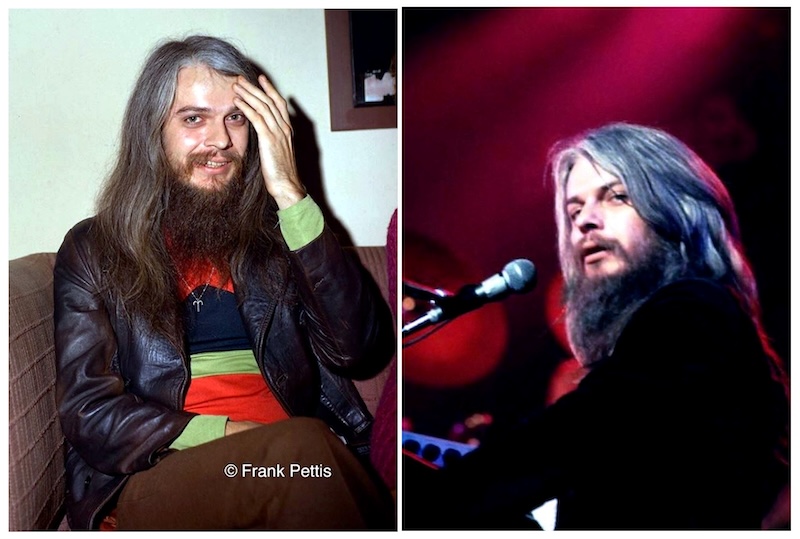
I love it when someone sends pictures of Leon that I hadn’t previously seen. These photos were taken in Detroit; the one on the left was at the Eastown Theater (1970) and on the right, Cobo Arena in 1972.

Ron Domilici  Cobo Arena photo by Charlie Auringer.·Magic bag

One of the most truly amazing live performances took place at Leon’s Paradise Studios in 1979. All the musicians are incredible, but it features Leon’s long-time friend and colleague, JJ Cale. The sole female guitarist is Christine Lakeland Cale, JJ’s wife.

Grammy winner, legendary singer, songwriter, and musician J.J. Cale (born John Weldon Cale,1938–2013) was one of the originators of the distinctive Tulsa Sound. He is most famous for writing songs popularized by others, including Eric Clapton’s hits “Cocaine” and “After Midnight” and Lynyrd Skynyrd’s “Call Me the Breeze”. Known for his laid-back, blues-rock style, Cale also pioneered the use of drum machines and produced his own records, engineering his own distinctive sound. He was also one of Leon Russell’s engineers in the 1960s.

Check out Leon on the drums!

PS There’s an album/dvd of that session but I haven’t found it available for purchase. JJ. Cale featuring Leon Russell – In Session at the Paradise Studios, L.A. 1979 [DVD] If anybody has one, please let me know! I’d love to own it.

Beautiful Love

If I could hug my crow family, I would be so happy. The love of an animal is pure and sweet.

Jean Marie Lucien Pierre Anouilh was a French dramatist and screenwriter 1910-1987.
Curated from Rivers in the Ocean / Craft Kreatively

Random Kindnesses

Early this morning, I opened the back door and walked on the deck. Near the steps, I saw a motionless bee which I gently nudged with a stick and found him able to move ever so slightly. I brought him a small amount of water in a jar lid and watched as he thirstily inhaled a few drops. As soon as he had enough, he stumbled down the rest of the steps to a shady area on the ground.

I’m not sure if I helped him or simply prolonged the inevitable, but at least I did something to aid a living creature and that always feels good.

Later that morning, I went to the grocery store where I picked up some yummy cherries and cucumbers and avocados.

The woman in front of me had a lot of items and it looked like she was making a special dinner, maybe anniversary, or at least that was the little story I told myself as I patiently waited my turn.

I noticed that she didn’t have her own shopping bags and I watched the clerk take out a couple “store” bags and fill them with her food. After the food was paid for, the employee asked her for thirty cents to pay for the bags, which was really odd because usually they’ll ask before, so they can add it to the total. Right??? So my spidey senses were on alert as I observed the conversation.

The lady became flustered as she looked in her handbag because she didn’t have any cash or change. I could see that she was super embarrassed and I could totally relate. It didn’t seem as if she was unsheltered or didn’t have money; she was well dressed with great jewelry (I always notice stuff like that).

I said, “Let me check. I think I have thirty cents.” I usually don’t have ANY cash or coins either, but I did locate enough to pay for her store bags.

The poor woman was beside herself with gratitude, wanted to pay me back, couldn’t believe I would do that for a complete stranger, asked me my name, WAY overly intensely thankful and appreciative for a mere handful of coins.

I told her it was my pleasure to help and it wasn’t as if I offered to buy her food (haha) and she could pay it forward to someone else in the future and keep the good deed moving along.

Because her gratitude seemed oddly disproportionate, I thought it was possible that she had a bad day and my minor act of kindness gave her a bit of hope — who knows.

She did seem close to breaking down, poor dear. And all for THIRTY CENTS! I wonder if this was some sort of low rent scam so the employee could pocket the money, but that was most likely not the case. Anyway, it was a strange encounter and I was glad to help because it did seem that was the only way I was going to get out of the store, haha. (BTW, I had my own bags.)

Sometimes I’ll see someone do a kind but simply mundane gesture and I’ll just get filled with this unexplainable joy that someone did something nice for someone else with no strings attached; no ulterior motives, no agenda.

After that experience, I went to Sprouts because I was out of probiotics (I love probiotics). The woman in front of me in line (same scenario!) turned to me. She held out a couple pieces of candy wrapped in shiny gold foil and asked me if I wanted them. She said they were free and pointed to where she got them, somewhere else in the store.

I told her how much I LOVE free things (I really do) but asked why she didn’t want them. She explained that she had tasted another one and they were milk chocolate and she only likes dark chocolate. I said I like all variety of chocolate (except white) and gladly accepted her little gifts.

Two acts of kindness were immediately repaid by another; what a great (and sweet) day!

Featured image credit to oechsli.com

Non-Thought: Thought-terminating Clichés Are All Around  

This blog is exactly like my personality: random

One minute I’m searching for seashells or a rock that speaks to my heart or I’m reveling in a designer treasure found at the local consignment shop after a day protesting that orange POS and the fall of democracy, yet at the same time, on any given day, I’m a voracious reader, whether it’s chick lit or poetry or something that catches my eye on social media, all the while obsessing over Leon Russell, Master of Space and Time. There are definitely many tabs open on my laptop screen (and in my head).

Like this…thought-terminating clichés.

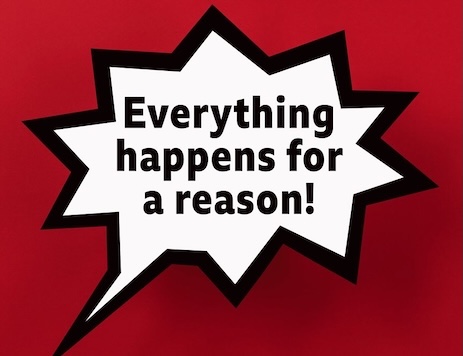
How many times have you heard this (or said it)? “Everything happens for a reason.” Did you find it helpful or frustrating? I find it frustrating and not helpful AT ALL. It makes me feel the person I’m talking to either doesn’t care about what I’m saying or is trying to act superior and patronizing.

For me, that attitude completely terminates the conversation. Sometimes I respond with “Does it really? Does everything REALLY happen for a reason?” but mostly I simply stop talking. There’s nowhere to go after that; for me It’s a convo-ender.

A thought-terminating cliché is a common saying or phrase used to shut down further critical thinking or debate about a topic. These phrases often present themselves as universally accepted truths or wisdom, discouraging deeper exploration or questioning. They can be used in various contexts, including conversations, debates, and even within workplaces or religious groups. 

The term was popularized by Robert Jay Lifton in his 1961 book Thought Reform and the Psychology of Totalism, who referred to the use of the cliché, along with “loading the language”, as “the language of non-thought”.

It’s also known as a semantic stop-sign, a thought-stopper, bumper sticker logic, or cliché thinking and is a form of loaded language—often passing as folk wisdom—intended to end an argument and quell cognitive dissonance with a cliché rather than a point. Some such clichés are not inherently terminating, and only becomes so when used to intentionally dismiss, dissent, or justify fallacies.

1. “It is what it is.” Used to dismiss any deeper inquiry into a situation or problem.

2. “You’ll figure it out.” Used to avoid helping or being asked for help. Condescending.

3. “Boys will be boys.” – Used to excuse or dismiss male behavior, often inappropriate or immature.

4. “Let’s agree to disagree.” Used to end a debate without resolving the underlying disagreement.

5. “Everything happens for a reason.” Used to shut down further questioning about why something occurred.

6.””Only time will tell.” Used to avoid making a decision or judgment about a situation.

7. “Such is life.” Used to dismiss the complexities or frustrations of a situation as being typical or unavoidable.

8. “What doesn’t kill you makes you stronger.”  Used to trivialize suffering or hardship without addressing its impact.

9. “God works in mysterious ways.”  Used to stop questions about religious or moral issues that are difficult to explain.

10. “It’s a free country.” Used to justify questionable actions or opinions without further discussion.

11. “You can’t win them all.” Used to discourage further effort or reflection after a failure or loss.

12. “Better safe than sorry.” Used to justify overly cautious behavior without considering the consequences of inaction.

13. “Everything in moderation.” Used to avoid discussing the nuances or dangers of certain behaviors or choices.

14. “That’s just your opinion.”  Used to dismiss someone’s perspective or argument without considering its merits.

15. “Let’s not rock the boat.” Used to discourage change or questioning of the status quo.

16. “This is the way we’ve always done it.” Used to resist change or new ideas without considering their potential benefits.

17. “Time heals all.” Completely puts a stop to any discussion that isn’t in agreement.

To transform thought-terminating clichés into conversation catalysts, we can create alternative phrases or questions that encourage further exploration and dialogue.

Here are some antidotes, each designed to open up rather than shut down conversations:

  1. Instead of “It is what it is”:  Ask, “What factors have led to this situation, and how can they be addressed?”
  2. Instead of “Boys will be boys”:  Query, “What behaviors are we accepting, and why, and how can we foster more responsible actions?”
  3. Instead of “We agree to disagree”:  Suggest, “Let’s delve into our differing viewpoints to understand each other better.”
  4. Instead of “Everything happens for a reason”:  Pose, “What can we learn from this situation, and how might it influence our future choices?”
  5. Instead of “Only time will tell”:  Consider, “What potential outcomes can we anticipate, and how can we prepare for them?”
  6. Instead of “Such is life”:  Reflect, “How does accepting this situation impact us, and are there aspects we can change or influence?”
  7. Instead of “What doesn’t kill you makes you stronger”:  Explore, “What challenges are we facing, and how can we grow or learn from them?”
  8. Instead of “God works in mysterious ways”:  Ask, “How can we find meaning or understanding in this situation?”
  9. Instead of “It’s a free country”:  Discuss, “How do our individual actions impact others, and where do we draw the line between freedom and responsibility?”
  10. Instead of “You can’t win them all”:  Consider, “What can we learn from this loss, and how can it inform our future efforts?”
  11. Instead of “Better safe than sorry”:  Ponder, “What are the risks and benefits of our choices, and how do we balance caution with opportunity?”
  12. Instead of “Everything in moderation”:  Question, “How do we find a healthy balance, and what does moderation look like in this context?”
  13. Instead of “That’s just your opinion”:  Offer, “I appreciate your perspective. Can you share more about how you arrived at this viewpoint?”
  14. Instead of “Let’s not rock the boat”:  Encourage, “What potential benefits and challenges could come from addressing this issue?”
  15. Instead of “This is the way we’ve always done it”:  Propose, “What new methods or ideas could we consider to improve this situation?”

Curated from desireebstephens.substack.com/p/the-power-of-silence-unpacking-thought, Wiki